
Normandy, France: The Complete Guide from the D-Day Beaches to Mont-Saint-Michel

By Maxime Roseau Co-founder, Master of Business and Communication, Université Nice Sophia Antipolis
Published

In this article
- Normandy at a Glance
- Where Is Normandy?
- The D-Day Beaches
- Omaha Beach
- The Pointe du Hoc
- Utah Beach and Sainte-Mère-Église
- Gold, Juno and Sword: the British and Canadian Beaches
- The Normandy American Cemetery
- D-Day Museums: Hours and Prices
- How to See the D-Day Beaches, With or Without a Car
- Mont-Saint-Michel
- Getting onto the Mont: car parks, the shuttle and the tides
- Bayeux and Its Tapestry
- Caen, William the Conqueror’s City
- Honfleur
- Deauville and Trouville
- Étretat and the Alabaster Coast
- Le Havre
- Rouen
- Giverny
- Camembert, Cider and Calvados
- Normandy in 2027: the Millennium of William the Conqueror
- The Weather in Normandy Month by Month
- When to Go to Normandy
- Getting to Normandy
- By train from Paris
- By car
- From Britain and Ireland by ferry
- By air
- Getting Around Normandy
- How Many Days in Normandy?
- Staying Longer in Normandy
- FAQ
- Conclusion
Normandy is the region of northwest France that faces England across the Channel, from the chalk cliffs of the Alabaster Coast to the bay of Mont-Saint-Michel: five departments, 3,345,842 residents according to INSEE, and 350 miles of coastline, its tourist board says. For Americans it is first the coast of June 6, 1944: Omaha and Utah beaches, the Pointe du Hoc and the Normandy American Cemetery, where 9,389 Americans lie above Omaha Beach, according to the American Battle Monuments Commission. Since July 2026 the D-Day beaches have been a UNESCO World Heritage site. It is also the land of William the Conqueror, born in Falaise in 1027, whose millennium the region celebrates all through 2027; of Monet’s gardens at Giverny and the cathedral he painted in Rouen; of the cliffs of Étretat, the harbor of Honfleur, Camembert, cider and Calvados; and of Mont-Saint-Michel, on the border with Brittany. On the fastest trains, Rouen is under two hours from Paris, and Caen and Bayeux under two and a half.
This guide covers the D-Day beaches sector by sector, the American Cemetery and its new booking rule for 2027, the museums with their hours and prices, how to see the beaches with or without a car, then Mont-Saint-Michel, Bayeux, whose Tapestry is in London until July 2027, Caen, Honfleur, Deauville, Étretat, Le Havre, Rouen and Giverny, the cheeses and the Cider Route, what is on in 2027, the weather month by month from Météo-France, when to go, how to get there from Paris, Britain and Ireland, how to get around, how many days to plan and what changes if you stay longer. Every price, date and opening time was read on the official page of the site, the town, the museum or the operator on November 27, 2026.
Normandy at a Glance
| Where | Northwest France, on the English Channel, from the Alabaster Coast, north of the Seine estuary, to the bay of Mont-Saint-Michel |
| Departments | Seine-Maritime, Eure, Calvados, Manche and Orne |
| Population | 3,345,842 (INSEE reference population 2023, in force since January 1, 2026); Rouen 117,662, Caen 109,400 |
| Capital | Rouen; the Région has its seat at the Abbaye aux Dames in Caen |
| World Heritage | Mont-Saint-Michel and its Bay (1979), Le Havre (2005), Vauban’s fortifications at Saint-Vaast-la-Hougue (part of a 2008 listing) and the Beaches of the D-Day Landings (2026) |
| From Paris | Trains from Saint-Lazare: Rouen 1 h 49, Caen 2 h 05, Bayeux 2 h 24 on the fastest trains listed by SNCF Connect |
| Airports | Paris-Charles de Gaulle and Orly; Caen-Carpiquet and Deauville list no scheduled flights to North America |
| Climate | Caen: 2.9 to 8.3 °C in January, 13.3 to 23.2 °C in August; 740 mm of rain and 1,746 hours of sunshine a year |
| In 2027 | The millennium of William the Conqueror, the Rouen Armada (June 17 to 27), the Bayeux Tapestry’s new museum (autumn) |
Sources: INSEE, reference populations 2023 (Normandy, Rouen and Caen); Normandy Tourism and its 2027 page; Légifrance, decree n° 2016-1263; Région Normandie; Caen-Carpiquet and Deauville airports; UNESCO, World Heritage in France; SNCF Connect, Paris to Caen; Météo-France, Caen-Carpiquet normals, read on November 27, 2026.
Where Is Normandy?
Normandy is in northwest France, west of Paris: Paris-Charles de Gaulle airport is only an hour’s drive from its easternmost border, the tourist board says, and Paris is about 170 miles east of the American Cemetery, the ABMC says. The region as it stands dates from January 1, 2016, when Lower and Upper Normandy (Basse-Normandie and Haute-Normandie) were merged; a decree of September 28, 2016 named it Normandie and made Rouen its capital, while the Région sits at the Abbaye aux Dames in Caen. It covers 5 percent of France’s area and holds 5.5 percent of its people, the tourist board says.
| Department | Capital | What the tourist board puts there |
|---|---|---|
| Seine-Maritime | Rouen | The cliffs of Étretat, Le Havre, Rouen |
| Eure | Évreux | Giverny, Château-Gaillard, Richard the Lionheart’s castle |
| Calvados | Caen | Falaise, where William the Conqueror was born in 1027; the D-Day beaches, Caen, Honfleur |
| Manche | Saint-Lô | From the bay of Mont-Saint-Michel to Utah Beach |
| Orne | Alençon | The Suisse Normande and the Roche d’Oëtre; the Falaise Pocket, the climax of the Battle of Normandy in August 1944 |
Source: Normandy Tourism, where is Normandy and the departments, read on November 27, 2026.
Its name comes from the Northmen, the tourist board says: Vikings led by Rollo reached the mouth of the Seine in the 880s, and in 911 the Carolingian king Charles the Simple granted him the land around Rouen by the Treaty of Saint-Clair-sur-Epte. His great-great-great-grandson William, Duke of Normandy, conquered England in 1066. For where Normandy sits among the other regions, see our guide to the regions of France.
The parts of the move Americans find out about too late.
What Americans get wrong about moving to France, and the number, form or deadline that fixes it. Straight to your inbox.
One email a week. Real numbers, nothing else.
The D-Day Beaches
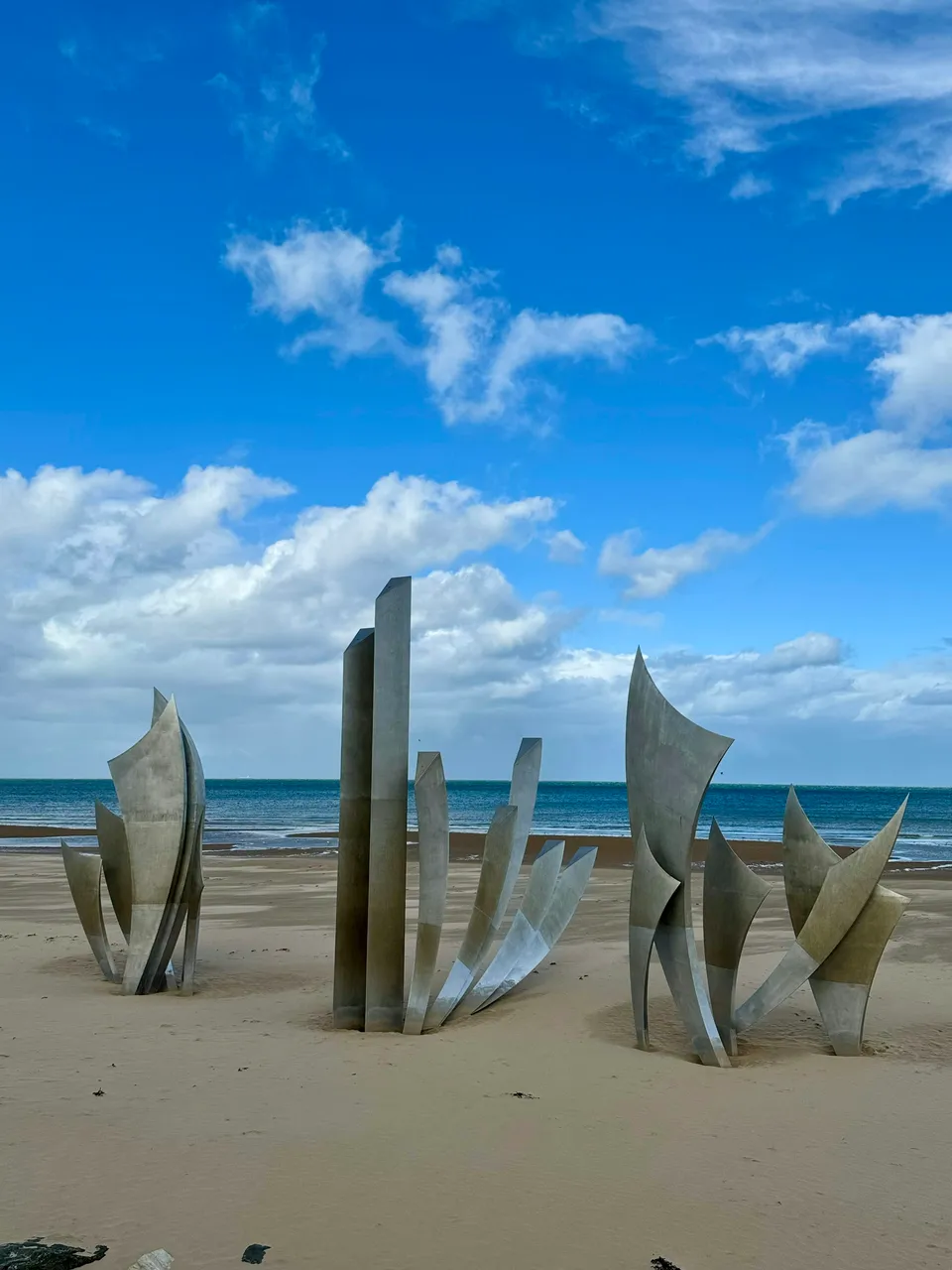
On June 6, 1944, the Allies landed on five beaches of Normandy, from west to east Utah, Omaha, Gold, Juno and Sword, and at the Pointe du Hoc, the sixth assault site, in “the opening phase of Operation Overlord”, in UNESCO’s words; seventeen Allied nations took part. In July 2026, at its 48th session in Busan, South Korea, the World Heritage Committee inscribed the Beaches of the D-Day Landings, Normandy, 1944 on the World Heritage List: six parts along about 80 km of coast, in the Calvados and Manche departments, with the remains of the German Atlantic Wall (casemates, batteries, fire-control posts), the artificial harbor known as Mulberry B, and the American Cemetery at Colleville-sur-Mer. Normandy’s memorial sites recorded more than 5.9 million visits in 2025, the tourist board says.
The American sector is in the west: Utah Beach and Omaha Beach, with the Pointe du Hoc between them. The British landed on Gold and Sword, the Canadians on Juno.
Omaha Beach
Omaha Beach runs for 6 to 7 km from Vierville-sur-Mer to Colleville-sur-Mer, in Calvados; the code name, given in March 1944, came from the city in Nebraska, the tourist board says. Fourteen German “resistance nests” covered it. The first wave landed at 6:30 a.m., almost all the amphibious tanks sank before reaching the shore, and the troops, the ABMC says, fought across up to 200 yards of open ground before attacking the steep bluffs. The tourist board gives two counts of the losses on the same page: casualties above 3,000 men, about 1,000 of them dead, fifteen times those of Utah Beach; and, among the 34,250 American soldiers landed there, 4,100 killed, wounded or missing. By evening the beachhead reached no more than 2 km inland. On the sand today stands the steel sculpture Les Braves; the American Cemetery is on the bluff above.
The Pointe du Hoc
Between Omaha and Utah, the Pointe du Hoc is a headland of 100-foot cliffs that the Rangers of the 2nd Ranger Battalion, under Lt. Col. James E. Rudder, scaled on June 6. The German guns they came for had been moved in April, the tourist board says; of the 225 Rangers engaged, only 90 were still fit to fight when they were relieved, around noon on June 8, and nearly 80 had died. Large bomb craters and uneven ground still fill the site, the ABMC warns: stay on the marked path. A granite pylon on a German bunker marks the site, which the ABMC has cared for since 1979.
Work under way until mid-2027. The ABMC is restoring the site until mid-2027 (summer 2027, says the tourist board): the visitor center has been closed since March 9, 2026, with staff at a welcome point by the provisional car park; the P1 car park is closed until early 2027; and since mid-May 2026 the historic site can be visited along the west path only. It stays open every day from 9 a.m. to 5 p.m., the ABMC’s works page says (its visiting page adds a break from 12:30 to 1:30 p.m. from October to March), free and without booking. The monument is not wheelchair accessible (the ABMC says the paths will be once the works end), picnics and pets are not allowed, and reenactors and vintage military vehicles are not admitted. The Pointe is 7 miles west of the American Cemetery on one ABMC page, 8 on another.
Utah Beach and Sainte-Mère-Église
Utah Beach, from Sainte-Marie-du-Mont to Quinéville in the Manche department, was added to the plan only in December 1943, by Eisenhower and Montgomery. At 6:30 a.m. on June 6 the 8th Regiment of the 4th Infantry Division landed there, about 2 km south of the intended spot; nearly 23,000 Americans came ashore that morning, and the division’s losses, killed, wounded and missing, did not exceed 200 men that day, the tourist board says. Inland, Sainte-Mère-Église had been captured at 4 a.m.; during the night of June 5 to 6, paratrooper John Steele hung there from the church steeple, on the square where the Airborne Museum, a tribute to the 82nd and 101st Airborne divisions, now stands. The nearest station is Carentan, on the Paris-Caen-Cherbourg line.
Gold, Juno and Sword: the British and Canadian Beaches
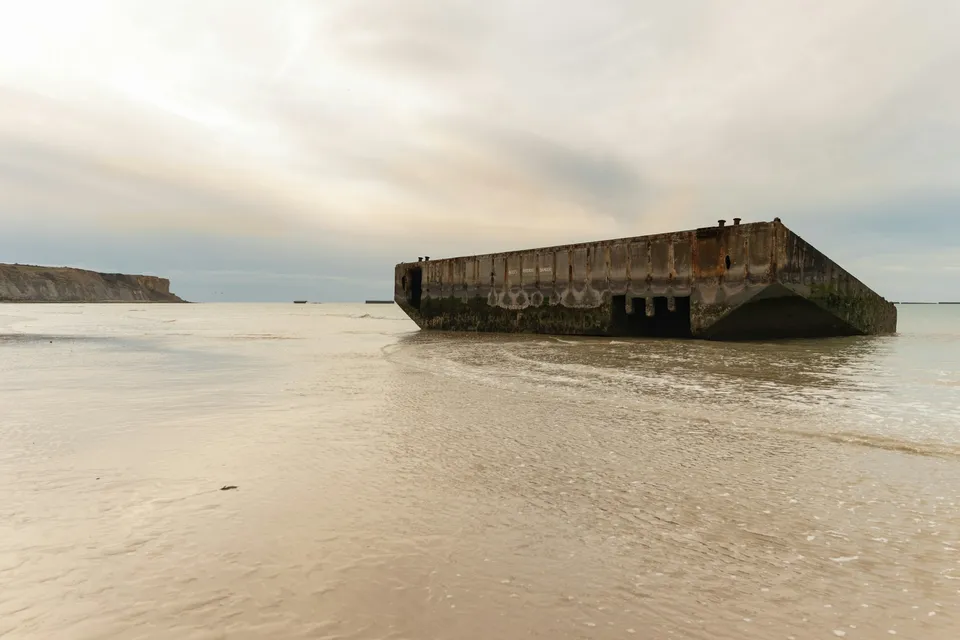
- Gold Beach, from Asnelles to Ver-sur-Mer: the British assault began at 7:25 a.m., an hour after the Americans’ because of the tide, and nearly 25,000 men landed that day. Off Arromanches the British then built “Port Winston”, the artificial Mulberry harbor proposed by Churchill, made of concrete caissons up to 60 meters long, whose remains still lie off Arromanches. It was meant to last three months and served about five, the tourist board says; it gives two figures for what landed there: 400,000 soldiers in 100 days on one page, 2.5 million men on another, with 500,000 vehicles and four million tonnes of supplies. Arromanches’ D-Day museum, opened in 1954, was the first museum of the landings.
- Juno Beach: at 7:35 a.m., 21,400 Canadian and British troops landed, and by nightfall the beachhead reached twelve kilometers inland. The Juno Beach Centre is at Courseulles-sur-Mer.
- Sword Beach, the easternmost: 28,845 men landed from 7:20 a.m., among them 177 French marines under Lieutenant Philippe Kieffer. Just inland, British gliders launched shortly before 11 p.m. on June 5 took the bridge at Bénouville, now Pegasus Bridge, during the night; the bridge is free to visit, but the Memorial Pegasus museum is closed for a full rebuild, with a reopening announced for June 2027 and not yet confirmed on its own hours page.
The beaches are also lined with the cemeteries of the other armies: the Bayeux War Cemetery, the largest Commonwealth cemetery of the Second World War in France, with 4,144 Commonwealth burials and, opposite, a memorial to more than 1,800 men with no known grave, permanently open, the Commonwealth War Graves Commission says; and the German cemetery of La Cambe, the largest in Normandy, where 21,245 German soldiers lie, the Volksbund says. More than 100,000 people died in the fighting of the summer of 1944, at least 14,000 of them French civilians, the Volksbund adds.
The Normandy American Cemetery
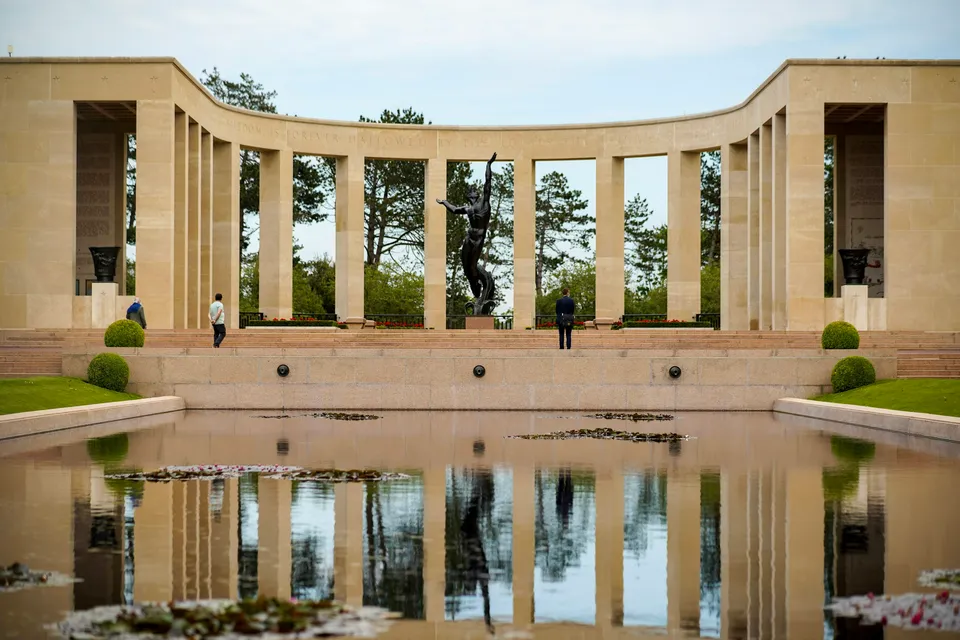
The Normandy American Cemetery sits on a cliff above Omaha Beach and the Channel, at Colleville-sur-Mer, on the site of the temporary St. Laurent cemetery that the U.S. First Army opened on June 8, 1944, the first American cemetery on European soil in the Second World War. It covers 172.5 acres, holds 9,389 headstones, 9,236 Latin crosses and 153 Stars of David, among them 45 sets of brothers and three Medal of Honor recipients, and its Walls of the Missing bear 1,557 names, with rosettes beside those found and identified since, the ABMC says (the tourist board gives 9,387 graves). It was dedicated on July 18, 1956. The memorial has a 22-foot bronze statue, “Spirit of American Youth Rising from the Waves”, and an orientation table looks over the beach. It is the ABMC’s most visited cemetery, with more than a million visitors a year.
| Normandy American Cemetery | As published |
|---|---|
| Hours | Every day, 9 a.m. to 5 p.m.; admission ends at 4:30 p.m.; open on French public holidays |
| Closed | December 25 and January 1 |
| Admission | Free; no booking needed today |
| From summer 2027 | Every visitor is expected to pre-register, free, the ABMC says; its reservation system is due online in late 2026; next of kin of those buried there can always visit when they choose |
| Flag lowering | One hour before closing, every day |
| Guided tours | Free, by ABMC staff, in summer (in 2026, every day until September 30, in English at 2 p.m.), no reservation |
| To the beach | The path down from the cemetery has been closed since 2016; public beach access is nearby |
Source: American Battle Monuments Commission, plan your visit, about the cemetery, pre-registration, summer guided tours, FAQs and the cemetery brochure (June 2025), read on November 27, 2026.
The visitor center, dedicated on June 6, 2007, tells the story of the landings through three galleries, Competence, Courage and Sacrifice, and a sloping corridor where you hear the names of those buried in the cemetery; staff in the visitor building answer questions and take relatives to the graves. The ABMC asks visitors to behave and dress with respect: no food or drink other than water, no smoking, no animals other than service dogs, personal photos only (no drones without a film permit), and natural flowers only on the graves.
Getting there. By car, take the A13 toward Caen, the N13 to Bayeux and Formigny, then the D517 and D514 to Colleville-sur-Mer. By train, go to Bayeux from Paris Saint-Lazare, where there are taxis and tours; local buses are intermittent, and the ABMC strongly encourages arranging the round trip before you leave Paris or Bayeux. The Overlord Museum stands at the roundabout of the cemetery road.
The Brittany American Cemetery, at St. James, in the Manche department, 12 miles south of Avranches, holds 4,404 more American dead and the names of 500 missing, on the site of a temporary cemetery opened by the U.S. Third Army on August 4, 1944. It opens every day from 9 a.m. to 5 p.m., free (closed December 25 and January 1); its memorial chapel was closed ahead of a renovation until late November, and the work is due to be complete by mid-2027.
D-Day Museums: Hours and Prices
| Museum | Where | Adult | Hours and closures |
|---|---|---|---|
| Mémorial de Caen | Caen | 20.80 euros (18.50 euros aged 10 to 18 and over 65; free under 10 and for veterans) | 9:30 a.m. to 6 p.m. in November and December 2026 (closed on some Wednesdays and on December 25), 9 a.m. to 6 p.m. in February and March 2027, 9 a.m. to 7 p.m. from April to September 2027; closed January 4 to 25, 2027 |
| Utah Beach D-Day Museum | Sainte-Marie-du-Mont | 10 euros (6.50 euros aged 6 to 15) | October to April 10 a.m. to 6 p.m., May to September 9:30 a.m. to 7 p.m.; closed November 16 to December 14 |
| Airborne Museum | Sainte-Mère-Église | 11.50 euros (7.50 euros child; free under 6) | October to March 10 a.m. to 6 p.m., April and September 9:30 a.m. to 6:30 p.m., May to August 9 a.m. to 7 p.m.; closed in December and January outside the Christmas holidays |
| Overlord Museum | Colleville-sur-Mer | 10.90 euros in 2027 (7.50 euros aged 7 to 15) | 10 a.m. to 5:30 p.m. in winter, up to 9:30 a.m. to 7 p.m. in summer; closed January 4 to February 12, 2027 |
| Musée du Débarquement (D-Day Museum) | Arromanches | 12.90 euros in 2026 (8.30 euros aged 6 to 18) | From 10 a.m. to 5 p.m. in winter to 9 a.m. to 7 p.m. from May to August; closed January 4 to 31, 2027 |
| Arromanches 360, a 20-minute film in a circular cinema | Arromanches | 7 euros; 24 euros with the Mémorial de Caen | 10 a.m. to 5 p.m. in winter, closed Mondays in November; closed January 4 to 25, 2027 |
| Juno Beach Centre | Courseulles-sur-Mer | 9 euros in 2026 (7 euros reduced) | February, November and December 10 a.m. to 5 p.m., up to 9:30 a.m. to 7 p.m. from May to August; closed in January |
| Memorial Pegasus | Ranville | Closed for rebuilding; reopening announced for June 2027 |
Source: the museums’ own websites (memorial-caen.com, utah-beach.com, airborne-museum.org, overlordmuseum.com, musee-arromanches.fr, arromanches360.com, junobeach.org, memorial-pegasus.com), read on November 27, 2026. Where no year is printed next to a price, it is the price the museum showed on that day.
Allow about four hours for the Mémorial de Caen, the museum itself says, and 1 to 2 hours for each of the others, 20 minutes for the Arromanches 360 film. Most stop selling tickets 45 minutes to 1 hour 15 minutes before closing. The Juno Beach Centre does not admit luggage or backpacks, and Arromanches’ D-Day museum sells its tickets on site only, with the audioguide included.
How to See the D-Day Beaches, With or Without a Car
The beaches stretch over about 80 km, and the American sites are far apart: Utah Beach to the west, the Pointe du Hoc, then Omaha and the cemetery. Three ways to do it:
- With a car, from Bayeux or Caen: the tourist board’s car-free page names no bus to Utah Beach or the Pointe du Hoc, so a car, or a guide, is the way to see the whole American sector. The Utah Beach museum, the Juno Beach Centre and the Pointe du Hoc have free parking.
- With a guide, from Bayeux, Caen or Paris: the ABMC points to the taxis and tours of Bayeux. The Mémorial de Caen sells its own guided tours of the beaches, from 150 dollars per person for at least 3 hours 45. For a day trip from Paris, take an early train to Bayeux and book the tour ahead; our guide to the best day trips from Paris sets out that day.
- By bus, train and bike: the tourist board lists the lines from the three rail hubs, Caen, Bayeux and Carentan.
| Without a car | Line | Service, as published |
|---|---|---|
| Caen station to the Mémorial | Bus 6A | Every 20 to 25 minutes, 7 days a week |
| Caen to Juno Beach (Courseulles) | Nomad coach 101 | 8 round trips Monday to Saturday, 4 on Sundays |
| Bayeux to the Overlord Museum, by the American Cemetery | Nomad coach 120 | One round trip a day, Monday to Saturday, April 20 to November 5 |
| Bayeux to Arromanches and Courseulles | Nomad coach 121 (line 74 to Arromanches, says Arromanches 360) | Seasonal |
| Carentan station to Sainte-Mère-Église | Nomad coach 301 | 2 round trips a day, Monday to Saturday |
| Bayeux to Omaha Beach | Bike | A greenway toward Port-en-Bessin; the Vélomaritime (EuroVelo 4) passes all five beaches |
Source: Normandy Tourism, D-Day landing beaches without a car, Gold Beach and Bayeux; Arromanches 360; Juno Beach Centre, read on November 27, 2026. The Mémorial de Caen also names its own city buses, Ellipse 6a or 6b from the station and line 2 from the center.
Tickets are sold on board or in the Atoumod app. For two people, the Normandy Discovery Pass, 20 euros, gives two days of unlimited travel on Nomad trains and coaches within Normandy, on weekends and during French school holidays, the tourist board and the Juno Beach Centre say. In July and August, the tourist board adds, a Nomad coach “D-Day Line” runs from Bayeux.
Mont-Saint-Michel
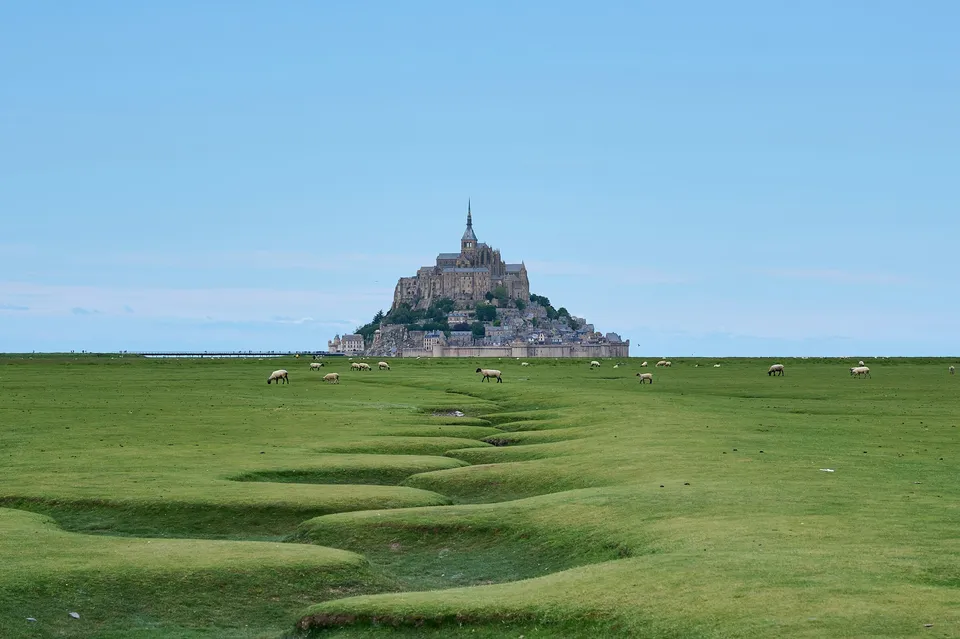
Mont-Saint-Michel stands on a rocky islet “in the midst of vast sandbanks exposed to powerful tides between Normandy and Brittany”, in the words of UNESCO, which inscribed the Mont and its bay on the World Heritage List in 1979. Normandy’s tourist board is categorical that it is “definitely located in Normandy”, in the Manche department. The Benedictine abbey was founded in 966 on a site dedicated to the archangel Michael since 708 and built between the 11th and 16th centuries; it became a prison after 1789, until 1863, and UNESCO and the Mont’s public body both count about three million visitors a year. The tourist board calls it the second most visited monument in France.
The village is free, the abbey is not. The village is a commune, open day and night all year, with no gate and no ticket. The abbey, run by the Centre des monuments nationaux, sells its tickets one month ahead; the Mont’s public body advises booking as early as possible, though there is a ticket office on site.
| Mont-Saint-Michel abbey | As published |
|---|---|
| Hours | May 1 to August 31: 9 a.m. to 7 p.m.; September 1 to April 30: 9:30 a.m. to 6 p.m.; last entry 1 hour before closing |
| Closed | January 1, May 1 and December 25 |
| Ticket | 13 euros from October 1, 2026 to March 31, 2027; 16 euros from April 1 to September 30, 2026 (the 2027 summer price is not yet published) |
| With a Nomad train ticket from Paris | 11.50 euros until March 31, 2027, within 5 days of the trip |
| Free | Under 18 with family; 18 to 25 for citizens of the European Union and non-EU residents of France; the first Sunday of January, February, March, November and December |
| Bags | No suitcases or large bags, no luggage storage at the abbey; bags smaller than cabin size are accepted |
| Time from the car parks | 45 minutes to 1 hour on foot to the abbey entrance, the abbey says |
Source: Abbaye du Mont-Saint-Michel (Centre des monuments nationaux), practical information, and Établissement public du Mont-Saint-Michel, hours and prices, read on November 27, 2026.
Normandy’s tourist board writes that admission is free all year for under-26s; the abbey’s own rules give that to 18-to-25-year-olds only if they are EU citizens or live in France, so an American student pays. Pets are not allowed in the abbey, even in a bag, and dogs are not allowed in the village church either.
Getting onto the Mont: car parks, the shuttle and the tides
The car parks are on the mainland, 2.5 km from the rock by the public body’s count (2.9 km, 40 minutes on foot, for the tourist board), and you pay as you leave. The free shuttle, Le Passeur, runs every 5 to 12 minutes, takes about 12 minutes and stops 350 m from the ramparts; it runs from 8:30 a.m. to 10 p.m. from November to February outside the school holidays, from 7:30 a.m. to 11 p.m. in spring, autumn and the school holidays, and from 7 a.m. to 1 a.m. in July and August. You can also walk: 45 minutes from the shuttle square to the Mont, by the bridge-walkway opened in 2014.
| Car park, per car | Up to 3 hours | Up to 6 hours | Up to 24 hours |
|---|---|---|---|
| Low season (January 1 to February 28, November 2 to December 31) | 10 euros | 12 euros | 14 euros |
| Middle season (March 1 to June 30, September 1 to November 1) | 16 euros | 19 euros | 22 euros |
| High season (July 1 to August 31) | 20 euros | 24 euros | 28 euros |
Source: Établissement public du Mont-Saint-Michel, hours and prices, read on November 27, 2026 (the low-season table is headed 2026, the other two 2027). The first 30 minutes are free all year, and parking is free from 6:30 p.m. to 3 a.m. from September to June; booking online takes 2 euros off a car’s day rate in low season.
The bay has the highest tides in continental Europe, the tourist board says, and when the tide coefficient passes 110 the Mont becomes an island again for a few hours. To see it, the public body advises arriving 1 to 2 hours before high tide; once the sea has closed around the rock, count 1 hour to 1 hour 30 before you can walk back to the bridge. Never cross the bay on foot alone: quicksand, the rising tide and the daily releases of the dam make it dangerous, and the public body says to go only with a certified guide; the walks are booked through the Mont-Saint-Michel Normandie tourist office. The village and abbey are quietest before 10 a.m. and after 5 p.m., the tourist board says, and it advises allowing at least half a day.
Getting there. From Paris, SNCF Connect listed 3 trains a day from Montparnasse to Pontorson-Mont-Saint-Michel, the fastest in 2 hours 28, from 25 euros; the direct “Mont-Saint-Michel train” runs at weekends all year and every day in summer, the Mont’s public body says (from April to October, says the tourist board). Pontorson station is 9 km away, and bus line 2 takes about 27 minutes from there. Otherwise, take a TGV from Montparnasse to Rennes, then the Keolis Armor coach to the Mont, every day including Sundays, in 1 hour 10 or 1 hour 15 (the public body’s page gives both). By car, it is 337 km from Paris by the A13 toward Caen, then the A84 toward Avranches. The nearest airports are Dinard (70 km) and Rennes (75 km), in Brittany, and Caen-Carpiquet (130 km). As a day trip from Paris it is long; our guide to the best day trips from Paris weighs it against the others.
Bayeux and Its Tapestry
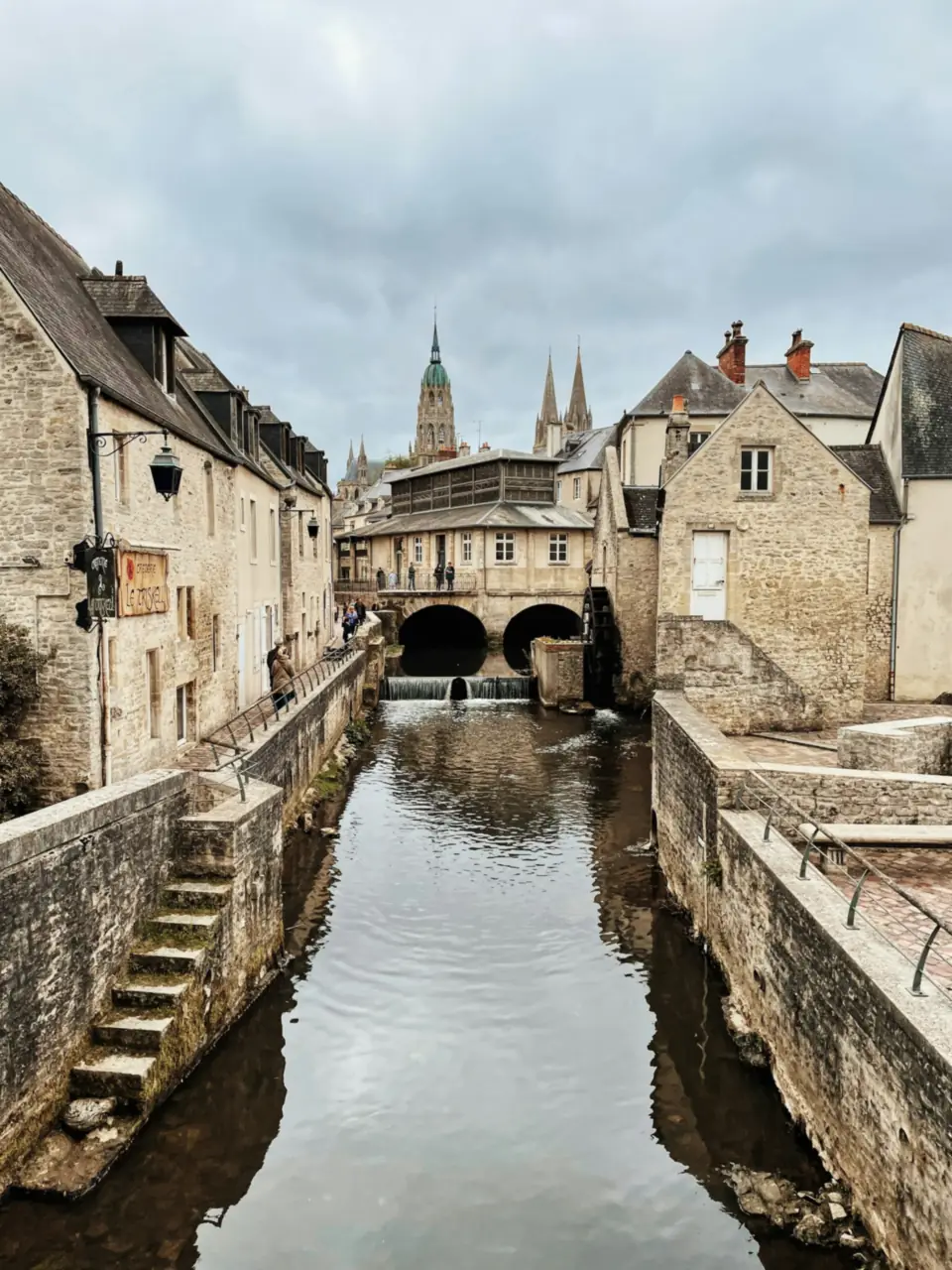
Bayeux, the town’s museums say, was “the first town to be liberated in June 1944”: the SS troops left on June 6, the Allies were told there was no point in bombing, and the town, unharmed, was liberated on June 7. On June 14, 1944, General de Gaulle landed in Normandy and went straight to Bayeux, where he gave his first speech on French soil. Its Notre-Dame cathedral was consecrated in 1077 by Bishop Odo, the half-brother of William the Conqueror, and was the Tapestry’s first showcase, the tourist office says; it is free and opens every day, from 9 a.m. to 6 p.m. from April 13 to November 1 and from 10 a.m. to 6 p.m. the rest of the year. The market is on Wednesdays and Saturdays. Bayeux is also the usual base for the D-Day beaches: the tourist office says the main sites are all less than 45 minutes away.
The Tapestry is in London until July 2027. The Bayeux Tapestry, 70 meters long and 50 centimeters high, is in fact an embroidery of wool on linen telling the conquest of England in 1066, and it is on UNESCO’s Memory of the World register. Its museum in Bayeux closed on September 1, 2025 for a full redesign, and the work has been lent to the British Museum in London, from September 10, 2026 to July 11, 2027, in Room 30, open from 10 a.m. to 6 p.m. from Sunday to Wednesday and until 9 p.m. from Thursday to Saturday. Tickets to March 31, 2027 are sold out; those for April to July 2027 go on sale in early 2027, from 25 to 33 pounds for an adult and free under 16. Bayeux says the Tapestry had been exhibited outside the town only twice before, in 1803 at Napoleon’s request and in 1945 at the Louvre. The new museum is due to open in the autumn of 2027, the town’s banner says; its other pages say “late 2027” and October 2027.
In Bayeux meanwhile, the town’s museums tell the story without the original:
| Bayeux museums | As published |
|---|---|
| Immersive Tapestry exhibition, Hôtel du Doyen | December 17, 2026 to September 19, 2027, every day 11 a.m. to 6 p.m.; adult 7 euros, under 18 4 euros, under 10 free; in French and English |
| Memorial Museum of the Battle of Normandy | 8.50 euros; free for World War II veterans |
| MAHB (art and history museum) | 8.50 euros |
| Both museums | 14 euros |
| Under 10 | Free |
| Hours of the two museums | January 19 to April 30 (the 2026 dates; the 2027 winter closure is not yet published) and October 1 to December 31: 10 a.m. to 12:30 p.m. and 2 to 6 p.m.; May 1 to September 30: 9:30 a.m. to 6:30 p.m. |
Source: Bayeux museums (Ville de Bayeux), practical information and the immersive exhibition page; British Museum, The Bayeux Tapestry, read on November 27, 2026. Tickets are sold at the museums only, not online. The whole Tapestry can also be seen online in high resolution on the museums’ site.
Caen, William the Conqueror’s City
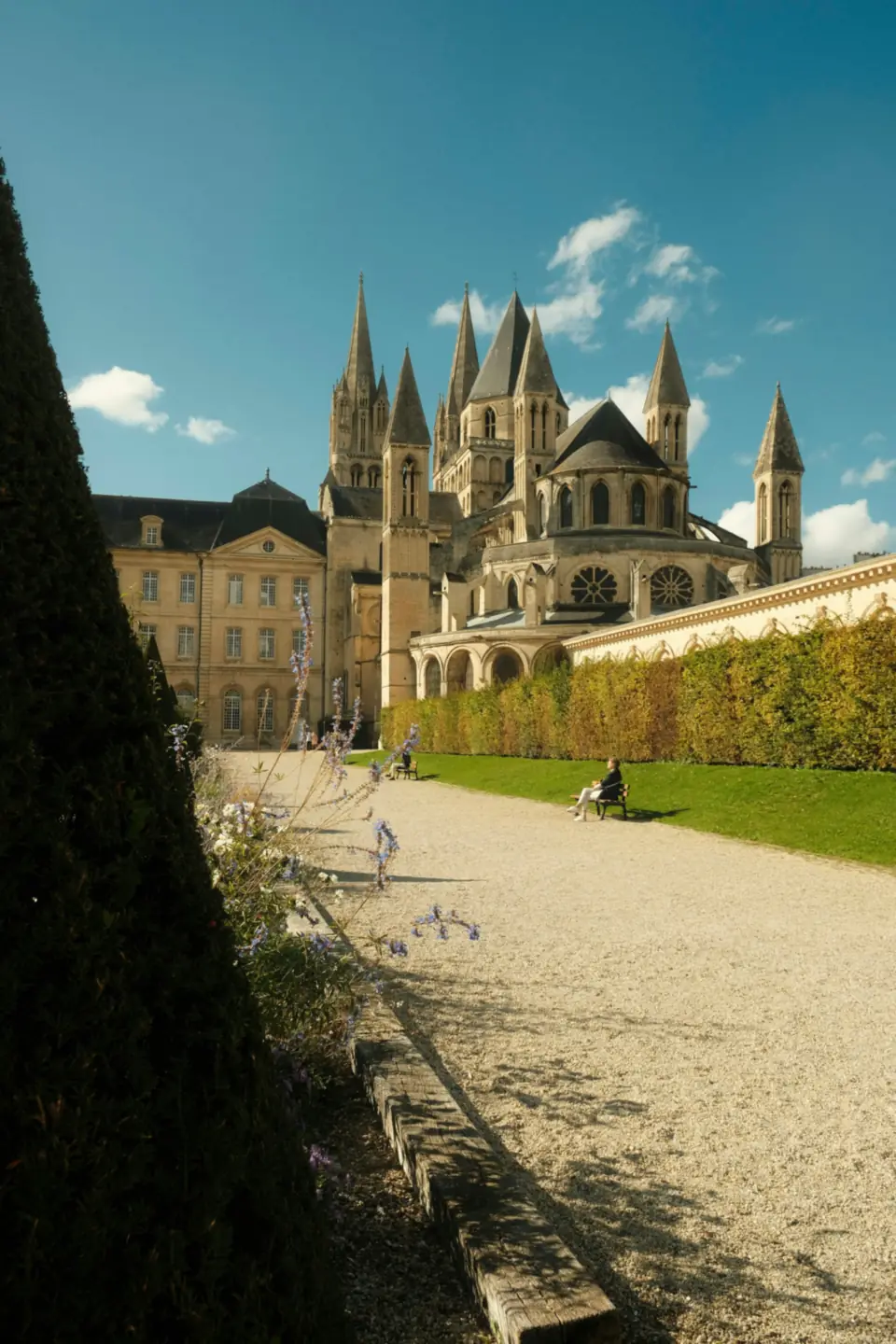
William the Conqueror was born in Falaise and made Caen his political capital, the tourist board says. He built a castle and the Abbaye aux Hommes there, and his wife, Matilda of Flanders, founded the Abbaye aux Dames; both abbeys still stand. On October 14, 1066 William won the Battle of Hastings, and on December 25, 1066 he was crowned King of England at Westminster. Caen is also home to the Mémorial de Caen, which takes about four hours to visit, the museum says, and it is the rail hub for Juno Beach, Pegasus Bridge and the eastern end of the landing beaches.
In 2027 Caen is at the heart of the millennium of William’s birth: a free immersive show, “The Gates of the Millennium”, in the cloister gardens of the Abbaye aux Dames from February 20 to 27, 2027, then an exhibition there on the Normans in the Middle Ages (911 to 1204), and, planned at the Musée de Normandie from April to October 2027, the Anglo-Saxon treasure of Sutton Hoo, lent by the British Museum, the tourist board says. Caen is 2 hours 05 from Paris Saint-Lazare on the fastest train, and the Mémorial is a bus ride from the station (see the museum table above).
Honfleur
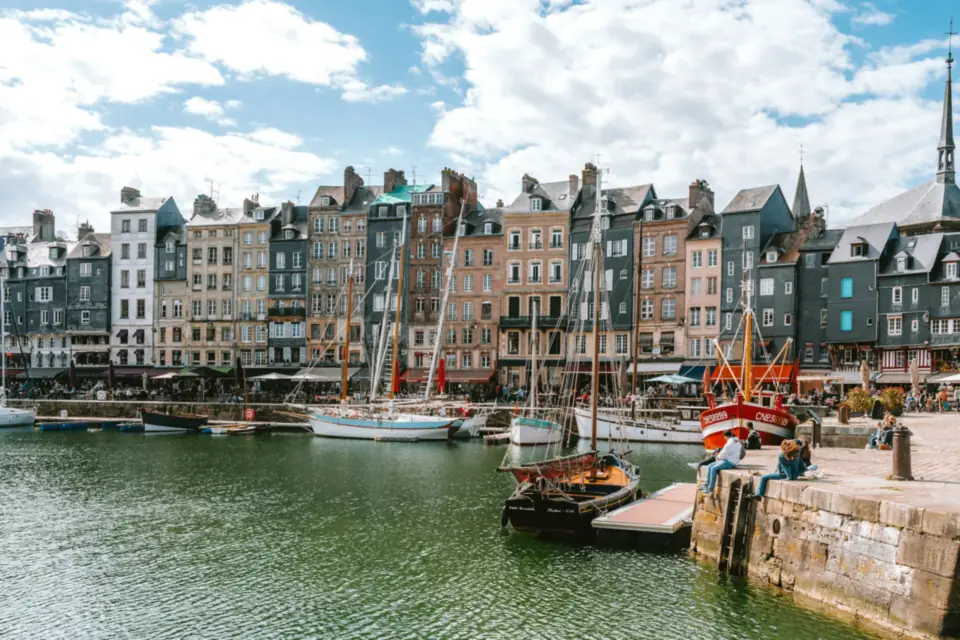
Honfleur sits on the estuary of the Seine, across from Le Havre; its name, like Barfleur’s, comes from the Old Norse of the Vikings, in which “fleur” meant an estuary, the tourist board says. Its Vieux Bassin, the old harbor ringed by tall, narrow houses, is “the best known and most visited site” of the town, the tourist office says; the Lieutenance is the last piece of the fortifications that surrounded the port until the end of the 17th century. The church of Sainte-Catherine, from the second half of the 15th century, was built by the townspeople after the English left, with wood from the Touques forest and the skills of shipbuilders; it is one of the largest wooden churches in France, a historic monument since 1879, and opens every day from 9 a.m. to 7 p.m. The tourist board notes that a small area around Quai Sainte-Catherine is under safety measures, while the town welcomes visitors as usual.
| Eugène Boudin museum, Honfleur | As published |
|---|---|
| Hours | April 1 to June 30 and September: 10 a.m. to noon and 2 to 6 p.m.; July and August: 10 a.m. to 1 p.m. and 2 to 6 p.m.; October 1 to March 31: 10 a.m. to noon and 2 to 5:30 p.m. |
| Closed | Tuesdays, January 1, May 1, July 14, December 25, and for the winter from January 4, 2027 (reopening Wednesday, January 27) |
| Ticket | 9 euros (7 euros reduced); Multi-Pass for the town’s museums 18 euros |
| Under 16 | Free |
Source: Musées de Honfleur, hours and prices, read on November 27, 2026. No booking is needed; last entry 45 minutes before closing.
The Pont de Normandie, opened in 1995, links Honfleur to Le Havre across the estuary: 6.10 euros by car since May 1, 2026, free on foot (allow 2 hours for the round trip). Honfleur has no train station: the nearest are Trouville-Deauville, Le Havre and Pont-l’Évêque, and Nomad coaches 111, 122 and 123 all serve the town. Deauville-Normandie airport is 10 km away.
Deauville and Trouville
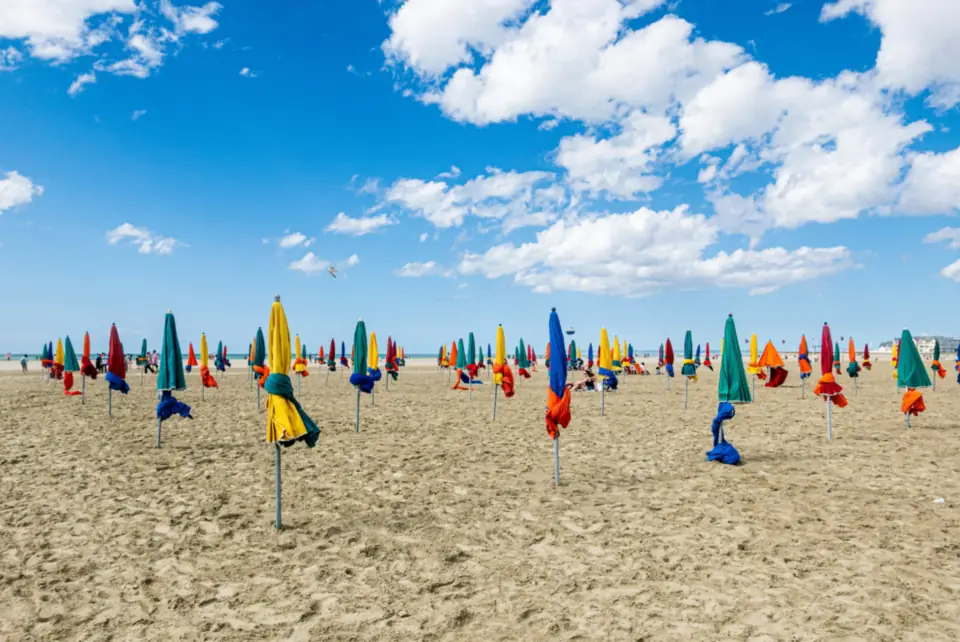
Deauville is the seaside resort that, in the tourist board’s words, “emerged from the sand dunes in the 1860s”. Its beach runs for 2 km with 450 parasols and 450 beach cabins, the town’s tourist office says; the first parasols date from 1875 and the boardwalk, Les Planches, from 1923: 762 meters of azobé wood marked with the names of the actors and directors invited to the Deauville American Film Festival, held every September since 1975. The 53rd festival runs from September 3 to 12, 2027. Trouville-sur-Mer, which shares Deauville’s station, has the oldest boardwalk of the Normandy coast, from 1867, a fish market of 1925 and markets on Wednesday and Sunday mornings, the tourist board says.
Étretat and the Alabaster Coast
The cliffs of Étretat, on the photograph at the top of this guide, belong to the Alabaster Coast, the chalk cliffs between the estuaries of the Seine and the Somme: 130 km for the tourist board, 140 km for the Le Havre Étretat tourist office. They rise to nearly 90 meters. Looking at the sea, the Falaise d’Aval on your left ends in the Porte d’Aval, an arch cut by the waves, beside the Aiguille, a needle of rock 51 meters high; beyond it, the Manneporte is so large that Maupassant claimed a ship could sail under it. On your right, the Falaise d’Amont carries the chapel of Notre-Dame de la Garde; Maupassant compared its arch to an elephant dipping its trunk in the sea. The painter Eugène Isabey was the first to paint Étretat, in 1820, the tourist office says, and Turner, Boudin and Monet followed. The Aiguille is also the hollow needle of an Arsène Lupin novel, L’Aiguille creuse, whose author bought the house now called the Clos Lupin in 1919, the tourist office says.
The rules on the cliffs. Cliff falls are always possible, and the town’s order is strict: no walking under the cliffs, stay at least 5 meters from the edge on the high plateaus, and no access to the rocky spurs, the cave and the tunnel of the “Trou à l’Homme” or the tunnels through the cliff points, under pain of a fine; and do not take the pebbles. The GR21 footpath, from Le Havre to Le Tréport, partly follows the coast: stay on it and away from the edge.
Crowds and parking. Étretat is packed on fine weekends, long May weekends and in summer: the tourist board advises avoiding July and August, weekends and school holidays, and says the busiest hours are 11 a.m. to 4 p.m.; the tourist office recommends arriving in the morning, or coming from October to March. Parking is paid all year, from 9 a.m. to 7 p.m.: 3 euros an hour in the center, 15 euros for a full day (10 hours) in the outer car parks. The market is on Thursday mornings.
Getting there. By train from Paris Saint-Lazare to Bréauté-Beuzeville, then bus 504; from Le Havre, buses LiA 13 and Nomad 509. From April to early November, SNCF sells combined train and coach tickets from Paris, the tourist board says.
Le Havre
Le Havre, less than 30 km from Étretat, was rebuilt after the war by a team led by Auguste Perret, from 1945 to 1964; UNESCO listed the rebuilt center, 133 hectares, in 2005, as “an outstanding post-war example of urban planning and architecture” in concrete. Its church of Saint-Joseph rises 107 meters, lit by 12,768 pieces of stained glass. Claude Monet painted the sun rising at Le Havre in 1872, in Impression, Sunrise, the painting that gave Impressionism its name, and the MuMa, the André Malraux museum, holds what the tourist office calls the second Impressionist collection in France after the Musée d’Orsay. It opens from 11 a.m. to 6 p.m. from Tuesday to Friday and until 7 p.m. at weekends, closed on Mondays; from November 28, 2026 to October 31, 2027 the ticket is 10 euros (6 euros reduced) with the exhibition “André Malraux et l’art moderne”, and it is free for under-26s and for everyone on the first Saturday of the month.
Rouen
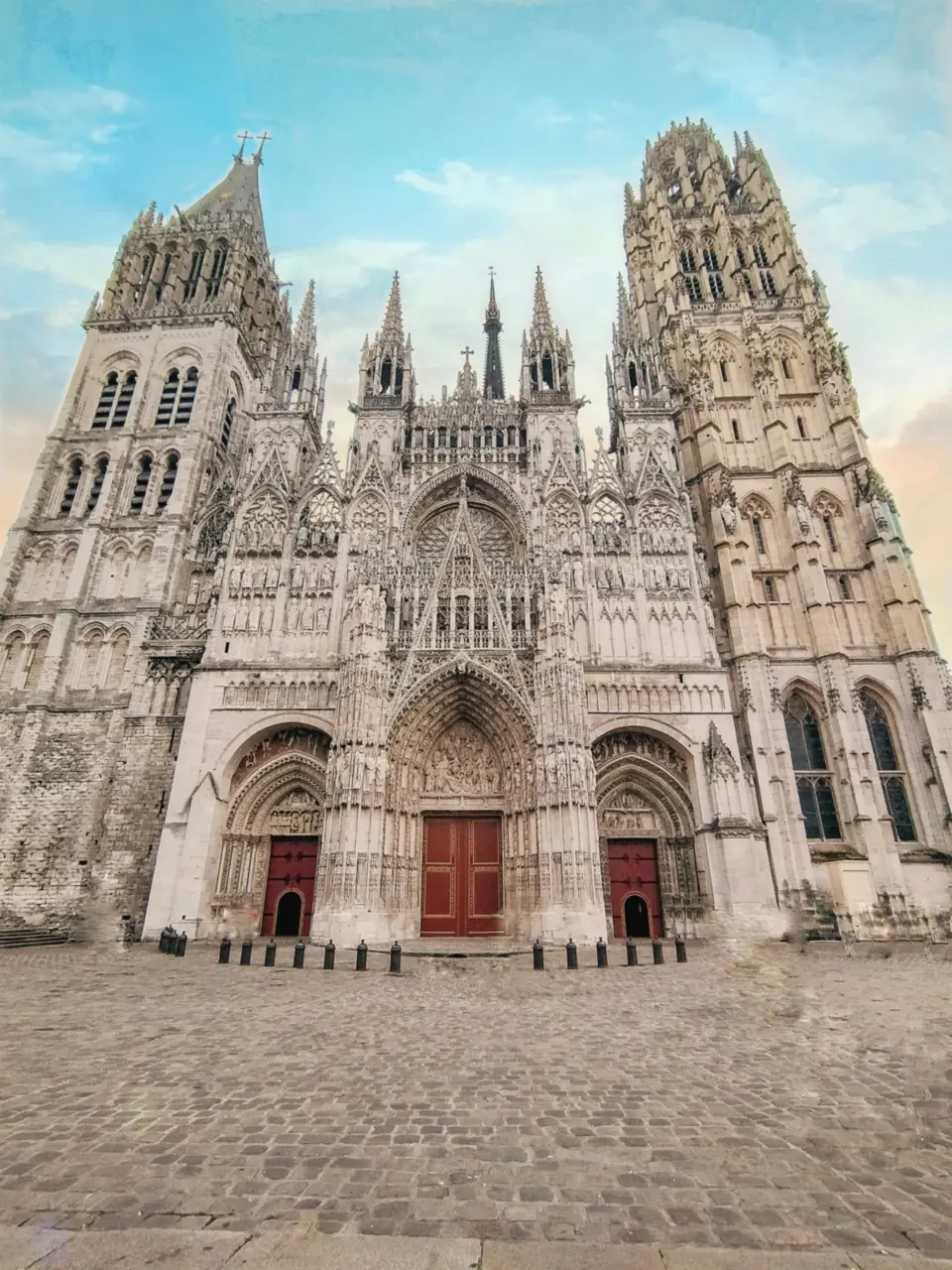
Rouen, the capital of the Normandy region, is 1 hour 49 from Paris on the fastest train SNCF Connect listed. The cast-iron spire of its Notre-Dame cathedral, put up in the 19th century after lightning destroyed the old one in 1822, rises to 151 meters, the highest in France, the tourist office says; its west front is 61 meters wide, and its choir holds the tomb of Rollo, the Viking founder of the duchy of Normandy, and the heart of Richard the Lionheart. Claude Monet painted that front in the springs of 1892 and 1893, twenty-eight views, from a room on the second floor of the Bureau des Finances, now the city’s tourist information point.
| Rouen | As published |
|---|---|
| Musée des Beaux-Arts | Free; 10 a.m. to 6 p.m., closed Tuesdays; “Claude Monet. Cathédrale, hors cadre!” (one of the cathedral paintings, out of its frame), free, November 7, 2026 to March 8, 2027; some 19th-century rooms closed from October 6, 2026 to February 2027, the Impressionist rooms stay open |
| Gros-Horloge, the great clock and its belfry | 7.85 euros (4 euros aged 6 to 18); April 1 to September 30: Tuesday to Sunday 10 a.m. to 1 p.m. and 2 to 7 p.m.; October 1 to March 31: Tuesday to Sunday 2 to 6 p.m. |
| Historial Jeanne d’Arc | 12 euros (9 euros aged 6 to 18); Tuesday to Sunday 10 a.m. to 7 p.m., last start 5:15 p.m.; closed Mondays, December 25, January 1 and May 1 |
Source: Rouen Tourisme; Musées de la Métropole Rouen Normandie; Ville de Rouen (Gros-Horloge); Historial Jeanne d’Arc, read on November 27, 2026.
The Historial is in the archbishop’s palace where Joan of Arc was condemned in 1431 and where her rehabilitation trial was held in 1456. Rouen holds the largest Impressionist collection in France outside Paris, the city’s museums say, and its Musée des Beaux-Arts gives one more reason to come in 2027: Italian Renaissance drawings from the British Museum from January to April, then pieces of the Lewis Chessmen from April to October. In 2021 Rouen became the first French city named a UNESCO Creative City for gastronomy, the tourist board says.
The Armada, June 17 to 27, 2027. The Rouen Armada, which the tourist board calls the largest gathering of tall ships in the world, drew more than 5 million visitors in 2023, its organizers say. The 2027 edition runs from June 17 to 27, with a gathering of Viking ships arriving from June 19.
Giverny
Giverny, in the Eure department, was Claude Monet’s home from 1883 until his death in 1926; his house and gardens, restored in the late 1970s thanks to donations, above all from the American patron Walter Annenberg, are the second most visited site in Normandy after the abbey of Mont-Saint-Michel, the tourist board says. 2026 marked the centenary of his death.
| Giverny | As published |
|---|---|
| Monet’s house and gardens | Open April 1 to November 1, 2026, 10 a.m. to 6 p.m. (last admission 5:30 p.m.); the 2027 dates are not yet published |
| Ticket | Adult 13 euros; child 7 to 17 and student 7 euros; under 7 free; with the Musée de l’Orangerie in Paris 25.50 euros, sold at Giverny |
| Musée des impressionnismes Giverny | Reopens March 26, 2027: “Bonnard-Vuillard” to July 4, then “Taikan / Monet. Japanese Impressions” from July 17 to November 1, 2027; 12 euros (9 euros reduced), free under 18 |
| From Vernon station | Shuttle 5 euros one way, 10 euros return, usually April to November; about an hour on foot |
Source: Maison et jardins de Claude Monet, useful information; Musée des impressionnismes Giverny; Normandy Tourism, Giverny, read on November 27, 2026.
Online booking is highly recommended at Monet’s house: once the online quota is reached, expect long waits on site, and there is no skip-the-line access. Bags are limited to 55 × 35 × 20 cm, with no luggage storage; picnics, painting and drawing are not allowed, and the house is not wheelchair accessible. The tourist board advises avoiding July and August, and says the busiest hours are 10 a.m. to 4 p.m.
Getting there. Vernon-Giverny station is 50 minutes from Paris Saint-Lazare and 40 minutes from Rouen Rive Droite, the tourist board says (45 minutes to 1 hour 30, says the Musée des impressionnismes), and Vernon is 5 km from the village. The car parks of Giverny, 800 spaces, are free. In Paris, the Musée de l’Orangerie, sold with Giverny in a combined ticket, is in our guide to the best museums in Paris.
Camembert, Cider and Calvados

Normandy cooks with what its cows and orchards give, and four of its cheeses carry the European protected designation of origin (AOP), each made from cow’s milk:
- Camembert de Normandie: a soft cheese with a bloomy rind, a flat cylinder about 11 cm across, made only from raw milk, from herds at least half Normande cows that graze at least six months a year, INAO says. The name “camembert” has become generic; only Camembert de Normandie carries the appellation. The tourist board dates the cheese to 1791, when Marie Harel made it near the village of Camembert, in the Orne, and its wooden box to 1890. In the village, the Maison du Camembert (4.50 euros) lists its next opening period from March 24, 2027, Orne Tourisme says.
- Livarot, from the Pays d’Auge, nicknamed “the Colonel” for the five strips of sedge around it.
- Pont-l’Évêque, square since the 18th century.
- Neufchâtel, from the Pays de Bray, made in six shapes, the best known a heart.
Apples are the other half. Normandy cider has 3 to 5 degrees of alcohol, the tourist board says, and the Pays d’Auge cider was the first Norman cider with an appellation, INAO says. The Cider Route, a signposted loop of about 40 km (25 miles) east of Caen, runs through Beuvron-en-Auge, one of the “most beautiful villages in France”, Cambremer, Bonnebosq and Beaufour-Druval, past some twenty producers marked by the sign “Cru de Cambremer”. Calvados is the brandy distilled from cider and perry and aged at least two years in oak; Calvados Pays d’Auge, double-distilled from at least 70 percent apples, was the first cider brandy to become an appellation, in 1942, INAO says. Pommeau de Normandie, apple must and Calvados aged at least 14 months, has been an appellation since 1991. In 2025 the trade sold 4,348,000 bottles of Calvados, nearly one in two abroad, its interprofession says.
At table, the tourist board names the “trou normand”, a Calvados sorbet between courses, salt-meadow lamb from the bay of Mont-Saint-Michel, Caen-style tripe, teurgoule rice pudding and Isigny caramel; Normandy is also France’s leading producer of scallops. Our guide to French food sets Normandy beside the other regions.
Normandy in 2027: the Millennium of William the Conqueror
2027 is a full year for Normandy. William the Conqueror was born in Falaise in 1027, and the region is celebrating “MILLENIUM, 2027, European Year of the Normans” from January 1 to December 31, 2027, with nearly 1,000 events across Normandy and Europe, the tourist board says, among them:
| 2027 | What, as announced |
|---|---|
| February 20 to 27 | “The Gates of the Millennium”, a free immersive show at the Abbaye aux Dames, Caen |
| March 20 and 21 | The Mont-Saint-Michel marathon |
| March 26 | The Musée des impressionnismes Giverny reopens (“Bonnard-Vuillard” to July 4, “Taikan / Monet” from July 17 to November 1) |
| April to October | The Sutton Hoo treasure, planned at the Musée de Normandie, Caen; pieces of the Lewis Chessmen at the Musée des Beaux-Arts, Rouen |
| June 6 | The 83rd anniversary of D-Day, the first since the UNESCO listing; the international ceremony is at Colleville-Montgomery, near Sword Beach |
| June 11 to 27 | A gathering of Viking ships along the estuaries, arriving in Rouen from June 19 |
| June 17 to 27 | The Rouen Armada |
| Summer | Visits to the Normandy American Cemetery are expected to need a free reservation; the Pointe du Hoc works are due to end |
| Until July 11 | The Bayeux Tapestry at the British Museum, London |
| September 3 to 12 | The 53rd Deauville American Film Festival |
| October 16 to 19 | FÊNO, the festival of Norman excellence, in a special edition |
| Autumn | The new Bayeux Tapestry Museum is due to open |
Sources: Normandy Tourism, 2027 European Year of the Normans and 83rd anniversary; Établissement public du Mont-Saint-Michel; Musée des impressionnismes Giverny; Armada de Rouen; Festival du Cinéma Américain de Deauville; ABMC; British Museum; Bayeux museums, read on November 27, 2026.
Every year around June 6, the tourist offices of the landing beaches also hold the D-Day Festival, with nearly 100 events from Pegasus Bridge to Sainte-Mère-Église: parachute drops, parades, concerts, reenactments and fireworks. Its 2027 dates are not yet published.
The Weather in Normandy Month by Month
Normandy has a mild, wet sea climate: cool summers, soft winters and rain in every month. These are Météo-France’s normals for Caen-Carpiquet, near the D-Day beaches, one of the two Normandy stations on Météo-France’s normals pages:
| Month | Low (°C) | High (°C) | Rain (mm) | Sunshine (hours) |
|---|---|---|---|---|
| January | 2.9 | 8.3 | 63.1 | 70.5 |
| February | 2.8 | 9.1 | 52.8 | 90.2 |
| March | 4.2 | 11.7 | 49.7 | 130 |
| April | 5.5 | 14.4 | 53.4 | 179.1 |
| May | 8.5 | 17.4 | 59.4 | 203.3 |
| June | 11.2 | 20.5 | 58 | 212.6 |
| July | 13.1 | 22.9 | 51.1 | 218.4 |
| August | 13.3 | 23.2 | 59.6 | 204.8 |
| September | 11.1 | 20.4 | 54.3 | 170.9 |
| October | 8.8 | 16.2 | 78.9 | 117.1 |
| November | 5.6 | 11.8 | 78.7 | 81.9 |
| December | 3.3 | 8.8 | 81.3 | 67.2 |
| Year | 7.5 | 15.4 | 740.3 | 1,745.9 |
Source: Météo-France, Caen-Carpiquet normals 1991-2020, read on November 27, 2026.
It rains on 126 days a year in Caen, most in October, November and December, around 80 mm a month, and least in March and July. Summer highs stay in the low 20s °C, around 73 °F: pack a sweater and a rain jacket even in August. Inland, at Alençon, the other Normandy station, summers are a little warmer (24.4 °C in August) and winter nights a little colder (1.7 °C in February).
When to Go to Normandy
- May, June and September give the best balance: highs of 17 to 21 °C, more than 200 hours of sunshine in May and June, the gardens of Giverny open, and the beaches before or after the summer crowds. Early June is D-Day time, with the commemorations and the D-Day Festival; book early for those days.
- July and August are the warmest months and the busiest: the tourist board advises avoiding them at Étretat and Giverny, and Mont-Saint-Michel’s car parks charge their highest rates. In 2026 the ABMC also ran free daily tours at the American Cemetery until September 30.
- October and November bring the apple and cider festivals (from late September to mid-November in 2026) and the scallop festivals (October to early December in 2026), along with the rain. The Étretat tourist office recommends October to March, “the other season”, for the cliffs without the crowds.
- Winter is quiet, and the American Cemetery, the abbey of Mont-Saint-Michel and Bayeux cathedral stay open, but many museums close for weeks in January: the Mémorial de Caen and Arromanches 360 from January 4 to 25, 2027, Arromanches’ D-Day Museum to January 31, the Overlord Museum to February 12, the Juno Beach Centre for the month; Monet’s house at Giverny is closed until its spring opening. The Utah Beach museum closes from November 16 to December 14.
Public holidays such as May 1 and December 25 close many sites; our guide to French public holidays lists them.
Getting to Normandy
By train from Paris
Trains to Normandy leave from Paris Saint-Lazare; those to Pontorson, for Mont-Saint-Michel, and some to Caen and Granville leave from Montparnasse. On these regional trains you can take all your luggage, with no weight or size limit, and a bike for free when there is room, SNCF Connect says.
| From Paris to | Station | Trains a day | Fastest | Average | From |
|---|---|---|---|---|---|
| Rouen Rive Droite | Saint-Lazare | 9 | 1 h 49 | 2 h 12 | 10 euros |
| Caen | Saint-Lazare | 17 | 2 h 05 | 2 h 22 | 17 euros |
| Bayeux | Saint-Lazare | 11 | 2 h 24 | 2 h 44 | 17 euros |
| Trouville-Deauville | Saint-Lazare | 5 | 2 h 24 | 2 h 25 | 17 euros |
| Le Havre | Saint-Lazare | 7 | 2 h 40 | 2 h 45 | 17 euros |
| Granville | Saint-Lazare or Montparnasse | 9 | 3 h 12 | 3 h 35 | 22 euros |
| Cherbourg | Saint-Lazare | 8 | 3 h 19 | 3 h 24 | 22 euros |
| Pontorson-Mont-Saint-Michel | Montparnasse | 3 | 2 h 28 | 3 h 37 | 25 euros |
Source: SNCF Connect route pages, read on November 27, 2026. These pages count the trains they list for the coming days, so check your own date: for Rouen, the Historial Jeanne d’Arc gives 1 hour 10 from Saint-Lazare and the tourist board about 1 hour 30. Fares are for one adult, one way, in second class, on some trains and dates.
By car
The A13 motorway is the road from Paris to Rouen and Caen, but until the end of August 2027 its Saint-Cloud tunnel, on the way out of Paris, is closed in the Paris-to-Normandy direction, from November 16, 2026; the A14 is toll-free throughout the works, the Île-de-France prefecture says, and the ABMC warns its visitors of the closure. On 210 km of the A13 and A14 the tolls are “free flow”: vehicles are detected automatically, and without a Bip&Go toll tag you have 72 hours to pay, the tourist board says.
From Britain and Ireland by ferry
Brittany Ferries sails from Portsmouth to Caen (Ouistreham), its most popular route, in 6 hours, up to three times a day all year, and from Portsmouth to Cherbourg up to twice a week overnight; DFDS sails from Newhaven to Dieppe in 4 hours, twice a day. From Ireland, Brittany Ferries sails from Rosslare to Cherbourg. The tourist board’s list also names Irish Ferries from Dublin and Stena Line from Rosslare to Cherbourg, and some crossings run only in summer.
By air
Paris-Charles de Gaulle and Orly are the gateways for most international visitors, the tourist board says, and coaches link Roissy-Charles de Gaulle to the main Normandy cities. Caen-Carpiquet and Deauville-Normandie, the airports the tourist board says run regular flights, list only flights to other French cities and to holiday destinations, with none scheduled to Paris, London or North America.
Getting Around Normandy
- By car: the easiest way to see the beaches, the Pays d’Auge and the coast, since many sites are far from a station. Mont-Saint-Michel’s car parks are 2.5 km from the rock, and in Étretat parking is cheaper in the outer car parks than in the center.
- By train: Normandy has 101 stations, the tourist board says. Caen, Bayeux and Carentan are the hubs for the beaches, Rouen for Giverny and the Seine valley, Le Havre and Bréauté-Beuzeville for Étretat.
- By coach: the Nomad network covers the towns and the beaches (see the table above), with tickets sold on board or in the Atoumod app. The Normandy Discovery Pass gives two people two days of unlimited Nomad trains and coaches for 20 euros, on weekends and in the French school holidays.
- By bike: the Vélomaritime (EuroVelo 4) runs past all five D-Day beaches. Arriving by train, coach or bike also gives the “low-carbon rate”, at least 10 percent off at many sites, the tourist board says; at the Juno Beach Centre it is 6 euros instead of 9.
How Many Days in Normandy?
- One day, from Paris: one theme only. Either an early train to Bayeux and a booked tour of the American sector (Omaha Beach, the cemetery, the Pointe du Hoc), or Giverny from April to November, or Rouen, 1 hour 49 away on the fastest train.
- Three days: base yourself in Bayeux: its tourist office says the main D-Day sites are all less than 45 minutes away, and the ABMC points to hotels there and in Port-en-Bessin. Day 1: Bayeux, its cathedral and museums, Arromanches and Gold Beach. Day 2: the American sector, the Pointe du Hoc, Omaha Beach, the cemetery and the Overlord Museum, then Utah Beach and Sainte-Mère-Église. Day 3: the Mémorial de Caen and Juno Beach, or Mont-Saint-Michel.
- Five days to a week: add Mont-Saint-Michel for a night, Honfleur and Deauville, the Cider Route and Camembert, then Étretat and Le Havre, and finish in Rouen and Giverny on the way back to Paris.
Where to stay. Bayeux for the beaches; Caen for the trains, the Mémorial and the Canadian and British sectors; Honfleur or Deauville for the coast and the Pays d’Auge; Rouen for Giverny, the Seine and Étretat; near Mont-Saint-Michel, the ABMC lists hotels at Pontorson, Avranches, St. James and on the Mont.
Staying Longer in Normandy
Normandy is also a place to spend a season, two hours from Paris. Three things matter once you stay beyond a holiday:
- The 90-day rule. As a visitor from a visa-exempt country such as the US, the UK, Canada or Australia, you can usually stay a maximum of 90 days within any 180-day period, according to the European Commission, and the European Union’s Entry/Exit System, fully operational since April 10, 2026, counts that period as one for all the countries using it. ETIAS, the travel authorization, is not in operation yet: the EU says it will announce the start date several months ahead, and it will cost 20 euros. Our guide to how long Americans can stay in France without a visa explains the count, and the Schengen calculator checks your dates. Beyond 90 days you need a long-stay visa.
- Your own car. Many of Normandy’s sights are far from a station, and the ABMC itself calls local public transport intermittent.
- A furnished rental. A bail mobilité, the furnished lease of 1 to 10 months, is open only to a tenant in training, higher education, an apprenticeship, an internship, civic service, a job transfer or a temporary work assignment, service-public says, so a visitor who simply wants a spring in Normandy cannot sign one: our bail mobilité guide sets out the other leases.
Finding that furnished house, calling owners and agencies, and booking the car, the internet or a bank appointment in French is the kind of work our Personal Assistant handles: the calls, the forms and the house search, in French.
FAQ
Where is Normandy, France?
In northwest France, on the English Channel, between Paris and Brittany: its five departments run from the Alabaster Coast, past Le Havre, Rouen and Caen, to the bay of Mont-Saint-Michel. Rouen, its capital, is under two hours from Paris by train.
What is Normandy best known for?
The D-Day landings of June 6, 1944 and their beaches, on UNESCO’s World Heritage List since 2026; Mont-Saint-Michel; William the Conqueror and the Bayeux Tapestry; Monet’s Giverny and Rouen’s cathedral; the cliffs of Étretat and the harbor of Honfleur; and Camembert, cider and Calvados.
Is Normandy worth visiting?
Yes, and for Americans above all for the beaches of the American sector and the Normandy American Cemetery, which receives more than a million visitors a year, the ABMC says. In two or three days you can add Bayeux, Mont-Saint-Michel or Honfleur.
What is the best time of year to visit Normandy?
May, June and September, with highs of 17 to 21 °C in Caen and fewer crowds than in July and August; early June for the D-Day commemorations, booked well ahead; autumn for the cider festivals. Many museums close for part of January.
How far is Normandy from Paris?
Rouen is 140 km from Paris by rail, Caen 239 km and Bayeux 269 km, SNCF Connect says: 1 hour 49, 2 hours 05 and 2 hours 24 on the fastest trains it listed from Saint-Lazare. The American Cemetery is about 170 miles west of Paris, the ABMC says.
Where are the Normandy D-Day beaches?
Along about 80 km of the coast of the Calvados and Manche departments: from west to east, Utah Beach, the Pointe du Hoc, Omaha Beach, Gold, Juno and Sword. Carentan, Bayeux and Caen are the nearest stations.
Can you visit the D-Day beaches without a tour?
Yes, with a car, or partly by coach: Nomad line 120 runs once a day from Bayeux to the Overlord Museum by the American Cemetery (Monday to Saturday, April 20 to November 5), line 101 from Caen to Juno Beach, and line 301 from Carentan to Sainte-Mère-Église. No line on the tourist board’s list reaches Utah Beach or the Pointe du Hoc, and the ABMC advises arranging transport before leaving Paris or Bayeux.
Do you need a reservation for the Normandy American Cemetery?
Not today: entry is free and needs no booking. From the summer of 2027 the ABMC expects every visitor to pre-register, still free, on a reservation system due to open in late 2026; next of kin can always visit when they choose.
Can you see the Bayeux Tapestry in 2027?
Yes, in London: it is at the British Museum from September 10, 2026 to July 11, 2027, with tickets to March 31 sold out and those for April to July on sale in early 2027. In Bayeux, an immersive exhibition at the Hôtel du Doyen tells its story until September 19, 2027, and the new museum is due to open in the autumn of 2027.
Conclusion
Normandy is three trips in one: the coast of June 6, 1944, from Utah Beach to Sword, with the American Cemetery above Omaha; the medieval Normandy of William the Conqueror, Bayeux, Caen and Mont-Saint-Michel; and the Impressionists’ coast and valley, from Étretat and Honfleur to Rouen and Giverny, with cider and Camembert in between. Come in May, June or September, plan around the January closures, and remember the two changes of 2027: the expected pre-registration at the American Cemetery from the summer, and the Tapestry back in Bayeux only in the autumn. For the rest of the country, region by region, see our guide to the best places to visit in France; for Normandy as a day trip, our guide to the best day trips from Paris; and for the sun at the other end of France, our guide to the South of France.
The parts of the move Americans find out about too late.
What Americans get wrong about moving to France, and the number, form or deadline that fixes it. Straight to your inbox.
One email a week. Real numbers, nothing else.
Written by
Maxime Roseau
Co-founder, EasyFranceNow
Maxime Roseau is a French entrepreneur and co-founder of EasyFranceNow. His work focuses on French visas, residency, and citizenship: long-stay visa applications, OFII validation, prefecture procedures, permit renewals, and naturalization files, along with the operational side of relocation such as housing, rental dossiers, and administrative coordination after arrival.


