How to Get a France Long-Stay Visa as an American: The Complete Guide to Getting Approved (2026)

Published Jan 20, 2026-Updated Sep 6, 2026

Which France visa actually fits your situation?
A perfect dossier in the wrong category is refused anyway. The category is settled before you gather one document, and remote work is where it goes wrong.
Key Takeaways
No single visa: Americans choose among 4 main pathways, Visiteur (no work), Salarié (French contract), Passeport Talent (skilled/founders), and Étudiant (students).
Visitor visa income: benchmarked around 1× the French SMIC net per month, from stable or passive income.
Where you apply: at any TLScontact center in the US, whatever your state; every US application is decided by the French Consulate General in Washington DC.
VLS-TS = visa + residence permit: most long-stay visas issued to Americans double as a residence permit once validated.
First step on arrival: validate your VLS-TS online on the ANEF platform within 3 months of entry, or your status becomes incomplete.
Lead time matters: TLScontact appointments and consulate review take weeks, apply with runway.
Sources: france-visas.gouv.fr, service-public.gouv.fr, ANEF
The France long-stay visa is the legal foundation of every American move to France that lasts more than 90 days. Whether you are retiring abroad, working remotely, joining a French partner, launching a business, or enrolling in a university, the visa category you choose and the dossier you build will determine whether your application is approved on the first submission or returned with a refusal letter. Most Americans who run into problems with this process are not ineligible. They chose the wrong pathway for their actual situation, presented their finances in a format the consulate could not evaluate clearly, or submitted their application without enough lead time to address a preventable problem.
This guide covers every major long-stay visa pathway available to Americans in 2026: what each category requires, how the TLScontact appointment and consulate review process works, and what you need to handle in France after your visa is issued. It is structured as the authoritative hub for this topic, with links throughout to the deeper guides that cover each subtopic in full. If you are still considering a short exploratory trip to France before committing to a visa application, note that the EU's ETIAS travel authorization for Schengen short stays is not yet in force: it is expected to launch in late 2026 and will not become mandatory for Americans until around 2027, so for now Americans still travel visa-free for short stays with a valid passport under the 90/180-day rule. ETIAS is a separate system from the long-stay visa and will not substitute for it.
This article is for informational purposes only and does not constitute immigration or legal advice. Rules change, and your situation may differ: always verify current requirements with the relevant French authorities or a licensed immigration professional.
Long-stay visa type | Best for | Work in France? | Typical income proof |
|---|---|---|---|
VLS-TS « Visiteur » | Retirees, remote workers with non-French clients, accompanying spouses | No | ~1× SMIC net/month |
VLS-TS « Étudiant » | Students enrolled at a French institution | Limited (legal cap) | Proof of means + enrollment |
« Passeport Talent » | Skilled workers, founders, investors | Yes | Category threshold, about 1x to 3x SMIC |
VLS-TS « Salarié / Travailleur » | Employees with a French contract | Yes | Signed French work contract |
Income thresholds: service-public.gouv.fr and france-visas.gouv.fr.
How this guide is organized
This guide begins by explaining what a France long-stay visa is and how it differs from Schengen short-stay access. A decision framework follows to help you identify the right visa category before preparing a single document. Each major pathway is then covered in practical detail. The document requirements section breaks down what the consulate actually evaluates for financial proof, health insurance, and accommodation. A dedicated section covers preparing U.S. documents before departure. The guide then walks through the TLScontact appointment, what to handle immediately after landing in France, and the legal position on remote work. It closes with a mistakes section, a phase-by-phase checklist, a full cluster navigation, and an FAQ.
What this covers and what it does not
This article gives you a complete, structured overview of the France long-stay visa process: categories, documents, timelines, post-arrival steps, and the failure points that matter most. It does not replace the detailed guides in this cluster. For the specific income thresholds and how to present U.S.-based income to the consulate in a format that reads clearly, the proof of income guide goes deeper. For accommodation evidence when you do not yet have a signed lease, the accommodation proof guide covers every format the consulate accepts. If your application is refused, the visa denial guide covers appeals, reapplication strategy, and how to read the refusal reason correctly.
What a France long-stay visa actually is
A long-stay visa only becomes necessary once you exceed the visa-free allowance, so it helps to first understand exactly how long Americans can stay in France without a visa and how the 90/180-day rule is calculated.
A France long-stay visa (visa de long éejour, or VLS) is the authorization that lets you legally remain in France for more than 90 days. Without one, Americans are limited to 90 days within any 180-day period under the Schengen rules that apply across most of Europe. The long-stay visa changes your legal status from temporary visitor to resident-in-process, and that distinction has immediate practical consequences: it is what allows you to register with the French healthcare system, open a French bank account under standard conditions, establish a legal address, and build the continuous residency record that leads, eventually, to a multi-year permit, a 10-year card, or citizenship.
Most long-stay visas issued to Americans today are the VLS-TS (visa de long sejour valant titre de séjour). The "valant titre de séjour" part means the visa itself counts as a first-year residence permit, removing the need to apply for a separate permit at the prefecture immediately after arrival. What it requires instead is an online validation within three months of your first entry into France, done on the Interior Ministry's ANEF platform and not on the OFII site, with a tax stamp bought during the same process. Depending on the reason for your stay, the OFII (Office Francais de l'Immigration et de l'Integration) may separately summon you for a medical visit and to sign the contrat d'integration republicaine. Failing to complete it on time can jeopardize your legal status and create complications at the one-year renewal stage.
The older standard VLS, issued without the TS designation, still applies to a small number of pathways. It carries the mention "carte de séjour à solliciter dans les 2 mois suivant l'arrivée", and that is exactly what it requires: you must apply for a carte de séjour within two months of arriving, not simply at some point before the visa runs out. In practice, securing a prefecture appointment is one of the most frequently cited administrative friction points for Americans in France. The ANEF (Administration Numerique des Etrangers en France) online platform now handles most permit applications, but understanding which pathway requires in-person versus online processing matters before you arrive.
Every visa application filed in the United States is examined by the Consulate General of France in Washington DC, which is the only French post authorized to decide visa cases in the U.S. Your file is collected on its behalf by TLScontact, and you can book your appointment at any of the centers listed for the United States, whichever state you live in. The official France-Visas page for the United States is the authoritative source for document requirements by visa category and for the current list of centers. Use it as your primary checklist reference. Requirements are updated periodically, and secondhand summaries from forums or blogs may reflect older versions.
Which France long-stay visa is right for you: a decision framework
If you are still deciding whether France is the right move at all, start with what living in France as an American is genuinely like before you commit to a visa category.
Which long-stay visa actually fits depends on your income, your work situation, and how long you plan to stay. If you'd rather not cross-check every category by hand, you can see which visa fits your situation in a few minutes.
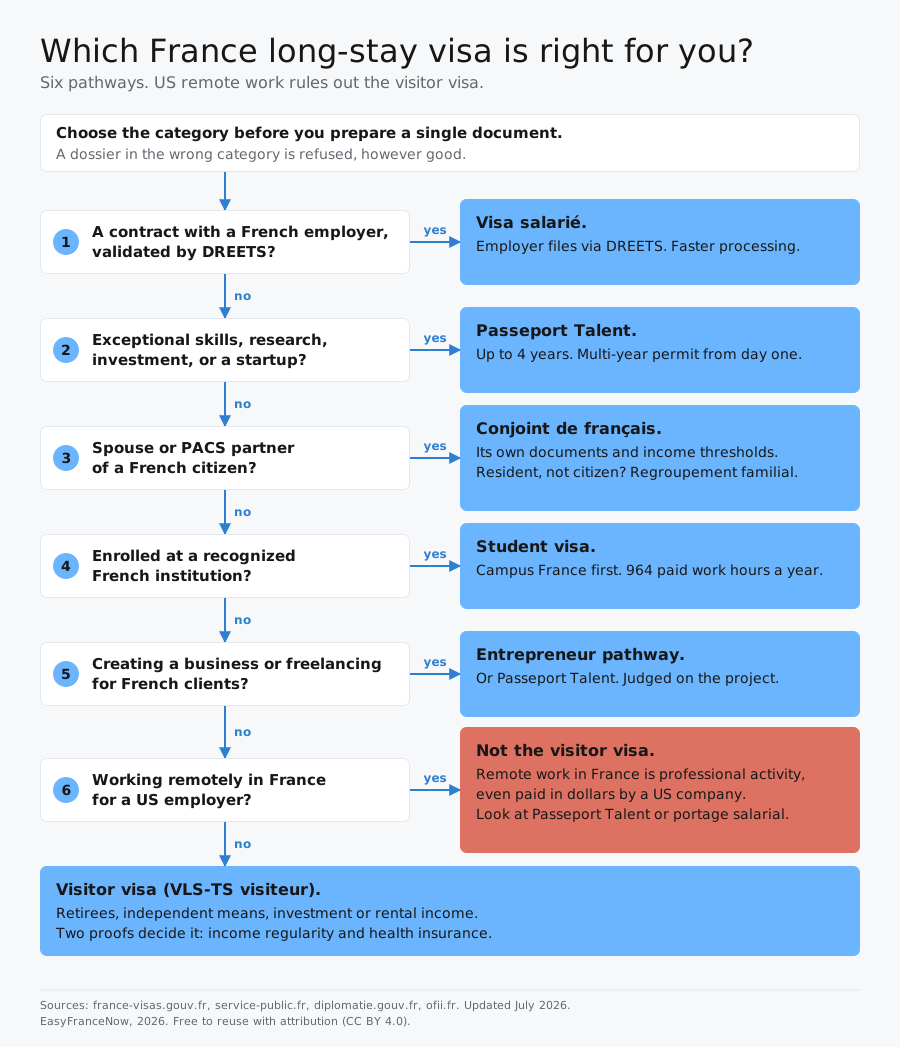
Choosing the correct visa category before you prepare a single document is the most consequential decision in this process. A dossier built for the wrong category will be refused regardless of its quality. Here is how to map your situation to the right pathway.
If you are employed by a French company, or if a French employer is sponsoring your relocation with a work contract backed by a work authorization, your pathway is the salarié (employee) visa. That authorization is no longer handled by the labour ministry: since April 2021 your employer applies for it online on the Interior Ministry's platform, and it is decided by the prefecture through one of the interregional foreign-labour platforms. The employer therefore starts part of this process before your consulate appointment, and you apply once the authorization has been issued. Processing times for salarié pathways are generally faster than for visitor visas at most consulates.
If you have exceptional qualifications, a research position at a recognized institution, a significant investment project in France, or a qualifying startup creation, you may be eligible for the Passeport Talent, renamed the "talent" residence permit by the law of 26 January 2024, which also regrouped the categories. This is a distinct category with its own income thresholds and a multi-year residence permit issued from the outset. The Passeport Talent guide for Americans covers the qualifying categories, the specific requirements for each, and how this pathway compares to the standard visiteur or salarié visa in terms of permit duration and renewal obligations. Because France-Visas and service-public.fr do not yet describe the categories identically, check the current official list on service-public.gouv.fr before settling on one.
If you are the American spouse of a French citizen, the conjoint de français pathway applies. It is worth being precise here: the route is for married spouses, and a PACS partner with less than a year of shared life is handled under the visitor card rather than this one. There is also no income threshold to clear, because the VLS-TS is issued to the spouse of a French national without a resources condition and can be refused only where the marriage is fraudulent or annulled or the applicant is a threat to public order. What the route does have is its own documentation set and its own processing logic. Our guide to moving to France as the American spouse of a French citizen covers the visa, the OFII steps, and the first administrative stages after arrival, and our spouse-of-a-French-citizen document checklist walks through exactly what to bring to your TLScontact appointment.
Family members joining a French legal resident (rather than a citizen) follow a different mechanism, the regroupement familial process, which is initiated by the resident already in France rather than the applicant in the U.S.
If you are enrolled at a recognized French educational institution, the student visa is your pathway. Applications go through the Campus France portal before the consulate appointment. Student visa holders operate under specific work authorization rules that differ significantly from other long-stay categories, including an annual hour limit for paid work. These rules, and their implications for Americans with U.S. employer arrangements, are covered in the guide to working on a French student visa and the 964-hour rule.
If none of the above applies and you plan to live in France without working for a French employer, the visitor visa (VLS-TS Visiteur) is your pathway. This covers retirees, people of independent means, those living on investment or rental income, and people accompanying a qualifying resident. It requires proof of financial self-sufficiency and compliant health insurance. It does not authorize professional activity in France, which is a distinction that matters critically for remote workers. (The section below on remote work addresses this directly.)
If you plan to create a business in France or offer freelance services to French clients, the standard entrepreneur pathway or the Passeport Talent Entrepreneur applies. The consulate evaluates the viability of your business project, not just your personal finances.
The main France long-stay visa pathways in detail
The visitor visa (VLS-TS Visiteur) is the most common long-stay visa issued to Americans. The dossier centers on two proofs: financial self-sufficiency and compliant health insurance. In our experience, the visitor visa dossier lives or dies on these two elements. The most common rejections we see are not from applicants who lack funds. They are from applicants whose financial picture is difficult to read: a large investment portfolio with no documented regular income, dollar-denominated statements without euro conversions, or income sources listed without the supporting documents that verify them.
What the consulate is looking for is predictable, accessible income sufficient to cover your stay without employment in France. The threshold is benchmarked against the French minimum wage (SMIC) and varies with the length of stay, but the core test is income regularity, not total account balance. Present income sources specifically: rental income, retirement distributions, Social Security payments, dividend income documented across several months, or a letter from a U.S. employer confirming active remote work for a non-French entity. A one-page financial summary in euros, organized by income source and supported by referenced documents, consistently produces better results than a raw stack of U.S. bank statements with no explanatory framework.
The salarié and related employee pathways are generally processed faster at most consulates, because the work authorization obtained by the employer provides a clear institutional anchor for the application. The personal dossier still requires the standard consular documents: passport, photos, accommodation proof, health insurance, and financial statements if applicable.
The Passeport Talent leads to a multi-year residence permit valid for up to four years depending on the qualifying category. The four years apply to the permit, not to the visa: if your stay is under twelve months the consulate issues a VLS-TS to validate online after arrival, and if it is a year or more it issues a long-stay visa valid three months, with the multi-year card to be applied for within two months of landing. For qualifying Americans, this is meaningfully more favorable than the annual renewal cycle of the visitor visa. The application requires documentation specific to the qualifying category: an employment contract and salary evidence for the highly skilled employee subcategory, a business plan and investment documentation for the entrepreneur subcategory, or institutional affiliation letters for the researcher subcategory.
The student visa requires applicants to begin the Campus France process before contacting the consulate. Campus France is a French government portal that pre-validates long-term study applications. The timeline for student visas is driven partly by Campus France processing and partly by consulate scheduling, which means early action matters significantly.
The conjoint de français visa gives American spouses of French citizens a pathway to a residence permit with faster multi-year access and, unlike the visitor pathway, no resources condition at all. A translated and apostilled marriage certificate is a core document requirement, and the permit renewal timeline is more favorable than for visitor visa holders.
Freelancers and consultants who plan to invoice their own clients should read our full guide to the self-employed profession libérale visa before settling on a pathway.
The document requirements that determine approval
Every pathway requires a core document set. You need a valid U.S. passport issued less than ten years ago, valid for at least three months beyond the end date of the visa you are applying for, and containing at least two blank pages for visa stamps. You need recent passport photos that conform to French biometric specifications. You need proof of accommodation in France covering at least the initial weeks of your stay. And you need evidence of compliant health insurance. Beyond that foundation, the pathway determines what additional financial, professional, or institutional documents are required.
Health insurance is the first of several policies a new arrival has to hold, and the order in which French insurance obligations fall due explains how the visa requirement relates to the rest.
Financial documentation is the pivotal element for the visitor visa and is critical for most other categories. The proof of income guide covers the specific thresholds and formatting in detail, but the core principle is consistent: consulates evaluate income regularity, not account balances. Bring three to six months of bank statements. Add a financial summary page that converts U.S. dollar amounts into euros and lists each income source by type and monthly amount. Include the supporting documents that verify each source: an award letter or distribution statement for retirement income, a lease agreement and bank deposits for rental income, or brokerage statements showing regular distributions (not just total portfolio value) for investment income.
Health insurance for a France long-stay visa must meet requirements that standard U.S. employer-sponsored health plans typically do not satisfy. Domestic U.S. plans do not cover care in France, which is precisely what the consulate is checking. You need an international health insurance policy, or a plan specifically structured for French visa compliance. The official requirement is medical cover valid in France for the whole period of the stay you are requesting, so the certificate from your insurer has to state the coverage territory (France or worldwide including France) and the coverage period without ambiguity. Policies that list "worldwide coverage" without specifying France, or that contain significant exclusions for chronic conditions, have caused rejections.
This is also where the difference between travel medical insurance and residence health insurance matters, and the two are constantly conflated online. A subscription travel policy is the right tool for the scouting trips and consulate runs that happen before the visa exists, and SafetyWing’s Nomad Insurance Essential is priced by the four-week block for exactly that. For the dossier itself, read the certificate rather than the marketing: if your life is genuinely multi-country, the Complete plan is the version that behaves like health insurance, with routine care and cover in more than 180 countries; if you are settling at one French address, a France-scoped expat policy is usually the cheaper and more predictable answer.
Proof of accommodation is more flexible than most applicants expect. It does not need to be a signed long-term lease. The accommodation proof guide covers every format the consulate accepts: an Airbnb reservation, a short-term furnished rental agreement, or a notarized attestation d'hébergement from a person hosting you in France. What matters is that the document demonstrates a concrete plan, with a name and address the consulate can verify.
What we see most often in incomplete or refused dossiers is internal inconsistency. A cover letter describing retirement, while the financial documents show active consulting invoices. A stated address in Paris, while the health insurance certificate shows a U.S. home address. A LinkedIn profile showing a current senior role at a major U.S. tech company, while the application states the purpose as passive living. The consulate reads the dossier as a whole narrative. Inconsistencies between stated purpose, professional profile, and financial documentation are the most common trigger for refusals. Those inconsistencies are visible in the file long before the consulate spots them, which is exactly what a visa dossier check is for.
Health insurance is the requirement Americans underestimate most, because the US habit is to treat coverage as an employment benefit rather than a document. For a long-stay visa it is a document: the consulate wants a certificate covering the entire requested period, issued before you travel. Expat health insurance designed for the French long-stay visa produces that certificate at signup and converts to a top-up policy later, once you are inside the public system.
Preparing your U.S. documents before you leave
Several standard U.S. documents need specific preparation before French institutions will accept them. This step is easy to overlook because it is not always prominently listed on every visa checklist, but it becomes critical at the CPAM, prefecture, and civil registration stages after arrival.
Birth certificates, marriage certificates, divorce decrees, and similar civil documents typically require two things when presented to French authorities: an apostille and a certified translation into French. An apostille is a standardized authentication issued by a U.S. state authority, typically the Secretary of State's office, that certifies the document's legitimacy for international use under the Hague Convention. France is a signatory to the Hague Convention and accepts apostilles for civil documents without requiring additional consular legalization. The apostille and sworn translation process for US documents explains which documents require this treatment, how to obtain apostilles state by state, and how to identify a sworn translator (traducteur assermente) recognized by a French court of appeal.
Americans often run into serious problems when they assume a notarized U.S. document is equivalent to an apostilled one. Notarization is a domestic U.S. certification. It does not carry the same international legal weight as an apostille and will typically be rejected by French administrative authorities, including CPAM and the prefecture. Similarly, a translation by a bilingual friend or a general translation service does not meet French standards. What French administrations accept is a translation by a traducteur agree, meaning a judicial expert listed by a French court of appeal or on the national list of the Cour de cassation, or a translation made by a translator approved locally and certified by the French consulate.
Several of these civil-status records have to be legalized before a French office will accept them, so plan ahead using our guide to the US documents you must apostille before moving to France.
Tax returns deserve specific attention for the financial proof component of your dossier. The consulate does not typically require apostilled tax returns at the visa stage, but including them as income evidence, which is useful for self-employed applicants or those with complex income structures, requires that they be complete, legible, and ideally accompanied by a certified translation of the key fields showing annual income, filing status, and signature. A partial return or one that references schedules not included in the package creates confusion and can slow the consular review.
The timing is also a practical issue. U.S. state apostille offices process requests by mail, with turnaround times ranging from a few days to several weeks depending on the state and season. Federal apostilles from the U.S. Department of State are required for federally issued documents. Build the apostille and translation step into your overall timeline before you book your TLScontact appointment, not after.
Budget for these documents alongside the visa fee itself: our full breakdown of what moving to France from the U.S. costs sets out the apostille and translation line next to the government fees that follow arrival.
The consulate appointment process
French long-stay visa applications for Americans are submitted through TLScontact, a private visa application center that handles appointment booking, document collection, biometric data capture, and passport processing on behalf of the French consulate. The consulate itself reviews the dossier and makes the final decision. TLScontact and consular fees are both required and paid separately. The TLScontact website is where you book your appointment and access the current checklist for your specific visa category and consulate.
You are not tied to a center by your state of residence: France-Visas states that applicants living in the United States can book at any of the centers, wherever they live. There are ten in the United States, in Atlanta, Boston, Chicago, Houston, Los Angeles, Miami, New York, San Francisco, Seattle and Washington DC, plus one in Jamaica. Availability varies significantly by city and season, so it is worth checking several centers rather than only the closest one.
In our experience, the realistic planning horizon from first document preparation to appointment date is six to ten weeks in most cities. Washington D.C., New York, and Los Angeles typically have the most constrained appointment calendars. From March through July, when demand is highest, applicants in these cities regularly find available slots pushed to twelve or fourteen weeks. This is not an exception: it is the normal peak-season pattern. Factor this into your relocation timeline from the start. Do not book non-refundable flights, shipping containers, or French apartment leases until your visa is physically in your hands.
At your appointment, bring your dossier organized in the exact sequence listed on the TLScontact checklist for your visa category. Bring originals of every document and at least one copy of each. A cover page that lists the contents in order, followed by documents in that sequence, makes the submission faster and presents the consulate reviewer with a document that is easier to evaluate. Consular staff reviewing many applications in sequence respond to clarity and organization. The appointment is also the last moment the file can change, which is why the most useful step in the week before it is a visa dossier check on the assembled file: anything weak or inconsistent gets fixed while it still can be, not cited in a refusal letter.
After submission, the official indicative decision time is around fifteen days, extendable to forty-five days when a file needs closer examination, and the French visa service in the U.S. asks applicants to allow at least fifteen days. In our experience, four to six weeks is the realistic range for American long-stay files. Indicative timelines are published on France-Visas, though actual timelines vary by volume and individual case complexity. You will be notified when your passport is ready for collection or courier return. Plan your departure around the four to six week range, not the fastest possible outcome.
For a full walkthrough of what happens on the day, including how to book, what to bring, and the no-slots problem, see our detailed guide to the TLScontact appointment for US applicants.
After your visa is issued: what to handle in France
Your visa is the entry document. What happens after you land is the stage most Americans are least prepared for, and the one where delays in one step create cascading delays in others.
If your visa is a VLS-TS, you must validate it online within three months of your first entry into France, on the government validation service run by the Interior Ministry, not on the OFII site. This is a firm deadline with real consequences. Validation means completing an online form with your visa, your passport and your French address, then paying the tax stamp for your category during the same session. Depending on your reason for stay, the OFII may then summon you separately for a medical visit and to sign the contrat d'integration republicaine. The full step-by-step process is covered in our guide to completing your OFII validation after landing in France. Failing to validate on time can create a legal status gap that affects your access to French institutions and your permit renewal application.
In parallel with OFII, your first weeks in France require setting up a bank account, registering at your residential address, securing longer-term housing if you arrived on a short-term arrangement, and beginning the CPAM healthcare registration process. These steps form a sequence where each depends on the previous: some institutions require proof of housing before proceeding, some banks ask for proof of address, and some address registrations require a lease that in turn requires a bank account. Understanding the practical order of operations before you land matters for avoiding bottlenecks in your first month.
After OFII validation, your VLS-TS acts as your residence permit for the first year. At the 12-month mark, you must apply for renewal before your current status expires. Renewal applications for most permit types now go through the ANEF online platform. Our guide to renewing your French residence permit as an American covers the ANEF process, the documents required for each major permit type at renewal, and the most common reasons renewal applications are returned incomplete or refused. Submit your renewal at the ten-month mark, not at the twelve-month deadline: the processing time must be factored in.
Your first year of legal residence also starts a clock that matters for long-term planning. Five years of continuous and legal residence in France creates eligibility for the 10-year carte de resident. Citizenship can be requested after five years with additional conditions. One of those conditions is new and easy to miss: since 1 January 2026, non-EU nationals have to pass a civic exam before applying for a first multi-year residence permit, for the carte de resident or for naturalization, and for the multi-year permit the 24-hour civic training now comes before the permit rather than after it. The VLS-TS to permanent residency timeline shows what each stage in that progression requires and what can interrupt your residency continuity, including gaps in permit coverage and changes of status.
Some Americans find that their situation changes after arrival. An American on a visitor visa who finds employment with a French company, or a student who graduates and wants to remain in France, must transition to a different permit type. Our guide to changing your visa status while already in France explains which transitions can be completed without leaving the country, which require a departure and re-entry, and how the prefecture and ANEF handle these requests.
Remote work and the visitor visa: where the legal line sits
This is the question we receive most frequently, and it requires a direct answer rather than a vague acknowledgment of complexity.
The France long-stay visitor visa explicitly prohibits professional activity in France. The official French government position, applied consistently by most consulates, is that performing remote work for a non-French employer while physically present in France constitutes professional activity on French soil. This applies even when you are paid in U.S. dollars by a U.S. company and have no contractual relationship with any French entity. This is not a legal gray area in official terms: it is a gray area in enforcement, but that distinction does not make the visitor visa the correct pathway for an active remote worker.
The consulate evaluates your intended purpose at the time you apply. An applicant whose LinkedIn profile shows an active senior role at a U.S. company, whose financial documents show regular employment income, and whose cover letter describes a plan to live passively as a retiree is presenting an internally inconsistent picture. Consulates are aware of this pattern. What we see consistently is that applications where the professional profile does not match the stated purpose are either refused outright or returned for additional explanation.
If working remotely is your primary intended activity in France, the visitor visa is the wrong category. The correct pathway depends on your specific situation: the Passeport Talent covers several qualifying professional profiles, and a portage salariale arrangement may provide a legal framework in some cases. These options require analysis specific to your profile. Our guide to working remotely from France on a visitor visa explains the full legal landscape, what the legitimate alternatives look like, and what the real risks are for Americans who proceed on the visitor visa with an active remote work arrangement.
There is also a tax dimension that is separate from but related to the visa question. Once you are tax-resident in France (which French domestic law determines under Article 4B of the tax code by where your home or main place of stay is, where your main professional activity is, or where your center of economic interests is, so that residency can apply well before any 183-day count rather than because of one), your worldwide income becomes potentially taxable in France. Your U.S. tax obligations continue regardless. The France-U.S. tax treaty governs how these obligations interact, but the analysis is not simple, and it is part of the same decision-making process if remote work in France is your plan.
Common mistakes to avoid
Applying for the visitor visa when remote work is the actual plan. We consistently see American professionals, particularly those in technology, finance, and consulting, apply for the visitor visa because no other category seems to fit and they intend to work from their laptop as they always have. The visitor visa explicitly prohibits professional activity. Consulates reviewing applications from active professionals examine the full picture: the stated purpose, the financial documents, and the applicant's professional profile. A LinkedIn profile showing a current senior role is publicly visible and routinely checked. The inconsistency between "passive visitor" and "active senior professional" is one of the most reliable predictors of a refusal in this category.
Submitting financial documents without an explanatory framework. What we see most often is a collection of U.S. bank statements accompanied by brokerage summaries and perhaps a tax return, with no document that translates this into a monthly euro income picture organized by source. French consular staff review many applications. A one-page financial summary listing income sources, monthly euro amounts, and the specific supporting documents for each entry takes twenty minutes to create and consistently produces better results than a raw stack of statements. A large account balance without a regular income line is not the same thing as documented income, and experienced consular reviewers will note the difference.
Applying without enough time to recover from a problem. A visa refusal followed by an appeal or a corrected reapplication adds six to twelve weeks to the timeline. Applicants who plan to depart France in three weeks are left without options if the application is refused. Build at least twelve weeks of buffer between your first submission and your intended arrival date in France. There is a ceiling as well as a floor, though: a long-stay application cannot be lodged more than three months before your planned departure, so any extra runway has to come from preparing documents earlier, not from applying earlier.
Assuming U.S. legal documents are ready to use without preparation. Birth certificates, marriage certificates, and similar civil documents typically need apostilles and certified French translations before French administrative institutions, including CPAM and the prefecture, will accept them. This step does not typically affect the visa dossier itself, but it will affect your post-arrival administrative setup. Getting these completed while still in the U.S. is considerably easier than doing so from France.
Practical checklist
Phase one: before preparing any documents
Identify your visa category based on your actual situation, not the category that seems simplest. Choose the TLScontact center you will apply at: any center on the France-Visas list will take your file, whatever state you live in. Review the current document checklist on the France-Visas page for the United States for your specific category. Check TLScontact appointment availability across centers and set a target appointment date before you begin gathering documents. Do not gather documents until you know your appointment window: some documents (bank statements, insurance certificates) have currency requirements.
Phase two: document preparation, six to ten weeks before your appointment
Obtain a France-compliant international health insurance policy with explicit France coverage running for the full period of the visa you are requesting. Prepare a financial summary that lists income sources in euros with referenced supporting documents for each. Request apostilles for civil documents (birth certificate, marriage certificate, divorce decree) that will be needed at CPAM and the prefecture after arrival. Commission certified translations from a sworn translator for any French-language requirements. Secure proof of accommodation in France for the initial weeks. Prepare passport photos to French biometric specifications.
Phase three: the appointment
Organize your dossier in the exact order listed on the TLScontact checklist for your category. Bring originals and copies of every document. Include a cover page listing contents in sequence. Pay both TLScontact and consular fees at submission. Retain your receipt and submission confirmation.
Phase four: after the visa is issued
Do not book non-refundable travel until the visa is physically in your hands. Enter France and validate your VLS-TS online through the official validation service within three months of arrival. Set up a French bank account and register at your address in the first two to three weeks. Begin the CPAM healthcare registration process as soon as your validation is confirmed. Track your permit expiry date from day one and submit your renewal application at the ten-month mark, not the twelve-month deadline.
Complete Topic Navigation
The France long-stay visa topic cluster covers every stage and variation of this process for Americans. Here is where to find the detailed guidance for each subtopic.
Proof of income for the France long-stay visa covers the specific income thresholds, how to document U.S.-based income sources in a format French consulates can evaluate, and what to do when your income is irregular, investment-based, or sourced from multiple streams.
Proving accommodation for a France long-stay visa without a signed lease explains every format the consulate accepts, from Airbnb reservations and short-term rental agreements to notarized host attestations, and what each document must include to satisfy the consulate.
What to do after a France long-stay visa denial covers the appeal process through the Commission de Recours Contre les Decisions de Refus de Visa, how to interpret a refusal reason correctly, and how to build a stronger reapplication dossier.
Moving to France as the American spouse of a French citizen covers the conjoint de français visa pathway, the specific documentation set for this route, and the OFII and prefecture steps that follow arrival.
The Passeport Talent visa for Americans explains who qualifies under each of the current talent categories, the income and asset thresholds, and how this pathway compares to the standard visiteur or salarié visa in terms of permit duration and renewal.
How to complete your OFII validation after landing in France covers every step of the OFII process: the online portal, the medical appointment, the tax stamp fee, and what the validation certificate means for your legal status going forward.
How to renew your French residence permit as an American covers the ANEF platform, the documents required for each major permit type at renewal, and the most common reasons renewal applications are returned incomplete or refused.
Working on a French student visa and the 964-hour rule explains the specific work authorization rules that apply to student visa holders, including the annual hour limit and how U.S. employer and freelance arrangements are treated differently from other long-stay categories.
How to change your visa status while already in France covers which status changes can be completed without leaving the country, which require a departure and re-entry, and how the prefecture and ANEF handle these requests for Americans in different situations.
ETIAS for Americans: what it is, when it started, and how to apply explains the Schengen travel authorization requirement for short stays, how it differs from a long-stay visa, and what Americans need to do before any exploratory trip to France.
When to get help
A straightforward visitor visa application with clearly documented income, no prior visa issues, and a standard profile (retiree, person of independent means, U.S.-source passive income) is manageable for most Americans without professional support. The process is predictable when the situation is clean.
The calculus changes in several common scenarios: self-employed applicants presenting consulting or freelance income rather than employment or passive income; applicants whose primary assets are investment portfolios without regular documented distributions; couples where one partner's documentation is significantly stronger than the other's; anyone who has received a prior refusal from a French consulate; Passeport Talent applicants where the qualifying category requires interpretation; and anyone on a firm departure timeline where a single refusal would derail a signed lease or a shipping container already in transit.
In any of these situations, the value of professional support is not convenience: it is the difference between approval on the first attempt and a fixable problem that costs months. Our visa dossier check is built for that gap: we read your assembled file line by line, the way the consulate will, and send it back marked up within 72 hours, so a thin income summary or an ambiguous accommodation proof is corrected before the appointment rather than after the decision.
FAQ
How long does it take to get a France long-stay visa from the US?
From your TLScontact appointment to the visa decision, the typical consulate processing time is four to six weeks. Total preparation time, from starting your documents to your appointment date, depends on consulate availability in your city and your own readiness timeline. Plan on a minimum of ten to twelve weeks from the start of document preparation to your intended travel date. Consulates in New York, Los Angeles, and Washington D.C. typically have the most constrained appointment calendars, and peak demand from March through July can push available slots to fourteen weeks or more in those cities. Build this buffer into your relocation timeline before committing to a departure date, signing a lease, or booking a shipping service in France.
Can I work remotely from France on a long-stay visitor visa?
The visitor visa formally prohibits professional activity in France, and the official French position treats remote work for a non-French employer as professional activity on French soil. Enforcement after arrival is inconsistent, but the risk at the application stage is direct: a consulate that identifies an inconsistency between your active professional profile and your stated visitor purpose will refuse the application. If working remotely is your primary intended activity, the visitor visa is not the right category. The Passeport Talent or a portage salariale arrangement may be appropriate depending on your profile and situation. Our guide to working remotely from France on a visitor visa covers the full legal landscape and what the legitimate alternatives look like for Americans.
What is the difference between a VLS and a VLS-TS?
A standard VLS (visa de long sejour) must be converted into a residence permit (carte de sejour) at the local prefecture within two months of your arrival in France, which requires an additional application and often an in-person prefecture appointment in your first weeks. A VLS-TS (visa de long sejour valant titre de sejour) acts as both a visa and a first-year residence permit, removing the immediate prefecture requirement. Most pathways for Americans now issue a VLS-TS. It requires an online validation within three months of first entry, on the Interior Ministry's platform rather than the OFII site, with a tax stamp paid during the process. If you are unsure which type you received, check the text on the visa sticker itself: a VLS-TS includes the notation "valant titre de sejour."
What happens if my France long-stay visa application is refused?
A refusal does not permanently bar you from reapplying. The French consulate is required to give a reason for the refusal, though the explanation is often brief and written in administrative language. Read it carefully to identify the specific gap: a missing document, a financial presentation issue, or a wrong visa category selection. Address that specific gap in your reapplication, not just the application generally. If you believe the decision was procedurally incorrect, you can file a recours (appeal) with the Commission de Recours Contre les Decisions de Refus de Visa, and the deadline is short: 30 days from the notification of the refusal, or from the implicit refusal that arises if the consulate has not replied within two months. That appeal is also compulsory before any application to the administrative court in Nantes, so letting the 30 days pass closes the litigation route as well. In most cases, a corrected reapplication with the identified problem addressed directly is faster than the appeal route. Our guide to what to do after a France long-stay visa denial covers both paths in detail.
Do I need apostilles and translations for my U.S. documents before the visa appointment?
For the consulate dossier itself, apostilles are not typically required for most documents at the visa application stage. The more critical moment comes after arrival, when you present civil documents (birth certificate, marriage certificate, divorce decree) to the CPAM, the prefecture, or civil registration authorities. French administrative institutions require apostilled and certified-translation versions of foreign civil documents before they process applications involving those documents. Getting apostilles and sworn French translations completed in the U.S. before departure is significantly easier than doing so from France, where the apostille request must go back to U.S. state offices by mail. Our guide to apostilles and certified translations for France covers which documents need which treatment and how to obtain both efficiently.
Conclusion
The France long-stay visa process follows a predictable logic once you understand what the consulate is actually evaluating: the right category for your situation, a financial picture that reads clearly in euros, compliant health insurance for the full visa duration, and a dossier that tells a consistent story from the cover page to the final document. Most refusals are preventable. Most delays come from insufficient preparation time or inconsistencies that a careful review would have caught before submission.
The visa is also only the beginning. OFII validation, the first-year permit period, the renewal deadline on ANEF, and the longer-term residency record all require ongoing attention from the day you land. Understanding that sequence from the start puts you in a significantly stronger position throughout the first year and beyond.
Most refusals come from inconsistencies the applicant never spotted, which is exactly what a visa dossier check is for: a review of the full dossier before it reaches the consulate.
About the author
Maxime Roseau
Related posts