
South of France: Where to Go, Region by Region, and When

By Aurelio Maurici Co-Founder, Master of Business Law, Aix-Marseille Université III
Published

In this article
- What Counts as the South of France
- The South of France at a Glance
- The French Riviera (Côte d’Azur)
- Provence: Avignon, Arles, Orange and Marseille
- The Calanques National Park: the rules before you go
- The Luberon, the Villages and the Lavender
- When the lavender blooms
- The Camargue
- Languedoc: the Pont du Gard, Nîmes and Carcassonne
- The South of France’s World Heritage Sites
- Weather in the South of France
- The 2027 Calendar of the South
- Getting to the South of France
- From the US
- From Paris by TGV
- A First Itinerary for the South of France
- Staying Longer: a Season in the South
- FAQ
- Conclusion
“The South of France” is not one place but two regions on the Mediterranean, Provence-Alpes-Côte d’Azur and Occitanie, and five very different trips: the French Riviera of Nice and Menton, the Provence of Avignon, Arles and Marseille, the perched villages and lavender of the Luberon, the wetlands of the Camargue, and the Roman and medieval Languedoc of the Pont du Gard and Carcassonne. Between them they hold more than a dozen UNESCO World Heritage listings, 700 km of coastline on the Provence-Alpes-Côte d’Azur side alone, according to its tourism board, and, on the coast of the Bouches-du-Rhône and the Var, some of the sunniest weather in France, according to Météo-France.
This guide takes the South area by area: what each is, what to see, when to go, how to get there from the US or from Paris, and how the calendar of 2027 falls. Every date, price and journey time below was read on the official page of the region, the park, the monument, the festival or the operator on November 25, 2026. For the Riviera, three guides go further: Nice, Èze and Menton.
What Counts as the South of France
In official terms, the Mediterranean South of France is two administrative regions, according to INSEE:
| Region | Departments | Capital |
|---|---|---|
| Provence-Alpes-Côte d’Azur | 6: Alpes-Maritimes, Alpes-de-Haute-Provence, Bouches-du-Rhône, Hautes-Alpes, Var, Vaucluse | Marseille |
| Occitanie | 13: Ariège, Aude, Aveyron, Gard, Gers, Haute-Garonne, Hautes-Pyrénées, Hérault, Lot, Lozère, Pyrénées-Orientales, Tarn, Tarn-et-Garonne | Toulouse |
Source: INSEE, Provence-Alpes-Côte d’Azur and Occitanie, official geographic code at January 1, 2026, read on November 25, 2026.
Two common confusions: the Basque coast (Biarritz, Bayonne) is in the Pyrénées-Atlantiques, part of Nouvelle-Aquitaine, not of either Mediterranean region; and “Provence” is narrower than the region of the same name. The regional tourism board defines Provence as four departments, the Bouches-du-Rhône (Marseille), the Vaucluse (Avignon), the Alpes-de-Haute-Provence and the Var, with a coast from the Calanques of Cassis to the Gulf of Saint-Tropez; the Alpes-Maritimes are the Côte d’Azur.
The South of France at a Glance
| Area | What it is | Highlights | Best known for |
|---|---|---|---|
| The French Riviera (Côte d’Azur) | The coast from Saint-Tropez or Hyères to Menton and the Italian border | Nice, Èze, Menton, Antibes, Cannes, Saint-Paul-de-Vence | The sea, the Belle Époque resorts |
| Provence | Marseille, the Rhône valley, the Alpilles | Avignon, Arles, Orange, Marseille, the Calanques, Les Baux-de-Provence | Roman and papal monuments, festivals, markets |
| The Luberon and Haute-Provence | Hills and plateaus north of the Durance | Gordes, Roussillon, Sénanque, the Valensole plateau, Moustiers-Sainte-Marie | Perched villages, lavender |
| The Camargue | The delta of the Rhône, between its two arms | Saintes-Maries-de-la-Mer, the Pont de Gau bird park, Aigues-Mortes | Flamingos, white horses, bulls, rice |
| Languedoc and the Occitanie coast | From the Camargue gardoise to the Catalan coast | The Pont du Gard, Nîmes, Montpellier, Sète, Carcassonne, Collioure | Roman sites, Cathar castles, beaches |
Sources: Provence-Alpes-Côte d’Azur Tourisme; Côte d’Azur France; Comité régional du tourisme Occitanie, read on November 25, 2026. The two tourism boards draw the western end of the Côte d’Azur differently: Saint-Tropez for the regional board, Hyères for the Alpes-Maritimes board.
The parts of the move Americans find out about too late.
What Americans get wrong about moving to France, and the number, form or deadline that fixes it. Straight to your inbox.
One email a week. Real numbers, nothing else.
The French Riviera (Côte d’Azur)
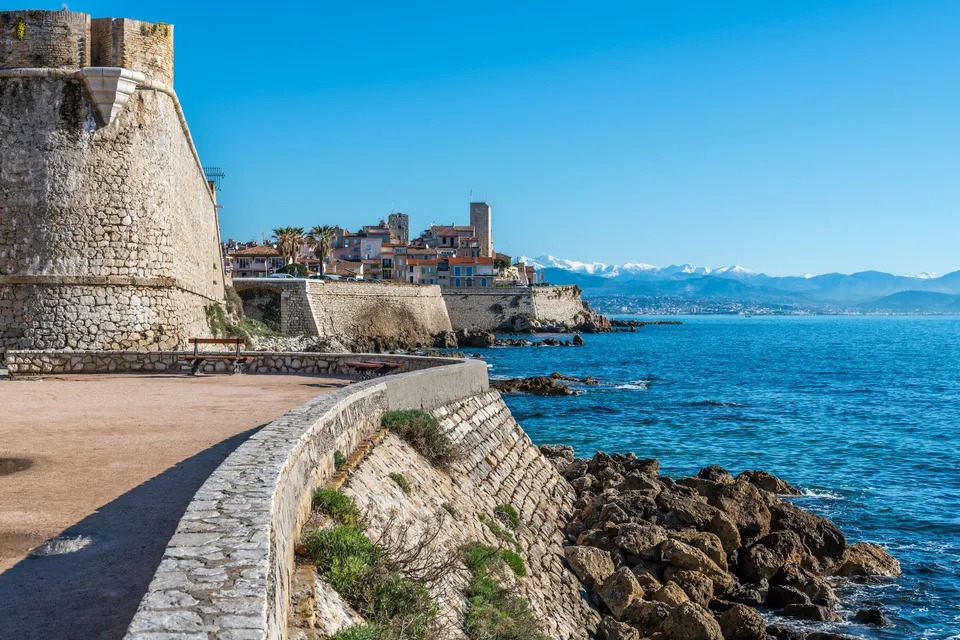
The Riviera is the South most Americans picture: towns between the Alps and the sea, which the Côte d’Azur France board sums up in its own list, “Nice, Cannes, Antibes, Grasse, Saint-Tropez, Monaco and Menton, to name but a few”. It is also a part you can do without a car: one coast railway links Cannes, Antibes, Nice, Monaco and Menton all day.
- Nice is the base: a city whose seafront UNESCO inscribed in 2021 as the “Winter Resort Town of the Riviera”, with the Promenade des Anglais, a baroque old town, the Matisse and Chagall museums and the region’s airport. Our Nice guide covers it neighborhood by neighborhood, with the weather month by month.
- Èze is the perched village between Nice and Monaco, 429 meters above the sea, with an exotic garden on the ruins of its castle: see our Èze guide.
- Menton is the last town before Italy, with a baroque old town and a Lemon Festival every February: see our Menton guide.
- Cannes hosts the film festival, whose 80th edition runs from May 11 to 22, 2027, according to the Festival de Cannes.
- Saint-Paul-de-Vence, inland, is a walled village with 11 listed historic monuments, its tourist office says, and the Fondation Maeght, the first independent art foundation in France, opened in 1964, whose collection now comprises 13,000 works. Marc Chagall lived nearby from 1966 and is buried in the village cemetery.
Provence: Avignon, Arles, Orange and Marseille
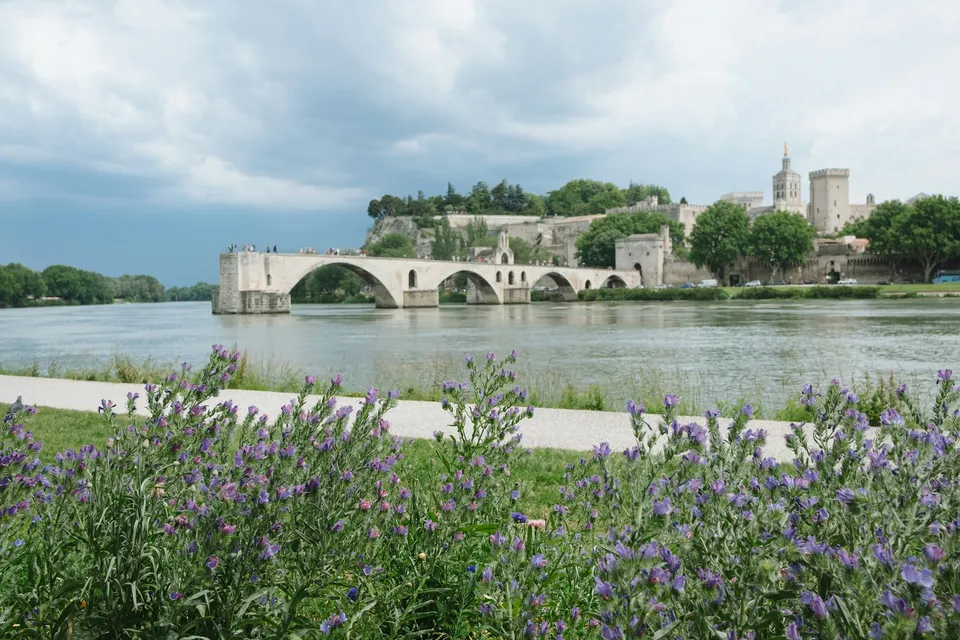
Avignon was the seat of the papacy in the fourteenth century, and UNESCO lists its historic center, the Papal Palace, the episcopal ensemble and the Avignon Bridge as a World Heritage site since 1995, recalling that “Avignon is known as the City of the Popes”. Every July since its founding by Jean Vilar in 1947, the Festival d’Avignon turns it into a city of theater, with about 45 shows and some 300 performances; the festival marks its 80th anniversary in 2027, and its 2027 dates were not yet announced on November 25, 2026.
Arles, on the Rhône, has a World Heritage listing of its own since 1981 for its Roman and Romanesque monuments: the arena, the Roman theater and the cryptoporticus from the first century B.C., the Alyscamps necropolis, and the church of Saint-Trophime and its cloister. Its Easter Feria, which opens the French bullfighting season, runs from March 26 to 29, 2027, according to the Arles tourist office. North of Avignon, the Roman theater of Orange, with a facade 103 meters long and 37 meters high, is “one of the best preserved of all the great Roman theatres”, in UNESCO’s words; it hosts the Chorégies d’Orange, founded in 1869 and presented as the oldest festival in France.
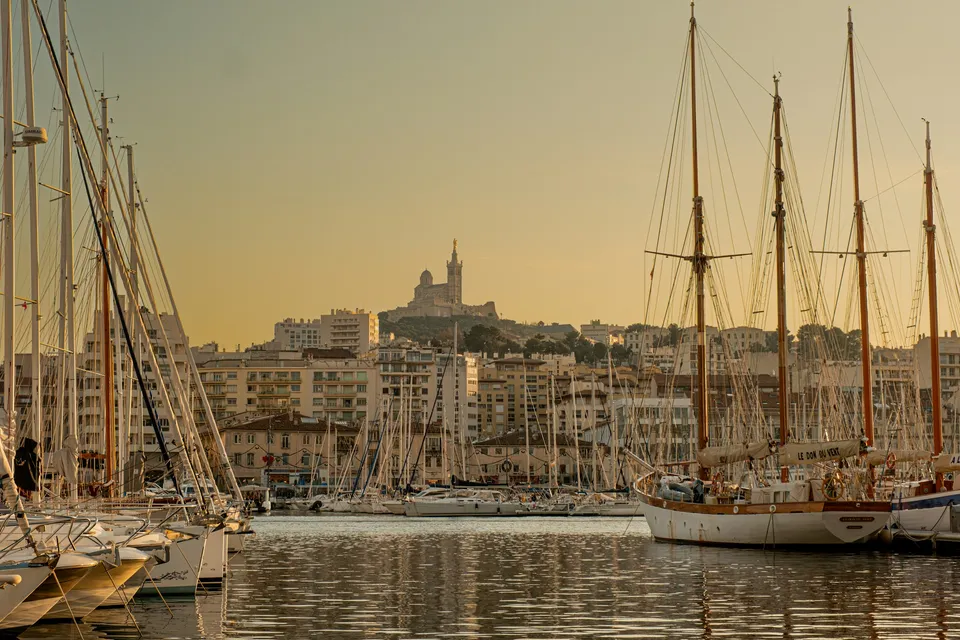
Marseille, the regional capital, is the gateway to the Calanques. Its Unité d’habitation is one of the buildings in UNESCO’s listing of the architectural work of Le Corbusier.
The Calanques National Park: the rules before you go
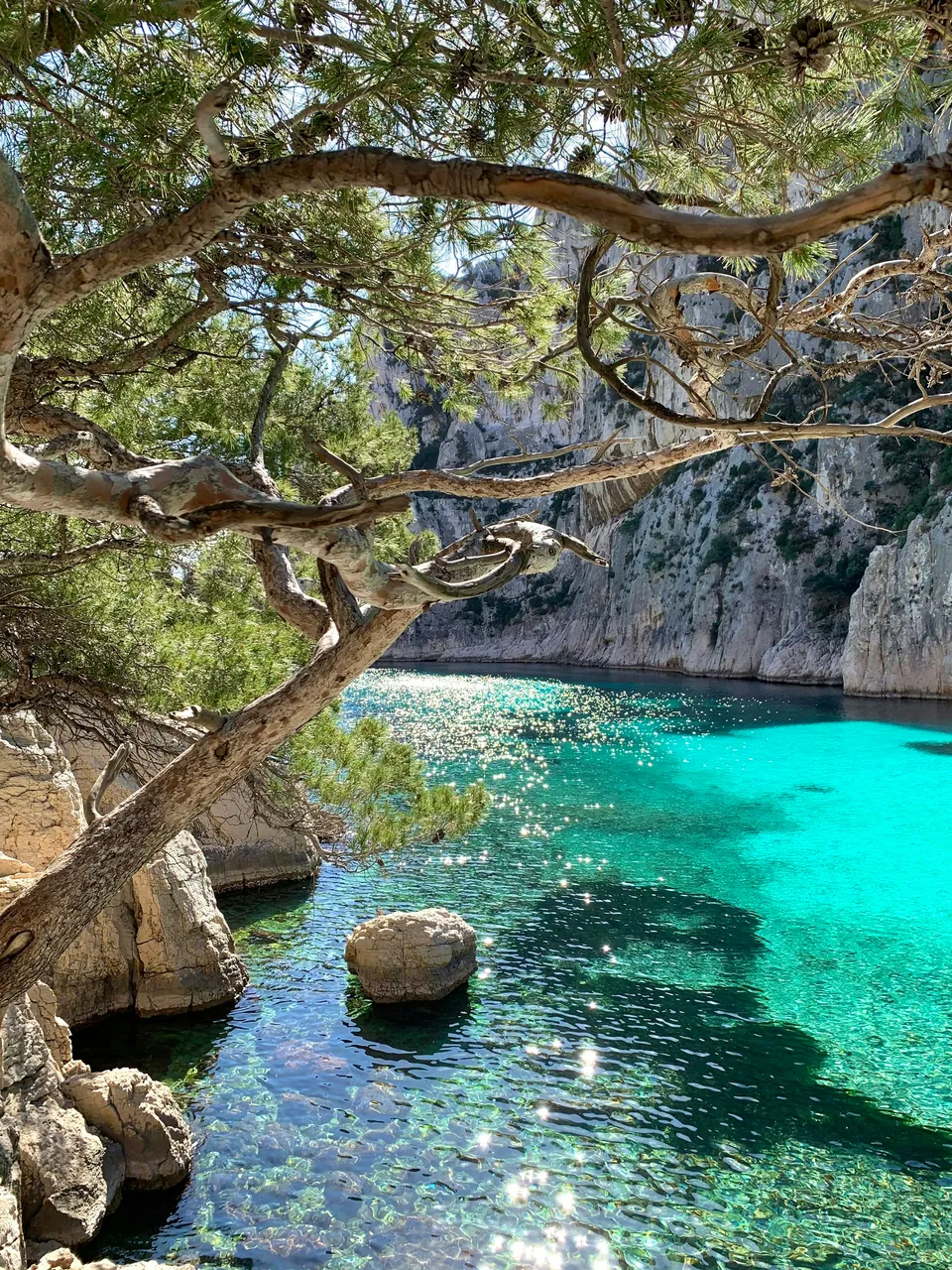
The limestone inlets between Marseille, Cassis and La Ciotat form the Parc national des Calanques, created by a decree of April 18, 2012. The park says it is open all year, free, and visited by 3 million people a year, and that it is the only peri-urban national park in Europe. Three rules shape a visit:
| Rule | When | What it means |
|---|---|---|
| Fire-risk access | June 1 to September 30 | The Prefecture decides every day, around 5 p.m., whether the forest massifs are open the next day. On a red day, access to the forest massifs is forbidden; visits by sea are allowed but landing is not |
| Reservation for Sugiton and Pierres Tombées | Mid-June to mid-September | Compulsory and free. In 2026 it applied on June 20 and 21, every day from June 27 to August 30, and on the weekends of September 5 and 6 and 12 and 13 |
| Road closures | Easter to All Saints’ Day | Some roads close to motor vehicles: in 2026, the roads to Sormiou, Morgiou and Callelongue from 7 a.m. to 7 p.m. every day from June 12 to August 30 |
Sources: Parc national des Calanques, preparing your visit, fire-risk rules, Sugiton 2026 dates and road closures; Légifrance, decree 2012-507, read on November 25, 2026. No 2027 dates were published yet.
Fire is forbidden inside the park and within 200 meters of its forests, smoking included, with a fixed fine of 135 euros. The park asks for at least 1.5 liters of water per person per half day: there is no fountain and no trash can in the Calanques. A train links Marseille, Cassis and La Ciotat, and bus line 78 runs from Marseille to Cassis over the Gineste road. The classic walk to Sugiton starts at the end of bus line B1 (direction Campus de Luminy): 4.6 km one way, about 2 hours with the viewpoint, 135 meters of climb. The park also gives a warning worth repeating: do not rely on artificial intelligence or social media to plan your route, it says, because the information there is often wrong. Check its site and the Prefecture’s the evening before.
The Luberon, the Villages and the Lavender
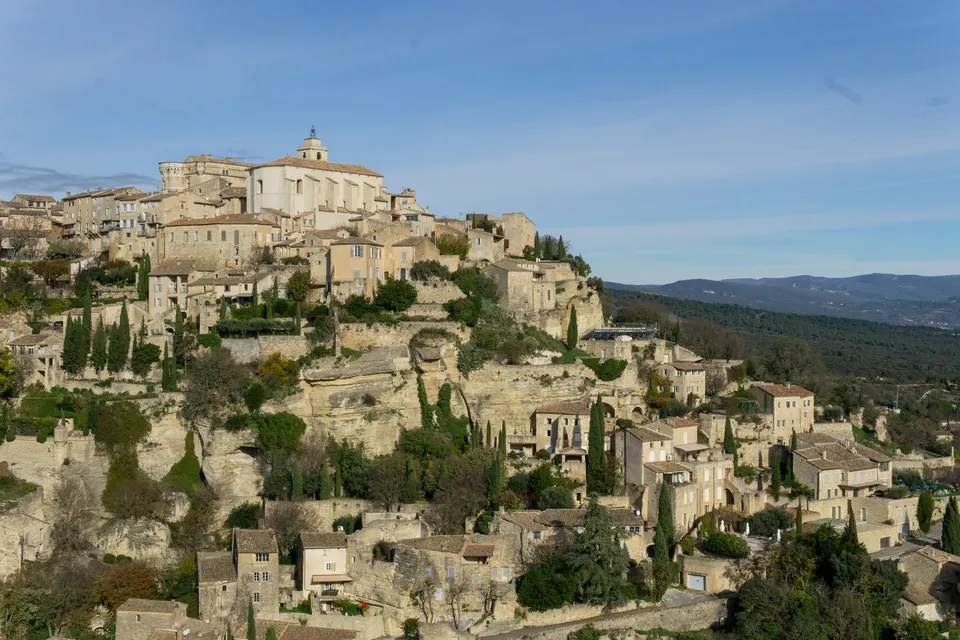
North of the Durance, the Parc naturel régional du Luberon covers 1,867 square kilometers and 77 communes in the Vaucluse and the Alpes-de-Haute-Provence. This is the Provence of perched villages, and several of them belong to the association Les Plus Beaux Villages de France, which counts 186 members:
- Gordes, “one of the most emblematic perched villages of Provence”, in the association’s words, built in dry stone around a Renaissance castle, with a market every Tuesday. Nearby, the Abbey of Sénanque, founded in the twelfth century, is a Cistercian monastery still inhabited by monks, set in a valley of lavender.
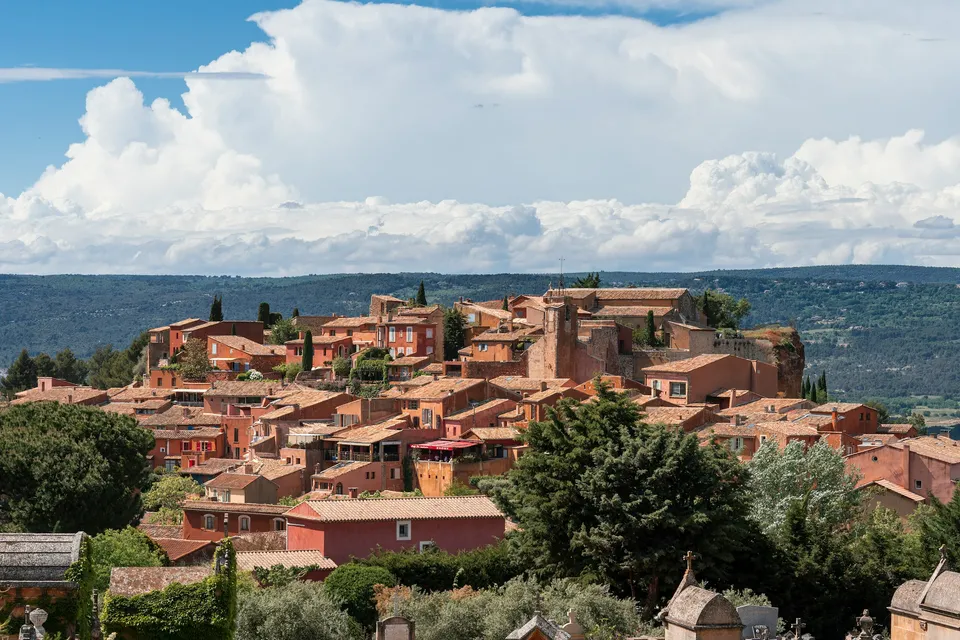
- Roussillon, in the heart of the largest ochre deposit in Europe, with two trails through the “French Colorado” of 30 and 50 minutes. The association’s own advice: beware of white clothes and shoes.
- Les Baux-de-Provence, perched in the Alpilles, with its medieval castle and the Carrières de Lumières, immersive shows projected on 7,000 square meters of quarry walls.
- Moustiers-Sainte-Marie, in the Alpes-de-Haute-Provence, hung between two cliffs, famous for its faience since the seventeenth century, with 262 steps up to its chapel and the Gorges du Verdon and the Lac de Sainte-Croix close by.
Saint-Paul-de-Vence, often listed with them, is not a member of the association.
When the lavender blooms
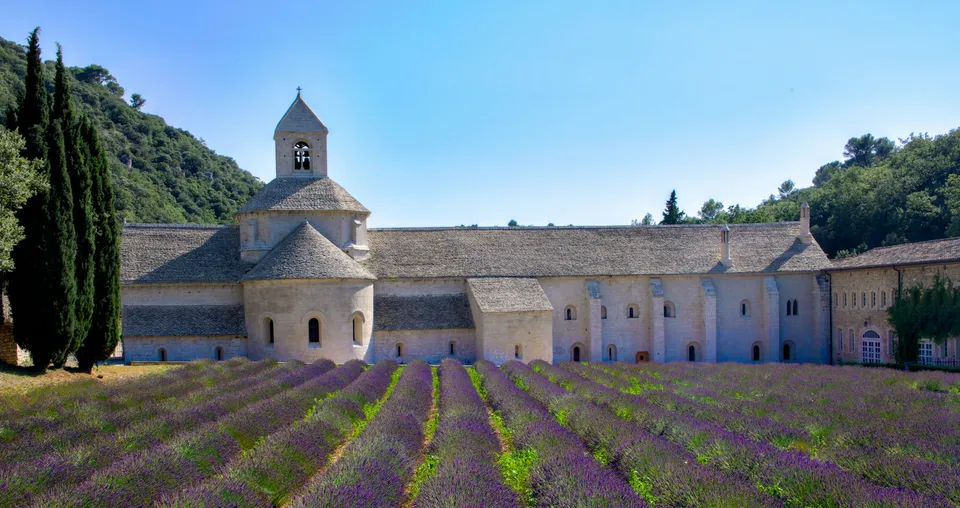
The lavender season depends on altitude and on the weather of the year. The regional tourism board gives the general window as mid-June to early August, and by area:
| Where | When it blooms, according to the tourism boards |
|---|---|
| Valensole plateau (Alpes-de-Haute-Provence) | From mid-June, for about a month; the Valensole town page gives mid-June to mid-July |
| Around Sault (Vaucluse) | From July to August |
| Near Avignon, the Comtat Venaissin and Aix-en-Provence | Early July is the best time |
| Alpes-de-Haute-Provence as a whole | Mid-June to the end of August depending on the place; harvest generally from the second half of July |
Sources: Provence-Alpes-Côte d’Azur Tourisme, spots to admire lavender in bloom and Valensole; Alpes-de-Haute-Provence Tourisme, lavender, read on November 25, 2026.
The Valensole Lavender Festival takes place on the third Sunday of July, which falls on July 18 in 2027. One rule the tourism boards repeat: do not walk into the fields and do not pick the flowers, even for a photograph. The board also advises checking the flowering dates locally, because they move from year to year.
The Camargue
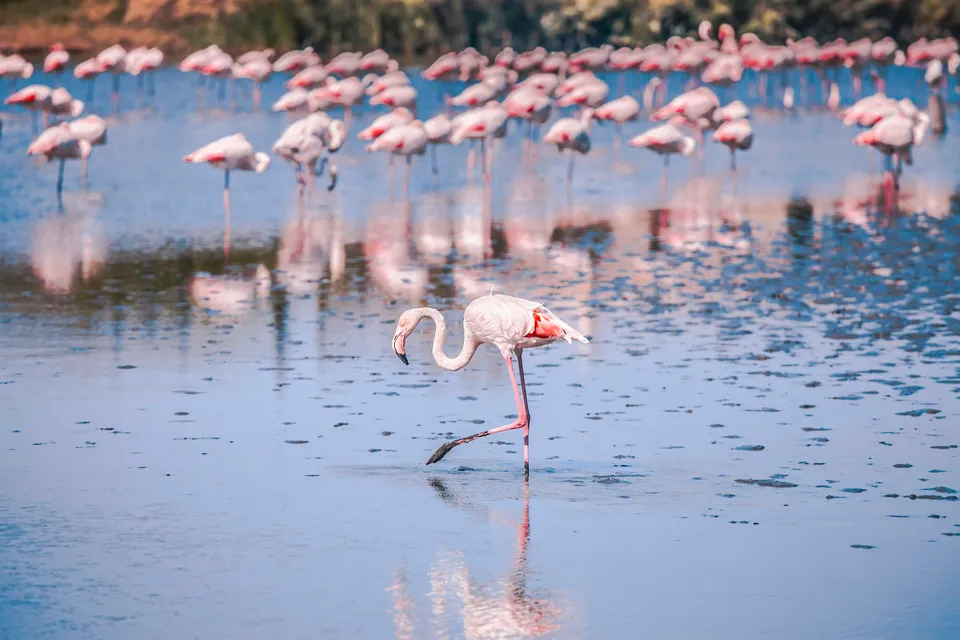
Between the two arms of the Rhône delta, the Parc naturel régional de Camargue, created on September 25, 1970, covers more than 100,000 hectares and 75 km of coast across three communes: Arles, Saintes-Maries-de-la-Mer and Port-Saint-Louis-du-Rhône. The park describes a lived-in rural land of horse and bull breeding, rice growing, hunting and fishing, where “wild flamingos and farmed bulls” live side by side, and one of the best sites in Europe for watching birds. Much of it is private land, often closed to the public, so the easiest way in is through the places built for visitors:
- The Parc ornithologique du Pont de Gau, near Saintes-Maries-de-la-Mer: 60 hectares where you can see hundreds of flamingos, which are present all year in the Camargue. Open every day from 10 a.m. to 5 p.m.; 8.50 euros, 5 euros for children aged 4 to 12; bus line A50 from Arles.
- Saintes-Maries-de-la-Mer, where the white Camargue horse works with the gardians, the local cowboys, and where the church keeps, in its crypt, the statue of Saint Sara, a major figure of the Gypsy tradition; a Gypsy pilgrimage takes place in May, according to its tourist office.
- Aigues-Mortes, the fortified town on the Occitanie side of the Camargue, which the Occitanie tourism board lists among the must-sees with the salt marshes.
Languedoc: the Pont du Gard, Nîmes and Carcassonne
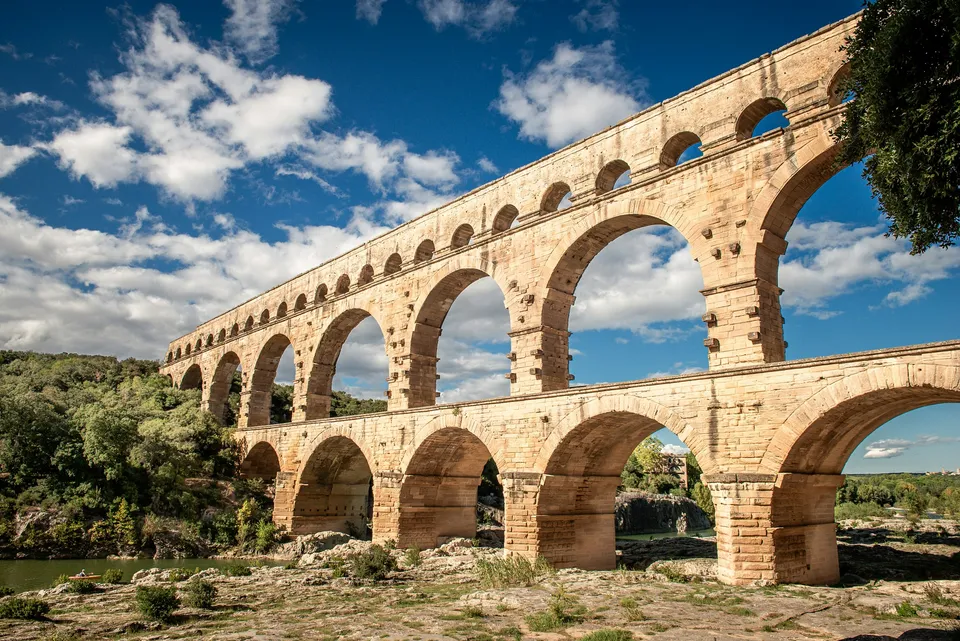
West of the Rhône, the Pont du Gard carried the aqueduct of Nîmes across the Gard river: UNESCO describes a bridge almost 50 meters high on three levels, built shortly before the Christian era, and inscribed in 1985. In Nîmes itself, the Maison Carrée, a Roman temple of the first century A.D., joined the World Heritage List in 2023.
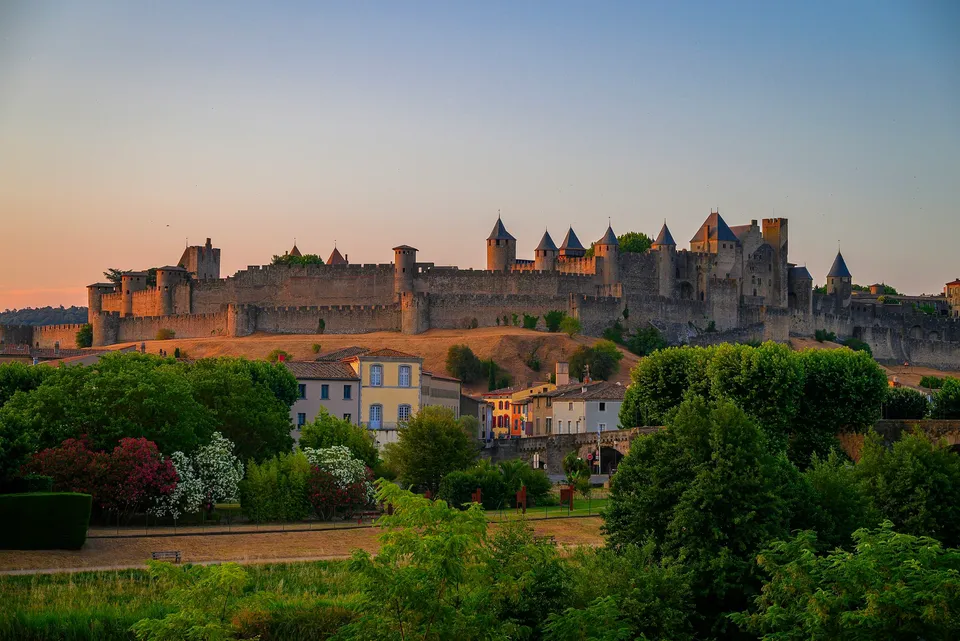
Farther west, the Cité of Carcassonne is a double ring of ramparts, 26 towers on the inner wall and 19 on the outer, restored by Viollet-le-Duc and inscribed in 1997. In 2026, UNESCO added the Royal Capetian Fortresses of Languedoc, eight sites that join the castle and ramparts of Carcassonne to the fortresses of Aguilar, Lastours, Montségur, Peyrepertuse, Puilaurens, Quéribus and Termes. The Canal du Midi, 360 km of waterways built between 1667 and 1694 by Pierre-Paul Riquet, links the Mediterranean to the Atlantic.
On the coast, the Occitanie tourism board runs the Languedoc from La Grande Motte through Palavas-les-Flots, the Thau lagoon, Sète and Cap d’Agde to Béziers, then the Catalan coast under the Canigó, from Canet-en-Roussillon and Argelès-sur-Mer to Collioure.
The South of France’s World Heritage Sites
| Site | Region | Inscribed | What you see |
|---|---|---|---|
| Historic Centre of Avignon: Papal Palace, Episcopal Ensemble and Avignon Bridge | Provence-Alpes-Côte d’Azur | 1995 | The seat of the papacy in the fourteenth century |
| Arles, Roman and Romanesque Monuments | Provence-Alpes-Côte d’Azur | 1981 | The arena, the Roman theater, the Alyscamps, Saint-Trophime |
| Roman Theatre and its Surroundings and the “Triumphal Arch” of Orange | Provence-Alpes-Côte d’Azur | 1981 | A Roman theater with a 103-meter facade, and an arch built between 10 and 25 A.D. |
| Nice, Winter Resort Town of the Riviera | Provence-Alpes-Côte d’Azur | 2021 | The resort of the British winter visitors, along the Promenade des Anglais |
| Pont du Gard (Roman Aqueduct) | Occitanie | 1985 | An aqueduct bridge almost 50 meters high on three levels |
| The Maison Carrée of Nîmes | Occitanie | 2023 | A Roman temple of the first century A.D. |
| Historic Fortified City of Carcassonne | Occitanie | 1997 | Two rings of ramparts and 45 towers |
| Royal Capetian Fortresses of Languedoc | Occitanie | 2026 | Carcassonne and seven fortresses: Aguilar, Lastours, Montségur, Peyrepertuse, Puilaurens, Quéribus and Termes |
| Canal du Midi | Occitanie | 1996 | 360 km of waterways and 328 structures between the Mediterranean and the Atlantic |
Source: UNESCO World Heritage Centre, France and the page of each property, read on November 25, 2026. UNESCO’s list for France also includes the Episcopal City of Albi on the Tarn, the Causses and the Cévennes, the Pyrenees of Mont Perdu, the routes of Santiago de Compostela (with Saint-Sernin in Toulouse) and Le Corbusier’s Unité d’habitation in Marseille.
Weather in the South of France
The South is sunny everywhere, but it is not one climate. Météo-France’s normals for four stations, averages for 1991 to 2020:
| Station | January low and high | July low and high | Sunshine a year | Rain a year |
|---|---|---|---|---|
| Nice (Riviera) | 5.8 and 13.3 °C | 20.8 and 27.5 °C | 2,760.5 h | 791.3 mm |
| Marignane (Marseille area) | 3.6 and 11.8 °C | 19.7 and 30.7 °C | 2,897.6 h | 532.3 mm |
| Montpellier airport (Languedoc) | 3.3 and 12.0 °C | 19.3 and 29.5 °C | 2,705.2 h | 639.2 mm |
| Perpignan (Catalan coast) | 4.8 and 12.7 °C | 19.7 and 29.5 °C | 2,488.6 h | 578.3 mm |
Source: Météo-France, climate normals 1991-2020, Nice, Marignane, Montpellier-Aéroport and Perpignan stations, read on November 25, 2026.
Two things the averages hide. The Riviera has the mildest winters of the four, which is why it became a winter resort. And Provence has the mistral: a dry, gusty regional wind that Météo-France describes as blowing at an average of 50 km/h, with gusts of 80 to 100 km/h or more, down the lower Rhône valley and across Provence to the coast from the Camargue. It is often stronger in winter and spring, can last several days or more than a week, and is strongest between Orange, Avignon, Istres and Arles; mistral days are often very sunny. It never reaches the Nice area, Météo-France adds.
When to go, in short: June and September for warm sea and fewer crowds; mid-June to July for the lavender; July for the festivals of Avignon and Orange; February for the Carnival of Nice and the Lemon Festival of Menton; and the Riviera in winter for mild days. In the Calanques, summer brings the fire-risk closures and the Sugiton reservation.
The 2027 Calendar of the South
| Event | Where | 2027 dates, as published |
|---|---|---|
| Carnaval de Nice (“Vive l’Amour”) | Nice | February 9 to 28 |
| Fête du Citron (93rd edition, “Douce France”) | Menton | February 13 to 28 |
| Feria de Pâques | Arles | March 26 to 29 |
| Festival de Cannes (80th edition) | Cannes | May 11 to 22 |
| Lavender Festival | Valensole | Third Sunday of July (July 18) |
| Festival d’Avignon (80th anniversary) | Avignon | July; dates not yet announced |
Sources: Carnaval de Nice; Fête du Citron; Office de Tourisme d’Arles; Festival de Cannes; Alpes-de-Haute-Provence Tourisme, Lavender Festival; Festival d’Avignon, read on November 25, 2026.
Getting to the South of France
From the US
The two airports of the South describe themselves on their own sites. Nice Côte d’Azur is the second airport in France, with 15,229,664 commercial passengers in 2025, and it lists non-stop flights from four US cities: New York (Delta to JFK and United to Newark, seven flights a week each from April to October, and La Compagnie four times a week all year), Philadelphia (American Airlines, daily from May to October), Atlanta (Delta, daily from May to October) and Boston (Delta, three times a week from mid-May). Marseille Provence welcomed 11.3 million passengers in 2025, and United opens a daily Marseille to Newark flight from June 5, 2027, the first US airline at the airport.
From Paris by TGV
| From Paris to | Trains a day | Fastest | Average |
|---|---|---|---|
| Avignon | 27 | 2 h 33 | 3 h 21 |
| Nîmes | 24 | 2 h 49 | 3 h 19 |
| Aix-en-Provence | 24 | 2 h 54 | 3 h 28 |
| Marseille | 26 | 3 h 03 | 3 h 36 |
| Montpellier | 24 | 3 h 12 | 3 h 47 |
| Perpignan | 12 | 5 h 01 | 5 h 48 |
| Cannes | 13 | 5 h 06 | 6 h 13 |
| Carcassonne | 10 | 5 h 24 | 6 h 42 |
| Nice | 13 | 5 h 42 | 6 h 49 |
Source: SNCF Connect, routes from Paris, read on November 25, 2026. Trains arrive at Avignon Centre or Avignon TGV, and at Montpellier Saint-Roch or Montpellier Sud de France: check which station your ticket names.
A First Itinerary for the South of France
For a first trip of 7 to 10 days, the geography suggests one simple plan: fly into Nice, the airport of the South with non-stop US flights, and work west. If your flight lands in Paris instead, our guides to the things to do in Paris and to the best day trips from Paris cover the start of the trip, before the TGV south.
- Days 1 to 4, the Riviera from Nice: Nice itself, then day trips by train to Èze, Monaco and Menton, and to Antibes or Cannes.
- Days 5 to 7, Provence: Avignon as a base for the Papal Palace, Arles, Orange and, by car, the Luberon villages and, in season, the lavender.
- Days 8 to 10, west or south: the Pont du Gard, Nîmes and Carcassonne, or Marseille and the Calanques, then a TGV back to Paris (2 h 33 from Avignon, 3 h 03 from Marseille).
Staying Longer: a Season in the South
A winter on the Riviera or a summer in Provence is a stay of months, and the rules change once you stay beyond a holiday. As an American visiting the Schengen area, you can usually stay a maximum of 90 days within any 180-day period, according to the European Commission: our guide to how long Americans can stay in France without a visa explains the count, and beyond 90 days you need a long-stay visa. For choosing a base, our comparisons of the best places to live in the South of France and of where to live on the Côte d’Azur give rents and the practical picture.
Finding a furnished home for a season, calling agencies and owners, and setting up a phone line or a bank account in French is the kind of work our Personal Assistant handles: the calls, the forms and the apartment search, in French.
FAQ
What is considered the South of France?
The two Mediterranean regions: Provence-Alpes-Côte d’Azur (Marseille, Nice, Avignon, the Riviera, Provence) and Occitanie (Montpellier, Nîmes, Carcassonne, Toulouse, the Languedoc and the Catalan coast). The Basque coast is in Nouvelle-Aquitaine, not in either.
What are the best places to visit in the South of France?
For a first trip: Nice and the villages of the Riviera (Èze, Menton, Saint-Paul-de-Vence), Avignon and Arles in Provence, the Luberon villages of Gordes and Roussillon, the Calanques near Marseille, the Camargue, and the Pont du Gard and Carcassonne in Languedoc. Several of them are World Heritage sites, and Gordes and Roussillon are listed among the most beautiful villages of France.
When is the best time to visit the South of France?
June and September for warm weather with fewer crowds, mid-June to July for the lavender, July for the festivals of Avignon and Orange, and winter on the Riviera, where Nice averages 13 °C highs in January. Provence is windier in winter and spring, when the mistral blows.
When does the lavender bloom in Provence?
From mid-June on the Valensole plateau, for about a month, and from July into August around Sault, according to the regional tourism board. Early July is the safest single window for most areas, but the dates move with the weather of each year.
How do you get to the South of France from the US?
Non-stop to Nice from New York, Philadelphia, Atlanta or Boston (mostly in season), or via Paris and the TGV: 2 h 33 to Avignon and 3 h 03 to Marseille at the fastest. From June 5, 2027, United flies daily from Newark to Marseille.
Is the Pays Basque part of the South of France?
Not in the Mediterranean sense used here: Biarritz and Bayonne are in the Pyrénées-Atlantiques, in the region of Nouvelle-Aquitaine, on the Atlantic.
Conclusion
The South of France is five trips in one: the Riviera for the sea and the Belle Époque towns, Provence for Avignon, Arles and the Calanques, the Luberon for its villages and lavender, the Camargue for its delta of flamingos and white horses, and Languedoc for the Pont du Gard and Carcassonne. Pick one or two for a first visit, time it by the calendar (lavender from mid-June, the big festivals in July, the Riviera’s carnivals in February), and check the Calanques rules the evening before if you go in summer. For the Riviera in detail, start with our guides to Nice, Èze and Menton.
The parts of the move Americans find out about too late.
What Americans get wrong about moving to France, and the number, form or deadline that fixes it. Straight to your inbox.
One email a week. Real numbers, nothing else.
Written by
Aurelio Maurici
Co-Founder, EasyFranceNow
Aurelio Maurici is a French entrepreneur and co-founder of EasyFranceNow. His work focuses on the intersection of French administration, banking constraints affecting U.S. nationals, tax residency and cross-border reporting, healthcare enrollment, and the procedural realities Americans encounter while settling in France.


