How Long Can Americans Stay in France Without a Visa? The 90/180-Day Schengen Rule Explained (2026)

Published May 29, 2026-Updated Aug 17, 2026

Key Takeaways
The core limit: Americans can stay in France visa-free for 90 days within any rolling 180-day period, counted across the entire Schengen Area, not per country.
It is a rolling window: there is no calendar reset and no fixed start date; you count back 180 days from any given day and your used days only return as they age out.
Both travel days count: your arrival day and departure day each count as a full day inside Schengen, which is where many Americans miscount.
Leaving does not reset it: a quick trip outside Schengen pauses new days but does not erase days already used, so border hops do not buy you a fresh 90.
Work and residence are out: the visa-free allowance covers tourism, business meetings, and family visits only; living, working, or studying requires a long-stay visa arranged before you arrive.
2026 border changes: the EES entry-exit system is now fully operational and logs your days digitally, while ETIAS is expected to launch in late 2026 and does not change the 90-day limit.
Check before you go: use the official EU short-stay calculator to confirm your remaining days for both your entry and departure dates.
Sources: france-visas.gouv.fr, home-affairs.ec.europa.eu, travel.state.gov
If you hold a US passport and you are wondering how long Americans can stay in France without a visa, the short answer is 90 days within any 180-day period. That allowance is not specific to France. It applies to the entire Schengen Area as a single zone, and it is the same whether you are sightseeing in Paris, house-hunting in Provence, or visiting family in Lyon. The number sounds simple, but the way it is calculated trips up more Americans than almost any other entry rule, because it does not work like a clean three-month calendar block. It works as a rolling window that moves forward every single day. Get the math wrong and you can be perfectly legal one week and an overstayer the next, with consequences that now follow you electronically. This article is for informational purposes only and does not constitute immigration or legal advice. Rules change, and your situation may differ: always verify current requirements with the relevant French authorities or a licensed immigration professional.
How long can Americans stay in France without a visa?
Americans can stay in France without a visa for up to 90 days within any 180-day period, for tourism, business meetings, or family visits. This is confirmed by both the US Department of State travel guidance for France and France's own official short-stay visa portal, which states plainly that stays may not exceed 90 days in any 180 consecutive days, whether or not you need a visa.
Two points matter immediately. First, the 90 days are counted across all Schengen countries combined, not per country. A week in Italy and a month in Spain both eat into the same 90-day budget you would use in France. Second, the visa-free allowance is a tourism and short-visit permission only. It does not allow paid work for a French employer, long-term study, or taking up residence. If your plan is to live, work, or study in France, you are in long-stay territory, and that requires a visa arranged before you arrive.
There is also a passport rule that sits underneath all of this. Your US passport must be valid for at least three months beyond your intended departure date from the Schengen Area, a requirement spelled out in the US Embassy in France travel page. In practice, the first checkpoint where this gets enforced is usually the airline gate agent in the United States, not the French border police. We regularly see travelers turned away at the departure gate over a passport that is technically valid but does not clear the three-month buffer, so check the expiration date before you book.
What the 90/180-day Schengen rule actually means
The 90/180-day rule allows visa-exempt travelers to spend a maximum of 90 days inside the Schengen Area within any rolling 180-day period. The word that does all the work in that sentence is "rolling." There is no fixed start date, no calendar quarter, and no January 1 reset. On any given day, the authorities look back at the previous 180 days and add up how many of those days you spent inside Schengen. If the total is under 90, you can stay. If it is at 90, you are out of room.
The Schengen Area is a group of European countries that have abolished passport checks at their shared internal borders, which is why your days are pooled across the whole zone rather than tracked country by country. France, Spain, Italy, Germany, the Netherlands, and most of the EU are inside it. Ireland is not. The United Kingdom is not in the EU or Schengen at all. Time spent in non-Schengen countries does not count against your 90 days, which becomes important if you want to extend a European trip legally.
Why "90 days" does not mean "three calendar months"
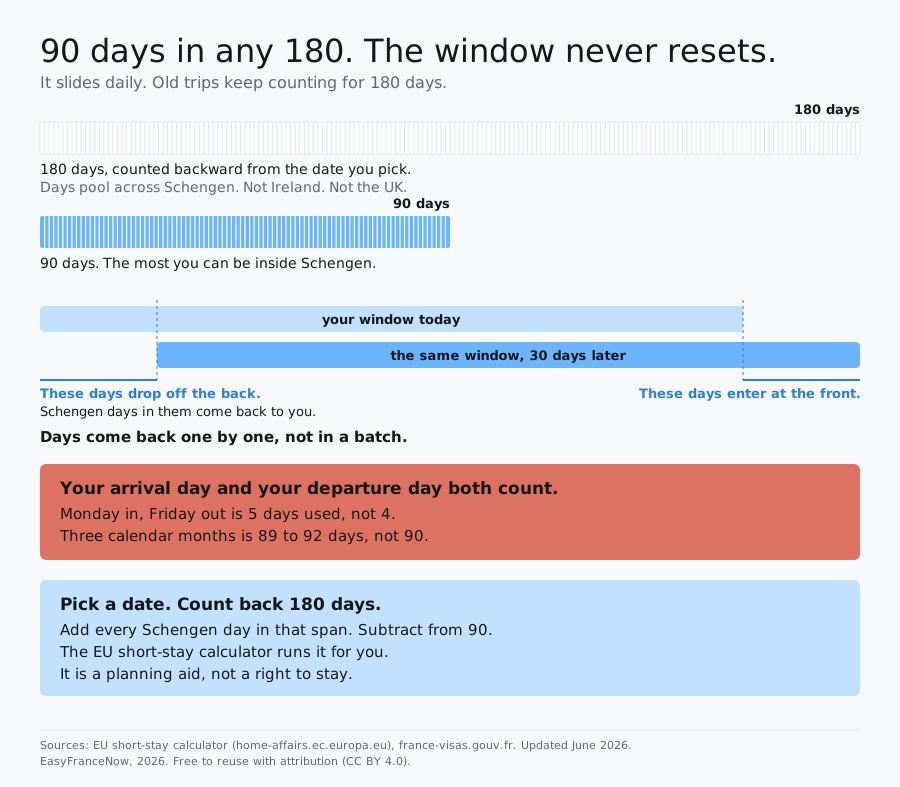
The most common American mental model is to treat the limit as roughly three months and count by the calendar. That model fails in two ways. First, three calendar months can be 89, 90, 91, or 92 actual days depending on which months you pick, so "three months" is not a reliable proxy for 90 days. Second, and more importantly, the rolling window means old trips keep counting until they are more than 180 days in the past. A two-week trip you took four months ago is still inside your 180-day window and still subtracting from your balance today.
A useful way to picture it is a conveyor belt. Each new day, today enters the front of the 180-day window and the day that is now 181 days old drops off the back. If the day that drops off was a day you were in Schengen, you effectively get that day back. This is why your available days do not refresh all at once. They trickle back one day at a time as old stays age out.
How to count your days the right way
The single most important detail Americans get wrong is that both your arrival day and your departure day count as full days inside Schengen. Land in Paris on a Monday and fly home on a Friday, and that is five days used, not four. To count correctly:
Pick the date you want to be in France, either today or a planned future entry date.
Count backward 180 days from that date. That is the left edge of your window.
Add up every day you were physically inside any Schengen country between that left edge and your chosen date, counting both entry and exit days as full days.
Subtract that total from 90. The result is the maximum number of additional days you can stay starting from your chosen date.
Repeat the check for your planned departure date, because the window will have moved by then.
Rather than doing this by hand, use the European Commission's free official short-stay calculator. It runs the rolling calculation for you and is the same logic French border authorities apply. It is a planning aid and does not grant any right to stay, but it is the cleanest way to avoid an accidental overstay. What we see most often is travelers who are confident they are "well under three months" and are surprised when the calculator shows them with only a handful of days left because of an earlier trip they forgot to include.
A worked example: counting days across multiple trips
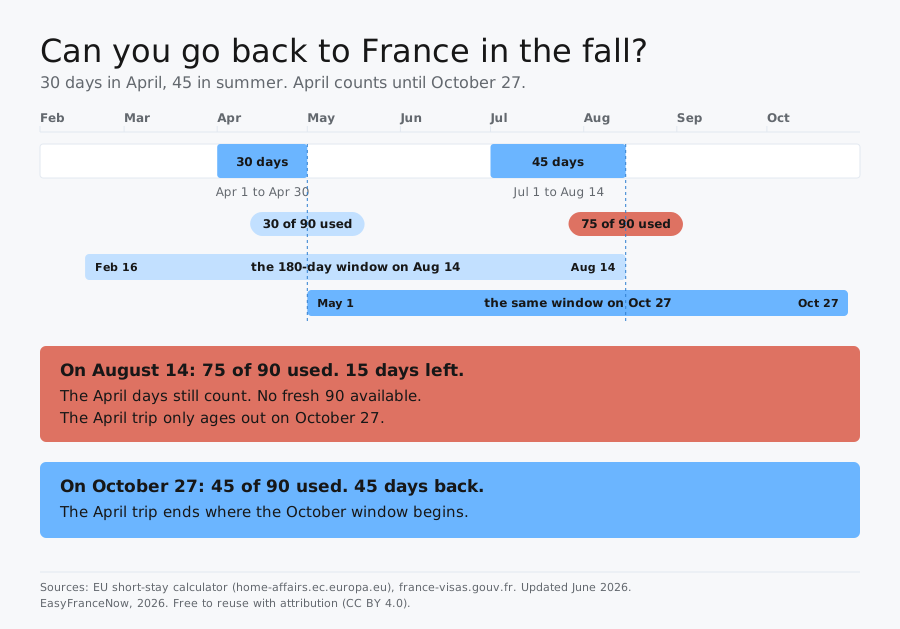
The rule is easiest to understand with a concrete scenario, because the rolling window only really clicks once you see it move. Consider an American who loves France and travels in stages over a single year.
Trip | Dates | Days used | Running total in the 180-day window |
|---|---|---|---|
Spring visit | Apr 1 to Apr 30 | 30 | 30 |
Summer visit | Jul 1 to Aug 14 | 45 | 75 (Apr days still counting) |
Fall attempt | Oct 27 | day 1 | Apr trip has aged out, so 45 used, 45 left |
By mid-August, this traveler has used 75 of their 90 days, because the April trip is still inside the 180-day look-back. They have only 15 days of room left and cannot simply start a fresh 90 days in the fall. By October 1, the April stay has finally dropped off the back of the window, freeing those 30 days, so the balance is healthier again. The lesson is that a long summer stay can quietly lock you out of a fall trip you assumed would be fine. This is exactly the trap that catches second-home owners and snowbirds, who tend to think in seasons rather than rolling windows.
The same arithmetic bites harder when the trips are groundwork for a move rather than holidays, because the days you spend viewing houses come out of the allowance your arrival window will need, and working out the days you have left before a move date walks through that calculation.
What you can and cannot do during a visa-free stay in France
A visa-free stay is a short-visit permission, not a light version of residency, and the distinction is where American assumptions cause the most trouble. The table below lines up what Americans often expect against what the visa-free allowance actually permits.
What Americans often assume | What the visa-free stay actually allows |
|---|---|
I can work remotely for my US employer while here | This is a legal grey area, not an explicit right; the allowance is for tourism and short visits, not employment |
I can rent an apartment and settle in | You can rent short-term, but you cannot establish legal residence on a visa-free stay |
I can extend my stay once I arrive if I like it | Extensions of visa-free stays are rarely granted; you generally cannot switch to a long-stay status from inside France |
I can enroll in a long course or program | Long-term study requires a student visa arranged in advance |
A quick hop to London resets my 90 days | Leaving Schengen does not reset the count; only time aging out of the 180-day window restores days |
Two of these deserve emphasis. First, remote work for a non-French employer occupies a genuinely unsettled space. Many Americans do it quietly during short visits, but the visa-free allowance was never designed to authorize earning a living, and there is no official guarantee it is permitted. If working from France is the actual goal, that decision belongs in the visa conversation, not the tourist conversation. Second, the State Department is blunt that it is almost impossible to obtain or change visa status from inside France, which is why "I will sort out a longer stay once I get there" is one of the riskiest plans an American can make.
What changes at the border in 2026: EES and ETIAS
Two new EU border systems are reshaping how visa-free travel is tracked and authorized, and Americans routinely confuse them. They are separate systems with separate timelines, and only one of them is live right now.
EES: the Entry/Exit System, already operating
The Entry/Exit System (EES) is the EU's digital record of every entry and exit by non-EU travelers, replacing manual passport stamping with electronic registration of your travel dates and biometrics. According to EU border authorities, EES began a progressive rollout in October 2025 and reached full operation on April 10, 2026 at external Schengen borders. The practical effect on the 90/180 rule is significant: your days in and out are now logged in a shared database, so the old assumption that a missed stamp or a quiet exit might go unnoticed no longer holds. Day-counting accuracy matters more than it ever did, because the system can flag an overstay automatically.
From 2026 those 90 days are counted automatically, which we explain in our breakdown of how the new biometric border system tracks your stay.
ETIAS: the travel authorization, coming later in 2026
ETIAS (the European Travel Information and Authorisation System) is a pre-travel authorization that visa-exempt visitors, including Americans, will need before entering the Schengen Area. It is not a visa, and it does not change the 90/180-day limit. As of spring 2026, ETIAS is not yet in force. The EU has confirmed a launch in the last quarter of 2026, with a published fee of 20 euros and a validity of three years per authorization, followed by a transitional period during which it is recommended before it becomes strictly required. Until it launches, Americans continue to travel to France with just a valid passport. Because the details, dates, and rollout phases are still moving, it is worth tracking the specifics in our dedicated guide to ETIAS for Americans and what it means for travel to France before you book a late-2026 trip. Any website currently selling ETIAS authorizations is not legitimate, since the official system is not open.
The clean way to hold these two in your head: ETIAS is the key that lets you in the door, and the 90/180 rule is the clock on the wall once you are inside. ETIAS does not add a single day to your 90.
What happens if you overstay your 90 days in France
Overstaying your 90-day visa-free allowance is treated as a breach of Schengen entry rules, and the consequences are real even if they are not always applied uniformly. Depending on the circumstances and the country of departure, overstayers can face fines, an entry ban for a period of years, removal, and lasting difficulty obtaining future Schengen visas or, eventually, ETIAS authorization. Because exact penalties vary by member state and by the length and reason for the overstay, the safest assumption is that any overstay creates a record that can complicate future travel. If ninety days is not enough for what you are planning, the France Navigator will show you which long-stay route fits your situation.
The bigger shift in 2026 is detection. Before EES, a few extra days might slip past a busy border officer. Now that entries and exits are logged digitally, the system can calculate your day count automatically and surface an overstay without a human having to do the arithmetic. In practice, the moment of friction for Americans is often not the day they overstay but their next attempt to enter Schengen, when the record is checked against the rolling window. If you realize mid-trip that you are close to your limit, the responsible move is to leave on time and verify your remaining days with the official calculator before planning your return, rather than gambling on a miscount.
Can you extend a 90-day stay or reset the clock?
You generally cannot extend a visa-free stay beyond 90 days, and you cannot reset the rolling window by briefly leaving the Schengen Area. These are the two workarounds Americans most often hope exist, and neither does.
Extensions of the 90-day allowance are reserved for narrow, documented circumstances such as force majeure or serious humanitarian reasons, and they are not granted simply because you are enjoying yourself or want more time to look for housing. The State Department's guidance that it is nearly impossible to change visa status from inside France reflects exactly this: the system expects you to arrange a long stay before you arrive, not to convert a tourist stay into residency on the ground.
The "border hop" idea, leaving Schengen for a weekend and returning to start a fresh 90 days, also does not work. Your days only come back as they age out of the 180-day window. After using a full 90 days, you would need to spend roughly 90 days outside Schengen before you could legally stay another long stretch. A quick trip to London or Istanbul pauses the accumulation of new days, but it does not erase the days you already used. The honest planning rule is that if you want to spend more than 90 days in any rolling 180-day period in France, the answer is a long-stay visa, not a clever itinerary.
How to stay in France longer than 90 days legally
If 90 days is not enough, the legal path is a long-stay visa applied for at a French consulate in the United States before you travel. France offers several long-stay categories depending on why you are coming, and choosing the right one is the difference between approval and a refusal. The table below summarizes the most common pathways for Americans, with links to deeper guidance.
Your situation | Typical long-stay route | Where to start |
|---|---|---|
Living in France without working (retiree, financially independent) | Long-stay visitor visa (VLS-TS Visiteur) | |
Retiring to France | Visitor visa plus healthcare and tax planning | |
Need to prove you can support yourself | Any visitor-type long stay requires sufficient income |
A few realities are worth setting expectations on. Long-stay visa processing at most French consulates runs around 15 days from the appointment, but spring and summer peaks can push that to a month or more, so most applicants should allow two to three months between booking the appointment and the intended departure. The visitor visa specifically prohibits professional activity in France, which is why remote workers sit in a grey zone and should read the fine print carefully. And the long-stay visa is not the end of the paperwork: once you arrive on a VLS-TS, you must validate it online within three months, a step that catches people who assume the visa alone is enough. It is also a file the consulate judges once, with no chance to add to it afterward, so if the long-stay route is yours, a visa dossier check on the assembled dossier before your appointment is worth more than another read of the checklist.
If you are not sure whether your plans fit inside 90 visa-free days or require a long-stay visa, mapping that out early saves a great deal of stress. Our overview of how to get a France long-stay visa as an American walks through the decision framework and the documents that actually determine approval.
One route is to formalize a relationship with a French citizen, and our guide to choosing between a PACS and a marriage in France explains which one actually secures an American partner's right to stay.
Common mistakes to avoid
Most visa-free problems come from a small set of recurring errors. The first two below are patterns we see repeatedly when Americans plan multi-trip years.
Counting by the calendar instead of the rolling window. In our experience, this is the single most common miscalculation. Travelers track "three months" by months on a wall calendar and forget that an earlier trip is still inside the 180-day look-back, leaving them with far fewer days than they assumed.
Forgetting that arrival and departure days both count. What we see most often is people undercounting a trip by a day or two on each leg, which adds up across several trips and quietly pushes them over 90.
Assuming a quick exit resets the clock. Leaving Schengen for a weekend does not restore your days. Only time aging out of the 180-day window does.
Treating remote work as obviously fine. The visa-free allowance is for visits, not employment. Working from France on a tourist entry is a grey area, not a clear right.
Planning to "extend once I arrive." Visa-free extensions are rarely granted, and switching to a long-stay status from inside France is generally not possible.
Ignoring the three-month passport validity buffer. Your passport must be valid at least three months beyond your planned Schengen departure, and airlines enforce this at the gate.
Practical checklist
Before any visa-free trip to France, run through this list:
Confirm your US passport is valid for at least three months beyond your planned departure from Schengen.
Add up all your Schengen days within the last 180 days, counting both entry and exit days.
Run your dates through the official EU short-stay calculator for both your entry and departure dates.
Keep evidence of your entry and exit dates (boarding passes, EES records) in case you ever need to prove your day count.
Confirm your purpose fits a visit: tourism, business meetings, or family. If it involves work, study, or residence, plan for a long-stay visa instead.
Check whether your travel dates fall after the ETIAS launch later in 2026, and if so, follow the official rollout.
If you want more than 90 days, start a long-stay visa application from the US well before you travel.
One item is deliberately not on that list, because it is not a legal condition for Americans entering visa-free: travel medical cover. Nobody asks you for it at the border, which is exactly why people skip it and then discover their US plan reimburses nothing against a French hospital invoice. Travel medical cover billed in four-week blocks fits the way these 90 days are usually spent, across several separate trips rather than one long stay, since you can stop it between visits and start it again for the next one.
When to get help
Most Americans can manage a straightforward 90-day visit on their own: the rule is simple once you understand the rolling window, and the official calculator does the math. You can comfortably handle this yourself if you take a single trip, count your days correctly, and confirm your passport validity.
Where it gets worth bringing in support is when your plans cross the 90-day line or involve repeated trips that are hard to track. Snowbirds splitting the year, retirees planning to relocate, families coordinating multiple travelers, and remote workers trying to understand where the legal line sits all benefit from a clear plan before they commit to flights or housing. And once you have decided a long-stay visa is the route, the file itself is a separate question: a visa dossier check before the consulate appointment catches what would otherwise turn into a refusal and a fresh 90-day count.
If you are splitting the year between two countries and the rolling window is getting hard to track across repeated trips, we count the days with you and say plainly where the next trip lands.
FAQ
Can Americans stay in France for 6 months without a visa?
No. Americans cannot stay in France for six months without a visa. The visa-free allowance is capped at 90 days within any rolling 180-day period across the whole Schengen Area, not six months. The "six-month" idea is a misreading of the 180-day reference window: the 180 days define the look-back period used to count your stay, not the length of stay you are permitted. If you want to spend roughly half the year in France, you need a long-stay visa arranged before you travel. Splitting time as a snowbird does not get around this, because earlier trips keep counting until they age out of the 180-day window. Use the official EU short-stay calculator to confirm your exact allowance for any set of dates.
Does leaving France and coming back reset my 90 days?
No. Leaving France, or even leaving the Schengen Area entirely, does not reset your 90-day count. The allowance is based on a rolling 180-day window, so your used days only come back as they pass beyond 180 days in the past. A short trip to a non-Schengen country such as the United Kingdom or Ireland pauses the accumulation of new days, but it does not erase the days you already spent. After using a full 90 days, you would generally need to spend about 90 days outside Schengen before you could legally stay another long stretch. If you need continuous time in France beyond 90 days, the correct path is a long-stay visa, not repeated entries.
Do days I spend in other Schengen countries count against my 90 days in France?
Yes. The 90/180-day limit applies to the entire Schengen Area as a single zone, so days spent in Italy, Spain, Germany, the Netherlands, or any other Schengen country all count toward the same 90-day budget you would use in France. The rule does not give you 90 days per country. This is one of the most common surprises for Americans planning a multi-country European trip. Time spent in non-Schengen countries, such as the United Kingdom, Ireland, or Croatia's neighbors outside the zone, does not count, which is why some travelers route part of a long trip through non-Schengen destinations. Always count your total Schengen days together, not separately by country.
Will I need ETIAS to visit France, and does it change the 90-day limit?
Eventually yes for ETIAS, but it does not change the 90-day limit. ETIAS is a pre-travel authorization, not a visa, and the EU has confirmed it will launch in the last quarter of 2026, with a 20 euro fee and three-year validity. As of spring 2026 it is not yet in force, so Americans currently travel to France with only a valid passport. When ETIAS does launch, it will authorize your entry, but you will still be limited to 90 days within any 180-day period. The two are separate: ETIAS is the entry authorization, and the 90/180 rule is the duration limit. Because the rollout is still phased, verify the current status in our dedicated ETIAS guide before booking a late-2026 trip.
Conclusion
The rule that governs how long Americans can stay in France without a visa is short to state and easy to miscount: 90 days within any rolling 180-day period, across the whole Schengen Area, with both your arrival and departure days counting as full days. Most trips are simple if you count correctly and check the official EU calculator before you go. The complications start the moment you want more than 90 days, take repeated trips, or plan to work, study, or settle, because those goals belong to the long-stay visa world, not the tourist one, and you generally cannot fix that from inside France. If you have realized your plans go beyond a visit, our Navigator maps the long-stay routes against your profile so you can see which one you actually qualify for.
About the author
Maxime Roseau
Related posts