
Lille, France: The Complete Guide from Vieux-Lille to the Christmas Market

By Aurelio Maurici Co-Founder, Master of Business Law, Aix-Marseille Université III
Published

In this article
- Lille at a Glance
- The Grand Place and the Vieille Bourse
- Vieux-Lille: Cobbled Streets and Waffles
- The Town Hall Belfry on UNESCO’s List
- The Citadel and the Bois de Boulogne
- The Palais des Beaux-Arts
- La Piscine and the Other Museums of the Metropolis
- The Lille Christmas Market 2026
- The Braderie de Lille
- Flemish Food and the Estaminets
- The Markets of Lille
- The Weather in Lille Month by Month
- Getting to Lille
- From London and Brussels by Eurostar
- From Paris and from Charles de Gaulle airport
- Lille Europe and Lille Flandres
- From Lille airport
- Getting Around Lille
- Day Trips from Lille
- The Louvre-Lens
- Arras
- The memorials of the First World War
- Brussels and the Cities of Flanders
- How Many Days in Lille?
- Staying Longer in Lille
- FAQ
- Conclusion
Lille is the capital of the Hauts-de-France region, a city of 238,246 residents according to INSEE, and one of the easiest in France to reach: Eurostar runs from London St Pancras to Lille Europe in 1 hour 22 minutes and from Brussels in 35 to 38 minutes, and the fastest of 32 trains a day from Paris takes 55 minutes. Its citizens, then Spanish subjects, asked the King of Spain for the right to build the Vieille Bourse, raised in 1652 and 1653 and decorated in the manner of the Flemish Renaissance, and Flanders is still everywhere: in the belfries, the rang du Beauregard on the Grand Place, and the estaminets that serve carbonnade and welsh, sometimes under garlands of hops.
This guide covers the Grand Place and Vieux-Lille, the belfry on UNESCO’s list, the Citadel, the Palais des Beaux-Arts and the museums of the metropolis with their prices, the 2026 Christmas market and the Braderie, Flemish food and the markets, the weather month by month from Météo-France, the trains from London, Brussels, Paris and Charles de Gaulle airport, getting around, the day trips and what changes if you stay longer than a vacation. Every price, date and opening time was read on the official page of the city, the tourist office, the museum or the operator on November 26, 2026.
Lille at a Glance
| Where | Capital of the Nord department and of the Hauts-de-France region; 110 km from Brussels and 220 km from Paris by road, according to the city |
| Population | 238,246 (INSEE reference population 2023, in force since January 1, 2026); the Métropole Européenne de Lille groups 95 towns and more than a million people |
| World Heritage | The town hall belfry, one of the 56 Belfries of Belgium and France; the 23 French belfries were added in 2005 |
| From London | Eurostar from St Pancras to Lille Europe in 1 hour 22 minutes, from £39 one way on a round trip |
| From Brussels | Eurostar to Lille Europe in 35 to 38 minutes |
| From Paris | 32 trains a day from Paris, from 55 minutes; 18 a day from Charles de Gaulle airport, from 50 minutes |
| Climate | 1,627 hours of sunshine a year; 1.7 to 6.6 °C in January, 14.2 to 23.7 °C in July |
| Best for | A weekend from London, Brussels or Paris, the Christmas market, museums, Flemish food |
Sources: INSEE, reference population of Lille and geography; Ville de Lille, Christmas 2026 and access; Métropole Européenne de Lille; UNESCO, Belfries of Belgium and France; Eurostar, London to Lille, Brussels to Lille and Lille to Brussels; SNCF Connect, Paris to Lille and Charles de Gaulle to Lille; Météo-France, Lille-Lesquin normals, read on November 26, 2026.
The Grand Place and the Vieille Bourse
The heart of Lille is two squares split by one building. The Grand Place, named since 1944 after General de Gaulle, who was born in Lille, saw its biggest change in the 17th century, the tourist office says, when the stock exchange was built across it, separating it from the Petite Place, today the Place du Théâtre. On the square stands the Column of the Goddess (la Déesse), raised in 1845, which commemorates the city’s resistance to the Austrian army in 1792; the statue is by Théophile Bra and the column by Charles Benvignat. Next to the Vieille Bourse, the rang du Beauregard shows the Flemish influence and the Grand-Garde, today the Théâtre du Nord, a French style, and the three graces on top of the Voix du Nord building stand for Artois, Flanders and Hainaut.
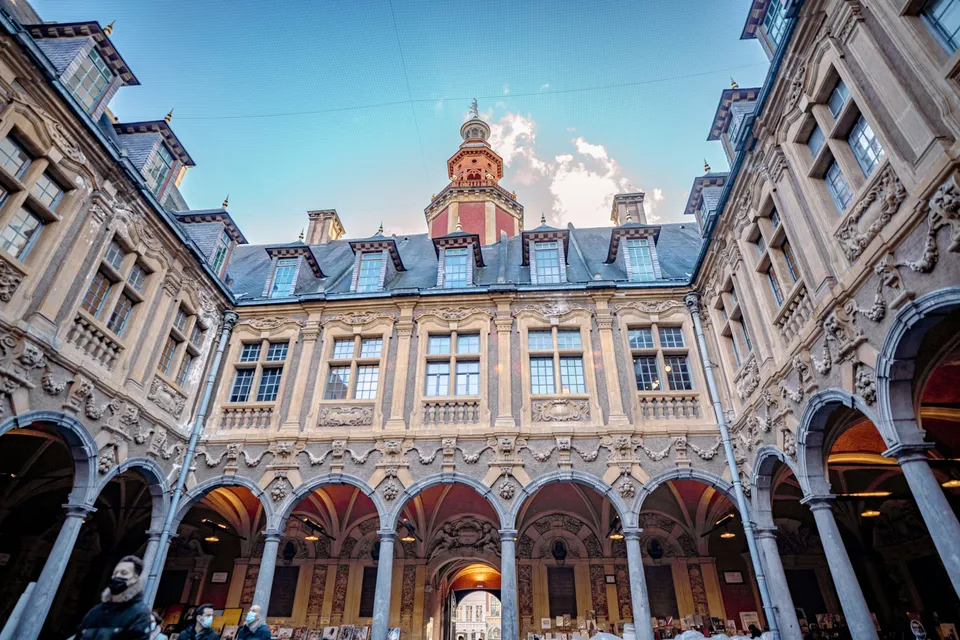
The Vieille Bourse (the old stock exchange) is, for the tourist office, the city’s most beautiful monument. It was built in 1652 and 1653 by Julien Destrée, after the citizens of Lille, then Spanish subjects, asked King Philip IV of Spain for the right to build a commodities exchange on the Grand Place: 24 private houses around a public courtyard ringed by a gallery, decorated in the manner of the Flemish Renaissance, with the lions of Flanders carved on the portals. Walk into the courtyard: the city lists a book market there every afternoon from Tuesday to Sunday, and in summer there is tango on Sunday evenings.
On the other side, the Place du Théâtre holds the belfry of the Chamber of Commerce, 76 meters, designed by Louis-Marie Cordonnier in a style inspired by Flemish architecture of the 17th and 18th centuries; every day at noon its 25 bells play the local lullaby “P’tit Quinquin”. It is not on UNESCO’s list: the listed belfry is the town hall’s, below.
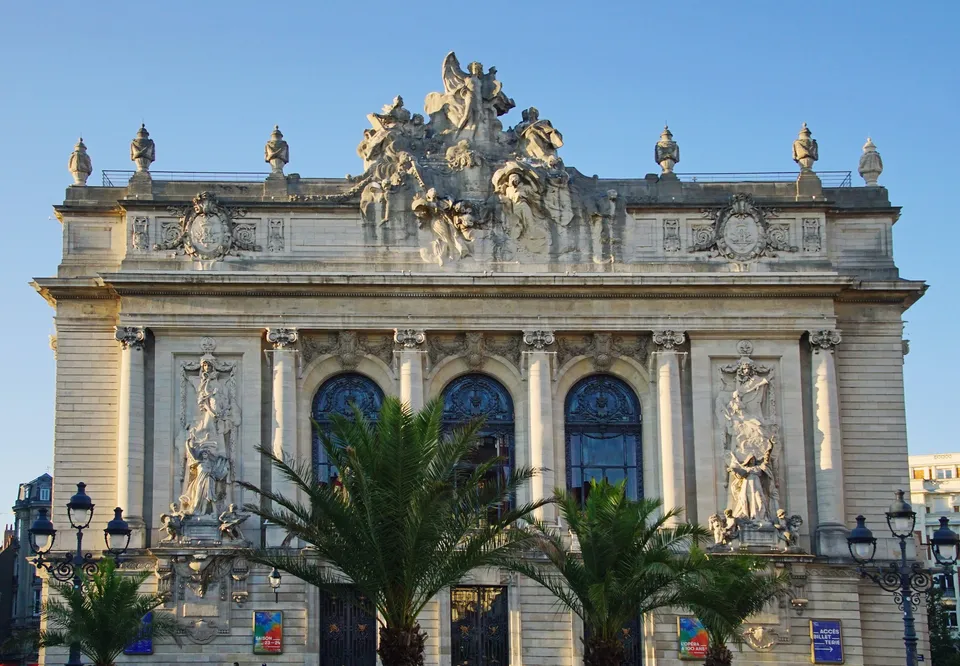
The Opera next to it was designed by the same Cordonnier after a fire destroyed the old Grand Théâtre in 1903. It is one of the last Italian-style halls built in France, the Opera says, neoclassical and composed on the model of the Palais Garnier in Paris; the structural work ended in July 1914, the German army took it over and staged about a hundred shows there during the occupation, and it gave its first French performance, its official inauguration, only on October 7, 1923. Restored, it reopened on December 9, 2003, for Lille’s year as European Capital of Culture in 2004.
On the Place Rihour, the Palais Rihour, ordered in 1453 by Philip the Good, Duke of Burgundy, is one of the last traces of flamboyant Gothic in Lille; its guardroom holds the tourist office, open every day from 10 a.m. to 5:30 p.m.
Sources: Office de Tourisme de Lille, the Grand Place, the Vieille Bourse, the belfries and the Palais Rihour; Opéra de Lille, history; Ville de Lille, the markets, read on November 26, 2026.
The parts of the move Americans find out about too late.
What Americans get wrong about moving to France, and the number, form or deadline that fixes it. Straight to your inbox.
One email a week. Real numbers, nothing else.
Vieux-Lille: Cobbled Streets and Waffles
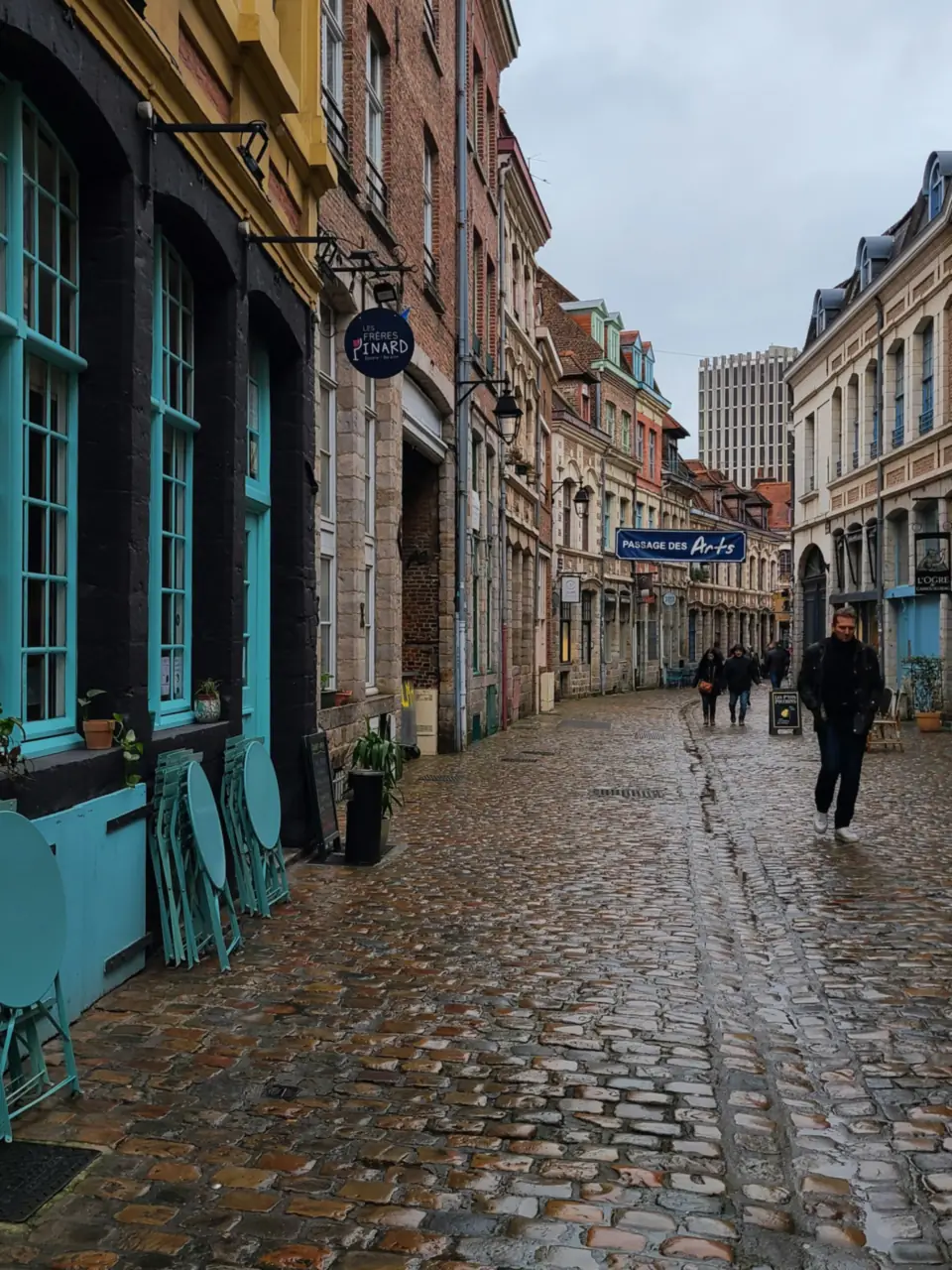
Directly accessible from the city center, as the tourist office puts it, Vieux-Lille (Old Lille) is the district to walk without a plan: cobbled streets, small shops, and restored facades in soft, bold colors whose decoration the tourist office calls exuberant. It points to three streets: the estaminets of rue de Gand, the Hospice Comtesse on rue de la Monnaie, and the waffles of Méert on rue Esquermoise. The Quai du Wault was a port, a major trading center with the neighboring countries by the Haute-Deûle.
- The Hospice Comtesse, founded in 1237 within the palace of Countess Jeanne of Flanders, was a hospital until 1939 and has been the city’s museum of art and history since 1962: a ward, a chapel and the buildings of the Augustinian sisters around two courtyards and a garden of medicinal plants, with paintings, tapestries, wood carvings, furniture and earthenware. It is open Wednesday to Sunday from 10 a.m. to 6 p.m. and on Monday from 2 to 6 p.m., closed on Tuesday; 4 euros, or 7 euros during a temporary exhibition, free for everyone on the first Sunday of the month.
- The cathedral of Notre-Dame-de-la-Treille, a neo-Gothic church begun in 1854, was finished only in 1999, 145 years later, with a facade by the architects Pierre-Louis Carlier and Peter Rice and a rose window by Ladislas Kijno. It is open Tuesday to Sunday from 10:30 a.m. to 6:30 p.m. and Monday from 2 p.m. (11 a.m. to 7 p.m. every day in July and August), but not during Sunday Mass, from 11 a.m. to 12:15 p.m.
- The house where Charles de Gaulle was born, on November 22, 1890, at 9 rue Princesse, is a 19th-century bourgeois home open every day except Tuesday from 10 a.m. to 6 p.m.: 8 euros, 6 euros reduced, free under 18 and on the first Sunday of the month. From December 2, 2026 to January 11, 2027, it is dressed for Christmas.
In Vieux-Lille, the market of the Place du Concert runs on Wednesday, Friday and Sunday, from 7 a.m. to 2 p.m.
Sources: Office de Tourisme de Lille, Old Lille, the Hospice Comtesse and the cathedral; Musée de l’Hospice Comtesse, hours and prices; Cathédrale Notre-Dame-de-la-Treille, hours; Maison natale Charles de Gaulle and Fondation Charles de Gaulle; Ville de Lille, the Maison natale at Christmas, read on November 26, 2026.
The Town Hall Belfry on UNESCO’s List
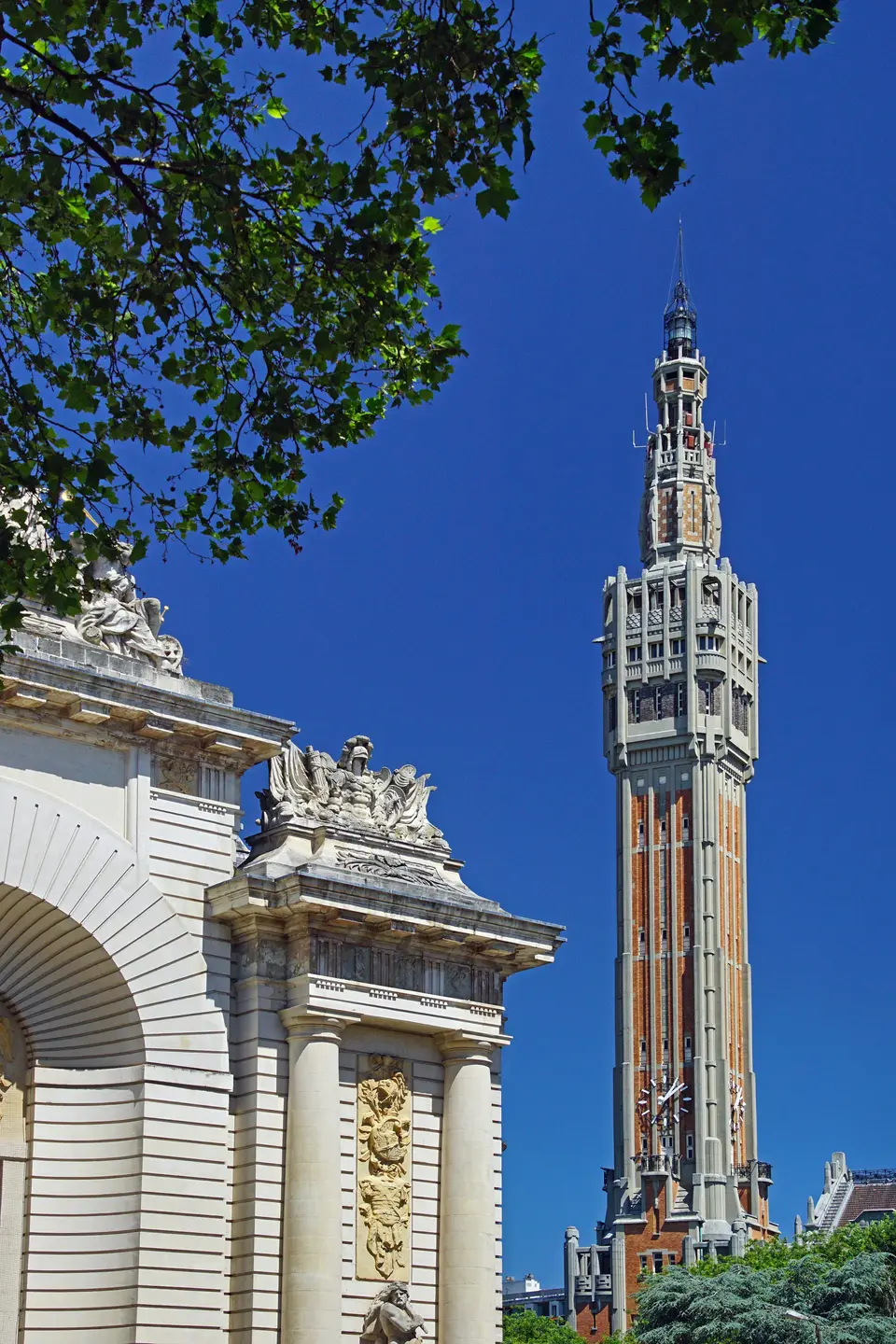
UNESCO first listed 32 belfries of Flanders and Wallonia in 1999, then added 23 belfries of northern France and Gembloux in Belgium in 2005, as the Belfries of Belgium and France: 56 towers built from the 11th to the 20th century, in a wide diversity of styles, from the Romanesque to Art Deco. Lille’s is the town hall belfry, a 1932 Art Deco tower by the architect Émile Dubuisson, inaugurated on October 16, 1932: at 104 meters, the tourist office calls it the tallest belfry in France and Belgium, and on a clear day the view from the top reaches 35 kilometers. Three others in the metropolis are on the list, at Armentières, Comines and Loos, and so is the belfry of Arras.
You climb the first 109 steps, then keep walking, 415 steps in all, or take the elevator to the top. The tourist office sells the visit online from 7.50 euros, includes it in the City Pass, and lists a booked visit every day at 10 a.m. and self-guided visits without booking from 11 a.m. to 1 p.m. and 2 to 5:30 p.m., last climb 45 minutes before closing; it is free on the first Wednesday of the month and not accessible to wheelchair users. Check before you go: the city’s own page says that since the events of Saturday, October 17, 2026, belfry visits are suspended, while the tourist office still offers dates from November 27. The tourist office, at the Palais Rihour, can tell you which is right on the day.
Sources: Ville de Lille, the town hall and its belfry; Office de Tourisme de Lille, belfry visit and belfries and town hall; UNESCO, Belfries of Belgium and France, read on November 26, 2026.
The Citadel and the Bois de Boulogne
The Citadel is the work of Vauban, built from 1667 on the orders of Louis XIV, the tourist office says, with nearly 60 million bricks, the city says; the tourist office calls it the “Queen of citadels” and Vauban’s masterpiece. It is still a military base: since 2005 it has housed the headquarters of the Rapid Reaction Corps France, 450 soldiers from 14 allied nations, and the tourist office arranges only one-off visits on request, with no published dates or prices.
The park of the Citadel holds the Bois de Boulogne, with many footpaths and bike paths, the tourist office says. The city’s Zoo de Lille is closed for the winter from November 9, 2026 to February 19, 2027, and reopens on Saturday, February 20, at 10 a.m.; it is free only for residents of Lille, Hellemmes and Lomme, and other visitors pay 6 euros an adult and 3 euros a child aged 5 to 17.
Sources: Office de Tourisme de Lille, the Citadel; Ville de Lille, the Citadel, the zoo’s winter closing and prices, read on November 26, 2026.
The Palais des Beaux-Arts
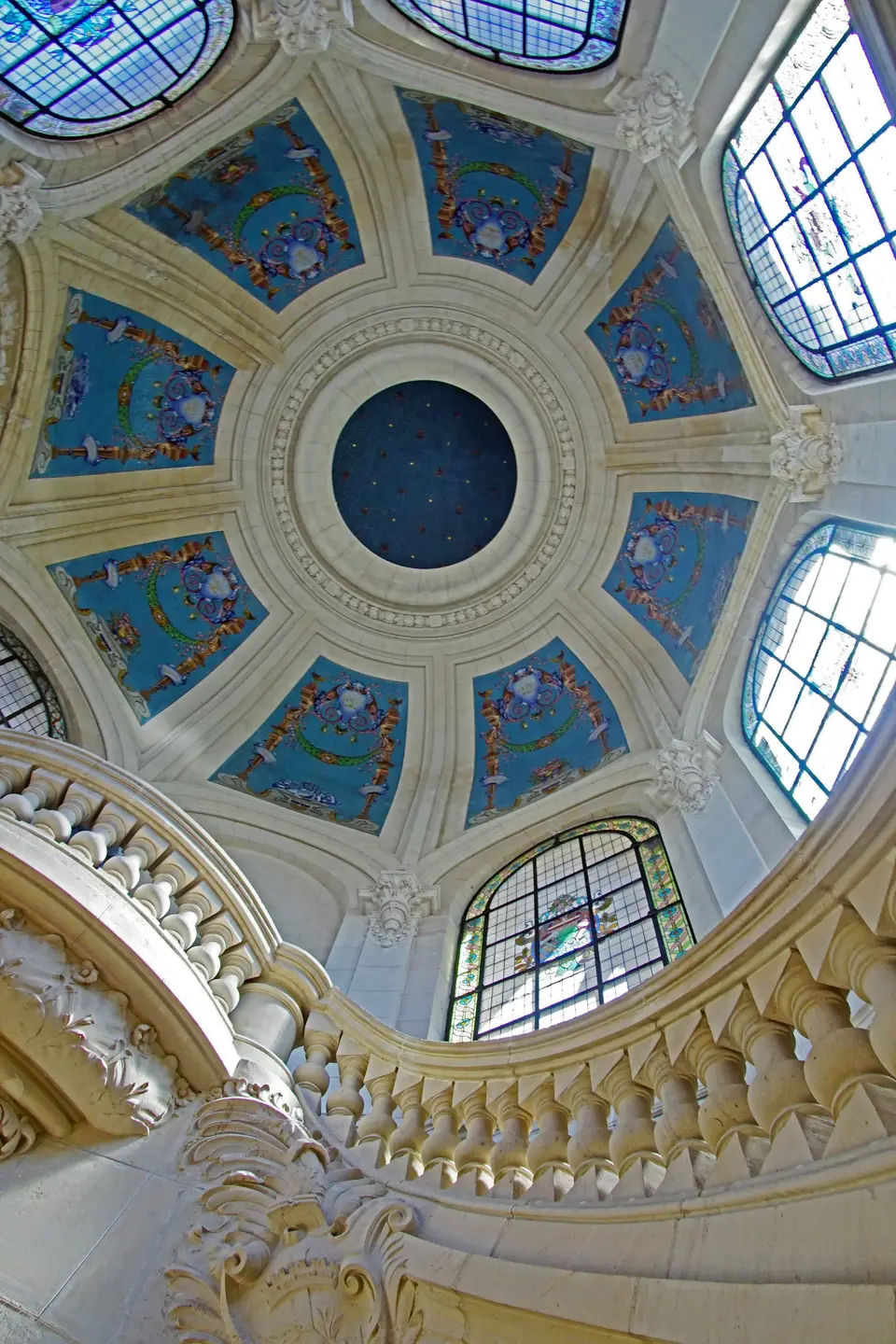
The Palais des Beaux-Arts, on the Place de la République, opened on March 6, 1892, and after a renovation by the architects Ibos and Vitart, reopened in 1997 with 22,000 square meters, a great European museum in its own words; the tourist office calls its collection one of the richest in Europe. It holds French and European painting, from Van Dyck and Rubens to Delacroix and Goya, whose “Les Jeunes” and “Les Vieilles” are among its most famous canvases, sculpture by Rodin, Claudel and Carpeaux, 40 drawings by Raphael, and, under the atrium, the relief maps of the towns of Flanders that Vauban fortified in the 17th century (16 of them, the museum says; some 15, the tourist office says).
| Palais des Beaux-Arts | As published |
|---|---|
| Open | Monday 2 to 6 p.m.; Wednesday to Sunday 10 a.m. to 6 p.m. |
| Closed | Tuesdays, the weekend of the Braderie, January 1, May 1, July 14, November 1 and December 25 |
| Collections | 7 euros; 4 euros reduced, and for everyone on weekdays from 4:30 p.m. |
| Free | Under 18; everyone on the first Sunday of the month |
| Exhibition “Voyage à l’anglaise”, William Turner and the artists of the Grand Tour | November 20, 2026 to March 22, 2027, with 23 works by Turner, in partnership with Tate Britain: 10 euros alone, 11 euros with the collections |
| Sheila Hicks, “Au-delà” | To March 8, 2027; the installation in the atrium is free |
Source: Palais des Beaux-Arts, practical information, the Turner exhibition and Sheila Hicks, the museum’s history and its renovation; Office de Tourisme de Lille, the Palais des Beaux-Arts, read on November 26, 2026. Because of work on the rooms, the first floor is only partly open, and some rooms reopen in early 2028; online ticketing was unavailable on the day we read it, so buy at the desk.
La Piscine and the Other Museums of the Metropolis
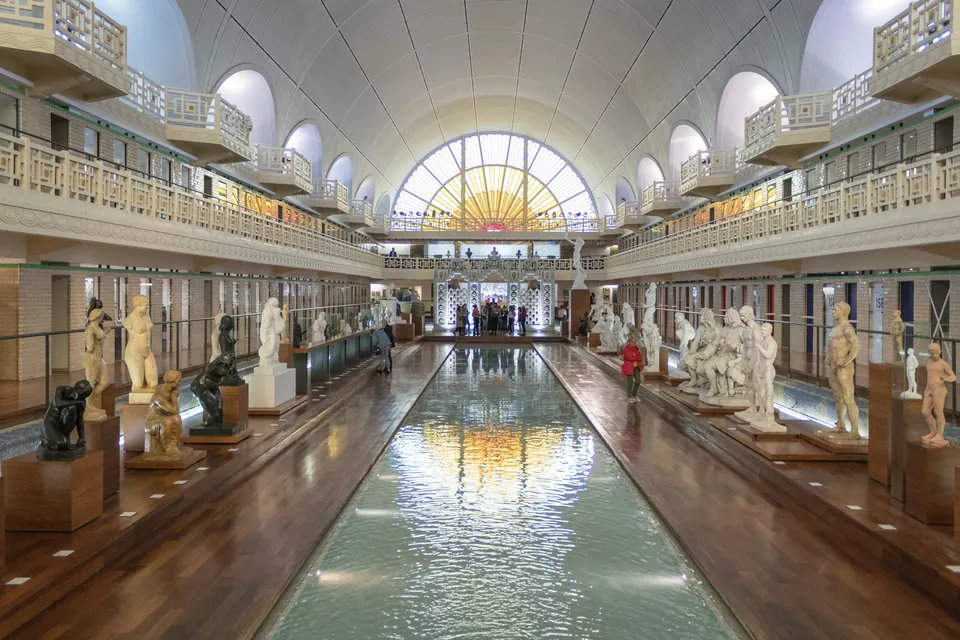
In Roubaix, La Piscine is the museum the municipal baths became: Albert Baert built them on the model of a Cistercian abbey, they opened in 1932 and closed in 1985, and they became the Musée d’art et d’industrie André Diligent in 2001. The tourist office calls the building “splendid Art Deco” and says not to miss the stained glass above the old pool. Metro line 2 takes you to Gare Jean Lebas station, 5 to 10 minutes’ walk away, about 30 minutes from the center of Lille, the museum says; the regional train from Lille Flandres takes 10 minutes, about once an hour.
| Museum | What it is | Open, as published | Adult price |
|---|---|---|---|
| La Piscine, Roubaix | Art and industry in a 1932 swimming pool; exhibitions “Ni Dieu ni maître, arts et anarchie de Courbet à Banksy” to January 24, 2027 and “Révolution denim” to February 14, 2027 | Tuesday to Thursday 11 a.m. to 6 p.m., Friday to 8 p.m., weekends 1 to 6 p.m.; closed Mondays | 11 euros during exhibitions, 9 euros otherwise; free under 18, on Fridays from 6 to 8 p.m. and, for the collections, on the first Sunday of the month |
| LaM, Villeneuve d’Ascq | Modern and contemporary art and art brut, with a sculpture garden | Tuesday to Sunday 11 a.m. to 7 p.m.; to 11 p.m. on the first Wednesday of the month | 11 euros; free under 26, and the collection is free for everyone on the first Sunday of the month |
| Villa Cavrois, Croix | The house the architect Mallet-Stevens designed from 1929 to 1932 for the family of Paul Cavrois, run by the Centre des monuments nationaux | Every day except Monday, 10 a.m. to 6 p.m. | 11 euros; 19.50 euros with La Piscine; free under 18, from 18 to 25 for EU nationals and residents of France (an 18-to-25-year-old from the US, the UK, Canada or Australia who does not live in France pays the full price), and for everyone on the first Sunday of the month from November to March |
| Hospice Comtesse, Lille | Art and history in a hospital founded in 1237 | Wednesday to Sunday 10 a.m. to 6 p.m., Monday 2 to 6 p.m. | 4 euros, 7 euros during exhibitions |
Sources: La Piscine, practical information and history; LaM; Villa Cavrois, practical information and history; Musée de l’Hospice Comtesse; Musée d’histoire naturelle; Office de Tourisme de Lille, La Piscine, read on November 26, 2026. The Villa Cavrois accepts no bag larger than a handbag or a small backpack. The natural history museum of Lille has been closed for renovation since April 2024.
The HelloLille City Pass. The tourist office’s pass gives free entry to about twenty experiences, museums, sights and guided tours, among them La Piscine, the Palais des Beaux-Arts, the Villa Cavrois, the town hall belfry, the LaM, the Hospice Comtesse and the house of de Gaulle, and one guided tour (the 1-hour-15 bus tour or a 2-hour walk in Vieux-Lille), and discounts at the Louvre-Lens, the Boves of Arras and the Wellington Quarry. Each site can be visited once.
| HelloLille City Pass | Digital, without transport | Card with 24 hours of public transport |
|---|---|---|
| 24 hours | 25 euros | 29 euros |
| 48 hours | 35 euros | 39 euros |
| 72 hours | 45 euros | 49 euros |
Source: Office de Tourisme de Lille, City Pass booking, prices shown for a visit on December 5, 2026, read on November 26, 2026. The City Pass site that the tourist office links to shows other prices (22, 32 and 42 euros without transport, 25, 35 and 45 euros with it); the booking page, which sells the pass, gives these. The 24-hour pass pays off if you fit three of the dearer sites into the day: the Palais des Beaux-Arts (7 euros), La Piscine (11 euros) and the Villa Cavrois (11 euros) come to 29 euros, against 25.
The Lille Christmas Market 2026
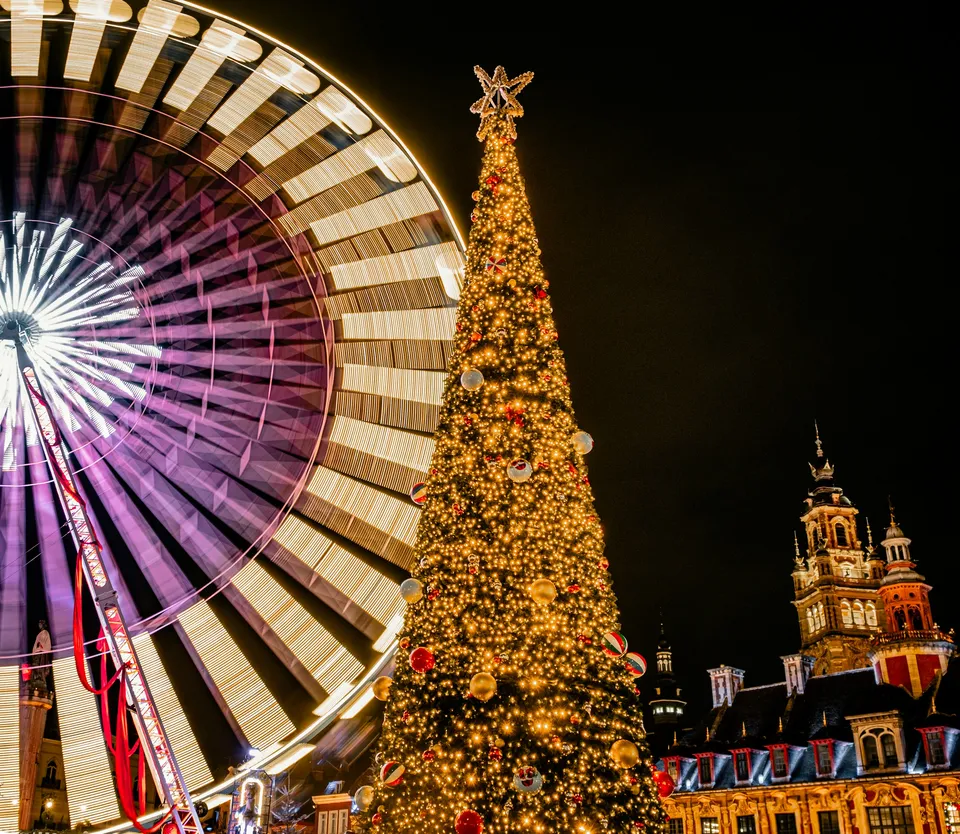
The Lille Christmas market (the Village de Noël) runs from November 18 to December 30, 2026 on the Place Rihour, with 90 wooden chalets of craftsmen, shopkeepers and producers from Lille and the rest of France. Entry is free. Created in December 1989, it moved to the Place Rihour in 1996, the city says, and the tourist office says it is fully accessible to people with reduced mobility. Its lights, all LED, come on from 5 p.m.
| Christmas in Lille, 2026 | Where | Dates and hours, as published |
|---|---|---|
| Christmas market (Village de Noël) | Place Rihour, metro Rihour (line 1) | November 18 to December 30; Sunday to Thursday 11 a.m. to 8:30 p.m., Friday and Saturday to 10 p.m.; closes at 6 p.m. on December 24, closed December 25 |
| Big wheel (Grande Roue) | Grand Place | November 18, 2026 to January 16, 2027; weekdays noon to midnight, weekends and school vacations 10 a.m. to midnight; 7 euros an adult, 5 euros a child under 1.40 m, cash or card |
| Christmas parades | From the Grand Place through Vieux-Lille | December 12 and 19 |
| Local Christmas market | Halles de Wazemmes | Saturdays December 5, 12 and 19, with about fifteen local designers and craftsmen |
| Pedestrian city center | Center | Sundays November 29 and December 6, 13 and 20, 2 to 8 p.m. |
Sources: Ville de Lille, Village de Noël 2026, the big wheel and Christmas 2026; Office de Tourisme de Lille, marché de Noël, read on November 26, 2026. The English page of the tourist office still shows the 2025 dates; the French page and the city give these.
The big wheel has lit up the Grand Place since 1990, with 36 gondolas rising to 50 meters, and the giant Christmas tree is 18 meters tall. The Idéal Chenille, a century-old merry-go-round in the tourist office’s words, has been part of the season since 1992, the city says. The market serves its drinks in reusable cups. For the Christmas markets of Alsace, our guide to Colmar covers the six markets of Colmar, from November 23 to December 29, 2026, and those of the Wine Route villages around it.
The Braderie de Lille
The Braderie de Lille is the city’s great flea market, held every year, usually on the first weekend of September: the 2027 edition is on Saturday, September 4 and Sunday, September 5, 2027, the city has announced. It runs non-stop: in 2026, for 34 hours, from 8 a.m. on Saturday, September 5 to 6 p.m. on Sunday, September 6. The city counted more than 2.5 million visitors in 2026, 5,425 exhibitors and 53 kilometers of stalls, among them 2,769 residents’ stands, and the tourist office calls it the biggest flea market in Europe. Its first written trace, as the “Franche Foire”, dates from 1127.
The dish of the weekend is moules-frites: about 500 metric tons of mussels are eaten over the weekend, and piling up the empty shells is a tradition, with 15 heaps in 2025, when 4 metric tons of shells were collected and recycled into floor tiles. Three practical points from the city and the tourist office: bring cash, since few sellers take cards; leave the stroller at home; and do not come by car, since traffic and parking are banned in the perimeter without a pass and the public and hotel parking garages close, while 13 park-and-ride lots take holders of an Ilévia ticket. Many museums, among them the Palais des Beaux-Arts and the house of de Gaulle, close that weekend.
Sources: Ville de Lille, Braderie 2027 dates, the 2026 figures, tips for bargain hunters and moules-frites; Office de Tourisme de Lille, the Braderie, read on November 26, 2026.
Flemish Food and the Estaminets
An estaminet, the tourist office explains, is the typical restaurant of the north of France, serving local dishes in a warm, traditional setting where every object is a reminder of Flemish culture, sometimes with garlands of hops on the ceiling and old Flemish games. Rue de Gand, in Vieux-Lille, is one of the best streets for them, the tourist office says. What to order, as the tourist office describes it:
| Dish | What it is |
|---|---|
| Carbonnade flamande | Beef simmered in beer with gingerbread, traditionally served with fries |
| Welsh | Bread soaked in beer with cheddar, ham and mustard, baked until golden |
| Potjevleesch | White meats (usually chicken, rabbit or veal) set in jelly, served hot or cold |
| Waterzooi | Chicken or fish simmered with vegetables in a creamy broth |
| Poulet au maroilles | Chicken in a Maroilles sauce |
| Moules-frites | Mussels in white wine or Maroilles sauce, with fries |
| Croquettes de crevettes | Fried dumplings of gray shrimp and béchamel |
| Cœur des Flandres | A tart of sausage meat and apple compote |
Source: Office de Tourisme de Lille, estaminets and savory specialties, read on November 26, 2026.
For dessert, the Lille waffle is “nothing like its Brussels cousin”: flat, thin, soft and filled with vergeoise, a brown beet sugar, best eaten at Méert, the patisserie of Vieux-Lille famous since 1761, the tourist office says. The merveilleux, two meringue shells filled with whipped cream and dusted with chocolate or speculoos shavings, was reinvented in 1985 by Frédéric Vaucamps, whose shop, Aux Merveilleux de Fred, is on rue de la Monnaie. Source: Office de Tourisme de Lille, sweet specialties, read on November 26, 2026.
The Markets of Lille
| Market | Where | Days and hours, as published |
|---|---|---|
| Wazemmes, the open-air market | Place de la Nouvelle Aventure, metro Gambetta (line 1) | Tuesday and Thursday 7 a.m. to 1 p.m.; Sunday 7 a.m. to 2 p.m. |
| Halles de Wazemmes, the covered market | Same square | Tuesday to Saturday 8 a.m. to 8 p.m.; Sunday 8 a.m. to 3 p.m.; closed Monday |
| Vieux-Lille | Place du Concert | Wednesday, Friday and Sunday, 7 a.m. to 2 p.m. |
| City center | Place Sébastopol | Wednesday and Saturday, 7 a.m. to 2 p.m. |
| Book market | Courtyard of the Vieille Bourse | Every afternoon, Tuesday to Sunday |
Source: Ville de Lille, the markets of Lille and the Halles de Wazemmes, read on November 26, 2026.
The Halles de Wazemmes, red brick on an iron frame, built at the end of the 19th century, hold 25 food shops, and on Sunday a creators’ market. The Sunday morning market around them is the one the tourist office calls almost a must, for cooked dishes from around the world.
The Weather in Lille Month by Month
These are Météo-France’s climate normals for its Lille-Lesquin station, averages for 1991 to 2020:
| Month | Average low | Average high | Rain | Sunshine |
|---|---|---|---|---|
| January | 1.7 °C (35 °F) | 6.6 °C (44 °F) | 58.2 mm | 62.1 h |
| February | 1.9 °C (35 °F) | 7.5 °C (46 °F) | 50.8 mm | 73.6 h |
| March | 3.8 °C (39 °F) | 11.2 °C (52 °F) | 52.1 mm | 127.3 h |
| April | 5.9 °C (43 °F) | 15.0 °C (59 °F) | 45.3 mm | 175.9 h |
| May | 9.3 °C (49 °F) | 18.4 °C (65 °F) | 61.6 mm | 195.7 h |
| June | 12.1 °C (54 °F) | 21.3 °C (70 °F) | 63.7 mm | 201.5 h |
| July | 14.2 °C (58 °F) | 23.7 °C (75 °F) | 67.8 mm | 209.7 h |
| August | 14.0 °C (57 °F) | 23.7 °C (75 °F) | 71.3 mm | 196.8 h |
| September | 11.4 °C (53 °F) | 20.2 °C (68 °F) | 56.8 mm | 155.3 h |
| October | 8.4 °C (47 °F) | 15.4 °C (60 °F) | 64.1 mm | 115.3 h |
| November | 4.9 °C (41 °F) | 10.3 °C (51 °F) | 75.0 mm | 61.7 h |
| December | 2.3 °C (36 °F) | 7.0 °C (45 °F) | 73.3 mm | 52.5 h |
| Year | 7.5 °C (46 °F) | 15.0 °C (59 °F) | 740 mm | 1,627.4 h |
Source: Météo-France, Lille-Lesquin climate normals 1991-2020, read on November 26, 2026. Fahrenheit figures are converted from the Celsius values.
What the table means for a trip:
- Rain is spread through the year: about 45 to 75 millimeters every month and rain on 126 days a year, so pack a raincoat in any season. April is the driest month and November the wettest.
- For walking and terraces: May to September, with highs of 18 to 24 °C and about 200 hours of sunshine a month from May to August.
- For the Christmas market: November and December are cold and dark, with highs of 7 to 10 °C and about 50 to 60 hours of sunshine a month.
- For the Braderie: September averages highs of about 20 °C.
Getting to Lille
From London and Brussels by Eurostar
Eurostar runs direct from London St Pancras International to Lille Europe in 1 hour 22 minutes, city center to city center, from £39 one way per person, a fare that requires a round trip in Standard class, for travel from December 16, 2026 to March 9, 2027. On a sample day, Friday, November 27, 2026, its schedule showed nine departures from London to Lille, from 7:04 a.m. to 7:34 p.m. Passport and luggage checks take place at St Pancras before you board, first the British exit check and then the French entry check, so at Lille you simply get off the train and walk out. Eurostar asks Standard passengers to arrive 75 minutes before departure in London, and 60 minutes before at Lille Europe for the trip back, and the gates close 30 minutes before the train leaves. The European Union’s Entry/Exit System (EES), which registers non-EU travelers, British nationals included, with their fingerprints and a face image, is done at border control at St Pancras on the day; it is free and needs no application.
Between Brussels-Midi and Lille Europe, Eurostar takes 35 to 38 minutes (its pages give 35, 36 and 38), with eight departures from Lille to Brussels on the same sample day.
Sources: Eurostar, London to Lille, Lille, Brussels to Lille, Lille to Brussels, check-in times, St Pancras and the EES, read on November 26, 2026.
From Paris and from Charles de Gaulle airport
From Paris, SNCF Connect lists 32 trains a day, from 6:44 a.m. to 10:07 p.m., 55 minutes at the fastest and 1 hour 13 minutes on average, from 10 euros on some trains and dates. The TGV INOUI trains leave from Paris Gare du Nord and arrive at Lille Flandres or Lille Europe in about an hour; the low-cost OUIGO trains leave from Paris Gare de Lyon, Marne-la-Vallée or Charles de Gaulle airport and arrive at Lille Flandres or Tourcoing.
If you fly to Paris from the US or elsewhere, you do not need to go into the city: 18 trains a day run from the Aéroport Charles de Gaulle 2 TGV station to Lille Europe and Lille Flandres, from 8:07 a.m. to 9:06 p.m., in as little as 50 minutes and 1 hour on average, from 16 euros. For Paris itself, our guide to things to do in Paris covers the city.
Sources: SNCF Connect, Paris to Lille and Charles de Gaulle to Lille, read on November 26, 2026. Fares are the lowest one-way second-class prices on selected trains.
Lille Europe and Lille Flandres
Lille has two main stations in the center. The Eurostar stops at Lille Europe; TGVs from Paris arrive at Lille Europe or Lille Flandres, and the regional trains to Roubaix and to Belgium leave from Lille Flandres. The two are a 10-minute walk apart, Eurostar says: leave Lille Europe by the main exit, go down the escalators and walk straight on, past the Euralille shopping center. SNCF Connect puts them 500 meters apart, one stop from each other on metro line 2. Sources: Eurostar, Lille Europe station; SNCF Connect, Lille stations, read on November 26, 2026.
From Lille airport
Lille airport, at Lesquin, has its own shuttle to the center: the Navette Aéroport runs every day to the stop in front of the CIC building, opposite the Place des Buisses, next to Lille Flandres station, in about 20 minutes. It costs 7.99 euros one way online, on the flibco app or at the kiosk, 9 euros from the driver, or 13.99 euros round trip, payable by card, and a child under 4 rides free with each adult. A taxi to central Lille costs about 25 euros by day and 30 euros at night (8 p.m. to 6 a.m.), the airport says, as an indication. Ilévia bus 68 also links the airport with the 4 Cantons metro station.
Sources: Aéroport de Lille, shuttle, public transport and taxis, read on November 26, 2026.
Getting Around Lille
Central Lille is easy on foot: Eurostar calls Lille Europe a short walk from the main square and the shops, and the two stations are 500 meters apart. For the rest of the metropolis, Ilévia runs the metro, the trams and the buses.
- The metro, opened on April 25, 1983, was the first fully automatic metro in the world, Ilévia says. Line 1 runs from 4 Cantons Stade Pierre Mauroy to CHU Eurasanté in 22 minutes, through Gare Lille Flandres, Rihour (for the Christmas market), République Beaux-Arts and Gambetta (for the Halles de Wazemmes); line 2 links Lomme and Tourcoing through Lille, Roubaix and Croix, and stops at both Gare Lille Flandres and Gare Lille Europe.
- The trams, lines R and T, known as the “Mongy” and in service since 1909, leave Gare Lille Flandres for Roubaix and Tourcoing; tram R stops at Villa Cavrois, 15 minutes’ walk from the villa.
| Ilévia ticket | Price | What it covers |
|---|---|---|
| Single trip (trajet unitaire) | 1.90 euros | One hour between the first and the last validation, on Ilévia and on the regional trains within the metropolis |
| Day pass (Pass 1 jour) | 5.70 euros | Unlimited travel for 24 hours from the first validation |
| 10 single trips | 16.60 euros | Ten one-hour trips |
| ZAP trip | 1.20 euros | A short trip of up to 3 stations by metro or tram |
| Rechargeable paper ticket or card, bought once | 0.20 euros or 2 euros | The support the tickets are loaded on |
Source: Ilévia, tickets and passes, FAQ, where to buy the metro, line 1, line 2, the tram and traveling well; Eurostar, Lille, read on November 26, 2026.
The machines at every metro and tram station take a bank card or cash; a first single trip costs 2.10 euros on a new paper ticket (1.90 euros plus 0.20 euros for the ticket). Beyond three trips in 24 hours, Ilévia’s own advice is to take the day pass, and one Pass Pass card can be used by up to 10 people, each validating once. Validate at every boarding and every change, on the regional trains too; on those, only tickets loaded on a card are accepted, not the paper ticket. Children under 4 travel free with an adult. No Ilévia page we read says that you can tap a bank card at the gates, so buy a ticket first.
V’Lille, the bike-sharing service, has 266 stations in 21 towns, open day and night. A 24-hour subscription costs 1.90 euros and a 7-day one 8.30 euros; the first 30 minutes of each ride are free, then each extra half hour costs 1.20 euros. You must be over 14, a deposit of 200 euros is asked but not charged, and the Ilévia app sells the subscription and unlocks the bike without going to a terminal. Sources: Ilévia, V’Lille and the catalog, read on November 26, 2026.
Day Trips from Lille
The regional trains and the high-speed lines to Belgium make most day trips from Lille easy:
| From Lille to | Trains a day | Fastest | From, one way |
|---|---|---|---|
| Lens, for the Louvre-Lens | 48 | 30 minutes | 2 euros |
| Arras | 34 | 19 minutes | 3 euros |
| Brussels-Midi, from Lille Europe | 18 | 34 minutes | 17 euros |
| Kortrijk (Courtrai), Belgium, from Lille Flandres | 15 | 36 minutes | Not shown |
Source: SNCF Connect, Lille to Lens, Lille to Arras, Lille to Brussels and Lille to Kortrijk, read on November 26, 2026. Fares are the lowest one-way second-class prices on selected trains and dates. For Roubaix, see La Piscine above.
The Louvre-Lens
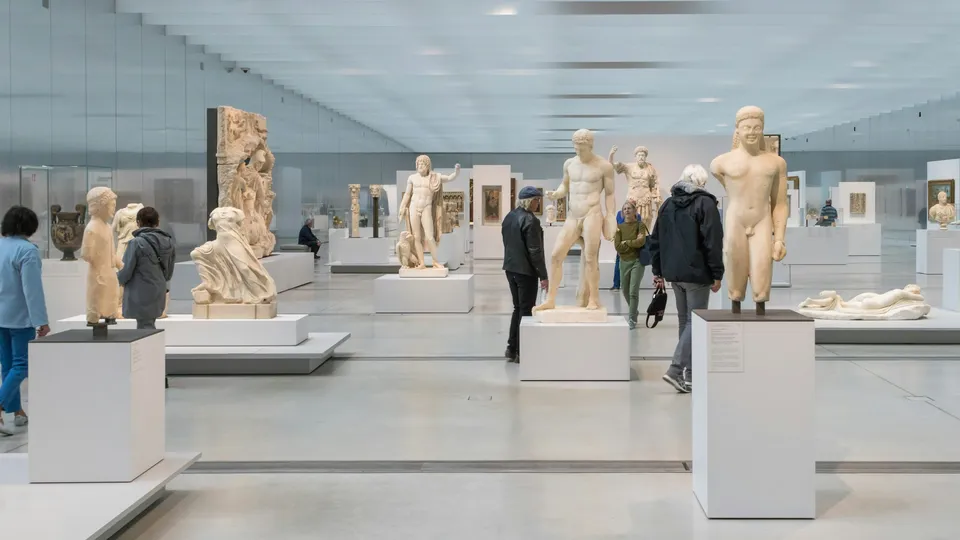
The Louvre’s museum in Lens is free for its main hall: the Galerie du temps, a single open space of 3,000 square meters, shows more than 250 masterpieces from the Louvre along a chronological route. It is open Wednesday to Monday from 10 a.m. to 6 p.m. (ticket desks close at 5:15 p.m.), closed on Tuesday and on January 1, May 1 and December 25. The main temporary exhibition, “Trop mignon ! L’art du bonheur”, with nearly 300 masterpieces, runs to January 18, 2027 (12 euros, 6 euros for ages 18 to 25, free under 18), and “Carthage” follows from March 24 to July 19, 2027. From Lens station, the Bulle 1 shuttle runs every 8 minutes to the museum, and the whole Tadao bus network has been free since January 1, 2026; on foot it takes 20 to 25 minutes. The regional railway’s Pass TER Louvre-Lens halves the round-trip fare from any station of the Hauts-de-France or from Paris Nord. Sources: Louvre-Lens, practical information, the Galerie du temps and exhibitions; TER Hauts-de-France, Pass TER Louvre-Lens, read on November 26, 2026.
Arras
Arras has two squares that, for its tourist office, look like no others in northern Europe: the Grand’Place and the Place des Héros, 155 facades on 345 columns, all listed historic monuments, destroyed in the First World War and rebuilt as they were. An edict of Philip II of Spain in 1583 imposed their stone and brick. Markets fill the squares on Wednesday and Saturday mornings, with more than 200 stalls.
- The belfry, on UNESCO’s list since 2005, rises 75 meters above the Place des Héros; built from 1463 to 1554 in flamboyant Gothic and rebuilt from 1927 to 1931, it can be climbed every day from 9:30 a.m. to noon and 2 to 5:30 p.m., but not by visitors with reduced mobility.
- The Boves, chalk quarries 12 meters below the town, dug from the 9th century, are seen on a guided tour from the tourist office in the town hall, from 4.40 euros; they close on December 25, January 1 and for the three weeks after the Christmas school vacation.
- The Wellington Quarry, 20 meters underground, keeps the galleries that New Zealand tunnelers dug between November 1916 and March 1917, where 24,000 soldiers waited before the attack of April 9, 1917, at 5:30 a.m. The visit takes 1 hour 30 and is accessible to people with reduced mobility; it is open every day from 9:45 a.m. to 12:30 p.m. and from 1:30 p.m. (2 p.m., the tourist office says) to 6 p.m., and closed on December 25, 2026 and from January 1 to 29, 2027.
Sources: Arras Pays d’Artois Tourisme, the squares, the belfry, the Boves and the Wellington Quarry; Carrière Wellington, read on November 26, 2026.
The memorials of the First World War
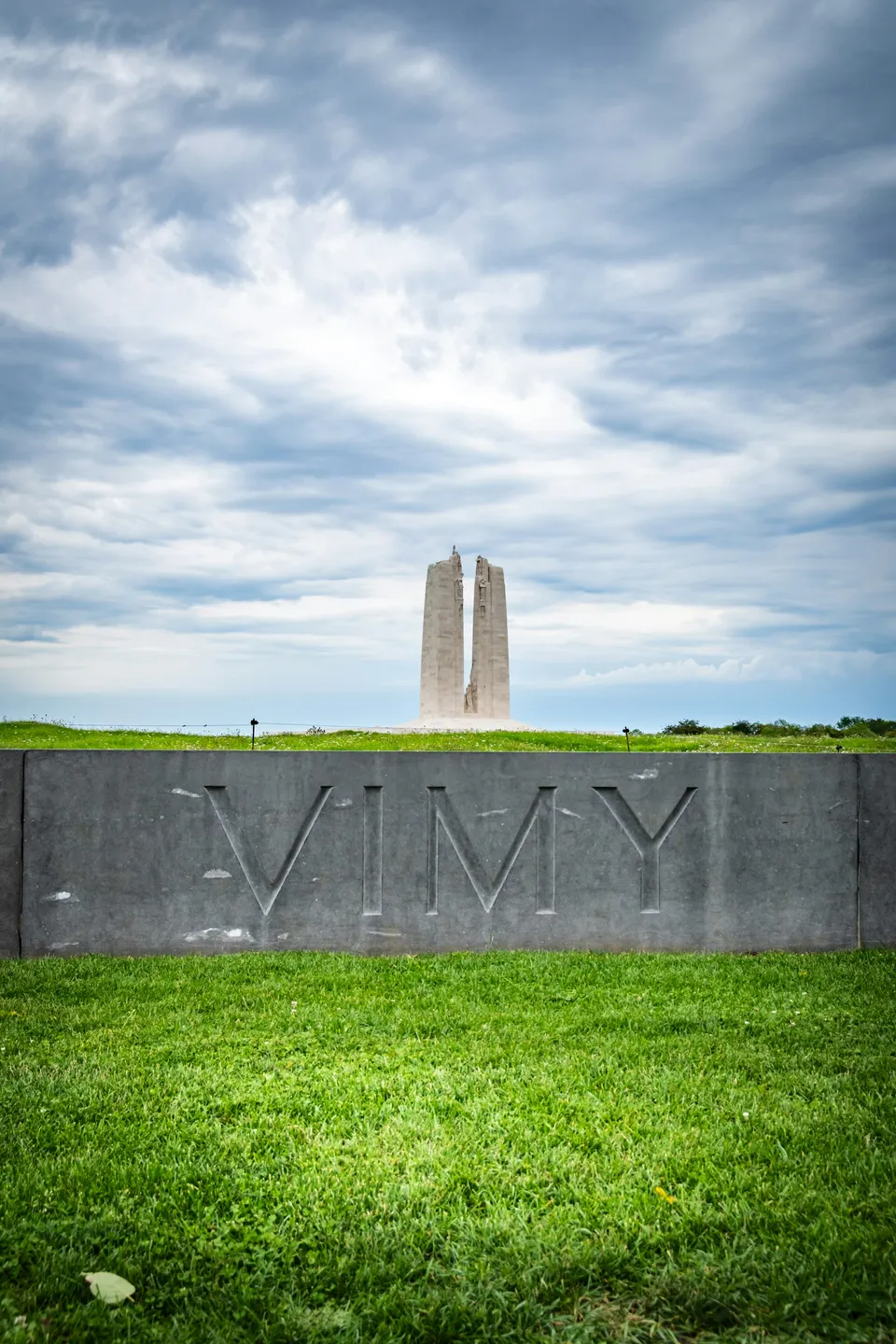
Around Lens and Arras ran the Artois front of the First World War.
- The Canadian National Vimy Memorial carries the names of 11,285 Canadian soldiers who died in France and whose bodies were unidentified or unrecovered at the time. The Canadian assault at Vimy, part of the Battle of Arras, began on Easter Monday, April 9, 1917, and the memorial was unveiled by King Edward VIII on July 26, 1936, after eleven years of work. Its preserved trenches, reconstructed where the Canadian and German outpost lines ran in 1917, are in places only 25 meters apart. Its visitor center is open from October to March on Mondays from 11 a.m. to 5 p.m. and Tuesday to Sunday from 9 a.m. to 5 p.m. (April to September, noon to 6 p.m. on Mondays and 10 a.m. to 6 p.m. otherwise); its 2027 season runs from January 29 to December 10, the parking lot closest to the monument (P1) is closed from November 12, 2026 to March 31, 2027, and on April 9, 2027, the 110th anniversary, the ceremony site is open only to pre-registered participants and the visitor center, tunnels and trenches are closed.
- The Ring of Remembrance (Anneau de la Mémoire) at Notre-Dame-de-Lorette, by the architect Philippe Prost, has listed since 2014 nearly 580,000 soldiers who fell in the Nord and the Pas-de-Calais from 1914 to 1918, in alphabetical order and, for the first time, without distinction of nationality, rank, gender or religion. Entry is free, and it is lit until 11 p.m. Beside it, the national necropolis of Notre-Dame-de-Lorette, the largest in France, holds more than 42,000 soldiers; its tower and basilica are by Louis-Marie Cordonnier, the architect of Lille’s Opera.
- The Last Post at Ypres (Ieper), across the border in Belgium, is sounded every evening at exactly 8 p.m. under the Menin Gate, 4 minutes’ walk from the Grote Markt, whatever the weather, by volunteer buglers of the town’s fire brigade. It is free, cannot be booked, lasts 5 to 10 minutes and is never applauded.
Sources: Veterans Affairs Canada, the Vimy Memorial and visitor information; Office de Tourisme de Lens-Liévin, the Ring of Remembrance, hours and the necropolis; Visit Ieper, the Last Post, read on November 26, 2026.
Brussels and the Cities of Flanders
Brussels is 34 to 38 minutes away by TGV or Eurostar from Lille Europe. For Bruges and Ghent, the regional railway of the Hauts-de-France sells a one-day “Billet Belgique Hauts-de-France” from Lille Flandres to Bruges, Ghent, Kortrijk, Brussels and Tournai (1 euro for an accompanied child), and the Belgian railways’ cross-border trains run via Kortrijk or Tournai, with 30 percent off the Belgian part of the trip on weekends and public holidays; check the times with the Belgian railways (SNCB). Bruges, whose historic center UNESCO listed in 2000 as an outstanding example of a medieval town, is closely tied to the Flemish Primitives; Ghent’s tourist office urges visitors not to miss the Mystic Lamb, the Van Eyck brothers’ masterpiece. Sources: TER Hauts-de-France, Billet Belgique; SNCB International, Lille; UNESCO, Historic Centre of Brugge; Visit Gent, read on November 26, 2026.
How Many Days in Lille?
- Day 1, the center: the Grand Place and the courtyard of the Vieille Bourse, the Place du Théâtre at noon for the carillon, then Vieux-Lille: the Hospice Comtesse, rue de la Monnaie, a waffle at Méert and dinner in an estaminet on rue de Gand.
- Day 2, the museums: the Palais des Beaux-Arts in the morning, then metro line 2 to La Piscine in Roubaix (closed on Mondays), or the Villa Cavrois; in the evening, a walk along the Citadel and the Bois de Boulogne.
- Day 3, a day trip: the Louvre-Lens, Arras and the First World War memorials, or Bruges or Ghent across the border.
On a Sunday, go to the Wazemmes market in the morning; on the first Sunday of the month, several museums are free. In November and December, add the Christmas market and the big wheel. With a week, Lille works as a base for Arras, Lens and Belgium.
Staying Longer in Lille
Lille is also a city to stay in for a season, with London 1 hour 22 minutes away, Brussels 34 minutes and Paris 55 minutes by the fastest trains. Three rules matter once you stay beyond a vacation:
- The 90-day rule. As a visitor from a visa-exempt country such as the US, the UK, Canada or Australia, you can usually stay a maximum of 90 days within any 180-day period, according to the European Commission, and the European Union’s Entry/Exit System counts that period as one for all the countries using it, so weekends in Brussels or Bruges count in the same total; it has been fully in operation at every external border since April 10, 2026. ETIAS, the travel authorization these visitors will need, is not yet in operation, and the EU says it will announce its start date several months ahead. Our guide to how long Americans can stay in France without a visa explains the count, and the Schengen calculator checks your dates. To stay longer than 90 days you need a long-stay visa or a residence permit, the Commission says.
- Furnished rentals. In Lille, a main residence may be let to tourists for up to 120 days a year; any other home, a second home or an investment, needs a change-of-use authorization first, with compensation required since April 1, 2024, and every listing must show the registration number issued by the city: check it before you book. Rents are also capped in Lille, Hellemmes and Lomme since March 1, 2020: the rent may not exceed the reference rent for the type of home and the district by more than 20 percent, apart from a rent supplement (complément de loyer) that the tenant has 3 months to contest, and both figures must appear in the listing and in the lease.
- The bail mobilité. This furnished lease of 1 to 10 months, not renewable and without a security deposit, is open only to a tenant in vocational training, higher education, an apprenticeship, an internship, civic service, a job transfer or a temporary work assignment, service-public says, so a visitor who simply wants a season in Lille cannot sign one: our bail mobilité guide sets out the other leases.
Sources: European Commission, short-stay calculator; European Union, what is the EES, EES FAQ and ETIAS; Ville de Lille, short-term rentals and change of use and rent control; Métropole Européenne de Lille, furnished tourist rentals; service-public, the bail mobilité, read on November 26, 2026.
Finding that furnished apartment, calling the agencies and setting up a phone line or a bank account is the kind of work our Personal Assistant handles: the calls, the forms and the apartment search, in French.
FAQ
Is Lille worth visiting?
Yes, especially for a weekend: the Grand Place and the Vieille Bourse, the cobbled streets of Vieux-Lille, a UNESCO-listed belfry, the Palais des Beaux-Arts, whose collection the tourist office ranks among the richest in Europe, at 7 euros, La Piscine in Roubaix by metro, Flemish food in the estaminets, a Christmas market from mid-November to the end of December and the Braderie in September. From London, it is 1 hour 22 minutes by Eurostar.
What is Lille most known for?
Its Flemish heritage (the Vieille Bourse of 1652 and 1653, the belfries, the estaminets), the Braderie, which the tourist office calls the biggest flea market in Europe, its Christmas market and big wheel, the Palais des Beaux-Arts, and the dishes of the north: carbonnade, welsh, potjevleesch, moules-frites and the Lille waffle.
Is Lille a day trip from Paris?
It can be: SNCF Connect lists 32 trains a day from Paris, the first at 6:44 a.m. and the fastest in 55 minutes, with fares from 10 euros on some trains and dates. A day is enough for the Grand Place, Vieux-Lille and one museum; two days let you add Roubaix or a day trip. From London, it is 1 hour 22 minutes by Eurostar.
When is the Lille Christmas market in 2026?
From November 18 to December 30, 2026, on the Place Rihour, with 90 chalets and free entry: Sunday to Thursday from 11 a.m. to 8:30 p.m., Friday and Saturday to 10 p.m., closing at 6 p.m. on December 24 and closed on December 25. The big wheel on the Grand Place stays until January 16, 2027.
When is the Braderie de Lille?
Usually on the first weekend of September: in 2027, on Saturday, September 4 and Sunday, September 5, the city says; in 2026 it ran from 8 a.m. on Saturday to 6 p.m. on Sunday. Bring cash, come by train or metro, and expect many museums to be closed.
What is the weather like in Lille?
Cool and changeable, with rain spread through the year: highs average 6.6 °C (44 °F) in January and 23.7 °C (75 °F) in July and August, with 740 millimeters of rain and 1,627 hours of sunshine a year at Lille-Lesquin, according to Météo-France. May to September is the most pleasant time; November and December are cold and gray, but that is when the Christmas market runs.
Conclusion
Lille rewards two or three days: a Grand Place split by a Spanish-era stock exchange, a belfry on UNESCO’s list, a fine arts museum at 7 euros and a swimming pool turned museum one metro line away, estaminets for carbonnade and welsh, and in season a Christmas market or the Braderie. Come from London or Brussels by Eurostar, from Paris in 55 minutes on the fastest trains, or straight from Charles de Gaulle airport after a flight, and check before you go whether the belfry has reopened. For Alsace, in the northeast, our guide to Strasbourg covers its cathedral, the Petite France and its Christmas market; for the rest of the country, region by region, see our guide to the best places to visit in France and our guide to the regions of France, and for how Lille compares with France’s other large cities, our guide to the cities in France.
The parts of the move Americans find out about too late.
What Americans get wrong about moving to France, and the number, form or deadline that fixes it. Straight to your inbox.
One email a week. Real numbers, nothing else.
Written by
Aurelio Maurici
Co-Founder, EasyFranceNow
Aurelio Maurici is a French entrepreneur and co-founder of EasyFranceNow. His work focuses on the intersection of French administration, banking constraints affecting U.S. nationals, tax residency and cross-border reporting, healthcare enrollment, and the procedural realities Americans encounter while settling in France.


