
Strasbourg, France: The Complete Guide from the Cathedral to the Christmas Market

By Aurelio Maurici Co-Founder, Master of Business Law, Aix-Marseille Université III
Published

In this article
- Strasbourg at a Glance
- Is Strasbourg French or German?
- Why Strasbourg Is a World Heritage City
- The Cathedral of Notre-Dame
- The platform: 330 steps for the view
- The astronomical clock
- The Grande-Île: The Old Town on Its Island
- The Petite France
- The Ponts Couverts and the Barrage Vauban
- The Neustadt: The German Imperial City
- The European Quarter
- The Museums of Strasbourg and Their Pass
- Boat Tours on the Ill
- The Strasbourg Christmas Market 2026
- The rules for visitors
- Alsatian Food and the Winstubs
- The Alsace Wine Route: A Day Trip
- The Weather in Strasbourg Month by Month
- Getting to Strasbourg
- By train
- By air
- Getting Around Strasbourg
- How Many Days in Strasbourg?
- Staying Longer in Strasbourg
- FAQ
- Conclusion
Strasbourg is the capital of Alsace, in France’s Grand Est region, on the Rhine facing Germany: a city of 293,771 residents according to INSEE, one of the seats of the European institutions, with the European Parliament, the Council of Europe and the European Court of Human Rights, and, the tourist office says, the first French city whose whole historic center, not just one monument, went on UNESCO’s World Heritage List. Its tram crosses the river into the German town of Kehl, the fastest train from Paris takes 1 hour 45 minutes, and from November 27 to December 24, 2026, its Christmas market, a tradition the city dates to 1570, fills the old town with more than 300 chalets, the tourist office says.
This guide covers what to see, from the cathedral and its astronomical clock to the Petite France, the Neustadt and the European quarter, with the hours and prices of the platform, the clock, the museums and the boat tours, the 2026 Christmas market and its rules, Alsatian food and the winstubs, the Wine Route as a day trip, the weather month by month from Météo-France, how to get there from Paris, Germany, Switzerland and London, how to get around, and what changes if you stay for more than a holiday. Every price, date and opening time was read on the official page of the city, the tourist office, the monument or the operator on November 26, 2026.
Strasbourg at a Glance
| Where | Capital of Alsace, Grand Est region, on the Rhine; tram line D crosses into Kehl, in Germany |
| Population | 293,771 (INSEE reference population 2023, in force since January 1, 2026) |
| World Heritage | “Strasbourg, Grande-Île and Neustadt”, inscribed by UNESCO in 1988 and extended in 2017 (183 hectares) |
| From Paris | 27 trains a day from the Gare de l’Est, the fastest in 1 h 45 |
| Airport | Strasbourg-Entzheim, 8 minutes from the main station by shuttle train; no flights to North America |
| Christmas market 2026 | November 27 to December 24 |
| Climate | -0.2 to 5.2 °C in January, 14.9 to 26.4 °C in July; 1,747 hours of sunshine a year |
| Best for | A first trip to Alsace, a December weekend, a base for the Wine Route, Germany and Switzerland |
Sources: INSEE, reference population of Strasbourg; UNESCO, Strasbourg; SNCF Connect, Paris to Strasbourg; Strasbourg airport; Ville de Strasbourg, Christmas market; Météo-France, Strasbourg-Entzheim normals, read on November 26, 2026.
Is Strasbourg French or German?
Strasbourg is in France, but you will see both countries in its streets. The city joined France in 1681, after which Vauban built a new ring of fortifications; from 1871 to 1918 it was German, and the German administration built the Neustadt, the new town that UNESCO calls the work of a city that was “the capital and symbol of the new German state”. The Grande-Île, the old center on its island in the Ill, holds the Gothic cathedral and the half-timbered houses; the Neustadt, its avenues and palaces. Today Germany starts on the far bank of the Rhine: tram line D runs to Kehl, and a footbridge for walkers and cyclists crosses the river in the Jardin des Deux Rives.
The parts of the move Americans find out about too late.
What Americans get wrong about moving to France, and the number, form or deadline that fixes it. Straight to your inbox.
One email a week. Real numbers, nothing else.
Why Strasbourg Is a World Heritage City
UNESCO lists the center of Strasbourg as “Strasbourg, Grande-Île and Neustadt”, 183 hectares in all. The first listing, in 1988, covered the Grande-Île, the historic center that the Ill rings like an island, “structured around the cathedral”. In 2017 UNESCO extended it to the Neustadt, the “new town” designed and built under the German administration, from 1871 to 1918, when Strasbourg was “the capital and symbol of the new German state”. Together they form, in UNESCO’s words, “an urban ensemble that is characteristic of Rhineland Europe”: a Gothic cathedral, half-timbered streets, the classical Palais Rohan of the eighteenth century, then the wide avenues and monumental squares of the German city. The cathedral has been a protected historic monument since 1862, and 170 other buildings or parts of buildings in the listed area are protected too.
The Cathedral of Notre-Dame
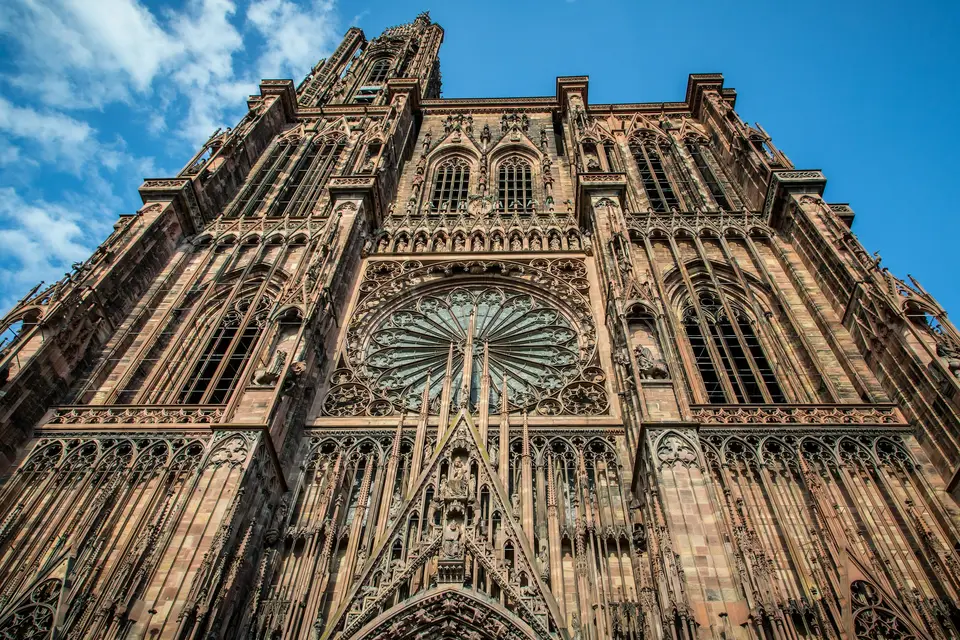
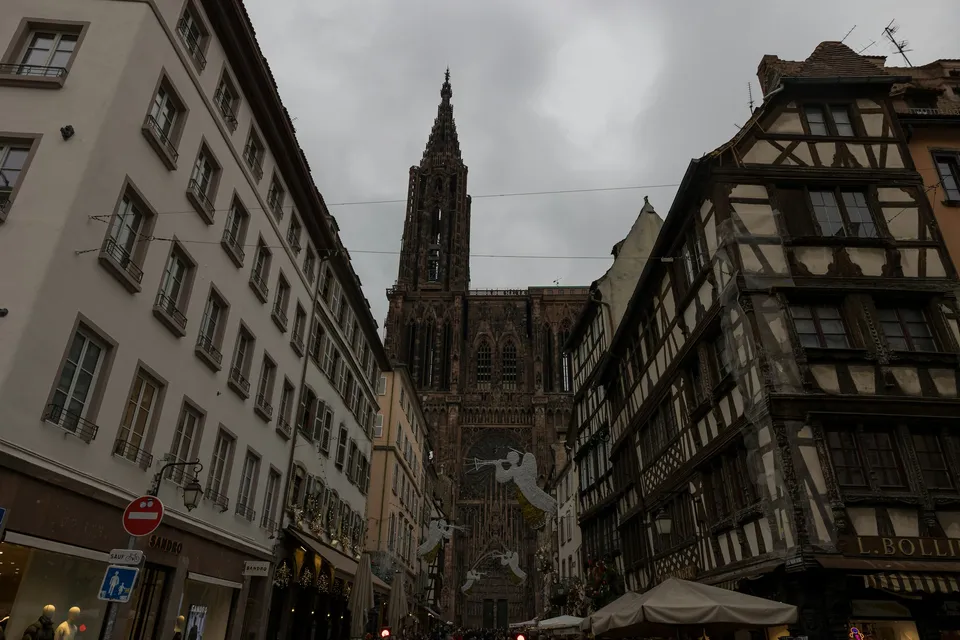
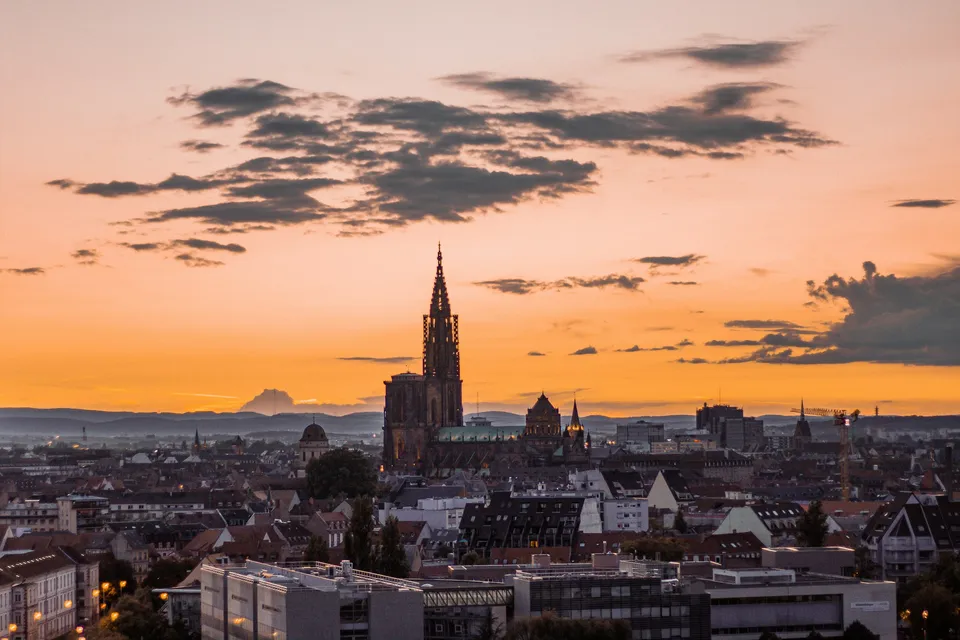
The cathedral, which the tourist office says dominates the whole Alsace plain, rises over the streets of the Grande-Île. Its own site calls it the most visited cathedral in France, with 2.5 million visitors in 2019. The parish site says it was built between the thirteenth and the fifteenth century. The tourist office says it replaced a Romanesque cathedral begun in 1015, of which only the crypt and the footprint remain, and that it took nearly three centuries of work in pink Vosges sandstone; UNESCO calls it “a major masterpiece of Gothic art”. Its spire, built from 1419 by Jean Hültz of Cologne, made it the tallest building in Christendom until the nineteenth century. Its height depends on the page you read: 142 meters for the tourist office and on one page of each of the cathedral’s two official sites, 142.15 meters on a history page of the Fondation de l’Œuvre Notre-Dame, which looks after the building, and 143 meters on another page of the parish site. The Fondation and the tourist office date the spire’s completion to 1439, the parish site’s history page to 1459.
Visiting the cathedral. Entry is free and needs no booking, but expect a security check at the door: have your bag open. The cathedral opens Monday to Saturday from 8:30 to 11:15 a.m. and from 12:45 to 5:45 p.m., and on Sundays and feast days from 2 to 5:15 p.m. During the Christmas market it stays open without a break, Monday to Saturday from 8:30 a.m. to 5:45 p.m., and you go in by the south portal, on Place du Château. In 2026 it closes on the afternoon of December 24, before the Christmas masses, which are free and need no booking. The cathedral asks for decent clothing, with covered shoulders, and asks men to take off their hats; there is a ramp for wheelchairs at the entrance and the exit.
Inside, look for the Pillar of Angels, carved with the Last Judgment, the pulpit, the rose window, 14 meters across, and, during Advent only, the seventeenth-century tapestries hung in the nave.
The platform: 330 steps for the view
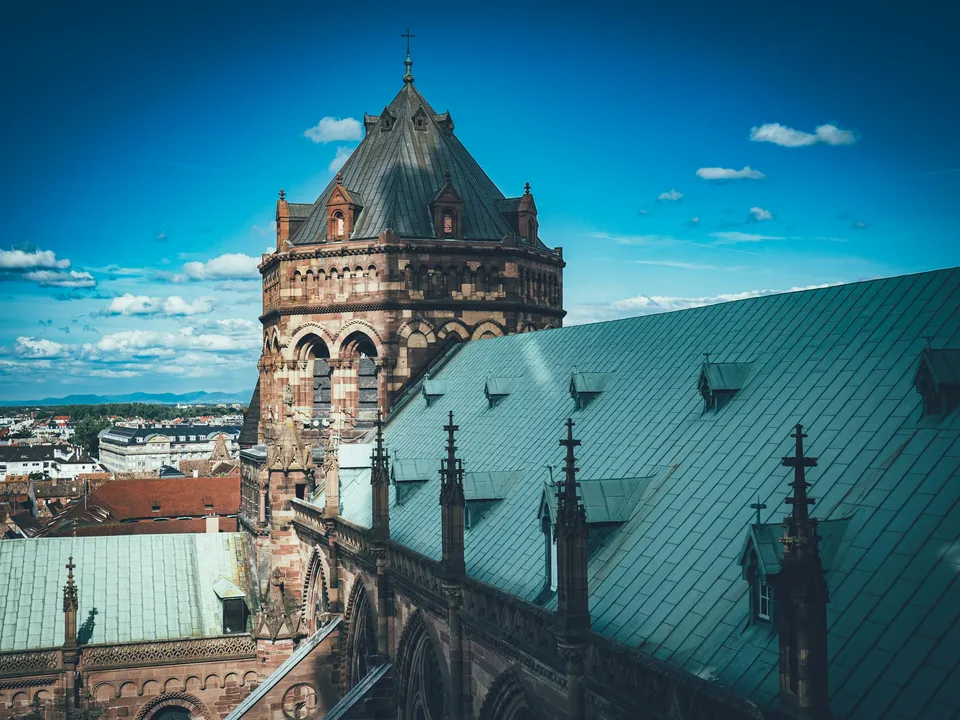
The cathedral’s platform, 66 meters up after 330 steps (the Fondation’s count; the city’s Christmas site says 332), looks over the roofs of the Grande-Île, the Petite France and, on clear days, the Vosges and the Black Forest. Its entrance is a ticket office on Place du Château, on the south side of the west front.
| The platform | As published |
|---|---|
| Winter hours (October 1 to March 31) | Every day, 10 a.m. to 1 p.m. and 1:30 to 6 p.m.; last climb 5:15 p.m. |
| Summer hours (April 1 to September 30) | Every day, 9:30 a.m. to 1 p.m. and 1:30 to 8 p.m.; last climb 7:15 p.m. |
| Closed | January 1, May 1 and December 25; at times when too many people are on the circuit (100 at most) or in bad weather |
| Price | 10 euros; 6 euros for ages 6 to 18 and students; free under 6; half price with the Strasbourg City Card |
| Booking | None: tickets are sold on the day only, there is no skip-the-line ticket and tickets are not refunded |
Source: Fondation de l’Œuvre Notre-Dame, climbing the cathedral, read on November 26, 2026. The climb is for people in good physical shape, with no access for reduced mobility; minors must be with an adult, visitors are asked not to bring large bags, since there is no left-luggage office, and there are no toilets at the top (there are public toilets on Place du Château).
At the top, the keepers’ house holds two fifteenth-century treadwheel winches and a clock mechanism by Jean-Baptiste Schwilgué, and sighting holes point you to the Petite France, the church of Saint-Thomas, the Ancienne Douane and the European institutions. An audio story in French, English or German goes with the climb, and the ticket money helps pay for the cathedral’s conservation and restoration. Keep your ticket: for two weeks it gives a reduced price at the Musée de l’Œuvre Notre-Dame.
The astronomical clock
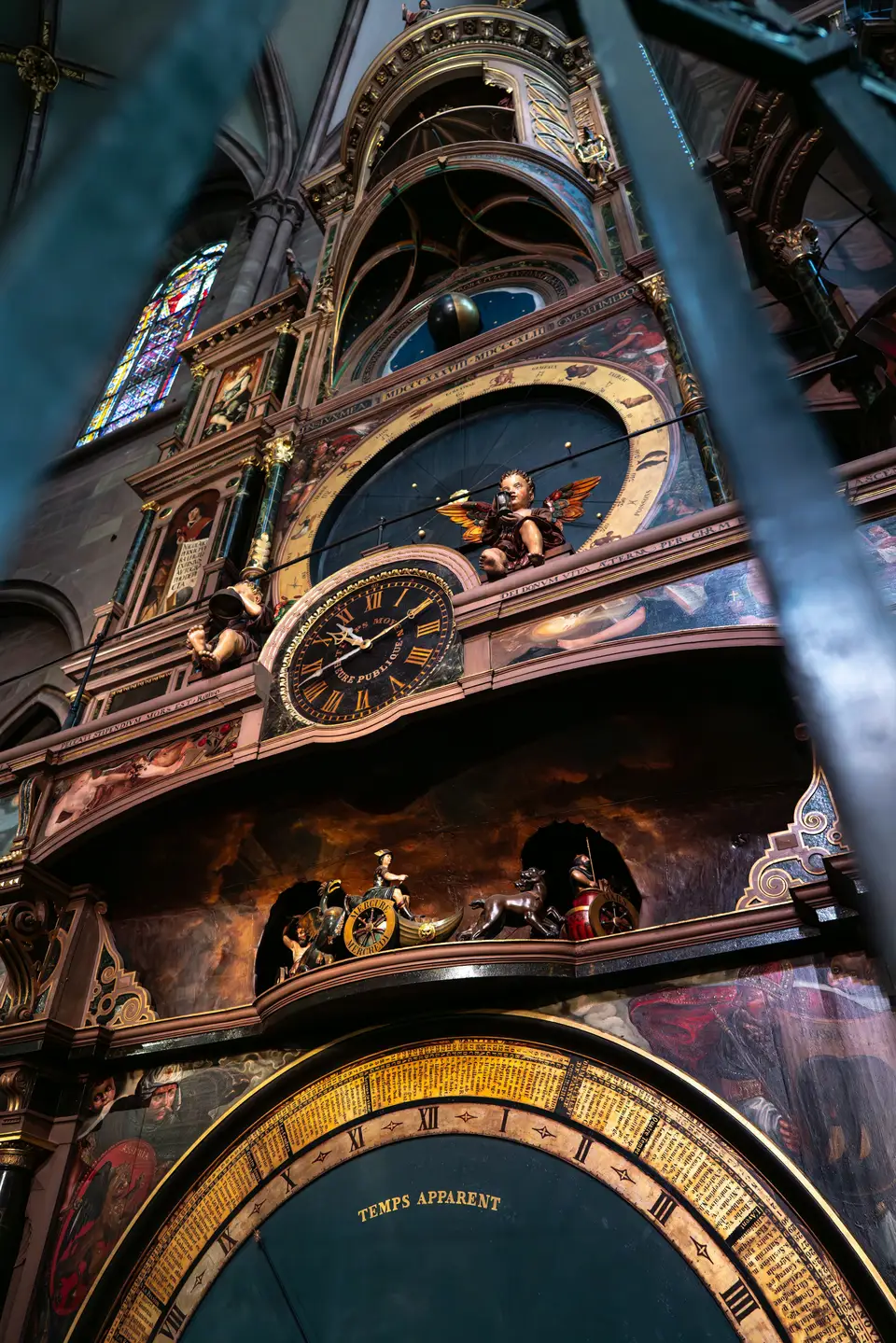
The astronomical clock is a listed historic object. Its Renaissance case dates from the sixteenth century (the cathedral dates that second clock to 1571, the tourist office to 1574); the mechanism that runs it now was built by the Strasbourg engineer Jean-Baptiste Schwilgué from 1838 to 1842. Every day at 12:30 p.m. its automata play their full show: the four ages of life pass before Death, the twelve apostles pass before Christ, and the cock crows three times. It strikes noon at 12:29 because it keeps Strasbourg’s local solar time, half an hour behind legal time.
Not during the Christmas market. The cathedral’s page says the clock show will not take place for the whole of the Christmas market, so from November 27 to December 24, 2026.
| The clock show | As published by the cathedral |
|---|---|
| When | Every day; 11:30 a.m. entry, 12 noon film (French, German, English), 12:30 p.m. chime and the procession of the apostles; on Sundays and feast days with an 11 a.m. mass, entry is free after the mass and there is no film |
| Where to buy | 10 to 11 a.m. at the cathedral’s shops; from 11:30 a.m. at the Saint-Michel entrance, reached from Place du Château |
| Price | 4 euros; 3 euros for students up to 25 and groups of 12 or more; 2 euros for ages 6 to 17; free under 6; cards accepted |
| Booking | None: tickets are sold on the day only |
Source: Cathédrale Notre-Dame de Strasbourg, the astronomical clock, read on November 26, 2026. The tourist office’s page differs on two points: it sells the tickets at the south portal from 11:35 a.m. to noon, and says the automata play Monday to Saturday, not on Sundays and public holidays.
The Grande-Île: The Old Town on Its Island
The cathedral quarter is entirely pedestrian, and most of the old town can be walked in a day. Around the cathedral:
- Maison Kammerzell, a merchant’s house with a stone ground floor dated 1467, rebuilt in 1589, with a carved wooden facade and 75 bottle-glass windows; it is now a restaurant.
- The Palais Rohan, the residence of the prince-bishops, built from 1732 to 1742 by Robert de Cotte, the king’s first architect, and home to three of the city’s museums.
- Place Kléber, the largest square of the old town, where the Great Christmas Tree stands every year; General Kléber’s ashes lie in a crypt under his statue.
- Place Gutenberg, with the statue of Gutenberg, who developed his printing press in Strasbourg around 1434, and the late sixteenth-century Neubau.
- Place Broglie, with a market on Wednesdays and Fridays and the Christkindelsmärik from late November to Christmas Eve; Rouget de l’Isle first played the Marseillaise a few steps away, in the salons of Mayor Dietrich.
- Saint-Thomas, often called the cathedral of Protestantism in Alsace, with the eighteenth-century tomb of the Maréchal de Saxe by Pigalle.
The Petite France
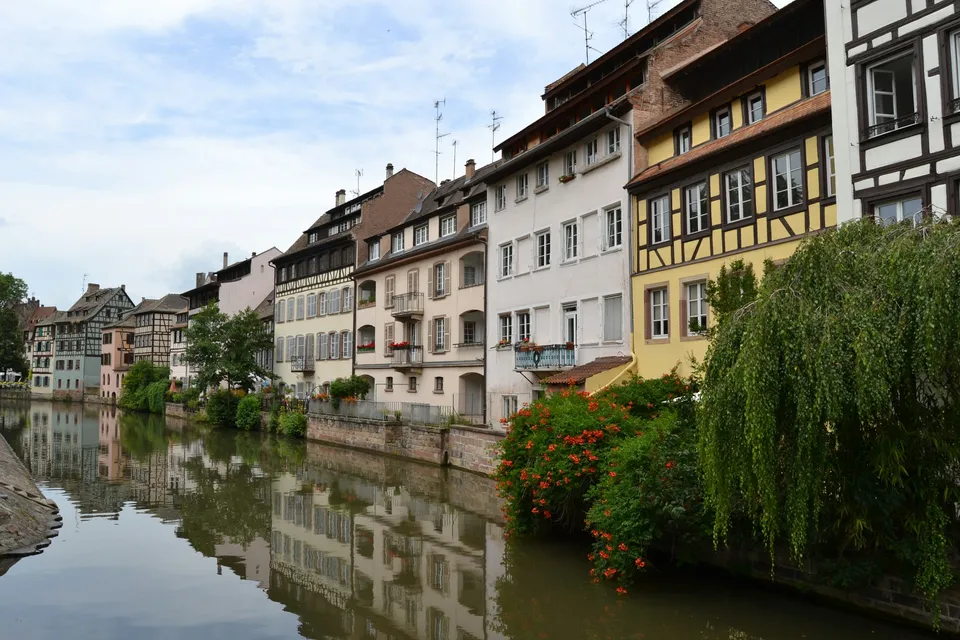
In the Petite France the Ill splits into five arms, and the quarter built along them was once, the tourist office says, the quarter of the tanners and the millers. Its jewel, the tourist office says, is the Maison des Tanneurs, covered with geraniums from spring to autumn, on Place Benjamin Zix. In the rue du Bain-aux-Plantes, the tanners’ houses are white, with half-timbering of every pattern and an extra roof, open wide, where hides were hung to dry. Watch the Pont du Faisan, the swing bridge that turns to let the tour boats through.
The Ponts Couverts and the Barrage Vauban
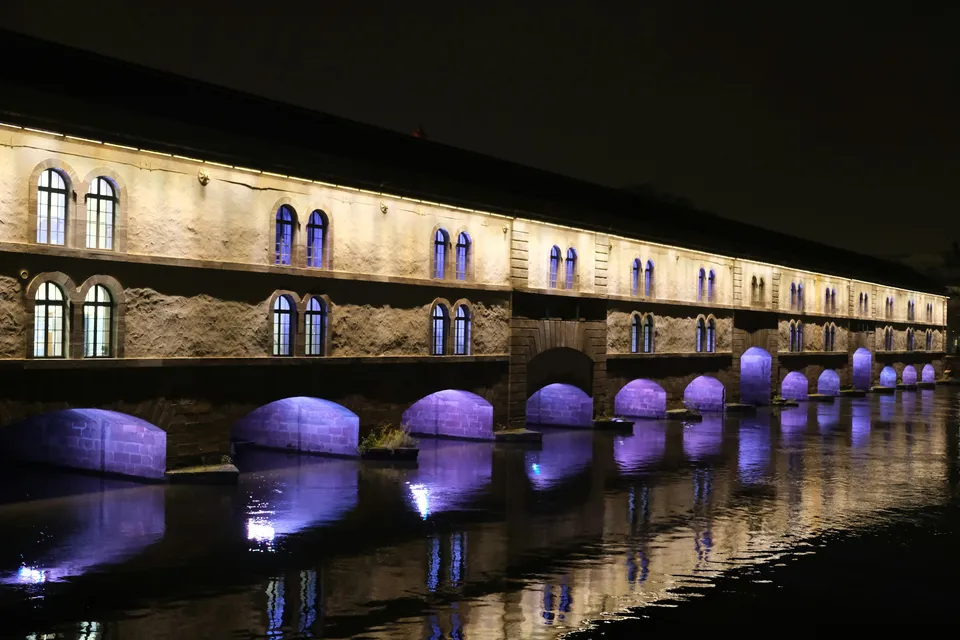
Beside the Petite France, the Ponts Couverts cross the Ill under three thirteenth-century towers, the remains of the old ramparts: the view at the top of this guide. They lost their roofs in the eighteenth century but kept their name (“covered bridges”). Just beyond them stands the Barrage Vauban, a dam of 13 arches built around 1690 from the plans of Vauban, Louis XIV’s military engineer, after Strasbourg joined France in 1681: with its gates closed, it could flood the whole south side of the city. On its roof, a panoramic terrace looks over the Ponts Couverts, the Petite France and the cathedral on one side, and the Museum of Modern and Contemporary Art on the other. The tourist office gives its winter hours, from November 1 to the end of February, as 8:30 a.m. to 4 p.m., and 7:15 a.m. to 9 p.m. from May to August (trams B and F, Faubourg National).
The Neustadt: The German Imperial City
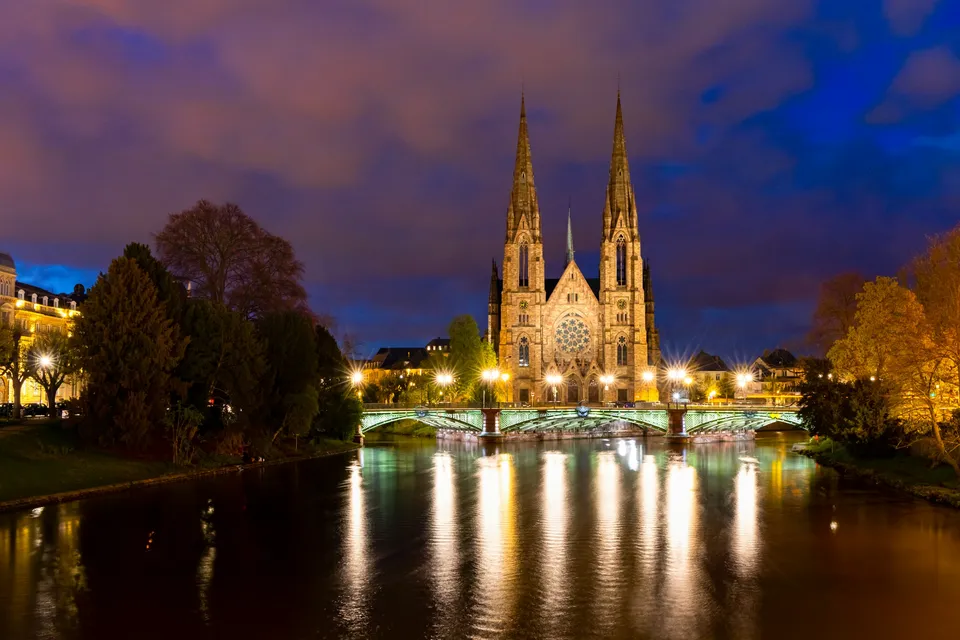
Beyond the Grande-Île, the city changes: wide avenues, large squares and stone palaces. This is the Neustadt, the new town built while Strasbourg was German, from 1871 to 1918, when its population more than doubled, from 80,000 in 1870 to 180,000 in 1915, the city says. UNESCO describes an urban plan partly drawn from the Haussmann model of Paris, in an architecture of Germanic inspiration.
- Place de la République, the former imperial square and the pivot of the plan, is a square laid out like a park. At its center, the war memorial of 1936 by the sculptor Drivier shows a mother with her two sons, one who died for France and one for Germany.
- The Palais du Rhin, on the square, was the emperor’s residence when he came to Strasbourg; since 1920 it has housed the Central Commission for the Navigation of the Rhine.
- The National and University Library, with more than 3 million documents, and the Théâtre National de Strasbourg, the former Landtag, the parliament of Alsace-Lorraine.
- The Palais universitaire, linked to the Palais du Rhin by the avenue de la Liberté, was designed on the model of the University of Berlin, with 36 statues of scholars around it; a black granite Ramses II recalls that Strasbourg’s chair of Egyptology is the oldest in France.
- The municipal baths (Bains municipaux), built from 1904 to 1911 by the architect Fritz Beblo, are a listed historic monument.
Trams B, C, E and F stop at République, the tourist office says.
The European Quarter
Strasbourg is one of the seats of the European institutions, and three of them can be visited, in different ways.
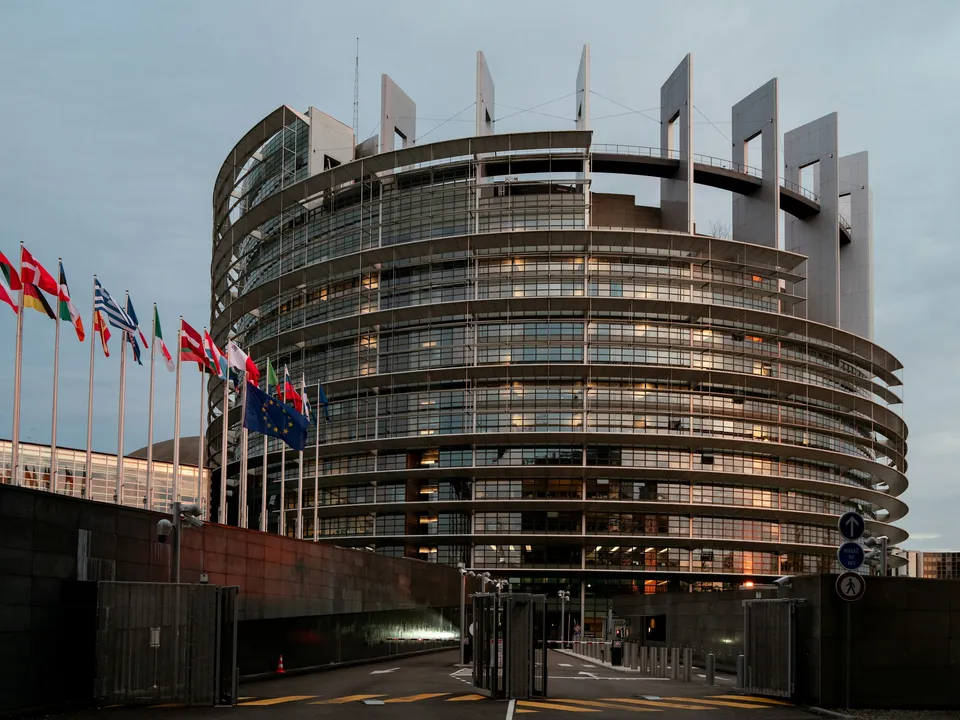
The European Parliament. Its Louise Weiss building, opened in 1999, has a hemicycle of more than 800 seats, and the Parliament meets there twelve times a year, from Monday afternoon to Thursday noon. It is open to visitors six days a week and visits are always free:
| Visiting the European Parliament | As published |
|---|---|
| Outside plenary sessions | Monday to Friday 9 a.m. to 6 p.m., Saturday 9:30 a.m. to noon and 1 to 6 p.m.; last entry 5 p.m.; about 60 minutes; no booking needed for individuals |
| During a plenary session | Booking compulsory to watch a debate from the gallery, for about 30 minutes; individuals can visit without booking, with a multimedia guide, on Monday morning, Friday and Saturday, when there is no debate |
| Next session | December 14 to 17, 2026 |
| Closed | Sundays, and from December 24, 2026 to January 3, 2027 |
| To bring | A physical ID card or passport (no photocopy, no ID on a phone, no driving license); no suitcase or large luggage; children under 14 with an adult |
Source: European Parliament, visiting the Parliament in Strasbourg, and its pages on visits outside and during plenary sessions, and the Parlamentarium Simone Veil, read on November 26, 2026. Expect airport-style security checks. The building also holds the Parlamentarium Simone Veil, an immersive exhibition on the Parliament’s work in the EU’s 24 languages, open the same hours outside sessions. Tram E stops at Parlement Européen.
The Council of Europe, in the Palais de l’Europe of 1977 by the architect Henry Bernard, gathers 46 member states. It receives groups of at least 15 people only, free, from Monday to Friday, so an individual cannot simply walk in; its premises are closed from December 21, 2026 to January 3, 2027.
The European Court of Human Rights, in the Human Rights Building by Richard Rogers, opened in 1995, holds occasional public hearings, which visitors aged 18 or over can attend after registering online, within the limited seats, and runs a public guided tour of about 90 minutes, in English or French, on the first Friday afternoon of each month: the tour of December 4, 2026 is full, and booking for February 5, 2027 opens on January 11, 2027.
Next to the institutions, the Parc de l’Orangerie, 26 hectares, is the largest park in Strasbourg, with the Pavillon Joséphine of 1807 and a lake and waterfall made for an exhibition of 1895 (tram E, Droits de l’Homme). On the Rhine, the Jardin des Deux Rives spreads over 150 hectares on both banks, joined by a footbridge for walkers and cyclists by the architect Marc Mimram: you can walk from Strasbourg into Kehl, in Germany.
The Museums of Strasbourg and Their Pass
The city’s museums charge one price, except the free Aubette 1928: 9 euros for one museum, 5 euros reduced, and free for everyone under 18. Tickets are sold only at the museum desks, not online.
| Museum | What it holds | Closed |
|---|---|---|
| Musée de l’Œuvre Notre-Dame, Place du Château | Medieval and Renaissance art, with the masterpieces of statuary from the cathedral, in the house of the Œuvre Notre-Dame, which has run the cathedral works since the thirteenth century | Mondays |
| Palais Rohan: Musée des Arts décoratifs, Musée des Beaux-Arts, Musée Archéologique | The cardinals’ state apartments on the ground floor; European painting from its beginnings to 1870 on the first floor (Giotto, Memling, Botticelli, Raphael, Rubens, Goya, Delacroix, Courbet); archaeology from prehistory to the early Middle Ages in the basement | Tuesdays |
| Musée d’Art moderne et contemporain (MAMCS) | Art from 1870 to today, in a building of 1998 on the Ill | Mondays |
| Musée Historique | Nine centuries of Strasbourg in 1,700 works, around a relief map of the city of 1727 ordered by Louis XV | Mondays |
| Musée Tomi Ungerer | 14,000 drawings given by the illustrator to his home town | Mondays |
| Musée Zoologique | Reopened on September 19, 2025, after six years of renovation | Mondays |
| Aubette 1928, Place Kléber | Rooms decorated by Sophie Taeuber-Arp, Hans Jean Arp and Theo van Doesburg, inaugurated in 1928 | Sunday to Tuesday (open Wednesday to Saturday, 2 to 6 p.m.; free) |
| Musée Alsacien | Alsatian life from the eighteenth century to today, in houses of the 1600s on the quai Saint-Nicolas | Closed for works until June 1, 2028 |
Source: Musées de Strasbourg, prices, opening hours and each museum’s page, read on November 26, 2026. The museums open from 10 a.m. to 1 p.m. and 2 to 6 p.m. on weekdays and from 10 a.m. to 6 p.m. on weekends. Over the holidays they close at 4 p.m. on December 24 and 31 (the Musée Historique is closed on December 31) and all day on December 25 and January 1.
The passes. A 1-day pass costs 20 euros (15 euros reduced), and a 1-day Palais Rohan pass, for its three museums and the Galerie Heitz, 20 euros (10 euros reduced); both are bought at the museum desks. Reduced prices apply to students, people aged 60 and over and holders of the Strasbourg City Card, the tourist office’s discount card: 5 euros for an adult and 3.50 euros for a child aged 3 to 17, valid for 7 consecutive days and collected at the tourist office, 17 place de la Cathédrale. On an adult card, the tourist office lists 4 euros off each city museum, 5 euros off the cathedral platform, 1 euro off the clock show and 3.24 euros off the boat tour (Batorama gives City Card holders 20 percent off at the start and end of the day on most days, only at its shop at 18 place de la Cathédrale). Keep your platform ticket too: it gives a reduced price at the Musée de l’Œuvre Notre-Dame for two weeks.
The museums check bags at the entrance, and suitcases and large bags are not allowed and cannot be left at the cloakroom.
Boat Tours on the Ill
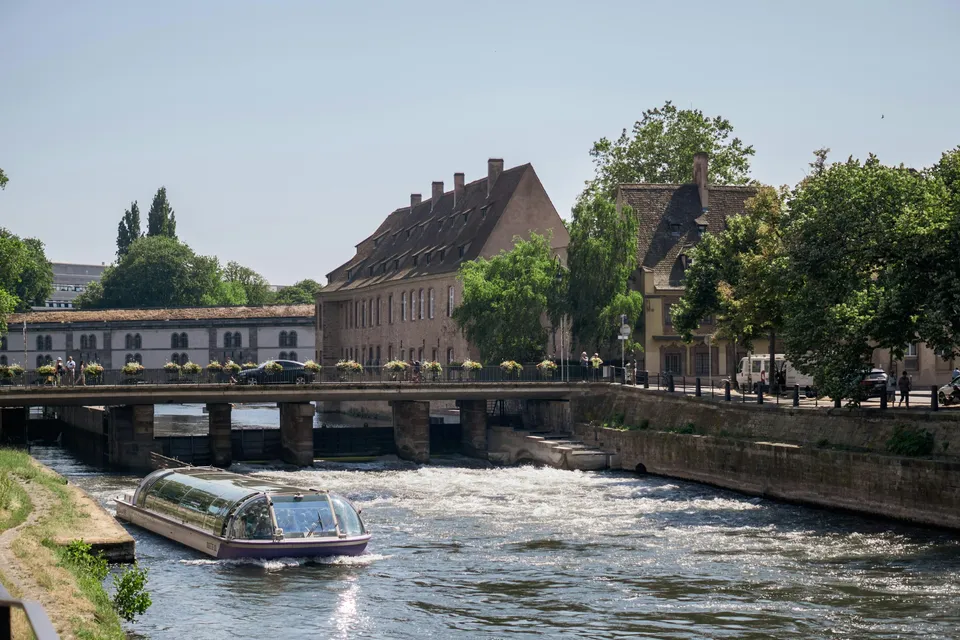
A boat tour shows much of the city in a little over an hour. Batorama’s red circuit leaves from the foot of the Palais Rohan, goes around the Petite France, through two locks, past the Ponts Couverts and the Barrage Vauban, along the Neustadt and its palaces, then out to the European quarter, past the Parliament, the Court of Human Rights and the Council of Europe.
| Batorama red circuit | As published |
|---|---|
| Length | 1 hour 10 minutes, 8 km |
| Price | 16.20 euros; 14.70 euros for ages 13 to 17; 8.90 euros for ages 4 to 12; 0.50 euro under 4 |
| First and last boats | November 28 to January 3: 10 a.m. to 5:45 p.m.; January 5 to February 8: 10 a.m. to 3:30 p.m. on weekdays and 4:30 p.m. on weekends; February 9 to March 29: to 4:30 p.m.; March 30 to November 1: to 8:30 p.m. |
| Departures | Every day of the year, at least 4 a day in the low season and up to 44 a day in July and August |
| Commentary | Audio guide in 12 languages, English among them |
| Boarding | The Cathédrale landing, Place du Marché-aux-Poissons, 150 m from the cathedral; during the works on its pontoons, some boats leave from the Quai au Sable, 100 m away |
Source: Batorama, red circuit, access and timetable and FAQ, read on November 26, 2026. The boats are covered, with panoramic windows, heated in winter and ventilated in summer. Bags are searched at boarding, and suitcases and bikes are not allowed on board.
Book ahead in December: on November 26, the red-circuit boats of 10:30, 11 and 11:30 a.m. the next morning were already full on Batorama’s site. From November 27 to January 3, the city’s Christmas site says, children get a Christmas audio tale on every circuit, in English, French, German or Italian, with a free game booklet.
The Strasbourg Christmas Market 2026
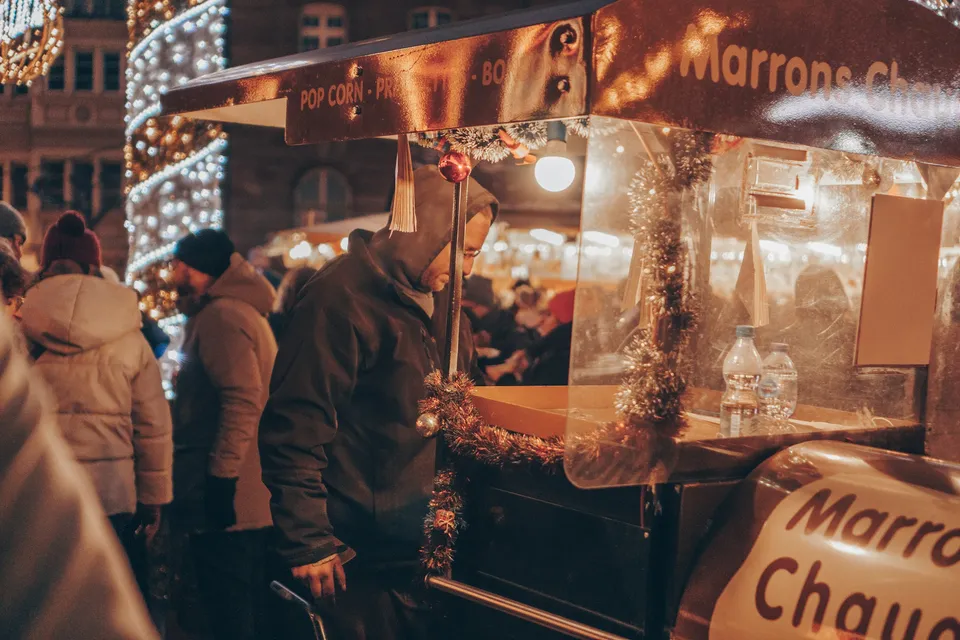
Strasbourg’s Christmas market runs from Friday, November 27 to Thursday, December 24, 2026, as eight markets across the squares and streets of the historic center, under the name the city gives the whole season, “Strasbourg Capitale de Noël”. Its historic market, the Christkindelsmärik on Place Broglie, was born in 1570: the city calls it one of the oldest in Europe and, for a long time, the only one in France, and the tourist office calls it the oldest Christmas market in France. The city counted 3.05 million visitors in 2025, after a record 3.4 million the year before; the tourist office’s page puts it at nearly two million a year.
Hours. Every day from 11:30 a.m. to 9 p.m., except:
- Friday, November 27 (opening day): from 2 p.m. to 9 p.m.
- December 11, 12, 18 and 19 (Fridays and Saturdays): until 10 p.m.
- Thursday, December 24: until 6 p.m.
All the markets close for good on the evening of December 24: no chalet opens on December 25 or before the New Year.
| The eight markets of 2026 | Where |
|---|---|
| Christkindelsmärik, the historic market | Place Broglie |
| Around the cathedral | Places de la Cathédrale and du Château, rue des Hallebardes and rue Gutenberg |
| At the foot of the Great Christmas Tree, with the Village du Partage of about 110 charities | Place Kléber |
| The quay of flavors and crafts, with the Grand Chalet des Bredle | Terrasse Rohan and Place du Marché-aux-Poissons |
| The Petite France | Places Benjamin Zix and Saint-Thomas |
| The Carré d’Or | Place du Temple Neuf |
| The Marché OFF, social and solidarity market, in shipping containers | Place Grimmeissen |
| The small producers of Alsace, next to the free Advent village for families | Square Louise Weiss |
Source: Ville de Strasbourg, the markets, read on November 26, 2026. The tourist office counts more than 300 chalets across the Grande-Île.
What to see. On Place Kléber, the Great Christmas Tree, 30 meters tall, lights up with music every hour from 4 to 9 p.m., and with light alone from 10 p.m. to midnight; the city’s Christmas site keeps it lit until January 5, while a city news article and the tourist office say January 3. On Place Broglie, the facade of the city hall, designed this year by Victor Weinsanto, comes alive with a light tale every hour from 4 to 9 p.m., until January 3, 2027. In the courtyard of the Palais Rohan, an ice rink is open from November 27 to January 3 (8 euros, 7 euros under 12, skates lent free). Inside the cathedral, the great nativity scene of 1907, 18 meters long, and 14 seventeenth-century tapestries of the life of the Virgin are on show. On November 27 and 28, from 6 to 9 p.m., the Compagnie Carabosse opens the season with a free fire show at the Ponts Couverts.
What to eat and drink. Mulled wine (vin chaud), which the Tribu des Gourmets stall makes with Alsace white wine, comes in a reusable cup with a 1-euro deposit: hand it back at any drinks chalet for your euro, or drop it in a charity bin and the euro goes to a Strasbourg charity. The tourist office’s list of Christmas specialties includes the bredle (the Christmas biscuits, baked on the market in the Grand Chalet des Bredle), the mannele, a brioche man eaten on Saint Nicholas’ Day, the Christstolle, the berewecke, a fruit bread of dried pears soaked in schnaps, gingerbread and foie gras. Almost every exhibitor takes cards, but the city advises bringing cash before you cross the bridges, because the cash machines of the Grande-Île are very busy.
The rules for visitors
- Security. About 1,000 police, soldiers, firefighters and security staff are on duty every day. During market hours, every way in by the 21 bridges of the Grande-Île is filtered, with systematic checks of bags and bulky luggage (suitcases, backpacks, cargo bikes) and random checks; Pont du Corbeau and Pont Kuss have security gates. There is no left-luggage office inside the perimeter: use the lockers of the railway station.
- The cathedral is entered and left by the south facade, on Place du Château, for the whole of the market.
- Cars. Traffic is banned on the Grande-Île, except for emergency and public services and permit holders, parking on the street is banned day and night, and the Kléber, Gutenberg and Broglie car parks are closed to non-subscribers. Taxis come in only for pre-booked passengers with reduced mobility, and ride-hailing cars not at all during market hours. Park at one of the tram’s park-and-ride car parks: from 4.20 euros a day, with buses and trams for up to 7 people.
- Trams. From November 27 to December 24, the Broglie, Alt Winmärik and Langstross Grand’Rue stations are closed every day during market hours, and Homme de Fer on Saturdays and Sundays, CTS says (the city’s pages give other versions for Homme de Fer). Get off at Porte de l’Hôpital (A, D) for the cathedral, Faubourg National (B, F) for the Petite France, République (C, E and F, the city’s Christmas site says) for Place Broglie, or Faubourg de Saverne (C) for the Great Tree. The railway station is a 10-minute walk from the center.
- Bikes and scooters are banned on the market squares during opening hours and must be walked by hand on the whole Grande-Île. In the Petite France, the Pont du Faisan is one-way for walkers, from north to south.
When to go. Mondays, Tuesdays and mornings are the quietest times, the city says; Wednesday afternoons, Friday evenings and weekends are the busiest, and it advises against bringing a dog on Saturdays and Sundays. Two information chalets, on Place de la Gare and Place Kléber, lend wheelchairs and walkers free, from 11:30 a.m. to 6:30 p.m., against an ID. Book your hotel early: in 2025, the city says, hotel occupancy was close to 90 percent during the market. Note also that December 26 is a public holiday in Alsace: our guide to French public holidays lists the two extra days of Alsace-Moselle.
Alsatian Food and the Winstubs
The place to eat Alsatian food in Strasbourg is a winstub, which the tourist office calls “the most typically Alsatian restaurant”. Winstubs began as working-class places where winemakers sold off their surplus by running a restaurant on their own premises, with wine served in pitchers and homemade local dishes; today a winstub is a kind of bistro where you eat elbow to elbow at tables with red checkered cloths, and most of them, the tourist office says, are in Strasbourg’s historic quarters. Wine still comes first: in some of them it is poured into the rutscherle, a small glass once slid along the table to serve everyone. The tourist office calls Chez Yvonne the best-known winstub in the city since Jacques Chirac and Helmut Kohl had dinner there. No official label for winstubs was found on the tourism pages read for this guide, so judge by the menu and the room.
What to order, in the words of the Strasbourg and Alsace tourism offices:
- Choucroute (sauerkraut), “the emblematic dish”: the tourist office says you cannot come to Strasbourg without eating one.
- Tarte flambée (flammekueche), a thin, light dough covered with onions, bacon and a mix of crème fraîche and fromage blanc, traditionally baked in a wood fire and eaten with the fingers; in Strasbourg it is shared in the evening and often served all you can eat.
- Baeckeoffe, three marinated meats and potatoes baked slowly in the oven.
- Winstub plates: Wädele (ham hock), Grumbeerekiechle (potato pancakes), Lewerknepfle (liver dumplings), Presskopf (head cheese) and Bibeleskäs (fromage blanc with garlic and herbs), and spätzle, the Alsatian noodles served with game or meat in sauce.
- Foie gras d’Alsace, which the tourist office says was invented in Alsace, in the form most eaten today, at the end of the eighteenth century.
- Munster, the cheese of the Munster valley, mild or strong depending on its aging.
- To take home: the kougelhopf, the region’s best-known cake, which “travels well”, the salted bretzel, and in December the bredle, the Christmas biscuits every Alsatian family bakes.
The regional tourism agency suggests Muscat for the aperitif, Riesling with fish and seafood, Pinot Gris with white meats and Gewurztraminer with cheese and desserts, and calls beer the emblematic drink of Alsace, “France’s leading brewing region”.
The Alsace Wine Route: A Day Trip
The Alsace Wine Route begins a few kilometers west of Strasbourg, at Marlenheim, and runs south through the vineyards to Thann, west of Mulhouse: 170 kilometers, opened in 1953, the Alsace wine council says, which makes it one of the oldest wine routes in France. Its villages lie between the plain and the Vosges; the Strasbourg tourist office counts no fewer than 70 of them, the regional wine route site nearly 119 wine communes. Alsace grows seven grape varieties (Sylvaner, Pinot Blanc, Riesling, Muscat, Pinot Gris, Gewurztraminer and Pinot Noir, its only red) and has 51 Grands Crus, about 5 percent of its production.
Without a car, the regional trains on the Strasbourg to Sélestat line stop at Molsheim, Rosheim, Obernai and Barr: Obernai is 29 minutes from Strasbourg on the fastest of 31 trains a day, from 4 euros, according to SNCF Connect, and Colmar, the wine capital of Alsace, 26 minutes on the fastest of 42 trains a day, from 6 euros. Our guide to Colmar covers the town and the Wine Route villages around it, Eguisheim, Kaysersberg, Riquewihr and Ribeauvillé among them, with their Christmas markets and the shuttles from Colmar station. From April to October, the Kut’zig shuttle loops from Colmar through Ribeauvillé, Riquewihr, Kaysersberg and Eguisheim. For a day of trains and regional coaches, the Alsa+ 24H Solo ticket covers the whole Bas-Rhin for 26.50 euros, or all of Alsace for 43 euros.
Back in Strasbourg, the historic cellar of the Hospices de Strasbourg keeps what the regional wine route site calls the oldest wine in the world aged in a cask: a white Alsace wine of 1472.
The Weather in Strasbourg Month by Month
Strasbourg has cold winters, warm summers and rain in every month. These are Météo-France’s climate normals for its Strasbourg-Entzheim station, at Entzheim, where the airport is, averages for 1991 to 2020:
| Month | Average low | Average high | Rain | Days with rain | Sunshine |
|---|---|---|---|---|---|
| January | -0.2 °C (32 °F) | 5.2 °C (41 °F) | 35.4 mm | 9.1 | 56 h |
| February | 0.0 °C (32 °F) | 7.3 °C (45 °F) | 34.1 mm | 8.3 | 86 h |
| March | 2.6 °C (37 °F) | 12.1 °C (54 °F) | 38.6 mm | 8.5 | 146 h |
| April | 5.7 °C (42 °F) | 17.0 °C (63 °F) | 41.8 mm | 8.6 | 187 h |
| May | 10.1 °C (50 °F) | 20.9 °C (70 °F) | 77.2 mm | 10.8 | 209 h |
| June | 13.4 °C (56 °F) | 24.4 °C (76 °F) | 68.5 mm | 10.2 | 226 h |
| July | 14.9 °C (59 °F) | 26.4 °C (80 °F) | 71.9 mm | 10.4 | 240 h |
| August | 14.5 °C (58 °F) | 26.1 °C (79 °F) | 61.3 mm | 9.5 | 224 h |
| September | 10.7 °C (51 °F) | 21.6 °C (71 °F) | 54.6 mm | 8 | 174 h |
| October | 7.2 °C (45 °F) | 15.8 °C (60 °F) | 59.5 mm | 9.6 | 100 h |
| November | 3.3 °C (38 °F) | 9.4 °C (49 °F) | 47.6 mm | 9.2 | 55 h |
| December | 0.8 °C (33 °F) | 5.9 °C (43 °F) | 45.2 mm | 10.2 | 44 h |
| Year | 6.9 °C (44 °F) | 16.0 °C (61 °F) | 635.7 mm | 112.3 | 1,747 h |
Source: Météo-France, Strasbourg-Entzheim climate normals 1991-2020, read on November 26, 2026. Fahrenheit figures are converted from the Celsius values; sunshine hours are rounded. The page’s table shows a dash for the February low, which its chart gives as 0 °C.
What the table means for a trip:
- For the Christmas market: December is the darkest month, with 44 hours of sunshine, and nights average just above freezing (0.8 °C): dress for the cold, with a hat and gloves for the evenings.
- For walking the city: May, June and September give highs of about 21 to 24 °C, with long days.
- For summer: July and August are the warmest months, with highs around 26 °C, but also among the wettest, with 61 to 72 millimeters of rain.
- The wettest month is May, with 77 millimeters, and the driest February, with 34; in every month it rains on 8 to 11 days.
Getting to Strasbourg
By train
Strasbourg is easiest by train. From Paris, 27 trains a day leave the Gare de l’Est, the fastest in 1 hour 45 minutes and 2 hours 10 on average, from 23 euros on some trains, SNCF Connect says. If you land at Paris-Charles de Gaulle, you do not need to go into Paris: 6 trains a day, most of them direct, leave the airport’s TGV station (Aéroport Charles de Gaulle 2 TGV) for Strasbourg, the fastest in 1 hour 50, from 48 euros.
| From | Trains a day | Fastest | From, one way |
|---|---|---|---|
| Paris (Gare de l’Est) | 27 | 1 h 45 | 23 euros |
| Paris-Charles de Gaulle airport | 6 | 1 h 50 | 48 euros |
| Karlsruhe (Germany) | 28 | 48 minutes | 19 euros |
| Stuttgart (Germany) | 16 | 1 h 27 | 26 euros |
| Frankfurt am Main (Germany) | 20 | 2 h 02 | 26 euros |
| Basel (Switzerland) | 30 | 1 h 17 | 11 euros |
| Lille | 17 | 3 h 03 | 73 euros |
| Lyon (Part-Dieu) | 18 | 3 h 42 | 19 euros |
Source: SNCF Connect route pages, Paris to Strasbourg, Charles de Gaulle airport, Frankfurt, Basel and the other routes, read on November 26, 2026. The German and Swiss routes are given from Strasbourg; “from” prices are SNCF’s lowest one-way second-class fares on a selection of trains and dates, and they move during the day (the Paris fare read 18 euros earlier on November 26).
From London, Eurostar puts Strasbourg “just over 5 hours” away with a change in Paris; the Eurostar to Paris takes 2 hours 16 on most trains. Another route goes through Lille: 1 hour 22 from London by Eurostar, then 3 hours 03 on the fastest direct train to Strasbourg; our guide to Lille covers that city, if you stop on the way.
By air
Strasbourg airport, at Entzheim, has direct flights to 45 destinations in Europe and North Africa, its destination map shows, and none to North America. A covered walkway leads from the terminal to its train station, Entzheim Aéroport, where a shuttle train leaves up to five times an hour for Strasbourg’s main station, 8 minutes away. The train ticket alone costs 3.20 euros, sold on the platform; a 4.60-euro ticket sold at the airport’s machine adds 24 hours of trams and buses in the Eurométropole, and the CTS app sells a 1.90-euro ticket for the train and one tram or bus trip, to be used within the hour.
EuroAirport Basel-Mulhouse-Freiburg, on the Swiss border, lists no US flight either; its only North American route is Montréal, in summer (Air Canada adds one from June 17, 2027). To reach Strasbourg from there, take bus 11 from the French-side arrivals to Saint-Louis station, every 15 to 30 minutes from 5 a.m. to midnight, in about 10 to 15 minutes (3 euros by text-message ticket), then one of the 31 trains a day to Strasbourg, the fastest in 1 hour 08, from 11 euros.
With no direct flight from the United States to either airport, and only a summer route from Montréal to EuroAirport, a transatlantic trip usually ends best at Paris-Charles de Gaulle, with its six trains a day to Strasbourg.
Getting Around Strasbourg
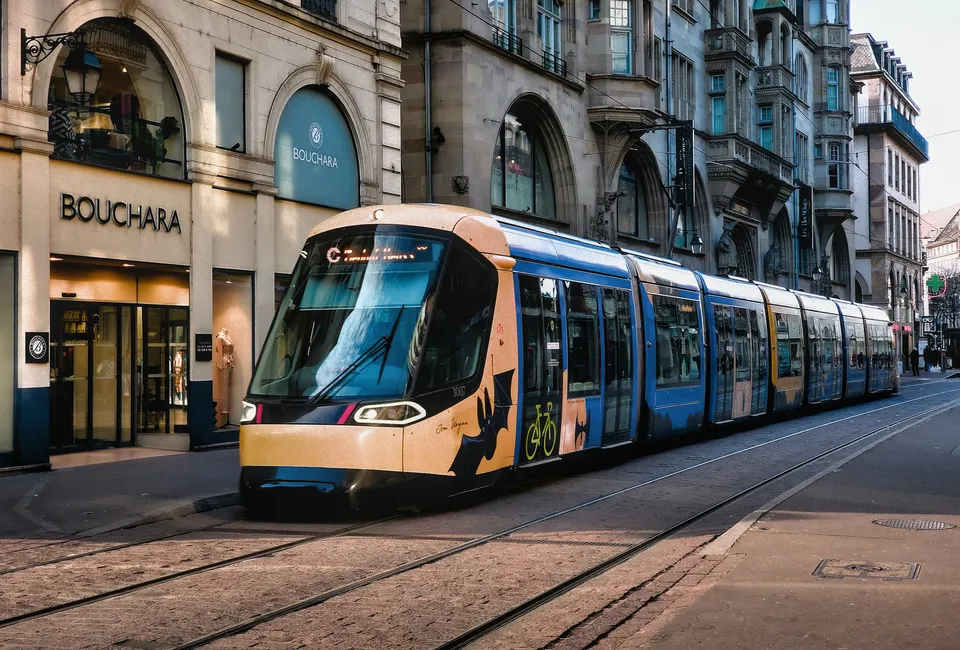
The Grande-Île is small enough to walk, and the trams of the CTS cover the rest: six lines, A to F, one of which crosses the Rhine into Germany. They run from 4:30 a.m. to 12:30 a.m. Monday to Saturday and from 5:30 a.m. on Sundays and holidays, every 5 to 10 minutes from 6:30 a.m. to 8 p.m.
| Ticket | Price | What it gives |
|---|---|---|
| Single trip | 1.90 euros in the CTS app or on a contactless ticket (0.20 euro for the card the first time); 2.50 euros bought on a bus | 1 hour, transfers included, as far as Kehl on line D |
| Contactless bank card or phone | 2.10 euros a trip | Tap on the purple validators, since November 3, 2026; up to 4 trips on one card |
| 24H Solo | 4.60 euros | 1 person, 24 hours from the first validation |
| 24H Trio | 10.20 euros | 1 to 3 people, 24 hours |
| 72H Solo | 10.20 euros | 1 person, 72 hours |
| Park and ride (P+R) | 4.20 euros a day | Parking plus buses and trams for 1 to 7 people, at 12 car parks by the tram |
Source: CTS, tickets, paying by bank card, park and ride and fines, read on November 26, 2026. Validate every time you board, on the platform before you step onto a tram; the fine for a missing or unvalidated ticket is 60 euros.
Into Germany by tram. Line D, which CTS calls France’s first cross-border tram, reached Kehl in 2017 and ends in front of Kehl’s town hall (Kehl Rathaus), the city of Kehl says. CTS tickets are valid as far as Kehl on line D; for a trip inside Kehl itself, between its station and the town hall, the German fare applies.
By bike. Strasbourg counts more than 600 kilometers of cycle routes and calls its network the first in France. The city’s Vélhop bikes, at more than 30 self-service stations, cost 1.20 euros an hour, 7 euros for up to 24 hours and 14 euros for up to 48 hours, paid in the Vélhop app, and must go back to the station they came from (25 euros otherwise).
By car. The Eurométropole is a low-emission zone (ZFE) that bans cars with no Crit’Air sticker or with a Crit’Air 4 or 5 sticker, and the rule applies to visitors too: a German environmental sticker is not enough. A car registered abroad orders its Crit’Air sticker on the government site, certificat-air.gouv.fr, for 5.11 euros; the fine is 68 euros. On October 8, 2026 the Eurométropole announced that it wants to push back by a year the ban on Crit’Air 3 cars planned for January 1, 2027, after a two-month public consultation; its ZFE page still showed the old date on November 26. For the old town, the park-and-ride car parks by the tram are simpler.
How Many Days in Strasbourg?
Two full days cover the essentials, and a third gives time for the European quarter or a day on the Wine Route. The tourist office’s own short list of must-sees is the cathedral, the Grande-Île, the Petite France, the Neustadt and the European quarter. A plan that follows it:
- Day 1, the Grande-Île: the cathedral at opening time, then the platform (and, outside the Christmas market, the clock at 12:30 p.m.), Maison Kammerzell, Place Gutenberg and Place Kléber, then the Petite France, the Ponts Couverts and the terrace of the Barrage Vauban before it closes.
- Day 2, museums and the river: the Musée de l’Œuvre Notre-Dame and the Palais Rohan in the morning, a boat tour on the Ill, then the Neustadt on foot, from Place de la République to the Palais universitaire, and dinner in a winstub.
- Day 3, Europe or the vineyards: the European Parliament and the Parc de l’Orangerie by tram E, then the tram or the footbridge to Kehl; or a train to Obernai or Colmar for the Wine Route.
In December, give the Christmas market its evenings, when the lights are on, and keep the mornings for the sights.
Staying Longer in Strasbourg
Strasbourg is also a city to stay in for a season, with Germany across the river and Colmar, Karlsruhe and Basel 26 minutes, 48 minutes and 1 hour 17 away by the fastest trains. Three rules matter once you stay beyond a holiday:
- The 90-day rule. As a visitor from a visa-exempt country such as the US, the UK, Canada or Australia, you can usually stay a maximum of 90 days within any 180-day period, according to the European Commission, and the European Union’s Entry/Exit System counts that period as one for all the countries using it, so the days you spend in Germany or Switzerland count in the same total. ETIAS, the travel authorization, is not in operation yet, and the EU says it will announce its start date several months ahead. Our guide to how long Americans can stay in France without a visa explains the count, and the Schengen calculator checks your dates. Beyond 90 days you need a long-stay visa.
- The tourist tax. The Eurométropole charges a taxe de séjour per person and per night; under-18s are exempt. In an unclassified furnished rental it is 5 percent of the pre-tax price per person and per night, plus a 10 percent departmental surcharge, capped at 5.06 euros per person per night, and booking platforms that take the payment collect it for private hosts.
- Furnished rentals. Every furnished tourist rental in Strasbourg needs a 13-character registration number, shown on every listing, even a main residence let for less than 120 days a year; beyond 120 days, or for a home that is not the owner’s main residence, the owner first needs a change-of-use permit, and the city tightened those rules for applications filed from February 1, 2026. A bail mobilité, the furnished lease of 1 to 10 months, is open only to a tenant in training, higher education, an apprenticeship, an internship, civic service, a job transfer or a temporary work assignment, service-public says, so a visitor who simply wants a winter in Strasbourg cannot sign one: our bail mobilité guide sets out the other leases.
Finding that furnished flat, calling the agencies and setting up a phone line or a bank account in French is the kind of work our Personal Assistant handles: the calls, the forms and the apartment search, in French.
FAQ
Is Strasbourg in France or Germany?
In France, in Alsace, on the Rhine facing Germany. The city joined France in 1681 and was German from 1871 to 1918, when the Neustadt was built; today tram line D crosses the Rhine to Kehl, in Germany, on a Strasbourg ticket.
Is Strasbourg worth visiting?
Yes: its whole historic center is a World Heritage site, with a Gothic cathedral that the tourist office says dominates the whole Alsace plain, the half-timbered Petite France, a German imperial district, the European Parliament, museums and a Christmas market the city dates to 1570, all 1 hour 45 minutes from Paris by train, with Germany a tram ride away and Basel 1 hour 17 by train.
When is the Strasbourg Christmas market in 2026?
From Friday, November 27 to Thursday, December 24, 2026, every day from 11:30 a.m. to 9 p.m. (from 2 p.m. on November 27, until 10 p.m. on December 11, 12, 18 and 19, and until 6 p.m. on December 24), in eight markets across the Grande-Île, according to the city. Nothing opens on December 25, and the astronomical clock’s show is suspended for the whole market.
What is the best time to visit Strasbourg?
May, June and September for walking, with highs of about 21 to 24 °C; late November and December for the Christmas market, in the cold (December averages 0.8 to 5.9 °C, with 44 hours of sunshine in the month); July and August for long, warm days around 26 °C, according to Météo-France’s normals.
How far is Strasbourg from Paris?
440 kilometers by rail: 27 trains a day from the Gare de l’Est, the fastest in 1 hour 45 minutes and 2 hours 10 on average, from 23 euros on some trains, according to SNCF Connect. Six trains a day, most of them direct, also leave Paris-Charles de Gaulle airport, the fastest in 1 hour 50.
How many days do you need in Strasbourg?
Two days for the cathedral, the Grande-Île, the Petite France, the museums and the Neustadt; three with the European quarter or a day trip on the Alsace Wine Route, to Obernai or Colmar, 29 and 26 minutes away on the fastest trains.
Conclusion
Strasbourg is two cities in one walk: the Grande-Île of the cathedral, the Petite France and the winstubs, and the Neustadt of the German empire, with Europe’s institutions a tram ride away and Germany across the Rhine. Come in May, June or September for the streets and the river, or from November 27 to December 24, 2026 for the Christmas market, and remember that the clock’s show is suspended during the market. For the rest of the country, region by region, see our guide to the best places to visit in France, for how Strasbourg compares with France’s other large cities, our guide to the cities in France, and for the sun at the other end of the country, our guide to the South of France.
The parts of the move Americans find out about too late.
What Americans get wrong about moving to France, and the number, form or deadline that fixes it. Straight to your inbox.
One email a week. Real numbers, nothing else.
Written by
Aurelio Maurici
Co-Founder, EasyFranceNow
Aurelio Maurici is a French entrepreneur and co-founder of EasyFranceNow. His work focuses on the intersection of French administration, banking constraints affecting U.S. nationals, tax residency and cross-border reporting, healthcare enrollment, and the procedural realities Americans encounter while settling in France.


