
Colmar, France: The Complete Guide from Little Venice to the Wine Route Villages

By Maxime Roseau Co-founder, Master of Business and Communication, Université Nice Sophia Antipolis
Published

In this article
- Colmar at a Glance
- A Short History of Colmar
- Little Venice and the Old Town
- La Petite Venise (Little Venice)
- A boat on the Lauch
- Three houses of the old town
- Saint-Martin and the Dominican church
- The Unterlinden Museum and the Isenheim Altarpiece
- Bartholdi and the Statue of Liberty
- The Museums of Colmar: Hours and Prices
- The Colmar Christmas Markets 2026
- Colmar Through the Year
- The Alsace Wine Route Villages Near Colmar
- Eguisheim
- Kaysersberg
- Riquewihr
- Ribeauvillé
- Other villages near Colmar
- The Christmas markets of the villages
- Alsace Wine and Where to Taste It
- The Haut-Koenigsbourg Castle
- The Weather in Colmar Month by Month
- Getting to Colmar
- By train from Paris and Strasbourg
- From Switzerland and Germany
- By air
- Getting Around Colmar and the Villages
- How Many Days in Colmar?
- Colmar or Strasbourg?
- Staying Longer in Colmar
- FAQ
- Conclusion
Colmar is the Alsace that most visitors picture: a protected old town of half-timbered houses that came through the wars virtually unscathed, flower-lined canals in Little Venice and, all around it, the vineyards and villages of the Alsace Wine Route. The prefecture of the Haut-Rhin, with 66,970 residents according to INSEE, lies between the Vosges and the Rhine, near Germany and Switzerland; its tourist office calls it “the most Alsatian city of Alsace”, and the town counts about 3.5 million visitors a year, 1.5 million of them for its Christmas markets, which run from November 23 to December 29, 2026. Direct TGV trains reach it from Paris in 2 hours 25 minutes at the fastest, and Strasbourg is 26 minutes away and Basel 40 on the fastest trains, according to SNCF Connect.
This guide covers Little Venice and the old town, the Unterlinden museum and the Isenheim Altarpiece, the birthplace of the sculptor of the Statue of Liberty, the 2026 Christmas markets, the Wine Route villages around Colmar (Eguisheim, Kaysersberg, Riquewihr, Ribeauvillé and their neighbors), Alsace wine and where to taste it, the Haut-Koenigsbourg castle, the weather month by month from Météo-France, how to get there and around without a car, and what changes if you stay longer. Every price, date and opening time was read on an official page (the town, a tourist office, the museum, the operator or the administration) on November 26, 2026.
Colmar at a Glance
| Where | Haut-Rhin, in Alsace (Grand Est region), between the Vosges and the Rhine, near Germany and Switzerland |
| Population | 66,970 (INSEE reference population 2023, in force since January 1, 2026) |
| Old town | A protected sector with a large pedestrian zone |
| From Paris | 23 trains a day, the fastest in 2 h 25, direct TGV from Paris Gare de l’Est |
| From Strasbourg and Basel | 42 trains a day from Strasbourg, from 26 minutes; 31 a day from Basel SBB, from 40 minutes |
| Nearest airports | EuroAirport Basel-Mulhouse-Freiburg (bus to Saint-Louis station, then the train); Strasbourg (train shuttle to Strasbourg station in 8 minutes) |
| Climate | 595 mm of rain and 1,882 hours of sunshine a year; -0.8 to 5.6 °C in January, 14.4 to 26.7 °C in July |
| Christmas 2026 | Six markets with 180 stalls, November 23 to December 29 |
| Best for | Christmas markets, a base for the Wine Route villages, a weekend from Paris, Strasbourg, Basel or Germany |
Sources: INSEE, reference population of Colmar; Colmar tourist office; SNCF Connect, Paris to Colmar, Strasbourg to Colmar and Basel to Colmar; Météo-France, Colmar-Meyenheim normals; Noël à Colmar, read on November 26, 2026.
A Short History of Colmar
Colmar first appears in 823, as the Carolingian estate of “Columbarium” in a charter of the emperor Louis the Pious, the tourist office’s history page says. In 1354 it took part in founding the Décapole, the league of the ten imperial towns of Alsace (the office’s page on the Koïfhus prints 1534), whose deputies met in the Koïfhus, the customs house finished in 1480, until 1678. The Treaty of Nijmegen made Colmar a royal town of France in 1679, and Voltaire spent 13 months there in 1753. With the rest of Alsace, it was annexed to the German Empire by the Treaty of Frankfurt in 1871, and French troops entered it on November 18, 1918. It was liberated on February 2, 1945, after the hard battles of the “Colmar Pocket”.
Despite the wars, the tourist office notes, Colmar remained virtually unscathed, and its streets still run from the Middle Ages to the Renaissance. Its historic center is a protected sector, restored over more than 20 years.
The parts of the move Americans find out about too late.
What Americans get wrong about moving to France, and the number, form or deadline that fixes it. Straight to your inbox.
One email a week. Real numbers, nothing else.
Little Venice and the Old Town
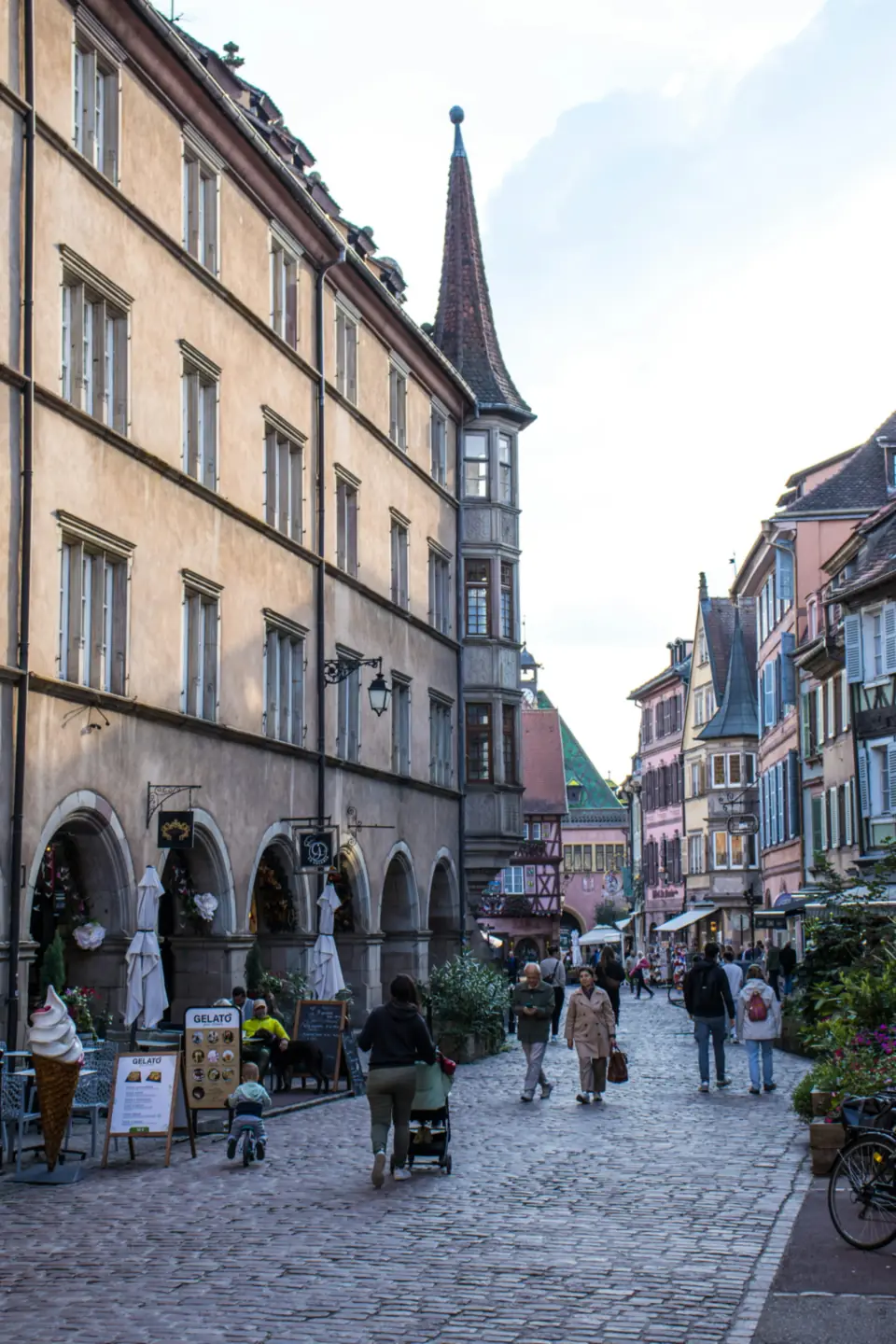
La Petite Venise (Little Venice)
“La Petite Venise” is the name given to the course of the river Lauch through Colmar, the tourist office explains, probably because of the way the houses line up on both banks. The district starts behind the Koïfhus, follows the Quai de la Poissonnerie and runs to the Turenne and Saint-Pierre bridges, at the start of the Krutenau, the old quarter of winegrowers, market gardeners and boatmen, whose name refers to the market gardens on the edge of town. The office calls Little Venice the “must” venue for photographers the world over.
The Quai de la Poissonnerie, the fishmongers’ quay, is where most of the town’s professional fishermen lived, organized with the boatmen in a powerful guild. A huge fire destroyed more than forty houses of the quarter in 1706, and the quay was restored from 1978 to 1981. Next to it, the Quartier des Tanneurs is a block of tall half-timbered houses, mostly from the 17th and 18th centuries, where tanners lived, worked and dried their skins on the open top floor; it was restored from 1968 to 1974. On the edge of Little Venice, the covered market (13 rue des Écoles), a brick and metal hall inaugurated in 1865, stands on the Lauch so that market gardeners could bring their produce by flat-bottomed boat, the town explains. Since its restoration in 2010 it is a market again, with about twenty merchants and extra stalls outside on Thursdays, open Tuesday to Thursday from 8 a.m. to 6 p.m., Friday to 7 p.m., Saturday to 5 p.m. and Sunday from 10 a.m. to 2 p.m. (closed on Mondays); a copy of Bartholdi’s statue of a young winegrower (1869) stands in its southwest niche; the original bronze has been in the Bartholdi museum since 1986. The town’s open-air markets are on Thursdays and Saturday afternoons, on the Place des Dominicains and the Place de la Cathédrale (some of them move to nearby streets during the Christmas markets).
A boat on the Lauch
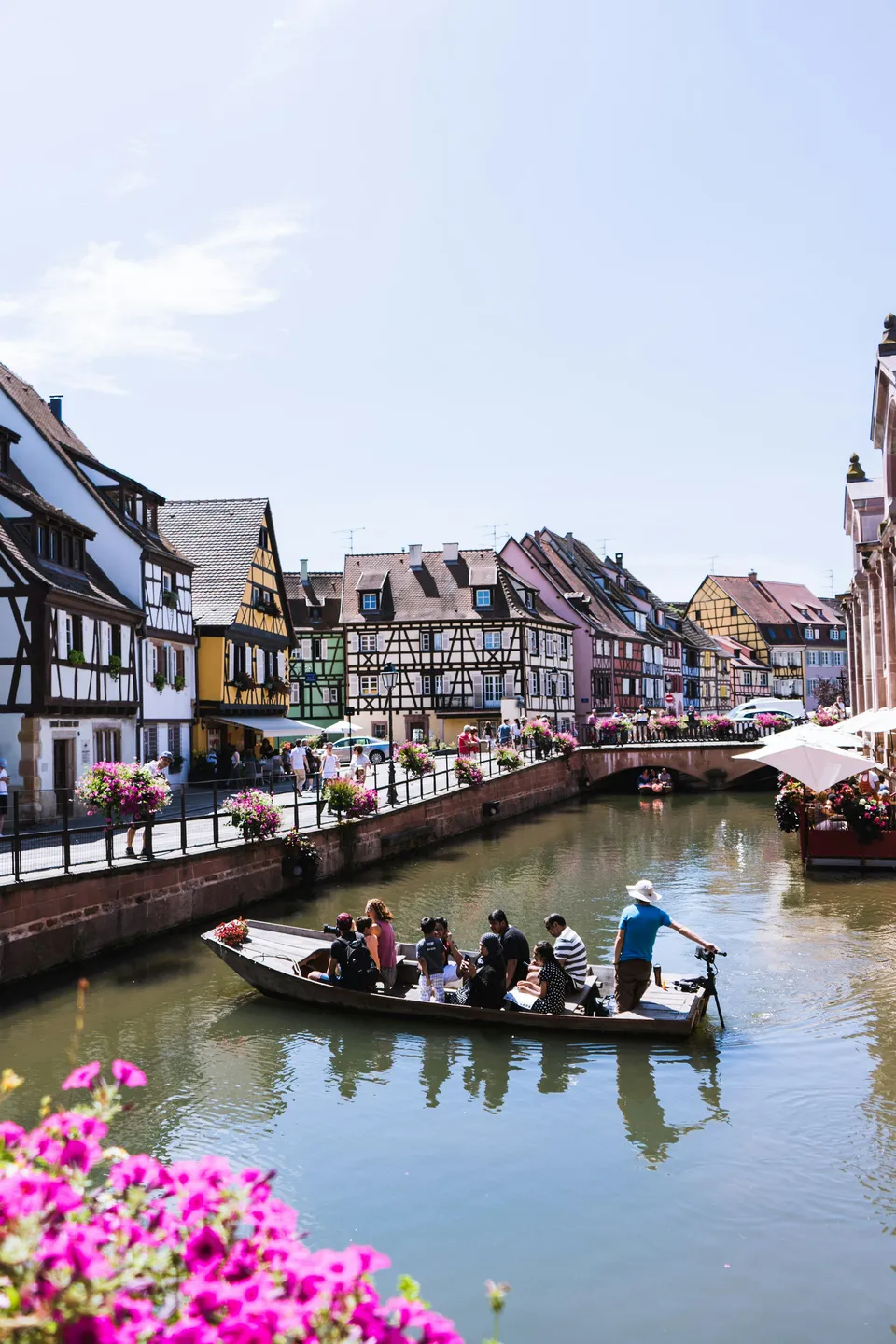
Sweet Narcisse runs guided trips of about 25 minutes on flat-bottomed electric boats through Little Venice and along the Quai de la Poissonnerie, past the market gardeners’ quarter, with commentary in French, English or German. Its booking page shows 9 euros for adults and 4 euros for children aged 4 to 10, free under 3 (the tourist office lists 10 and 5 euros), and gives daily hours of 10 a.m. to 11:45 a.m. and 1:30 to 6 p.m.; neither the operator nor the tourist office publishes its season dates. Boats leave from the foot of the Pont Saint-Pierre, 10 rue de la Herse, next to the Caveau Saint-Pierre restaurant.
Three houses of the old town
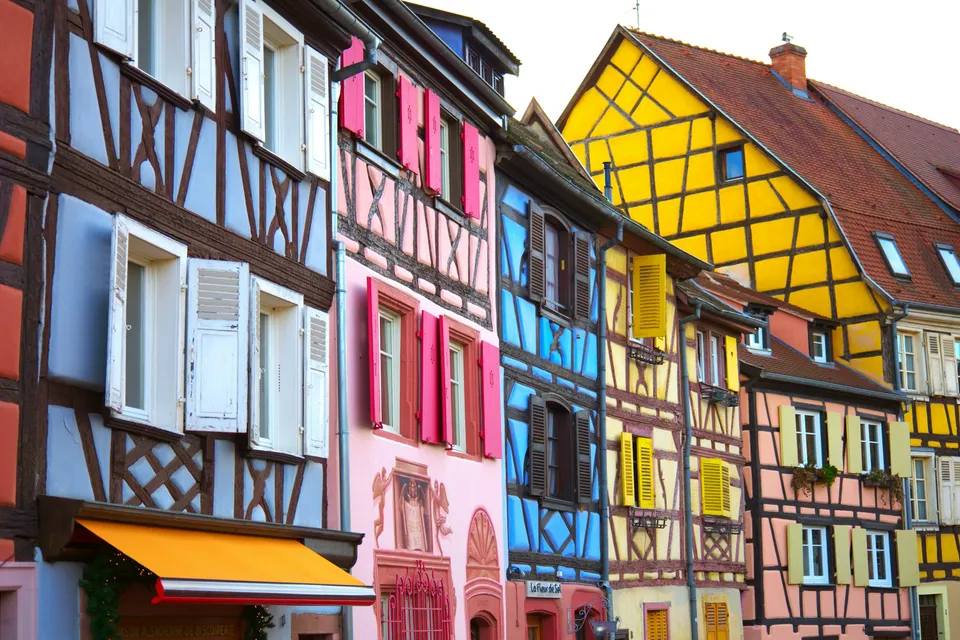
Three houses sum up the old town. The tourist office’s fact sheets describe them:
- The Maison des Têtes (House of the Heads, 19 rue des Têtes), built in 1609 for the merchant Anton Burger and attributed to the architect Albert Schmidt, owes its name to the grotesque heads and masks of its façade, with a three-story oriel window: 106 heads, according to the town and the tourist office’s fact sheet, or 111, according to other pages of the office. It has been a listed historic monument since 1898. The cooper on its gable is a statue of 1902 by Auguste Bartholdi, ordered by the Wine Exchange, which moved into the building in 1898.
- The Maison Pfister (11 rue des Marchands), built in 1537 for a merchant (the town says he came from Besançon, the tourist office names the hatter Ludwig Scherer), is the first example of Renaissance architecture in Colmar, with a two-story corner oriel, a wooden gallery, an octagonal turret and wall paintings of biblical and secular scenes. It takes its name from the family that owned it in the second half of the 19th century.
- The Koïfhus, or old customs house, at the meeting of the Grand’Rue and the rue des Marchands, is the oldest public building in town. Finished in 1480, it stored and taxed the goods that came in and out on its ground floor, and the deputies of the Décapole met upstairs.
The Maison Adolph (16 Place de la Cathédrale), built about 1350, is considered one of the oldest houses in Colmar. The office also points to the Palais du Conseil Souverain, whose neo-classical façade dates from 1771, and the old hospital of 1744.
Saint-Martin and the Dominican church
The Collégiale Saint-Martin, built from 1235 to 1365, is a major work of Gothic architecture in Alsace; its choir, by Wilhelm von Marburg, was finished in the middle of the 14th century. A fire destroyed the roof and the top of its south tower in 1572, and the bulb-shaped lantern that replaced it three years later gives the church its outline. The people of Colmar call it their cathedral, from the German “Münster”, but it was one only from 1790 to 1801. It is open Monday to Saturday from 8 a.m. to 6:45 p.m., and Sundays and holidays from 10 a.m. to 7 p.m., except during services.
The Église des Dominicains, begun in 1283, the tourist office says (1289, says its parish), and finished in 1346, has held Martin Schongauer’s masterpiece, the Virgin of the Rose Bush (La Vierge au buisson de roses), since 1973. Schongauer painted it in 1473 for Saint-Martin; it was stolen in 1972 and found by chance the next year, the parish recounts. The church’s 14th-century stained glass lights up at night. It opens Tuesday, Thursday and Sunday from 10 a.m. to 1 p.m. and 3 to 6 p.m., Wednesday from 3 to 6 p.m., and Friday and Saturday from 10 a.m. to 6 p.m., and it is closed every year from January to March, until Palm Sunday, according to the parish (the City Pass site gives other dates: open from March 5 to 31 and from July 24 to December 30). Entry costs 2 euros, 1 euro from 12 to 18, free under 12. The Protestant church of Saint-Matthieu, the former Franciscan church begun in 1292, hosts the symphonic concerts of the International Festival.
From nightfall on Fridays and Saturdays all year, and every evening during the International Festival, the Wine Fair and Christmas, computer-driven lights pick out the old town: 1,100 light sources, the tourist office says, or 1,150, according to the Christmas site, which adds that Colmar was the first town in France to light its heritage on this scale.
The Unterlinden Museum and the Isenheim Altarpiece
The masterpiece of the Musée Unterlinden, the Isenheim Altarpiece, is a monumental polyptych made between 1512 and 1516 by the painter Grünewald and the sculptor Niclaus of Haguenau, one of the masterpieces of late Gothic art, the museum says. It was fully restored from 2018, a project completed in late June 2022, and it is still shown in the chapel of the convent.
The museum takes its name from the convent that two noblewomen founded about 1230 in a district northwest of the city known as “Sub tilia”, under the linden trees. The nuns left in 1793, the buildings became a barracks, and the city archivist Louis Hugot saved them from demolition by turning them into a museum, which opened on April 3, 1853. After an international competition launched in 2009, the Basel architects Herzog & de Meuron added a new building, the Ackerhof, linked to the convent by an underground gallery under the Place Unterlinden; the tourist office dates the extension to 2015. The collections cover nearly 7,000 years, from prehistory to the 20th century, with Schongauer, Holbein and Cranach in the medieval cloister, Monet, de Staël, Picasso and Dubuffet in the contemporary wing, and the Guernica tapestry woven by Jacqueline de la Baume-Dürrbach after Picasso.
The museum is open Wednesday to Monday from 9 a.m. to 6 p.m. (last entry 5:30 p.m.), closed on Tuesdays and on January 1, May 1, November 1 and December 25, and it closes at 4 p.m. on December 24 and 31. Admission costs 14 euros (17 euros with the audioguide), 12 euros reduced, 9 euros for ages 12 to 17 and students under 30, 36 euros for a family, and it is free under 12 and for holders of the Museums-PASS-Musées.
This winter, from November 25, 2026 to January 3, 2027, the museum stays open until 7 p.m. and screens “Once Upon a Night”, a sound and light show of about 10 minutes in the cloister, every 15 minutes from 5 p.m. to 6:30 p.m. (not on Tuesdays, nor on December 24, 25 and 31 and January 1). From 4 p.m. a ticket costs 8 euros from age 12, free under 12, and gives access to the museum until 7 p.m. and to every show of the day.
Bartholdi and the Statue of Liberty
Auguste Bartholdi (1834-1904), the sculptor of the Lion of Belfort (1880) and the Statue of Liberty (1886), was born in Colmar. Since 1922, the house where he was born, at 30 rue des Marchands, has been the Bartholdi museum: family furniture, personal souvenirs, models, drawings, paintings, engravings and photographs on three floors, from his monument to Admiral Bruat to the Statue of Liberty. It is open from February 3 to December 31, Tuesday to Sunday, 10 a.m. to noon and 2 to 6 p.m. (3:30 p.m. on December 24 and 31), closed on Mondays, through January and on May 1, November 1 and December 25. Admission costs 5 euros, and it is free under 18 and, for every visitor, on July 4, the American national holiday. In 2026, the 140th anniversary of the statue’s inauguration in New York on October 28, 1886, 70 of the works in the Musée d’Orsay’s Bartholdi exhibition in Paris (September 15, 2026 to January 31, 2027) come from its collections.
His work is all over town: the fountain of Admiral Bruat (1864), the Roesselmann fountain (1888), the cooper on the Maison des Têtes (1902) and the Schwendi fountain (1898) on the Place de l’Ancienne Douane, whose bronze Lazare de Schwendi holds up the Tokay grape that legend says he brought to Alsace. His first public monument, the statue of General Rapp on the Place Rapp, was inaugurated in 1856; the Nazi occupiers toppled it in 1940, and it was put back on an identical base in 1948. The town dedicated a monument to Bartholdi himself in 1907, in the park of the Château d’Eau, and at the northern entrance of Colmar, on the route de Strasbourg, a 12-meter replica of the Statue of Liberty in composite material, by Guillaume Roche and Pascal Bigel, has stood since 2004, the centenary of his death. Colmar has been twinned with the university town of Princeton since 1986.
The Museums of Colmar: Hours and Prices
| Museum | What it holds | Opening, as published | Adult price |
|---|---|---|---|
| Musée Unterlinden | The Isenheim Altarpiece, a 13th-century convent and its cloister, 7,000 years of art | Wednesday to Monday, 9 a.m. to 6 p.m. (to 7 p.m. from November 25, 2026 to January 3, 2027); closed Tuesdays | 14 euros; free under 12 |
| Musée Bartholdi | Bartholdi’s birthplace, models of his monuments, the Statue of Liberty | February 3 to December 31, Tuesday to Sunday, 10 a.m. to noon and 2 to 6 p.m.; closed in January and on December 25 | 5 euros; free under 18, and for all on July 4 |
| Musée du Jouet (toy museum), 40 rue Vauban | Toys, and a train network across the whole third floor | 10 a.m. to 5 p.m. except Tuesdays from January to November; every day 10 a.m. to 6 p.m. in July, August and December and in the short French school vacations; closed January 1, May 1, November 1 and December 25 | 6.50 euros, children 5 euros; free under 8 |
| Église des Dominicains | Schongauer’s Virgin of the Rose Bush | Tuesday to Sunday; closed from January to Palm Sunday | 2 euros; free under 12 |
Sources: Musée Unterlinden, hours and prices; Musée Bartholdi, hours and prices; Colmar tourist office, toy museum; Catholic parish of Colmar, Dominican church, read on November 26, 2026.
The tourist office sells a Colmar City Pass for 48 euros: one visit to each of 9 museums and sites (Unterlinden, Bartholdi, the toy museum and the Dominican church among them), one boat trip and one ride on a little tourist train. Its terms make it valid for 4 days from its first use (a heading of the tourist office’s page says 7 days), it does not let you skip lines, and from January to March several of its sites are closed. During the Christmas markets, the ride on the little green tourist train is replaced by two guided tours a day, at 11 a.m. and 5 p.m., in French only, the City Pass site says. Visitors who also cross into Germany and Switzerland can look at the Museums-PASS-Musées, 129 euros for a year in more than 350 museums, castles and gardens of the three countries, for one adult and up to five children.
The Colmar Christmas Markets 2026
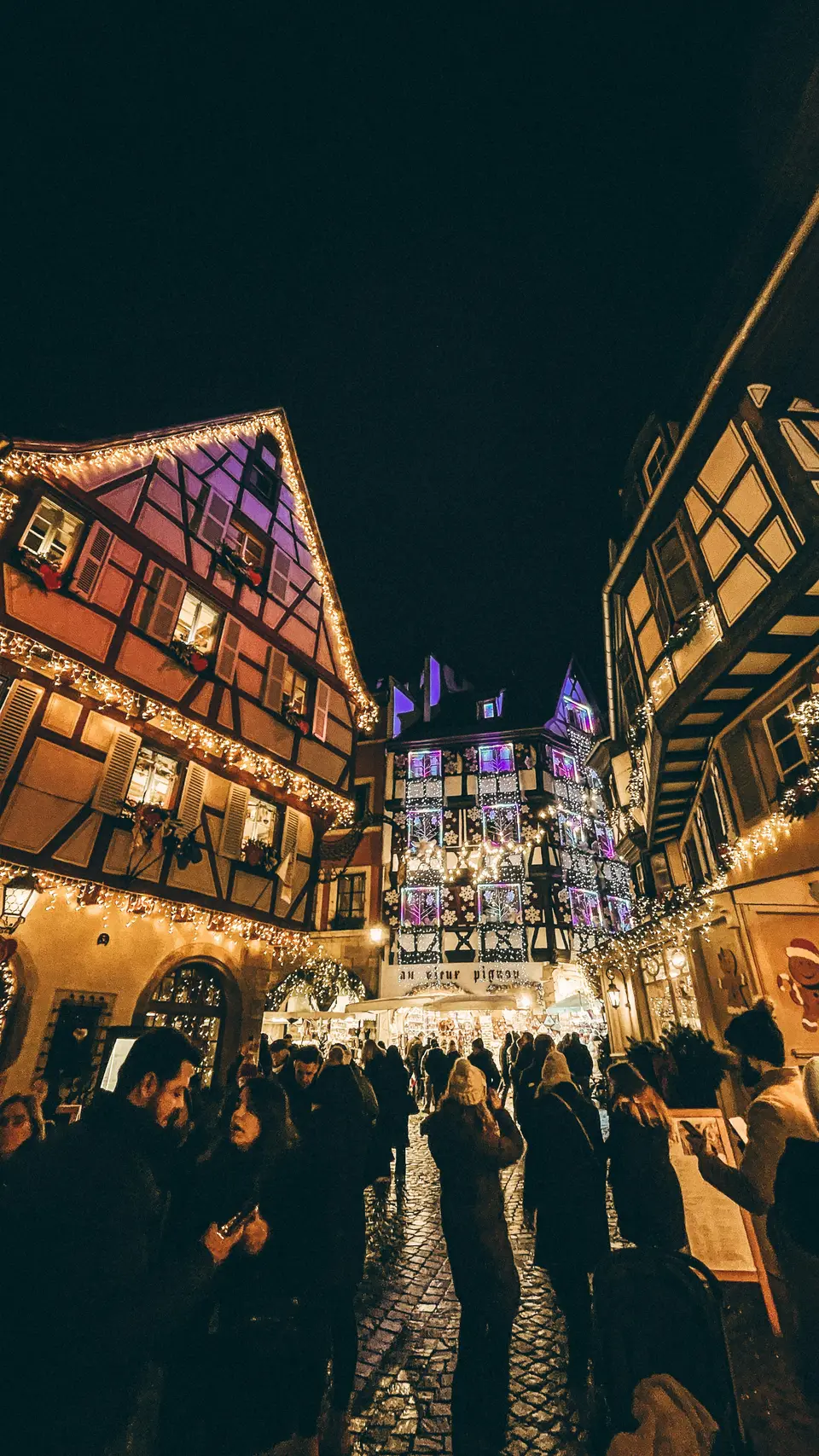
For six weeks the old town becomes one large Christmas market: six markets and 180 stalls, from November 23 to December 29, 2026, organized by the tourist office with the town, most of the exhibitors from Alsace and chosen for the quality of what they sell.
| Market | Where | What, as published |
|---|---|---|
| Place des Dominicains | Around the Dominican church, whose stained glass lights up at night | About sixty wooden chalets |
| Place de l’Ancienne Douane | Around the Schwendi fountain, on both banks of the Lauch, up to the porch of the Koïfhus | About fifty chalets |
| Place Jeanne d’Arc | Local products in the setting of an Alsatian village: foie gras, cold cuts, wine, schnapps, bredalas (Christmas cookies) | |
| Petite Venise (Place des Six Montagnes Noires) | Little Venice | The children’s market: 43 colorful cottages, a merry-go-round and a giant mailbox for Santa Claus |
| The Koïfhus (29 Grand Rue) | Indoors | Crafts by about twenty local makers |
| Gourmet market | Plateau sportif de la Montagne Verte, 2 rue de la Montagne Verte | 9 cabins and 9 chefs, open every day from 11 a.m. to 10 p.m. until January 3, 2027 (5 p.m. on December 31) |
Source: Noël à Colmar, the six markets, practical information and gourmet market, read on November 26, 2026. One English page of the site still places the gourmet market on the Place de la Cathédrale; its other pages say the Montagne Verte.
What to know before you go:
- Hours: Monday to Thursday 11 a.m. to 7 p.m., Friday to Sunday 10 a.m. to 8 p.m.; December 24, 11 a.m. to 5 p.m.; December 25 and 26, 10 a.m. to 8 p.m. (some market pages give 11 a.m. on December 26). For safety reasons the markets close exactly on time. December 26 is a public holiday in Alsace, service-public notes.
- After December 29: the gourmet market, the Ferris wheel (10 euros, 8 euros for children under 1.20 m) and the Christmas fair on the Place Rapp stay open until January 3, 2027, every day from 11 a.m. to 10 p.m. (5 p.m. on December 31).
- Getting in: the first market is about a 12-minute walk from the train station, which has a Christmas information point. During market hours the town center is closed to all vehicles. On weekends (November 28 and 29, December 5, 6, 12, 13, 19 and 20), a park and ride at the Parc des Expositions costs 5 euros a day, with the bus to the center included.
- Shops open on the Sundays of November 29 and December 6, 13 and 20.
- Guided tours: the tourist office’s 90-minute tour of Christmas Colmar is listed in French, from 10:30 a.m. to noon, between November 23 and December 31, for 10 euros; on November 26 its booking page offered tours in French and German only, although the Christmas site still mentions a tour in English (7 euros, 5 euros from 12 to 18) whose booking page could not be opened that day.
The Christmas site also asks visitors to follow a short charter of respect for residents. One of its five points says it plainly: “Too crowded? I’ll come back later.”
Colmar Through the Year
Christmas is the peak, but the calendar has other high points, all on the official pages:
| When | What |
|---|---|
| March 19 to April 11, 2027 | Spring and Easter markets on the Place des Dominicains and the Place de l’Ancienne Douane, every day from 10 a.m. to 7 p.m. |
| April to October | Wine festivals in the villages, in turn; Turckheim’s night watchman makes his round every evening at 10 p.m. from May 1 to October 31 |
| July | The Colmar International Festival of classical music, founded in 1979 (July 5 to 14 in 2026; the 2027 dates are not yet published) |
| July 30 to August 8, 2027 | The Alsace Wine Fair, the 78th, with concerts in its open-air theater |
| First Sunday of September | The Pfifferdaj, the minstrels’ festival of Ribeauvillé |
| November 23 to December 29, 2026 | The Christmas markets, and those of the villages from November 27 |
Sources: Colmar celebrates Spring; Festival international de Colmar; Foire aux Vins d’Alsace; CIVA, the Wine Route; Turckheim, the night watchman; Ribeauvillé and Riquewihr tourist office, read on November 26, 2026.
The Alsace Wine Route Villages Near Colmar
The Alsace Wine Route (Route des Vins d’Alsace) runs for 170 km at the foot of the Vosges, from Marlenheim in the north to Thann in the south; it was inaugurated in 1953 and is one of the oldest wine routes in France, the Alsace wine council (CIVA) says. Colmar sits in the middle of it, and the tourist office counts 37 wine communes and 30 Grands Crus in the Colmar wine country. Six Alsace villages belong to Les Plus Beaux Villages de France, the association of the most beautiful villages of France, and four of them are near Colmar: Eguisheim, Riquewihr, Hunawihr and Bergheim (the other two, Hunspach and Mittelbergheim, are in the Bas-Rhin).
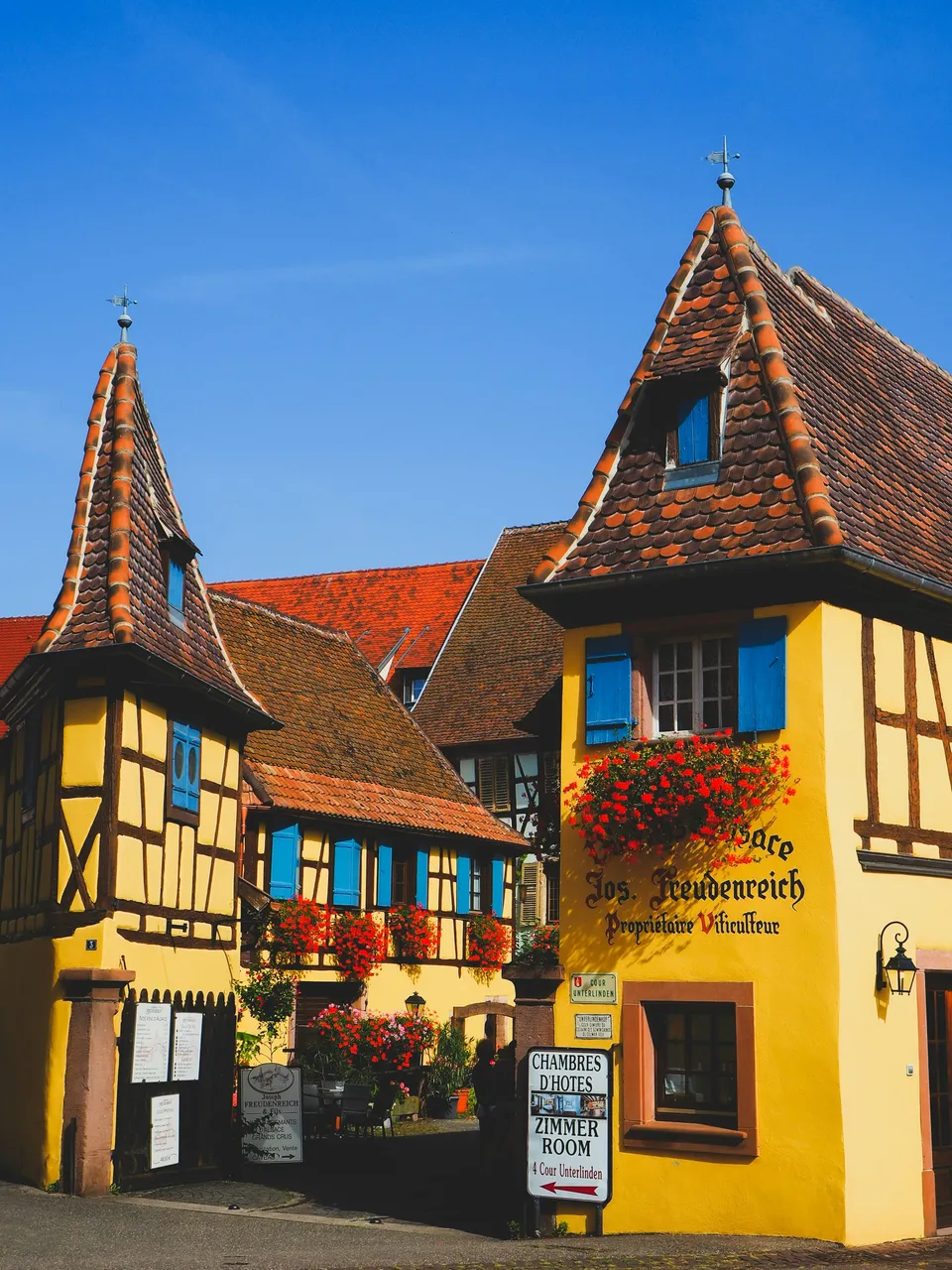
Eguisheim
Just south of Colmar, Eguisheim is built in concentric circles around its castle, with fountains, old courtyards and a church that holds a 13th-century “Vierge Ouvrante”, an opening statue of the Virgin. It has been one of the Plus Beaux Villages de France since 2003 and won the title of “Village préféré des Français” (France’s favorite village) on the France 2 program presented by Stéphane Bern in 2013, its tourist office says. Bruno of Eguisheim, born in 1002, became Pope Leo IX; the neo-Romanesque chapel of Saint-Léon, consecrated in 1894 on the site of the old keep, holds his relics and is open from 8 a.m. to 6 p.m. A self-guided trail of 9 enameled lava panels, “Entrez dans la ronde”, circles the village (booklet 3 euros at the tourist office). Above it, the Three Castles (Trois Châteaux) of Husseren-les-Châteaux, three pink sandstone keeps at 591 meters, are free to visit; from November 15 to March 15 you can reach them only on foot. Regular bus line 830 links Colmar, Eguisheim and Rouffach.
Kaysersberg
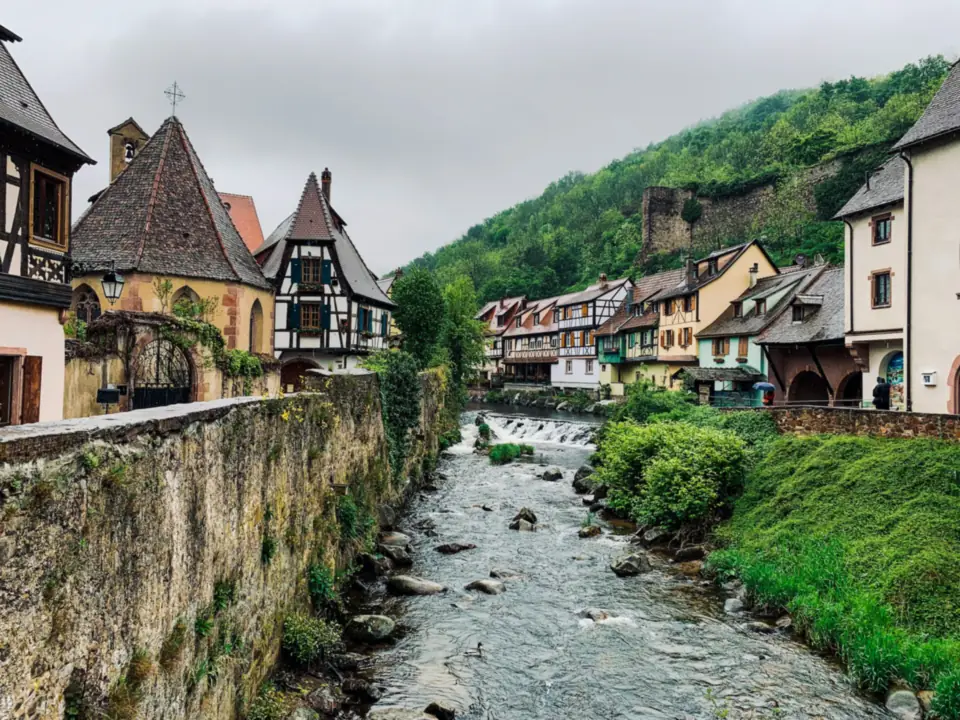
Kaysersberg (in the commune of Kaysersberg Vignoble) was voted France’s favorite village in 2017, its tourist office says. The river Weiss runs through it, under a fortified bridge watched over by a 13th-century castle; the castle is free, open every day from 9 a.m. to 6 p.m., and 122 steps lead to the top of its round keep, one of the oldest in Alsace, for the view over the Schlossberg Grand Cru and, on clear days, Germany’s Black Forest. The church of Sainte-Croix holds a carved wooden altarpiece of 1518. Albert Schweitzer, the doctor who won the 1952 Nobel Peace Prize, was born in Kaysersberg on January 14, 1875; the Centre Schweitzer, in his birthplace at 126 rue du Général de Gaulle, opened in 2023 and is open Wednesday to Monday, 10:30 a.m. to 1 p.m. and 2 to 5:30 p.m. (closed in January, on May 1 and on December 25 and 26): 7 euros, free under 18. Bus line 813 links Colmar and Kaysersberg from Monday to Saturday, but not on Sundays or public holidays. If you drive, winter equipment is compulsory in Kaysersberg Vignoble from November 1 to March 31, whatever the weather.
Riquewihr
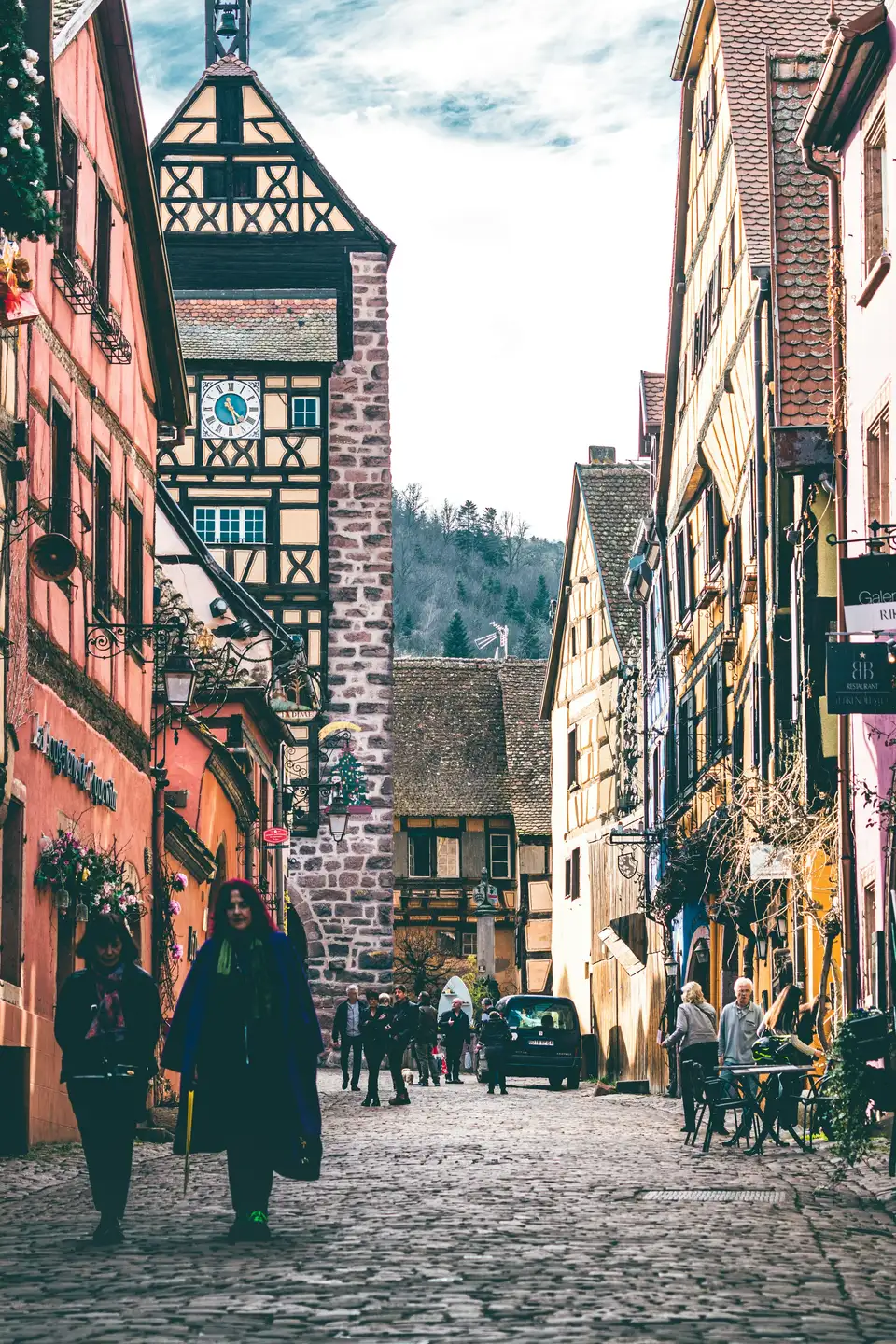
Riquewihr, “the pearl of the Alsace vineyard”, is a medieval town among the vines and one of the Plus Beaux Villages de France, its tourist office says: half-timbered houses from the 13th to the 18th century, packed tight inside walls that only the vines besiege today, and the Dolder, a town gate of the 13th century whose museum tells the life of a fortified town from the 13th to the 17th century and ends on a view over the roofs. The Thieves’ Tower, the old prison, is the second museum, visited with a 16th-century winegrower’s house. Two Grands Crus, Schoenenbourg and Sporen, climb the slopes above it. The two museums open from April to October (in 2026, April 3 to October 31): the Thieves’ Tower every day for 5 euros, the Dolder, dated 1291 and 1565, on weekends and holidays and every day from July 4 to August 30, for 3 euros (7 euros for both, free under 15 with an adult); this winter the Dolder also opens on the four Advent weekends and on December 21 to 23, from 11 a.m. to 5 p.m.
Ribeauvillé
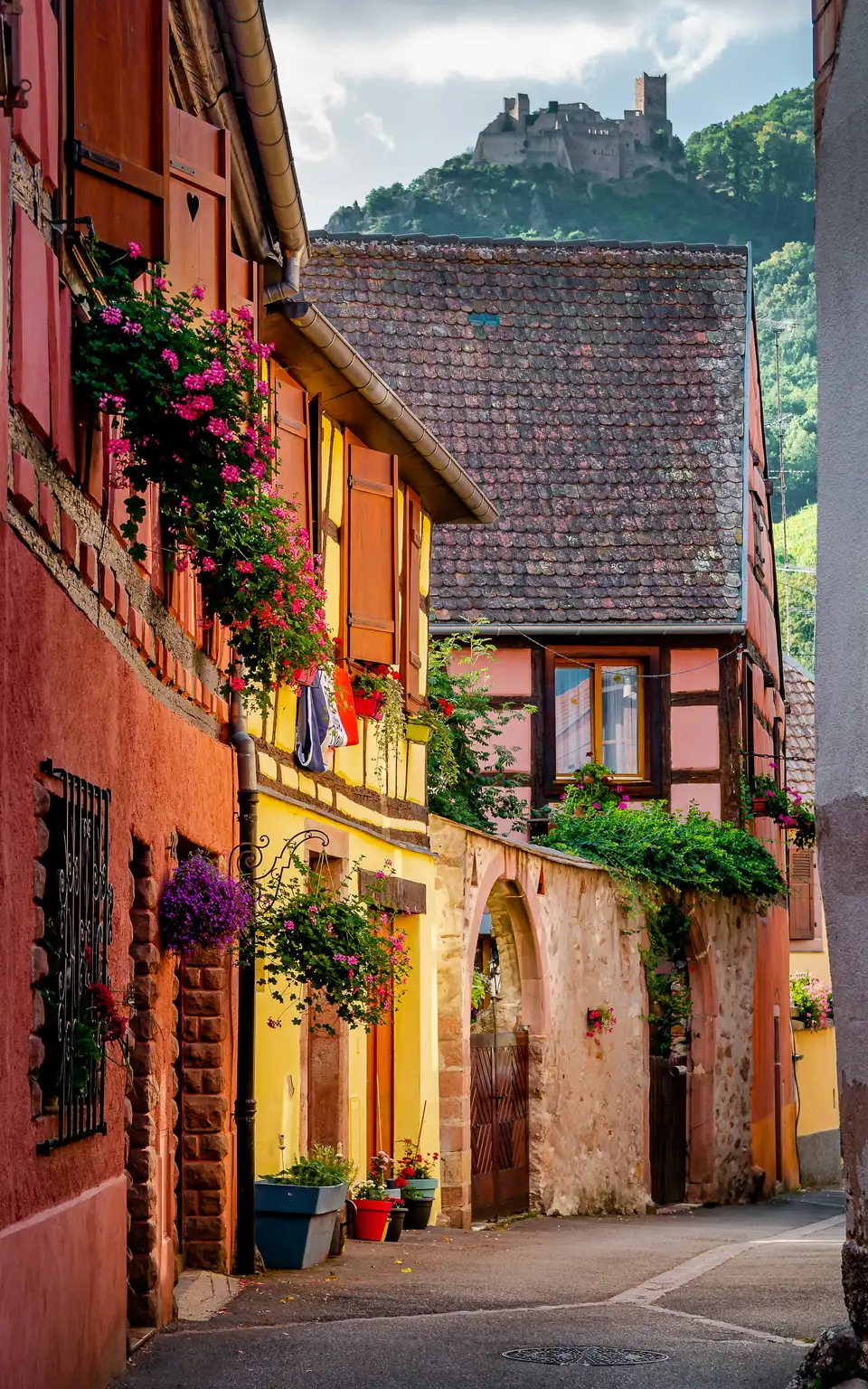
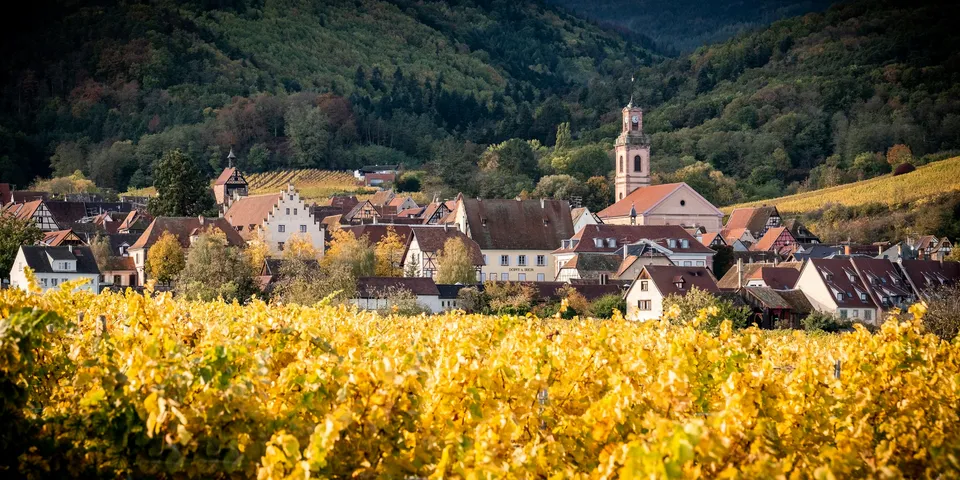
Ribeauvillé, 20 minutes from Colmar by car, was the seat of the lords of Ribeaupierre, who built the three castles whose ruins still stand above it: Saint-Ulrich, the oldest and largest, Girsberg, and Haut-Ribeaupierre, the highest, all reached by a hiking trail. In town, look for the 13th-century Butchers’ Tower (rebuilt in the 18th century), the 18th-century town hall and its silver drinking cups, and the house of the minstrels, with a façade dated 1683. On the first Sunday of September the town holds the Pfifferdaj, the minstrels’ festival and the oldest festival in Alsace, which recalls the guild of Alsace’s musicians that met here from 1481.
Other villages near Colmar
- Hunawihr, one of the Plus Beaux Villages de France, has a 15th-century fortified church inside a fortified cemetery, which served as a keep where villagers took refuge. The NaturOparC, a 5-hectare animal park among the vines, began in 1976 with the reintroduction of the stork and now also works for the otter and the European hamster; it is closed for the winter and reopens on March 20, 2027 (adults 12.50 euros in 2026).
- Bergheim, voted France’s favorite village in 2022, has kept almost all of its 14th-century walls (a walk of an hour around them) and a museum of the witch trials of the 16th and 17th centuries, open from late June to October.
- Turckheim, an imperial town from 1312 and a member of the Décapole from 1354, keeps three town gates and the round of “the last night watchman of Alsace”: from May 1 to October 31, every evening at 10 p.m., a watchman in a tricorn hat, with halberd, horn and lantern, sets off from the 16th-century guardhouse. Turckheim is easy to reach from Colmar without a car: Trace buses A and C go there, and so does the TER from Colmar to Metzeral.
The Christmas markets of the villages
| Village | Dates in 2026 | Hours, as published |
|---|---|---|
| Eguisheim | Every day from November 27 to December 30, except December 24, 25 and 26 | Friday to Sunday 10 a.m. to 7 p.m.; Monday to Thursday noon to 7 p.m. until December 10, then 10 a.m. to 7 p.m. |
| Kaysersberg | The four Advent weekends, Friday to Sunday: November 27 to 29, December 4 to 6, 11 to 13 and 18 to 20 | 10 a.m. to 8 p.m. |
| Riquewihr | Every day from November 27 to December 20 | Monday to Friday 10 a.m. to 6:30 p.m.; weekends 10 a.m. to 7 p.m. |
| Ribeauvillé (medieval market) | December 5 and 6, 12 and 13 | Saturday 10 a.m. to 7 p.m.; Sunday 10 a.m. to 6 p.m. |
| Turckheim | November 27 to December 30, closed December 25 | 10 a.m. to 7 p.m. (8 p.m. on Saturdays until December 19); 6 p.m. on December 24 and 30 |
| Bergheim | November 27 to 29 and December 2 to 6 | Wednesday to Friday 4 to 9 p.m.; Saturday 10 a.m. to 9 p.m.; Sunday 10 a.m. to 8 p.m. |
| Neuf-Brisach (a village of the year 1700) | December 11 to 13 |
Source: Noël à Colmar, Christmas in the villages, village pages for Eguisheim, Kaysersberg, Riquewihr, Ribeauvillé, Turckheim, Bergheim and Neuf-Brisach, read on November 26, 2026. The regional tourism board’s page for Riquewihr starts its market on November 28.
On weekends, Riquewihr, Ribeauvillé and Kaysersberg run park-and-ride lots with shuttles to their markets, from 4 to 10 euros per car. The simplest way in, though, is the Christmas shuttle (navette de Noël) from Colmar station, from November 27 to December 20, 2026, with a day ticket for unlimited rides:
- Lines 1 and 2, Colmar, Kaysersberg, Ribeauvillé and Riquewihr in a loop: Friday to Sunday only, hourly on Fridays and every 30 minutes on weekends, 17 euros.
- Line 3, Colmar to Eguisheim (about 20 minutes): 8 euros Monday to Thursday, 17 euros Friday to Sunday.
- Line 4, Colmar, Turckheim and Munster (Friday to Sunday only, hourly), and line 5, Colmar to Neuf-Brisach (December 12 and 13 only): 17 euros, or 10 euros with the explorer ticket.
Tickets are sold online only, in limited numbers (more go back on sale three days before each day), and children under 12 ride free with a free ticket that must be booked.
Alsace Wine and Where to Taste It
Colmar has officially carried the name of “capital of Alsace wines” since 1999, and the wine council of Alsace has its seat there. Alsace names its wines after the grape, not the village, and its vineyard is the only one in France whose wines are mostly white, the Ribeauvillé and Riquewihr tourist office says. It counts seven grape varieties: six whites, Sylvaner, Pinot Blanc, Riesling, Muscat, Pinot Gris and Gewurztraminer, and Pinot Noir, made as a rosé or a red. Riesling goes with fish, shellfish and choucroute, Pinot Gris with foie gras, and Gewurztraminer with strong cheeses and desserts, the office suggests. According to the CIVA:
- AOC Alsace, recognized in 1962, makes more than 70 percent of the wine, 90 percent of it white, always sold in the tall “flûte d’Alsace” bottle and bottled in the region since 1972. A blend of white grapes is sometimes called Edelzwicker.
- Crémant d’Alsace, the sparkling wine, defined in 1976, makes a quarter of the production.
- The 51 Grands Crus, hillside vineyards between 200 and 400 meters classified from 1975 to 2007, make about 5 percent; only Riesling, Muscat, Pinot Gris and Gewurztraminer are allowed in them, with a few exceptions.
- Vendanges Tardives (late harvest), a mention used since 1984, are rich sweet wines from overripe grapes, and Sélection de Grains Nobles, also since 1984, are lusciously sweet wines from grapes touched by noble rot and picked by hand. The Ribeauvillé and Riquewihr tourist office adds that Vendanges Tardives come only from Gewurztraminer, Pinot Gris, Riesling or Muscat.
Unlike in other vineyards, the wineries sit inside the villages, along the Route, and most of their tasting cellars (caveaux) are open all year, the CIVA says; some run wine schools, commented tastings and food pairing workshops. In Eguisheim, the tourist office suggests a typical caveau for a commented tasting of the seven grapes; around Riquewihr, its neighbor office promises a meeting with the winemaker, know-how and a tasting. From April to October the villages take turns holding wine festivals, where the tourist office says entry costs about 5 euros, and Colmar holds the Alsace Wine Fair every summer (July 30 to August 8 in 2027). For the history, the wine museum of Kientzheim, near Kaysersberg, is in the Château Schwendi.
The Haut-Koenigsbourg Castle
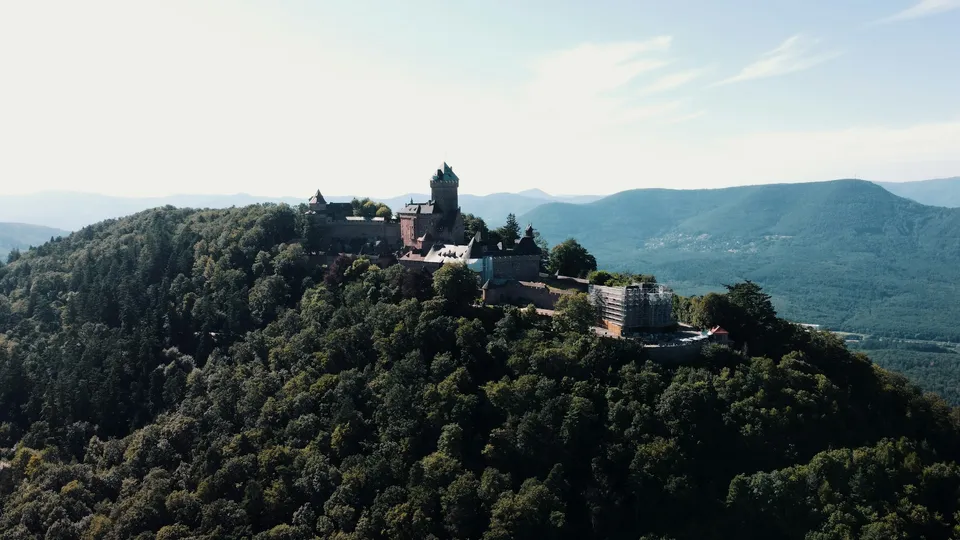
Above the wine village of Orschwiller, the Château du Haut-Koenigsbourg stands at 755 meters and dominates the whole plain, the regional tourism board says; it is one of the most visited monuments of Alsace, with more than half a million visitors a year, according to the Sélestat tourist office, and is run by the Collectivité européenne d’Alsace. Its own ticket office promises “900 years of history”.
- When: every day of the year except January 1 and December 25 and 26. Until December 31, 2026, the Sélestat tourist office gives hours of 9:30 a.m. to noon and 1 to 4 p.m. (from 10:30 a.m. on Mondays), so arrive by 3 p.m.; for a date in 2027, check the hours before you go.
- Price: 12 euros, 8 euros from 6 to 17, free under 6, 30 euros for a family of two adults and two children; free for everyone on the first Sunday of each month from November to March.
- The visit: self-guided, 45 minutes to 2 hours, with 300 steps; strollers are not allowed inside. The Sélestat tourist office advises buying tickets online at busy times, and the ticket office advises printing them in advance.
- Getting there: the castle is 12 km from Sélestat station, the tourist office says.
Sources: Château du Haut-Koenigsbourg, ticket office; Sélestat Haut-Koenigsbourg tourist office; Visit Alsace, read on November 26, 2026.
The Weather in Colmar Month by Month
Colmar lies in one of the driest regions of France, its tourist office says, with about 500 mm of rain a year; Météo-France’s climate normals for its Colmar-Meyenheim station, averages for 1991 to 2020, give 595 mm:
| Month | Average low | Average high | Rain | Sunshine |
|---|---|---|---|---|
| January | -0.8 °C (31 °F) | 5.6 °C (42 °F) | 33.1 mm | 71 h |
| February | -0.7 °C (31 °F) | 7.6 °C (46 °F) | 30.6 mm | 99 h |
| March | 1.9 °C (35 °F) | 12.6 °C (55 °F) | 34.0 mm | 156 h |
| April | 5.1 °C (41 °F) | 17.1 °C (63 °F) | 42.8 mm | 189 h |
| May | 9.4 °C (49 °F) | 21.0 °C (70 °F) | 69.8 mm | 210 h |
| June | 12.9 °C (55 °F) | 24.7 °C (76 °F) | 66.2 mm | 234 h |
| July | 14.4 °C (58 °F) | 26.7 °C (80 °F) | 62.8 mm | 251 h |
| August | 14.0 °C (57 °F) | 26.5 °C (80 °F) | 60.8 mm | 233 h |
| September | 10.2 °C (50 °F) | 22.0 °C (72 °F) | 51.3 mm | 181 h |
| October | 6.7 °C (44 °F) | 16.3 °C (61 °F) | 56.8 mm | 122 h |
| November | 2.7 °C (37 °F) | 9.8 °C (50 °F) | 43.6 mm | 72 h |
| December | 0.2 °C (32 °F) | 6.3 °C (43 °F) | 43.2 mm | 63 h |
| Year | 6.3 °C (43 °F) | 16.4 °C (62 °F) | 595.0 mm | 1,882 h |
Source: Météo-France, Colmar-Meyenheim climate normals 1991-2020, read on November 26, 2026. Fahrenheit figures are converted from the Celsius values; monthly sunshine hours are rounded.
What the table means for a trip:
- Drier and sunnier than Strasbourg: 595 mm of rain and 1,882 hours of sunshine a year at Colmar-Meyenheim, against 635.7 mm and 1,747 hours at Strasbourg-Entzheim, on Météo-France’s figures. The tourist office calls the area one of the driest in France.
- Christmas is cold: in December the average high is 6.3 °C (43 °F) and the low just above freezing, with 63 hours of sunshine in the whole month. Dress for an evening outdoors.
- For the villages and the vineyards: May, June and September give highs of 21 to 25 °C (70 to 76 °F), and October is still mild, at 16 °C (61 °F). The Eguisheim tourist office finds the in-between seasons, April and May, September and October, generally fine and pleasant, and names July, August and December as the peak of the tourist season.
- The wettest months are May and June, at about 66 to 70 mm, which is still little: February, the driest, gets 31 mm.
Getting to Colmar
By train from Paris and Strasbourg
| From | Trains a day | Fastest | Average | From (one way) |
|---|---|---|---|---|
| Paris | 23 | 2 h 25 | 2 h 43 | 40 euros |
| Strasbourg | 42 | 26 minutes | 32 minutes | 6 euros |
| Mulhouse | 54 | 19 minutes | About 26 minutes | 6 euros |
| Basel SBB (Switzerland) | 31 | 40 minutes | 49 minutes | 6 euros |
| Lyon Part-Dieu | 13 | 3 h 17 | 4 h 14 | 19 euros |
| Frankfurt (Germany) | 18, with a change | 2 h 49 | 3 h 23 |
Source: SNCF Connect route pages, Paris, Strasbourg, Mulhouse, Basel, Lyon and Frankfurt, read on November 26, 2026. “From” prices are one way, second class, on a selection of trains and dates.
From Paris, TGV INOUI and OUIGO trains run direct from the Gare de l’Est to Colmar; other trips change at Strasbourg for a regional TER. Bikes travel free on most TER trains, within the space available.
From Switzerland and Germany
From Basel SBB, 31 TER regional trains a day run to Colmar, at least one of them direct, in 40 minutes at the fastest, from 6 euros, and Zurich is 2 hours away at the fastest, with a change (29 trains a day), according to SNCF Connect. From Germany, Frankfurt is 2 h 49 away at the fastest, with a change. For Freiburg im Breisgau, in Germany, SNCF Connect sells only one train journey a day, with a change, so check Deutsche Bahn’s schedules or come by car.
By air
Colmar is at equal distance from two international airports, 70 km each, the tourist office says: EuroAirport Basel-Mulhouse-Freiburg, which has a French and a Swiss sector, and Strasbourg-Entzheim. At EuroAirport, on the French side, bus line 11 leaves the arrivals forecourt for Saint-Louis train station every 15 to 30 minutes from 5 a.m. to midnight (about 10 to 15 minutes, 3 euros by SMS ticket), and from Saint-Louis direct trains run to Colmar every 30 minutes, the airport says. A taxi from the airport to Colmar station costs about 125 to 135 euros by day. From Strasbourg airport, a train shuttle reaches Strasbourg station in 8 minutes, up to five times an hour, for 3.20 euros, and you change there for Colmar. From farther away, you can also fly into Paris and take the direct TGV from the Gare de l’Est.
Sources: Colmar tourist office, by plane; EuroAirport, public transport; Strasbourg airport, train shuttle, read on November 26, 2026.
Getting Around Colmar and the Villages
In town, walk. The old town is a large pedestrian zone, and from the station the first Christmas market is about 12 minutes on foot. Colmar’s buses, the Trace network, cost 1.50 euros a trip (valid one hour, and you can pay by bank card on the validator in the bus) or 7 euros for a 72-hour ticket; all Trace buses are free on the weekends of December 5 and 6, 12 and 13, and 19 and 20, 2026, and they stop around 6:30 p.m. on December 24 and 31. If you come by car, on-street parking is paid from 9 a.m. to noon and 2 to 7 p.m. (not on Sundays and holidays), 2 euros an hour in the orange zone, and the Parking Mairie, entered from the rue des Cloches near the tourist office, is free for the first hour.
To the villages without a car:
- Regional buses (Fluo Grand Est) leave Colmar for Eguisheim and Rouffach (line 830), Kaysersberg (line 813, Monday to Saturday only), and Riquewihr and Ribeauvillé (lines 816 and 817, which the Christmas site still calls 16 and 17: Fluo renumbered its coach lines on September 1, 2026). A one-ride ticket costs 4 euros, and a TER ticket dated the same day is valid on the Fluo coaches of the Haut-Rhin.
- Turckheim has Trace buses A and C and the train from Colmar to Metzeral.
- The Kut’zig open-top bus loops from Colmar station and the Unterlinden through Ribeauvillé, Riquewihr, Kaysersberg, Turckheim and Eguisheim, with six departures a day from the station from 8:30 a.m. to 5:15 p.m., from 32 euros a day, hop on and off, on reservation. Its 2026 season ran from April 3 to October 11, Friday to Sunday in spring and October and Tuesday to Sunday from July to September.
- The Christmas shuttles, from November 27 to December 20, 2026, are described above.
- By bike, the Véloroute du Vignoble follows the Wine Route from Marlenheim to Thann, and Le Vélo Libre rents self-service electric bikes in Colmar (37 rue Turenne) and Riquewihr.
By car, the villages are close: the Ribeauvillé and Riquewihr tourist office puts Ribeauvillé 20 minutes from Colmar. In winter, remember that snow equipment is compulsory in Kaysersberg Vignoble from November 1 to March 31.
How Many Days in Colmar?
The old town is small enough to walk in a day, and the villages fill the rest:
- Day 1: Little Venice and the Quai de la Poissonnerie, on foot or by boat, the Koïfhus, the Maison Pfister and the Maison des Têtes, Saint-Martin and the Dominican church, then the Unterlinden museum, open until 7 p.m. in the Christmas season.
- Day 2: Eguisheim in the morning, a short bus ride south of Colmar, and Kaysersberg in the afternoon, with its castle and the Centre Schweitzer.
- Day 3: Riquewihr, Hunawihr and Ribeauvillé, or the Haut-Koenigsbourg castle.
With four or five days, add Turckheim and its night watchman in summer, the Wine Route further north or south, Strasbourg, 26 minutes away on the fastest train, or Basel, 40 minutes.
Colmar or Strasbourg?
Both, if you can: they are 26 minutes apart on the fastest of 42 trains a day, so either one makes a base for the other. The difference is one of size and of purpose. Strasbourg, with 293,771 residents according to INSEE, is a large city; Colmar, with 66,970, keeps the atmosphere of a “country town”, as its tourist office puts it, with a protected old town you can cross on foot, with the Wine Route villages at its door. It is also the drier and sunnier of the two on Météo-France’s normals, and its Christmas markets run until December 29, 2026. For the other side of the comparison, our guide to Strasbourg covers its cathedral and astronomical clock, the Petite France, the Neustadt, the European quarter and its Christmas market.
Staying Longer in Colmar
Colmar works well for a longer stay: a walkable town of 66,970 people, trains to Strasbourg, Basel and Paris, and the villages and the Vosges at its door. Three rules matter once you stay beyond a vacation:
- The 90-day rule. As a visitor from a visa-exempt country such as the US, the UK, Canada or Australia, you can usually stay a maximum of 90 days within any 180-day period, according to the European Commission, and the European Union’s Entry/Exit System counts that period as one for all the countries using it, so days in Germany and Switzerland count in the same total. Our guide to how long Americans can stay in France without a visa explains the count, and the Schengen calculator checks your dates. To stay in France for more than 3 months without working, France-Visas says you must apply for a long-stay “visitor” visa.
- The tourist tax. The town of Colmar charges a taxe de séjour per person and per night, plus a 10 percent surcharge for the department: in 2026, the town’s rate is 1.68 euros in a three-star hotel or furnished rental and 2.59 euros in a four-star one, before that surcharge, and 5 percent of the price per person and per night in an unclassified rental.
- Furnished rentals. In Colmar, letting a home as a short-term tourist rental has needed a change-of-use authorization since September 1, 2019, a main residence can be let for no more than 120 days a year, and every rental needs a registration number, the town says. A furnished lease under the bail mobilité, from 1 to 10 months, is open only to a tenant in training, higher education, an apprenticeship, an internship, civic service, a job transfer or a temporary work assignment, service-public says, so a visitor who simply wants a season in Alsace cannot sign one: our bail mobilité guide sets out the other leases.
Finding that furnished apartment, calling the agencies, setting up power and internet or booking the bank appointment in French is the kind of work our Personal Assistant handles: the calls, the forms and the apartment search, in French.
Sources: European Commission, short-stay calculator; European Union, Entry/Exit System; France-Visas, private stay of more than 3 months; DGFiP, tourist tax rates of Colmar; Ville de Colmar, furnished tourist rentals; service-public, bail mobilité, read on November 26, 2026.
FAQ
Where is Colmar, France?
In Alsace, in the Grand Est region of France: it is the prefecture of the Haut-Rhin, between the Vosges and the Rhine, near Germany and Switzerland, between Strasbourg and Mulhouse. By train it is 26 minutes from Strasbourg, 40 minutes from Basel and 2 hours 25 minutes from Paris at the fastest.
Is Colmar worth visiting?
Yes. Its old town came through the wars virtually unscathed and is a protected sector, with Little Venice, the Maison Pfister and the Maison des Têtes; the Unterlinden museum holds the Isenheim Altarpiece; and the Wine Route villages, Eguisheim, Kaysersberg and Riquewihr among them, are a short bus ride away. It does get crowded: the town counts about 3.5 million visitors a year, 1.5 million of them for the Christmas markets, and the Eguisheim tourist office names July, August and December as the peak of the tourist season, while April and May, September and October are generally fine and pleasant.
Is it better to visit Colmar or Strasbourg?
Do both if you can: they are 26 minutes apart on the fastest train, 32 minutes on average. Strasbourg is a large city of 293,771 people; Colmar, with 66,970, is smaller, walkable, and the natural base for the Wine Route villages.
When are the Colmar Christmas markets in 2026?
From November 23 to December 29, 2026: six markets and 180 stalls, open Monday to Thursday from 11 a.m. to 7 p.m. and Friday to Sunday from 10 a.m. to 8 p.m., with shorter hours on December 24 (11 a.m. to 5 p.m.). The gourmet market and the Ferris wheel stay open until January 3, 2027.
How do you get from Paris to Colmar?
SNCF Connect lists 23 trains a day, the fastest in 2 hours 25 minutes and 2 hours 43 on average, from 40 euros one way: direct TGV INOUI and OUIGO trains from Paris Gare de l’Est, and others with a change at Strasbourg or Mulhouse.
Can you visit the Alsace wine villages without a car?
Yes. Regular buses run from Colmar to Eguisheim (line 830) and, Monday to Saturday, to Kaysersberg (line 813); Turckheim has Trace buses and a train. From November 27 to December 20, 2026, Christmas shuttles leave Colmar station for Kaysersberg, Riquewihr, Ribeauvillé, Eguisheim, Turckheim, Munster and Neuf-Brisach, from 8 euros a day, and the Kut’zig open-top bus, whose 2026 season ran from April 3 to October 11, loops from Colmar through five of them.
Conclusion
Colmar is the easiest way into Alsace: a protected old town of half-timbered houses, canals and churches, a museum built around one of the great altarpieces of Europe, the birthplace of the sculptor of the Statue of Liberty, and the villages of the Wine Route on its doorstep. Come for the Christmas markets until December 29, 2026, or in spring and early fall for the vineyards, base yourself in town, and keep the 90-day rule in mind if you stay. For the rest of Alsace, start with our guide to Strasbourg, and for the north of France our guide to Lille covers its Grand Place, its Palais des Beaux-Arts, its Christmas market and the Eurostar from London and Brussels; for the rest of the country, region by region, see our guide to the best places to visit in France and our guide to the regions of France.
The parts of the move Americans find out about too late.
What Americans get wrong about moving to France, and the number, form or deadline that fixes it. Straight to your inbox.
One email a week. Real numbers, nothing else.
Written by
Maxime Roseau
Co-founder, EasyFranceNow
Maxime Roseau is a French entrepreneur and co-founder of EasyFranceNow. His work focuses on French visas, residency, and citizenship: long-stay visa applications, OFII validation, prefecture procedures, permit renewals, and naturalization files, along with the operational side of relocation such as housing, rental dossiers, and administrative coordination after arrival.


