
Aix-en-Provence, France: The Complete Guide, from the Cours Mirabeau to Cézanne's Mountain

By Aurelio Maurici Co-Founder, Master of Business Law, Aix-Marseille Université III
Published Updated

In this article
- Aix-en-Provence at a Glance
- A Short History of Aix
- The Cours Mirabeau and Its Fountains
- The Old Town and the Mazarin Quarter
- The Place de l’Hôtel de Ville and the clock tower
- Saint-Sauveur Cathedral
- The Place d’Albertas and the Mazarin quarter
- The Pavillon de Vendôme
- The calisson
- The Markets of Aix-en-Provence
- In the Footsteps of Cézanne
- The Museums of Aix: Hours and Prices
- The Sainte-Victoire Mountain
- The Festival d’Aix-en-Provence and the Year’s Events
- The Weather in Aix-en-Provence Month by Month
- Getting to Aix-en-Provence
- From the US
- From Paris and Lyon by train
- From the TGV station or the airport to the center
- From Marseille
- Getting Around Aix
- Day Trips from Aix-en-Provence
- How Many Days in Aix-en-Provence?
- Staying Longer in Aix-en-Provence
- FAQ
- Conclusion
Aix-en-Provence is the elegant city of Provence: a town of 149,695 residents according to INSEE, 32 kilometers from Marseille by road, at the foot of the Sainte-Victoire mountain, “Cézanne’s muse” in the tourist office’s words: the painter was born here. The Romans founded it around hot springs in 122 B.C., the tourist office says, and water is still its signature: the town counts 250 fountains, from the Rotonde, facing the Cours Mirabeau, to the warm-water fountain on the Cours itself, green with moss. Add a market every day of the year, two major art museums and an opera festival every July, and Aix is the easiest place to feel Provence in a single day.
This guide covers the Cours Mirabeau and its fountains, the old town and the Mazarin quarter, the markets and their days, Cézanne’s places (and which are closed this winter), the museums and their prices, the Sainte-Victoire, the 2027 Festival, the weather month by month, how to get there from Paris, Marseille airport or the US, and what changes if you stay longer than a vacation. Every price, date and opening time was read on the official page of the town, the tourist office, the museum or the operator on November 26, 2026.
Aix-en-Provence at a Glance
| Where | Bouches-du-Rhône, in the Provence-Alpes-Côte d’Azur region, 32 km from Marseille by road |
| Population | 149,695 (INSEE municipal population 2023, in force since January 1, 2026) |
| Founded | 122 B.C., as Aquae Sextiae, according to the tourist office (the town’s own site says 123 B.C.) |
| Fountains | 250, according to the town; the oldest still standing dates from 1532 |
| Airport | Marseille Provence, 25 km from the center according to the tourist office; A2 shuttle bus in about 30 minutes |
| From Paris | 24 trains a day to Aix-en-Provence TGV station, the fastest in 2 h 54 |
| Climate | 300 days of sunshine a year, according to the tourist office; at Marignane, the closest of the six stations on Météo-France’s regional normals page, average lows and highs of 3.6 and 11.8 °C in January, 19.7 and 30.7 °C in July |
| Best for | A base in Provence, Cézanne and art museums, markets, the opera festival in July |
Sources: INSEE, reference population of Aix-en-Provence; tourist office, history, access and Aix in a few words; Ville d’Aix-en-Provence, presentation and fountains; SNCF Connect, Paris to Aix-en-Provence; Météo-France, Marignane normals, read on November 26, 2026.
A Short History of Aix
The name tells the story. In 122 B.C., the tourist office writes, the Romans left the Entremont plateau and settled on a site where springs were bubbling up: “Aquae Sextiae (the waters of Sextius) was born”, after the Roman general Sextius. Four aqueducts built in the first and second centuries carried nearly 30,000 cubic meters of water a day into the town, and on the site of the Roman baths a spa still operates today, the Thermes Sextius.
Aix became the home of the Counts of Provence in 1182, and in 1409 Louis II of Anjou founded its university. In the fifteenth century came Good King René, who died in Aix in 1480 and whose statue stands at the far end of the Cours Mirabeau; a year after his death, Provence was annexed by the Kingdom of France. From 1646, the town’s aristocrats, advisers and magistrates left the medieval town for the new Mazarin quarter; with its mansions (hôtels particuliers), Aix has, according to the tourist office, the third-largest collection of Baroque architecture in France, after Paris and Versailles.
The parts of the move Americans find out about too late.
What Americans get wrong about moving to France, and the number, form or deadline that fixes it. Straight to your inbox.
One email a week. Real numbers, nothing else.
The Cours Mirabeau and Its Fountains
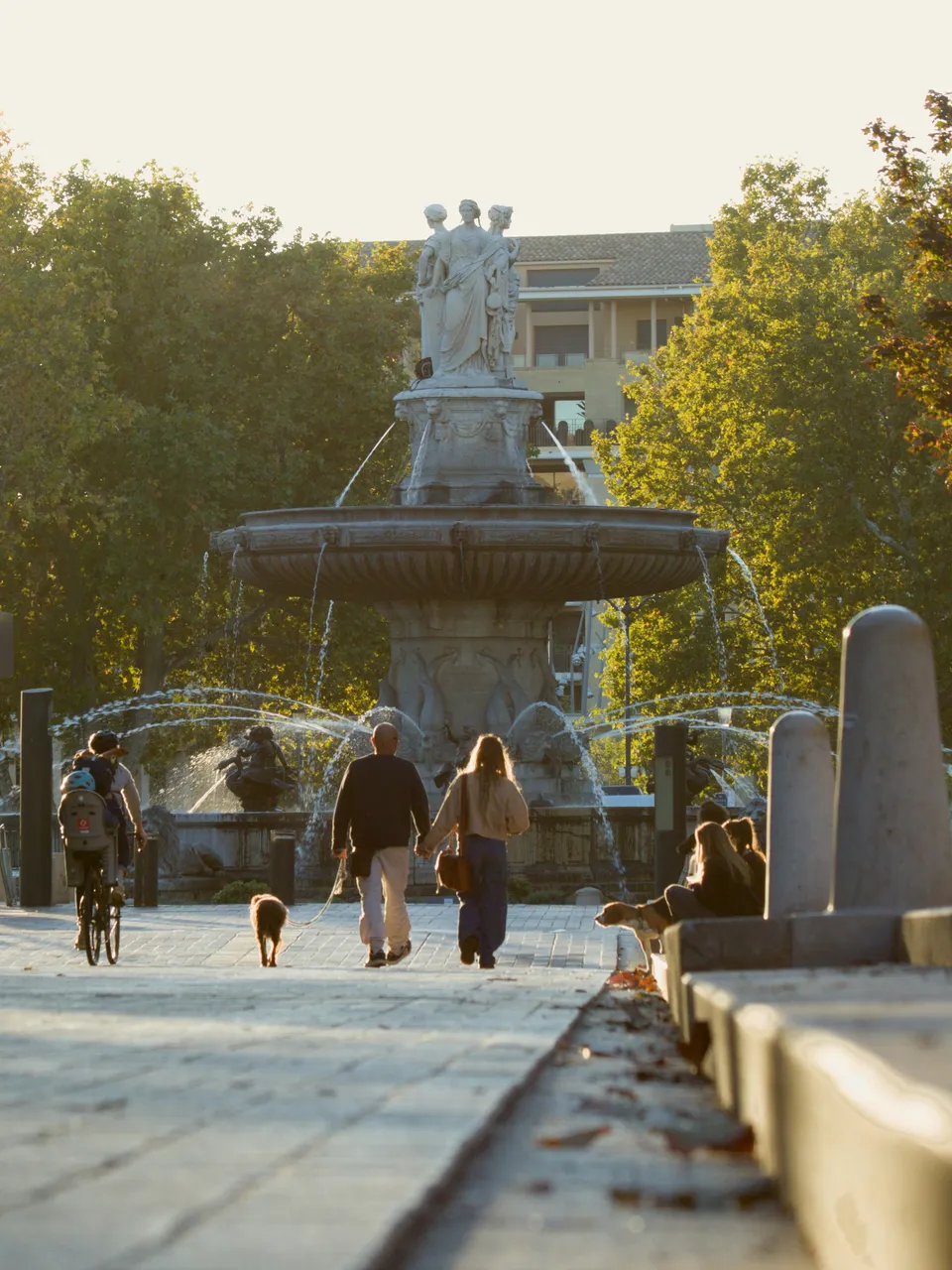
In 1650, the Parliament opened a street for horse-drawn carts in place of the crumbling ramparts; in the nineteenth century it took the name of Mirabeau, the “idol of Provence”, a deputy of the Third Estate in 1789. The Cours Mirabeau is 440 meters long, the town says, shaded by plane trees and lined with café terraces: the tourist office’s advice is to come for a morning coffee, a lunch in the shade or the after-work happy hour. Every evening in July and August, until midnight, the summer market of “Les Nuits d’Aix” fills it with craftsmen and traders.
The fountains on and around the Cours:
| Fountain | What to look for |
|---|---|
| La Rotonde, Place du Général de Gaulle | Built in 1860, 12 meters high and, the tourist office says, 32 meters wide, with 12 lions and 6 swans ridden by bronze putti, and three statues on top: Justice facing the Cours, Agriculture facing Marseille and the Fine Arts facing Avignon |
| Fontaine des Neuf Canons | A low basin with nine spouts, built so that sheep coming from Arles on their seasonal migration could drink; the town dates it to 1651, the tourist office to after 1691 |
| Fontaine Moussue (the mossy fountain) | The warm-water fountain of the Cours, home to three protected species of moss, with water at 18 degrees, the tourist office says; the town dates it to 1666, the tourist office to 1667. The water is thermal and not drinkable |
| Fontaine du Roi René | At the far end of the Cours: King René in white marble, sculpted by David d’Angers in 1822 and inaugurated in 1823, holding a bunch of muscat grapes |
Sources: Ville d’Aix-en-Provence, the fountains and the Rotonde; tourist office, the Rotonde, the Neuf Canons and the Fontaine Moussue; Ville d’Aix-en-Provence, summer on the Cours, read on November 26, 2026.
The tourist office’s fountains walk, 2.7 kilometers on foot from its door, links them with the others across town. The oldest fountain still standing is the Fontaine des Deux Canons on the rue Boulegon, from 1532.
The Old Town and the Mazarin Quarter
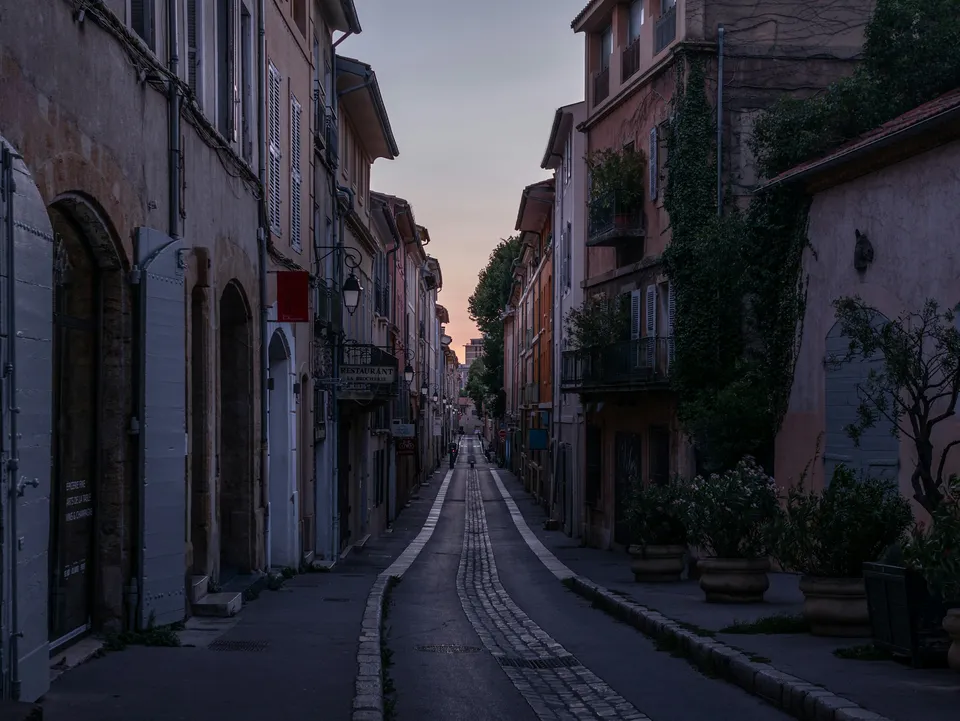
North of the Cours lies the old town, largely pedestrian (“semi-pedestrian”, the tourist office says), with its squares and churches.
The Place de l’Hôtel de Ville and the clock tower
The town hall has stood at the foot of the clock tower since the fourteenth century; it was rebuilt from 1655 to 1660 and from 1665 to 1678 by the architect Pierre Pavillon. On the square stand a fountain topped by a Roman granite column, signed by the sculptor Jean Chastel (1755, the town says on one page and 1756 on another), and the Halle aux Grains, the former grain market built from 1754, decorated with Chastel’s allegories of the Rhône and the Durance. The square is also home to the flower market, below.
Saint-Sauveur Cathedral
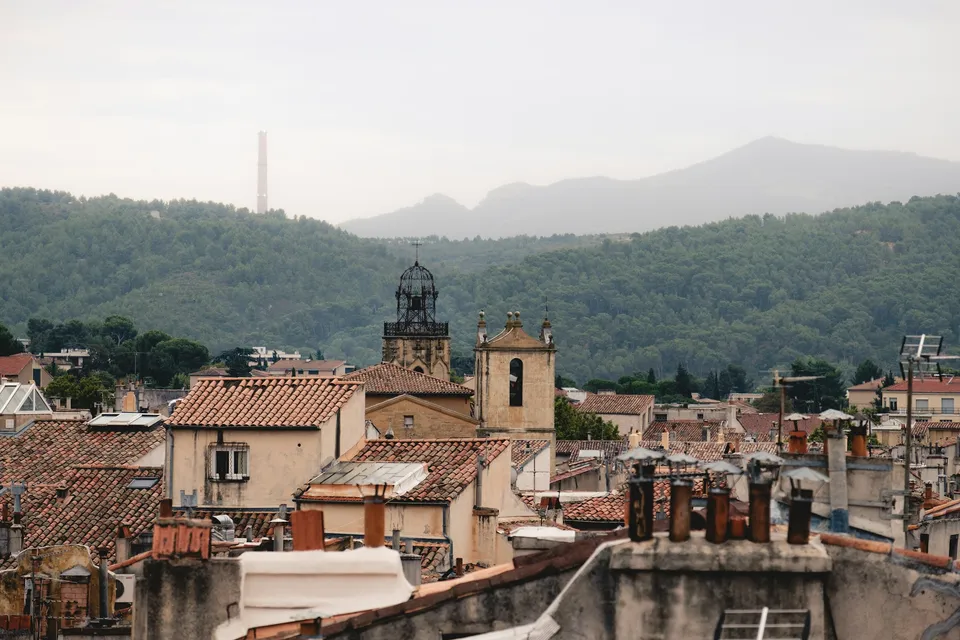
Saint-Sauveur Cathedral was built between the fifth and the eighteenth centuries on the site of the ancient forum, and its facade shows it: a Romanesque portal of the twelfth century beside a Roman wall on the right, a richly carved Gothic portal on the left, under an octagonal bell tower built from 1323 to 1425. Inside, three naves of different styles stand side by side, Romanesque, Gothic and Baroque, next to a sixth-century baptistery whose columns, it is said, come from an ancient temple, and a cloister of the late twelfth century. The carved doors, by the sculptor Guiramand, date from 1500 to 1508 and show four prophets and twelve sibyls; they survived the Revolution, which destroyed the statues of the facade except two, the Virgin of the Gothic portal’s central pillar and the great Saint Michael.
Its treasure is the Triptych of the Burning Bush, painted by Nicolas Froment around 1476 for King René. It is opened only at set times: from Easter Sunday to Whit Monday, from July 1 to September 8, on the European Heritage Days weekend in September, from October 1 to November 1, and from the first Sunday of Advent to Epiphany, which covers the Christmas season of 2026. The cathedral is open every day from 8:40 a.m. to 6:30 p.m., free.
The Place d’Albertas and the Mazarin quarter
The Place d’Albertas, in the photograph at the top of this guide, was built in six years, from 1735 to 1741, by Jean-Baptiste d’Albertas; the ironwork of its fountain only dates from 1912. South of the Cours, the Mazarin quarter was laid out from 1646 on a grid plan by the architect Jean Lombard, for the archbishop Michel Mazarin, the brother of the cardinal; the tourist office tells how the town’s magistrates and nobles left the medieval town to settle there. On the former Place Mazarine, the Fontaine des Quatre Dauphins, four Baroque dolphins under a pine cone, was sculpted by Jean-Claude Rambot in 1667, according to the town (the tourist office gives 1668).
The Pavillon de Vendôme
The Pavillon de Vendôme, with the atlantes of its facade, was built in 1665 by Pierre Pavillon and Antoine Matisse for the Duke of Vendôme, and in 1914 it became the first building in Aix listed as a historic monument. It is a municipal museum today, open every day except Tuesday, from 10 a.m. to 12:30 p.m. and 1:30 to 5 p.m. until April 15 (to 6 p.m. from then until October 15), for 5 euros; it is free under 26, with the City Pass, and on the first Sunday of every month, like all the town’s museums. Its garden is open all year.
The calisson
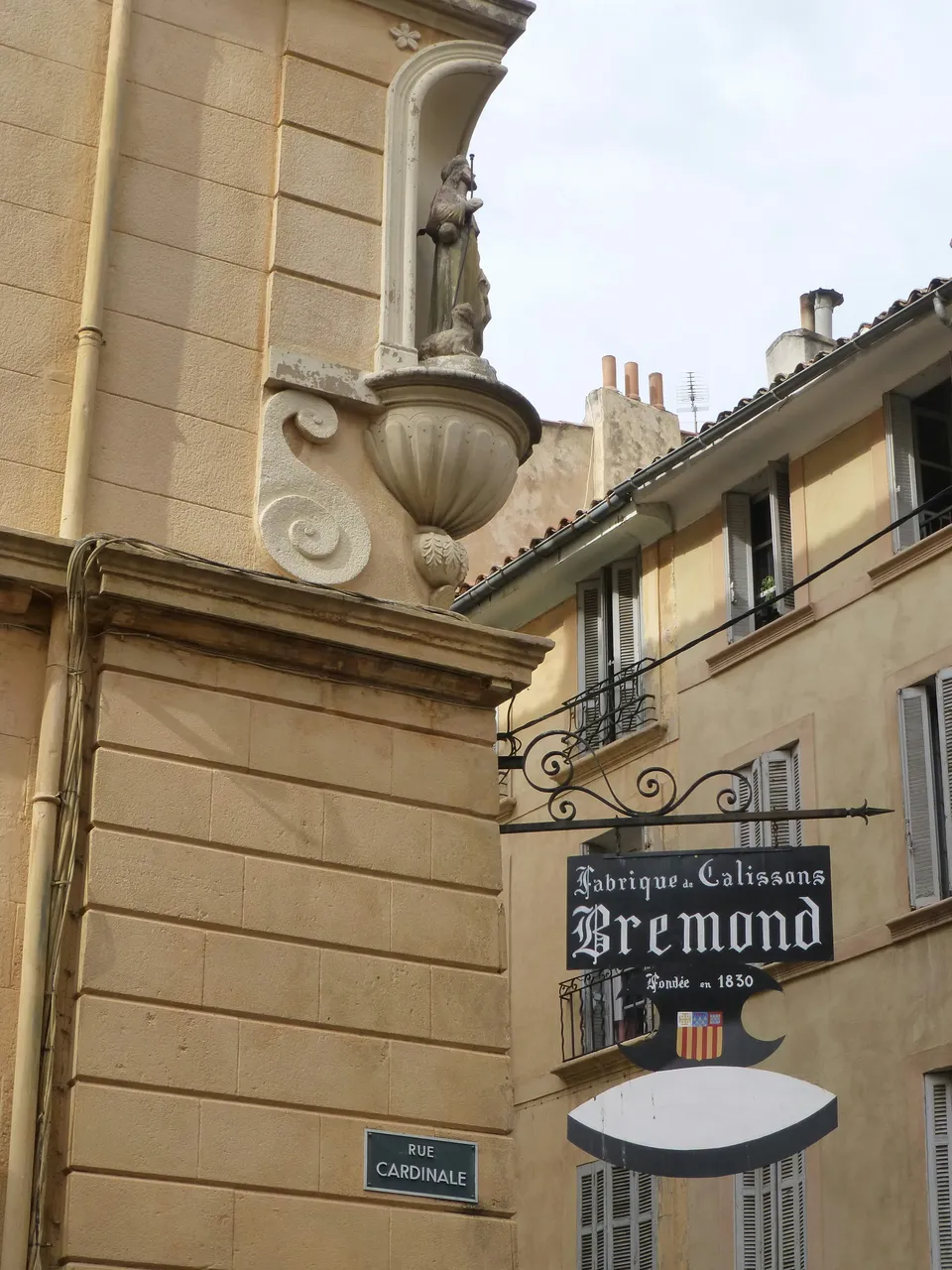
The calisson maker’s sign in the photograph above points to the town’s specialty, “a mix of almonds and candied melon with orange blossom fragrance”, in the tourist office’s words. Each year, on the first Sunday of September, the calissons are blessed at the church of Saint-Jean-de-Malte.
Sources: tourist office, Saint-Sauveur Cathedral, the Pavillon de Vendôme and must-dos; Ville d’Aix-en-Provence, the town hall, the Place de l’Hôtel de Ville, the Cathedral, the Place des Quatre Dauphins, the fountains and the Pavillon de Vendôme, read on November 26, 2026.
The Markets of Aix-en-Provence
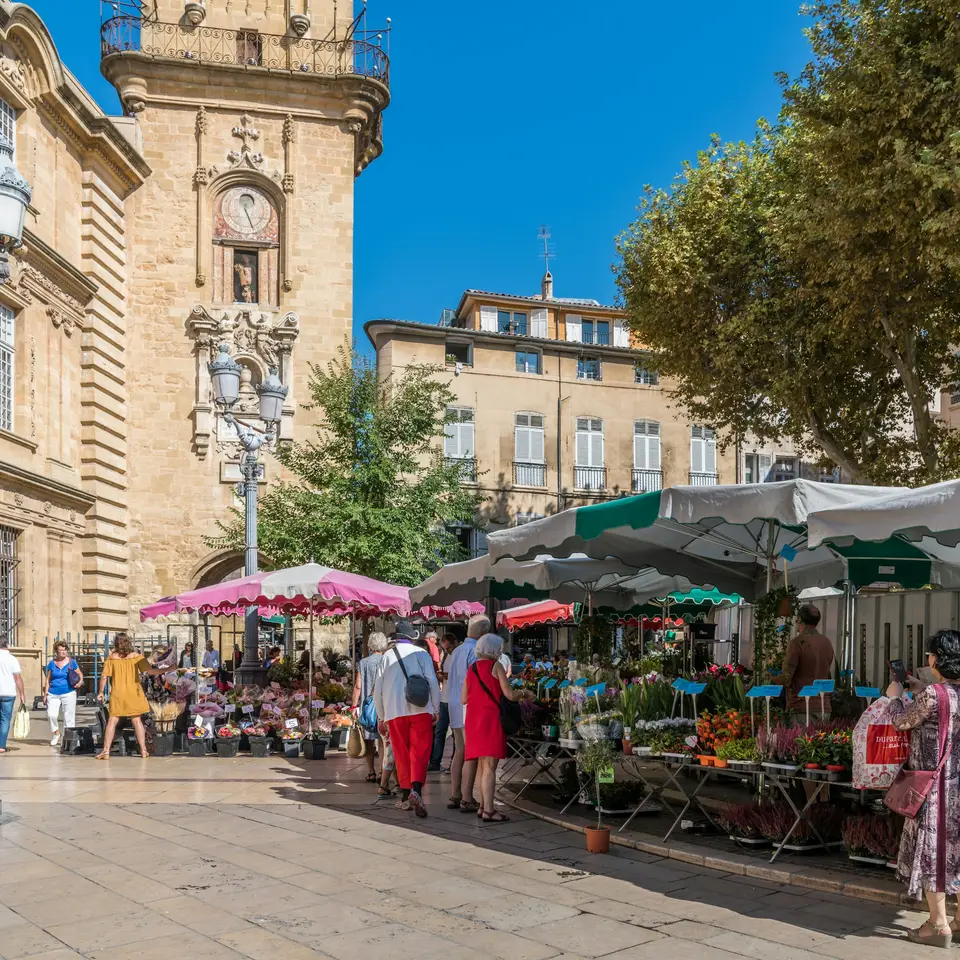
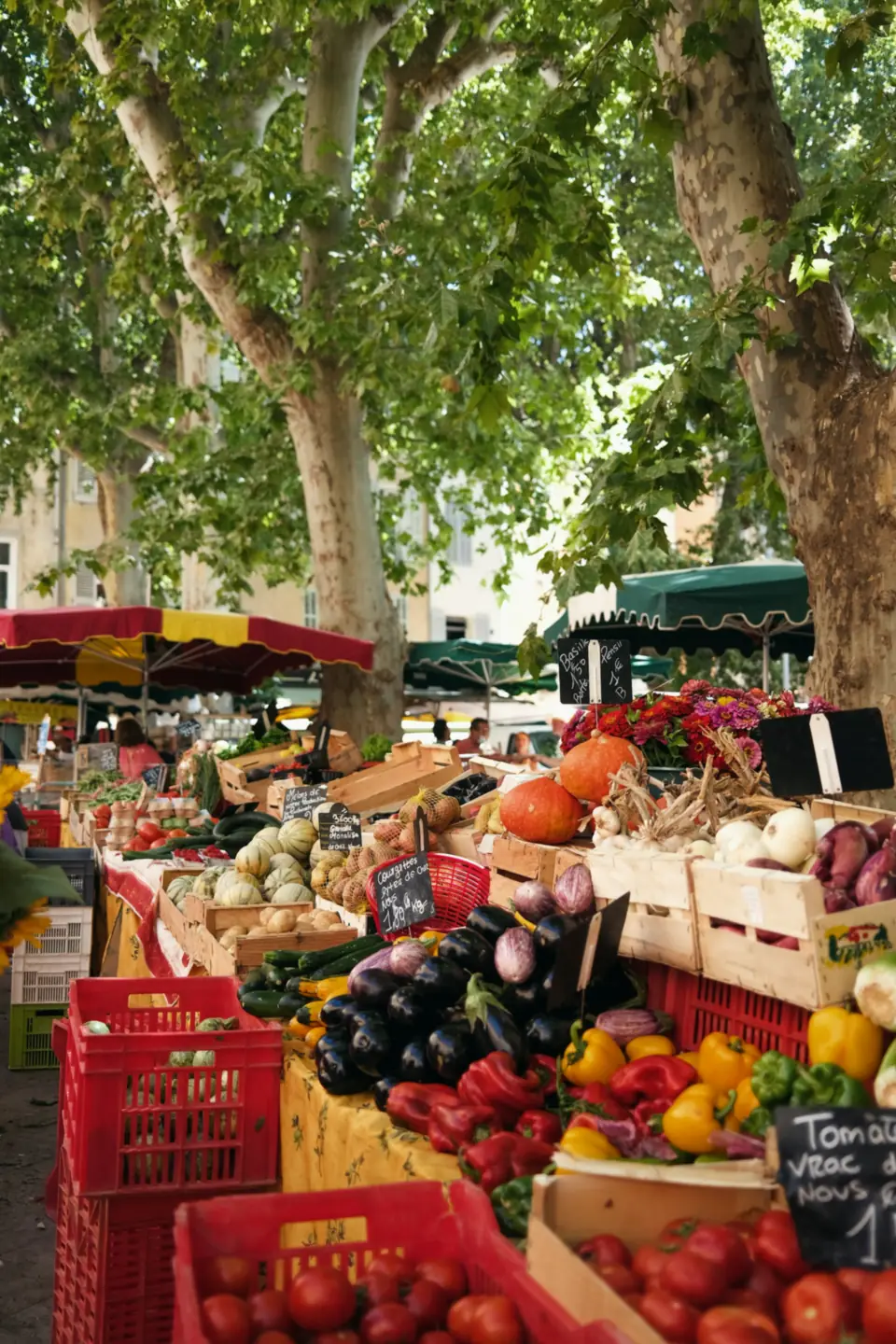
“In Aix there are as many markets as days in the week”, the tourist office writes, and the town confirms that markets are held every day of the year.
| Market | Where | When |
|---|---|---|
| Fruit, vegetables and local produce | Place Richelme | Every day of the year except January 1 |
| Fruit, vegetables and local produce | Places Comtales | Tuesdays, Thursdays and Saturdays |
| Fish | Place Richelme | Every day |
| Flowers | Place de l’Hôtel de Ville | Tuesdays, Thursdays and Saturdays |
| Flowers | Places Comtales | Wednesdays, Fridays and Sundays |
| Big market: textiles, crafts and flea market | Textiles on the Cours Mirabeau; crafts at the top of the Cours (Place Forbin), rue Thiers and Place de Verdun; the flea market on the Place des Combattants d’Afrique du Nord and the lower Cours | Tuesdays, Thursdays and Saturdays, 8:30 a.m. to 1 p.m., except January 1 |
Sources: tourist office, the markets, the food market and the big market; Ville d’Aix-en-Provence, the markets and their year-end changes, read on November 26, 2026.
The two official sources give slightly different hours: the tourist office says the markets run every day from 8 a.m. to 1 p.m.; the town says sales open at 8:30 a.m. and stop at 12:30 p.m., or 1 p.m. for the food, crafts, flea, textile and Prêcheurs flower markets. Come in the morning either way. For the holidays, from November 10, 2026 to January 5, 2027, the flea market moves to the Place du Général de Gaulle (by the Rotonde) and the textile market to the avenue Giuseppe Verdi, the Esplanade Cezanne, the square du Colonel Antoine Matteï, the Place Jeanne d’Arc and the avenue des Belges, for the year-end festivities.
In the Footsteps of Cézanne
Paul Cézanne was born in Aix, baptized at the church of the Madeleine on February 20, 1839, and buried after a funeral at the cathedral on October 24, 1906; 2026 marked 120 years since his death. Four places tell his story, and two of them are closed this winter:
| Place | What it is | Status and price |
|---|---|---|
| Atelier des Lauves (Cézanne’s studio), 13 avenue Paul Cézanne | The house and studio he had built on the Lauves hill, where he bought a plot of land in 1901, and where he worked every day for the last four years of his life | Closed for restoration since November 1, 2026; reopening planned for spring 2027. In the 2026 season, 9.50 to 15 euros, booking required |
| Bastide du Jas de Bouffan, 4 rue de Valcros | The eighteenth-century country house bought by his father in 1859, the family’s home for nearly forty years; he painted about fifty oils and watercolors of its views from 1859 to 1899 | Closed for restoration of the house and park since November 1, 2026; no reopening date published |
| Carrières de Bibémus (the Bibémus quarries) | A 7-hectare plateau of quarries 6 km from Aix, where he painted 11 oils and 16 watercolors, among them “Le Rocher rouge” | Open all year, on guided tours only, booked through the tourist office (no tickets on site): 18 euros for the tour in French (13 euros for children 6 to 12), from 23 euros for the two-hour tour “The Bibémus quarries of Paul Cezanne” |
| Jardin des Peintres, chemin de la Marguerite | Formerly the Terrain des Peintres: a public garden of 400 square meters facing the Sainte-Victoire, dear to Cézanne in his last years, with 9 reproductions of his views in enameled stone | Open all year, free |
Sources: Cezanne en Provence, the Atelier des Lauves, the Jas de Bouffan, the Bibémus quarries, the Jardin des Peintres and tickets; tourist office, the Lauves studio and the Bibémus quarries; tourist office booking, Bibémus tours; tourist office, Cézanne’s footsteps and Paul Cézanne; Musée Granet, Cézanne at the museum, read on November 26, 2026.
Ticket sales for the studio and the Jas de Bouffan are suspended during the works, online and on site, and no price for 2027 has been published. The Jardin des Peintres is 10 minutes’ walk from the studio according to the town, 15 according to the Cézanne sites’ own page; bus line 5 stops at “Les Peintres”. The Bibémus quarries have no regular bus (a car or a taxi is recommended), the path is steep, and from June to September the site may be closed by prefectoral order, depending on the weather.
In town, a walking route marked by studs stamped with a “C” leads from the house where Cézanne was born to his grave, past the Café des Deux Garçons, where, he wrote to his son on October 7, 1906, he had spent the hours before dinner the evening before with friends. The tourist office hands out a free Cézanne pocket guide; its French page ends the route at the Saint-Pierre cemetery, its English page at the “St Jean cemetery”. To see the paintings themselves, go to the Musée Granet, below: since 2025, two rooms are devoted to Cézanne, with the eight paintings the State deposited there in 1984, his portrait of his friend Émile Zola, acquired in 2011, and new gifts and loans, among them “Bathers in Front of Mont Sainte-Victoire”. The tourist office counts 10 of his oil paintings owned by the museum.
The Museums of Aix: Hours and Prices
| Museum | What it holds | Opening, as published | Adult price |
|---|---|---|---|
| Musée Granet, Place Saint-Jean-de-Malte | The museum of Aix, opened in 1838, with more than 13,000 works, among them two rooms of Cézannes and the Meyer donation of modern art (Picasso, Giacometti, Léger, de Staël); until January 3, 2027, “Paul McCartney Photographer 1963-64, Eyes of the Storm”, more than 250 photographs shown in France for the first time | Tuesday to Sunday, noon to 6 p.m., until June 18, 2027; closed Mondays | 14 euros (12 reduced) until January 3, 2027; free under 18 and for students under 26 |
| Granet XXe, Chapelle des Pénitents blancs | “L’héritage cézannien”, about 100 contemporary works by 27 artists, from December 8, 2026 | From December 8, 2026 | 4 euros (2 reduced), not valid at the Granet itself |
| Caumont Centre d’Art, 3 rue Joseph Cabassol | An eighteenth-century mansion of the Mazarin quarter, with its salons, French garden and café, and two exhibitions a year; until March 21, 2027, Henri Cartier-Bresson, more than 200 photographs; the film “Cézanne au pays d’Aix” is shown every day | Every day, 10 a.m. to 6 p.m. until April 21, 2027, then to 7 p.m. until October 3, 2027 | 18.50 euros on site, 2 euros less with a timed ticket online; 14 euros for ages 7 to 25 |
| Fondation Vasarely, 1 avenue Marcel Pagnol | 16 hexagonal modules holding 42 monumental works by Victor Vasarely that play with perspective and optical illusion | Wednesday to Sunday, 10:30 a.m. to 5:30 p.m. | 15 euros; online prices rise by 1 euro from January 1 |
| Site-Mémorial du Camp des Milles | The only large French internment and deportation camp still intact, used from 1939 to 1942, where interned artists left more than 400 works | Every day, 10 a.m. to 7 p.m.; ticket office closes at 5:30 p.m. | 14 euros (11 reduced) |
| Pavillon de Vendôme | A seventeenth-century “folly” and its garden | Every day except Tuesday | 5 euros |
Sources: Musée Granet, hours and prices, the McCartney exhibition, L’héritage cézannien and its history; Caumont, prices, hours and the Cartier-Bresson exhibition; Fondation Vasarely; Camp des Milles; tourist office, the Fondation Vasarely, the Camp des Milles and the Musée Granet; Ville d’Aix-en-Provence, Pavillon de Vendôme, read on November 26, 2026.
The Granet had not yet published its price after January 3, 2027 (in 2026, outside the summer exhibition, it was 7 euros). Caumont’s next exhibition, after Cartier-Bresson, was not yet announced. The Granet recommends not coming with a backpack: large bags are refused.
The tourist office’s City Pass costs 29 euros for 24 hours, 39 euros for 48 hours and 49 euros for 72 hours (19, 24 and 30 euros for children 3 to 13). It gives free entry or a guided tour at 16 sites, among them the Musée Granet, Caumont, the Fondation Vasarely and the Pavillon de Vendôme, plus guided tours (three of them in English) and unlimited travel on the Aix buses and the Diablines, but not on the shuttles to the TGV station and the airport. It starts on first use and allows one entry per site, according to the tourist office’s City Pass page, read on November 26, 2026.
The Sainte-Victoire Mountain
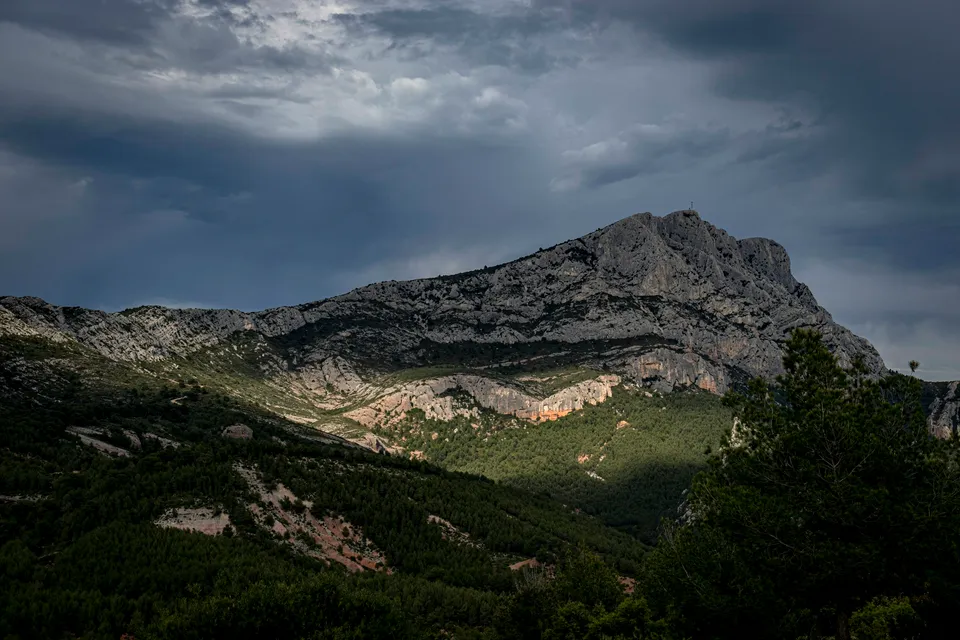
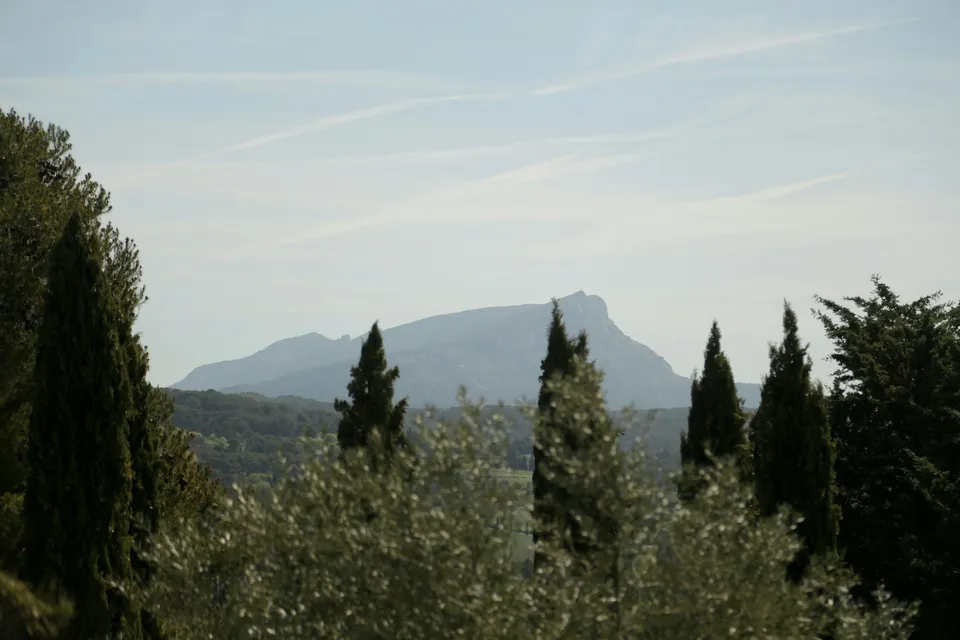
The Sainte-Victoire rises to 1,011 meters at the Pic des Mouches, its highest point. On its western tip stands the Croix de Provence, at 946 meters, built from 1871 to 1875: a 7-meter metal cross on an 11-meter base. From the Pic des Mouches, on a clear day, the view reaches the sea, Mont Ventoux and the Alps, the tourist office says. The massif has been a Grand Site de France since 2004, and the great fire of 1989 that swept its south face still marks it.
Three hikes from the Grand Site’s own list of ideas:
| Hike | Start | Time, distance and climb |
|---|---|---|
| The Priory and the Croix de Provence, by the GR 9 | Parking des Cabassols, Vauvenargues | 4 hours, 12 km, 600 m of climb |
| The Zola and Bimont dams | Parking des Infernets, Le Tholonet | 3 hours, 9 km, 400 m |
| The Saint-Ser chapel and the Pic des Mouches, a sporty hike with climbing passages, two of them fitted with chains | Parking Saint-Ser, Puyloubier | 3 hours 45, 6 km, 650 m |
Sources: Grand Site Sainte-Victoire, Vauvenargues hike, Le Tholonet hike and Puyloubier hike; tourist office, the Sainte-Victoire, read on November 26, 2026.
The Zola dam was built from 1847 to 1854 by François Zola, the novelist’s father, and swimming is forbidden in both reservoirs. At the Priory, a refuge with 14 beds is open to all, and the marked path from the Priory to the Croix de Provence reopened in November 2026 after works. For an easy walk, the tourist office suggests the olive groves and the Doudon canal at Le Tholonet: 4.5 km and 1 hour 30. The free Maison Sainte-Victoire, at Saint-Antonin-sur-Bayon, is open Tuesday to Sunday, 9 a.m. to 12:30 p.m. and 1:30 to 6 p.m., with a display of real dinosaur eggs found in the massif. Without a car, the intercity buses L110 (to Puyloubier) and L140 (to Vauvenargues) serve the mountain.
The villages around the mountain are worth the drive in themselves: Le Tholonet, Beaurecueil (“the prettiest view of the mountain”, the tourist office says), Saint-Antonin-sur-Bayon, Puyloubier and Pourrières among the vineyards, and Vauvenargues in its green valley. The vineyards of the Aix country have four appellations, according to the tourist office’s wine page (Coteaux d’Aix-en-Provence, Côtes de Provence, Côtes de Provence Sainte-Victoire and Palette, one of the smallest in France, with four estates), although another page of the office speaks of five.
In summer, check before you go. From June 1 to September 30, access to the forest massifs of the Bouches-du-Rhône, the Sainte-Victoire among them, is set every day according to the weather and the drought, the prefecture says, and published around 6 p.m. for the next day on its map at risque-prevention-incendie.fr/13, which shows each massif as open (green) or closed (red). The Grand Site adds a phone line, 0811 20 13 13 (0.06 euro a minute). The department counts about 250 fires a year, nearly 90 percent of them caused by people.
Sources: Grand Site Sainte-Victoire, the Priory and the Croix de Provence, the reopened path, the Maison Sainte-Victoire and walking; Département des Bouches-du-Rhône, the Maison Sainte-Victoire; tourist office, the mountain, the Grand Site, the Le Tholonet walk, the vineyards and FAQ; Préfecture des Bouches-du-Rhône, access to the massifs, read on November 26, 2026.
The Festival d’Aix-en-Provence and the Year’s Events
The Festival d’Aix-en-Provence, founded in 1948 and one of the major events of the international opera season, runs from July 1 to 20, 2027. Its 2027 program will be revealed on December 4, 2026 at noon, and bookings open on January 28, 2027. Performances take place in the open-air courtyard of the former archbishop’s palace, the Théâtre de l’Archevêché, turned into a theater in 1948; in the Théâtre du Jeu de Paume, where Louis XIV played real tennis in 1660, one of the last Italian-style halls of the eighteenth century; in the Grand Théâtre de Provence (1,350 seats, opened in 2007); and in the Conservatoire Darius Milhaud by the architect Kengo Kuma. The City Pass gives 10 to 50 percent off selected shows.
| Event | When |
|---|---|
| Christmas market in chalets, about fifty craftsmen and traders, Cours Mirabeau | November 13 to December 31, 2026; late opening to 9:30 p.m. on Fridays and Saturdays; closed December 25 |
| Santons fair, Esplanade Cezanne, held since 1934 | November 13 to December 31, 2026, every day 10 a.m. to 7 p.m.; closed December 25 |
| Christmas lights | November 28, 2026 to January 3, 2027 |
| Advent calendar projected on the Halle aux Grains | December 1 to 24, 2026, every day at 6, 7 and 8 p.m. |
| Truffle market | Wednesday, December 16, 2026 |
| Market of the 13 Christmas desserts and local produce | December 17 to 24, 2026 |
| Lavender in bloom around Aix | About June 15 to July 15, according to the tourist office |
| Festival d’Aix-en-Provence | July 1 to 20, 2027 |
| Les Nuits d’Aix, evening market on the Cours Mirabeau | Every evening in July and August, until midnight |
| Blessing of the calissons, church of Saint-Jean-de-Malte | The first Sunday of September |
Sources: Festival d’Aix-en-Provence, 2027 dates and bookings, the festival and its venues; Ville d’Aix-en-Provence, Christmas markets, the chalets and the santons fair; tourist office, Christmas and lavender, read on November 26, 2026.
For the lavender, the tourist office points to an organic farm in Aix itself, Terre Ugo, at its best from June 25 to July 25 and free with the City Pass, and to minibus excursions to the Valensole plateau or to Sault, where the harvest comes later. Our guide to the South of France has the blooming dates and the Luberon villages.
The Weather in Aix-en-Provence Month by Month
Météo-France publishes no climate normals page for an Aix station. The closest of the six stations it lists for the region is Marignane, in the Bouches-du-Rhône, with these averages for 1991 to 2020:
| Month | Average low | Average high | Rain | Sunshine |
|---|---|---|---|---|
| January | 3.6 °C (38 °F) | 11.8 °C (53 °F) | 47.1 mm | 148 h |
| February | 3.7 °C (39 °F) | 12.8 °C (55 °F) | 29.8 mm | 173 h |
| March | 6.5 °C (44 °F) | 16.4 °C (62 °F) | 29.5 mm | 235 h |
| April | 9.4 °C (49 °F) | 19.3 °C (67 °F) | 51.6 mm | 251 h |
| May | 13.3 °C (56 °F) | 23.5 °C (74 °F) | 37.7 mm | 299 h |
| June | 17.2 °C (63 °F) | 27.9 °C (82 °F) | 27.9 mm | 338 h |
| July | 19.7 °C (67 °F) | 30.7 °C (87 °F) | 10.8 mm | 372 h |
| August | 19.4 °C (67 °F) | 30.5 °C (87 °F) | 25.8 mm | 334 h |
| September | 15.9 °C (61 °F) | 25.9 °C (79 °F) | 82.0 mm | 264 h |
| October | 12.6 °C (55 °F) | 21.3 °C (70 °F) | 73.3 mm | 196 h |
| November | 7.7 °C (46 °F) | 15.7 °C (60 °F) | 75.9 mm | 151 h |
| December | 4.4 °C (40 °F) | 12.4 °C (54 °F) | 40.9 mm | 138 h |
| Year | 11.1 °C (52 °F) | 20.7 °C (69 °F) | 532.3 mm | 2,898 h |
Source: Météo-France, Marignane climate normals 1991-2020, read on November 26, 2026. Fahrenheit figures are converted from the Celsius values; monthly sunshine hours are rounded.
What the table means for a trip:
- For walking and museums: April, May, September and October bring highs of about 19 to 26 °C.
- In summer: July and August are the hottest and driest months, with highs above 30 °C at Marignane; it is the season of the Festival and of the evening market on the Cours, and also of the fire rules on the Sainte-Victoire.
- The wettest months are September, October and November, with 73 to 82 millimeters of rain on average, against 11 in July.
- In winter: highs of about 12 to 13 °C and lows of about 4 °C, with the Christmas markets until December 31. The tourist office says Aix is protected from the north winds and only slightly affected by the Mistral, and counts 300 days of sunshine a year.
Getting to Aix-en-Provence
From the US
Marseille Provence, the airport of Aix, gets a non-stop flight from the US in June 2027: United Airlines opens a daily route between Newark and Marseille on an Airbus A321XLR, as the only US airline flying non-stop to the city (like all its new routes, subject to government approval, United says). United’s release gives June 4 as the start and the airport June 5, and the airport puts the flight at 9 hours 15. Until then, you change planes on the way, in Europe or in Canada (the airport lists direct flights from Montréal and Québec), or you fly to Paris and take the train: OUIGO trains run from the Paris-Charles de Gaulle airport station (Paris Aéroport Roissy CDG 2 TGV) to Aix-en-Provence TGV in about 3 hours 20, SNCF Connect says.
From Paris and Lyon by train
Twenty-four trains a day run from Paris to Aix-en-Provence TGV station, the fastest in 2 hours 54 minutes and 3 hours 06 on average, from Paris Gare de Lyon or Marne-la-Vallée Chessy, according to SNCF Connect, which gives prices from 16 euros (19 euros for OUIGO on the same page). From Lyon, 16 trains a day reach Aix-en-Provence TGV, the fastest in 1 hour 08, from 10 euros. Aix has two stations: Aix-en-Provence TGV, 15 km from the town, and Aix-en-Provence (Centre), 2 minutes from the Cours Mirabeau, reached by regional trains from Marseille; from Paris to the central station you change in Marseille, for about 5 hours.
Sources: SNCF Connect, Paris to Aix-en-Provence and Lyon to Aix-en-Provence TGV; United Airlines, new routes for 2027; Marseille Provence airport, the New York flight and North American destinations; tourist office, access, read on November 26, 2026.
From the TGV station or the airport to the center
| From | How | Time and price, as published |
|---|---|---|
| Aix-en-Provence TGV station | A2 shuttle bus (formerly line 40) to the Aix bus station, boarding on level -1 (hall A, south door) | Every 25 to 30 minutes; about 15 minutes according to the tourist office, 20 according to SNCF Connect; 9 euros one way (adults 26 to 64), 14.50 euros return |
| Marseille Provence airport | The same A2 shuttle bus, from the coach station between terminals 1 and 2 | From the airport every 25 to 30 minutes from 5:35 a.m. to 11:05 p.m., with extra buses at 11:40 p.m. and 12:25 a.m.; about 30 minutes according to the airport, 25 according to the tourist office; 15 euros one way, 25 euros return |
| Marseille Provence airport | Shuttle bus lebus 13 to Vitrolles-Aéroport Marseille Provence station, then a regional train | About 5 minutes by shuttle, then 14 trains a day to Aix-en-Provence (Centre), all with a change, from 1 hour 17 (1 hour 36 on average), SNCF Connect says: the A2 bus is faster |
| Marseille Provence airport | Taxi from the rank in front of Terminal 1 | 86 taxis, day and night, card or cash; the airport publishes only the prefectoral per-kilometer rates, no fixed fare to Aix |
Sources: La Métropole Mobilité, shuttles to stations and airports and fares from November 1, 2026; Marseille Provence airport, bus to Aix, trains and taxis; tourist office, access; SNCF Connect, Paris to Aix-en-Provence and Vitrolles to Aix-en-Provence, read on November 26, 2026.
The A2 ticket can be paid by contactless bank card on board, in the La Métropole Mobilité app, or at the machines of the Aix bus station and the TGV station. If you drive to the TGV station, the Plan d’Aillane park-and-ride on the A2 route is free for 7 days with an A2 ticket.
From Marseille
Regional trains run from Marseille Saint-Charles to Aix-en-Provence (Centre) in 45 minutes on average, for 10.90 euros one way at full fare (7.70 euros with a ZOU! Malin discount card). SNCF Connect counts 37 trains a day from Marseille to Aix; TER Sud counts more than 60 a day in both directions, one every quarter of an hour at peak times. Coach lines 50 and 48 also link Marseille and Aix, for 7 euros one way. Long-distance coaches such as Flixbus and BlaBlaCar Bus stop at the Krypton park-and-ride, outside the center, which bus line A links to the town, the tourist office says.
Sources: TER Sud, Marseille to Aix; SNCF Connect, Marseille to Aix-en-Provence; La Métropole Mobilité, fares; tourist office, access, read on November 26, 2026.
Getting Around Aix
The center is best on foot. For tired legs, the Diablines, small electric buses for up to seven passengers, wind through the narrow pedestrian streets on three lines from the Rotonde, Monday to Saturday from 8:30 a.m. to 7:30 p.m., every 10 minutes; wave at one and it stops anywhere on its route, except on the avenue Victor Hugo and at the Rotonde, where you board at the stops. A trip costs 1.40 euros by contactless card, or 1.90 euros from the driver.
The town buses use the same fares: 1.40 euros for one hour of travel (1.90 euros bought on board), 4.60 euros for 24 hours, 11 euros for 10 trips, since the new fares of the Métropole on November 1, 2026; children up to 5 ride free with an adult. If you come by car, the center has 5,810 underground parking spaces, the tourist office says; the Rotonde car park, next to the Cours, is free for the first 30 minutes and capped at 25 euros for 24 hours. A cheaper option is a park-and-ride: 3.50 euros a day, with the return bus trip into town included for everyone in the car.
Sources: Aix en Bus, the Diablines; tourist office, getting around on foot; La Métropole Mobilité, fares, profiles and park-and-ride; tourist office, car parks; Rotonde car park, read on November 26, 2026.
Day Trips from Aix-en-Provence
| Destination | By train, as published | By road, according to the tourist office |
|---|---|---|
| Marseille | 45 minutes on average to Saint-Charles, 10.90 euros at full fare | 32 km |
| Cassis and the Calanques | From 1 hour 17, with a change; 24 trains a day | Not published |
| Avignon | From 1 hour 56, 2 hours 29 on average, from Aix-en-Provence (Centre) to Avignon Centre, with changes; 17 trains a day | 88 km |
| Arles | 3 hours on average, with changes; 8 trains a day | 75 km |
Sources: TER Sud, Marseille to Aix; SNCF Connect, Aix to Cassis, Aix to Avignon and Aix to Arles; tourist office, access, read on November 26, 2026.
Marseille is the obvious first trip, for its Old Port and the Calanques: our Marseille travel guide covers its sights and their prices, and our guide to Cassis the calanques on its side, the boat trips and the beaches. From the central station, the trains to Avignon and Arles involve changes, so both are easier by car. Our guide to Provence takes the region area by area, from the Luberon villages to Avignon, Arles and the Camargue, our guide to the South of France adds the rules of the Calanques National Park, and our guide to the best places to visit in France puts Provence in the context of the whole country.
How Many Days in Aix-en-Provence?
Two full days cover the town, and a third adds the mountain:
- Day 1: a morning market (Place Richelme, or the flowers on the Place de l’Hôtel de Ville on a Tuesday, Thursday or Saturday), the old town and Saint-Sauveur Cathedral, lunch on the Cours Mirabeau, then the Musée Granet in the afternoon (it opens at noon).
- Day 2: the Mazarin quarter and the Fontaine des Quatre Dauphins, the Hôtel de Caumont and its garden, the Jardin des Peintres for the view of the Sainte-Victoire, and the Fondation Vasarely from Wednesday to Sunday.
- Day 3: a hike on the Sainte-Victoire or a guided tour of the Bibémus quarries, then the villages and vineyards around the mountain.
With four days or more, add Marseille, Cassis or Avignon. From spring 2027, when Cézanne’s studio reopens, keep a morning for it and book ahead: in 2026, booking was required.
Staying Longer in Aix-en-Provence
Aix is also a city where people come to live: a university town (Aix-Marseille Université counts 84,000 students across its campuses, 12,000 of them international) with the TGV to Paris and an airport 25 km away. Three rules matter once you stay beyond a vacation:
- The 90-day rule. Visiting the Schengen area, you can usually stay a maximum of 90 days within any 180-day period, according to the European Commission, and the European Union’s Entry/Exit System counts that period as one for all the countries using it. Our guide to how long Americans can stay in France without a visa explains the count, and the Schengen calculator checks your dates. To stay in France for more than three months, a foreigner needs a long-stay visa (type D), service-public says.
- The tourist tax. The town of Aix charges a taxe de séjour per person and per night all year, including a 10 percent surcharge for the Bouches-du-Rhône department and a 34 percent regional surcharge. In a three-star hotel or furnished rental it is 2.16 euros in 2026 and 2.45 euros in 2027, in a four-star one 3.27 euros and then 3.74 euros, and in an unclassified rental 5 percent of the pre-tax price per person and per night, capped at 4 euros in 2026 and 4.90 euros in 2027, plus the surcharges. Minors are exempt, and the town passes the whole tax on to its tourist office.
- Furnished rentals. In Aix, every furnished tourist rental needs a 13-digit registration number, which the booking platforms ask for before publishing a listing. Service-public puts the yearly limit for letting out a main residence at between 90 and 120 days, depending on the town, and a second home needs a change-of-use authorization from the town hall; failing to ask is fined up to 100,000 euros. A furnished lease under the bail mobilité runs from 1 to 10 months, but only for a tenant in training, higher education, an apprenticeship, an internship, civic service, a job transfer or a temporary work assignment, service-public says.
If Aix is on your list for a move, our comparison of the best places to live in the South of France sets it against Nice, Marseille and Montpellier, and our renting playbook explains the rental file French landlords expect.
Finding that furnished apartment, calling the agencies and setting up a phone line or a bank account in French is the kind of work our Personal Assistant handles: the calls, the forms and the apartment search, in French.
Sources: European Commission, short-stay calculator; European Union, Entry/Exit System; Ville d’Aix-en-Provence, tourist tax and furnished rentals; service-public, long-stay visa, renting out a main residence, furnished tourist rentals and bail mobilité; Aix-Marseille Université, read on November 26, 2026.
FAQ
Is Aix-en-Provence worth visiting?
Yes. In a walkable town you get the Cours Mirabeau and its fountains, a market every day of the year, the Baroque mansions of the Mazarin quarter, Cézanne’s paintings at the Musée Granet and the places he painted, and the Sainte-Victoire on the horizon. It is 2 hours 54 from Paris by the fastest TGV (3 hours 06 on average) and 25 km from Marseille airport.
What does Aix mean, and why is it called Aix-en-Provence?
Aix owes its name to its thermal springs, the town says: the Romans founded it in 122 B.C., according to the tourist office, as Aquae Sextiae, “the waters of Sextius”, after the general who settled there. The springs still feed the Fontaine Moussue on the Cours Mirabeau, with its water at 18 degrees, and the Thermes Sextius spa.
Is Cézanne’s studio open?
Not this winter. The Atelier des Lauves has been closed for restoration since November 1, 2026, and its reopening is planned for spring 2027; the Jas de Bouffan is closed too, with no date. The Bibémus quarries are open all year on guided tours booked through the tourist office, the Jardin des Peintres is free and open all year, and the Musée Granet shows his paintings.
What is the best time to visit Aix-en-Provence?
April to June and September to October, for warm days in the 19 to 28 °C range; July for the Festival (July 1 to 20, 2027) and the evening market on the Cours, if you can take highs above 30 °C; mid-June to mid-July for the lavender; and November to December for the Christmas market and the santons fair. September to November are the wettest months.
How do you get from Paris to Aix-en-Provence?
By TGV: 24 trains a day to Aix-en-Provence TGV station, the fastest in 2 hours 54 minutes, from 16 euros according to SNCF Connect. The A2 shuttle bus then takes you to the town’s bus station in about 15 to 20 minutes, for 9 euros.
How far is Aix-en-Provence from Marseille?
32 km by road, according to the tourist office, and 45 minutes on average by regional train from Marseille Saint-Charles to the central station, for 10.90 euros. Coach lines 50 and 48 cost 7 euros. Marseille Provence airport is 25 km from Aix.
Conclusion
Aix-en-Provence is Provence at its most polished: the Cours Mirabeau under its plane trees, fountains on its squares, a market every morning, two museums worth the trip and the mountain the tourist office calls Cézanne’s muse. Come in spring or early autumn for the walking weather, in July for the Festival, or in December for the Christmas markets, and book Cézanne’s studio once it reopens in 2027. For the rest of Provence, area by area, see our guide to Provence; for the whole South, from the Riviera to the Languedoc, our guide to the South of France; and for how Aix fits among France’s other cities, our guide to the cities in France.
The parts of the move Americans find out about too late.
What Americans get wrong about moving to France, and the number, form or deadline that fixes it. Straight to your inbox.
One email a week. Real numbers, nothing else.
Written by
Aurelio Maurici
Co-Founder, EasyFranceNow
Aurelio Maurici is a French entrepreneur and co-founder of EasyFranceNow. His work focuses on the intersection of French administration, banking constraints affecting U.S. nationals, tax residency and cross-border reporting, healthcare enrollment, and the procedural realities Americans encounter while settling in France.


