
Nice, France: The Complete Guide, from the Promenade des Anglais to the Weather Month by Month

By Aurelio Maurici Co-Founder, Master of Business Law, Aix-Marseille Université III
Published

In this article
- Nice at a Glance
- Why Nice Is a World Heritage City
- The Neighborhoods and What to See
- The Promenade des Anglais and the Baie des Anges
- Vieux Nice (the old town) and the Cours Saleya
- Castle Hill (Colline du Château) and the port
- Place Masséna and the Promenade du Paillon
- Cimiez, the hill of Matisse and the Romans
- The Russian Orthodox Cathedral
- The Museums of Nice: Hours and Prices
- The Beaches of Nice
- The Weather in Nice, Month by Month
- The Carnival of Nice 2027
- Getting to Nice and Around It
- From the US and from Paris
- From the airport to the city
- Getting around Nice
- Day Trips from Nice by Train
- How Many Days in Nice?
- Staying Longer in Nice
- FAQ
- Conclusion
Nice is where most trips to the French Riviera begin: a city of 357,737 residents according to INSEE, with France’s second airport after Paris, the tourist office says, 15 minutes from the center, and a seafront that UNESCO put on its World Heritage List in 2021 as the “Winter Resort Town of the Riviera”. It sits on the Mediterranean at the foot of the Alps, near the Italian border, and it is the easiest base on the coast: trains run from Nice to Monaco, Èze, Menton, Antibes and Cannes all day.
This guide covers the neighborhoods worth your time, the museums and what they cost, the beaches, the 2027 Carnival, the weather month by month from Météo-France, how to get in from the airport and around town, the best day trips, and what changes if you stay for more than a holiday. Every price, date and opening time was read on the official page of the city, the museum or the operator on November 25, 2026.
Nice at a Glance
| Where | Alpes-Maritimes, on the Mediterranean at the foot of the Alps, near the Italian border |
| Population | 357,737 (INSEE reference population 2023, in force since January 1, 2026) |
| World Heritage | “Nice, Winter Resort Town of the Riviera”, inscribed by UNESCO in 2021 (522 hectares) |
| Airport | Nice Côte d’Azur, 15 minutes from the center according to the tourist office; tram line 2 |
| From the US | Non-stop flights to New York, Philadelphia, Atlanta and Boston, mostly seasonal |
| From Paris | 13 trains a day, from 5 h 42 |
| Climate | 2,760 hours of sunshine a year; 5.8 to 13.3 °C in January, 21.1 to 27.9 °C in August |
| Best for | A first trip to the Riviera, a base for day trips, a winter stay |
Sources: INSEE, reference population of Nice; UNESCO, Nice; Météo-France, Nice normals; Nice airport, US flights; SNCF Connect, Paris to Nice, read on November 25, 2026.
Why Nice Is a World Heritage City
UNESCO’s listing explains how Nice became what it is. In 1832, Nice, then part of the Kingdom of Sardinia, set up a planning council, the “Consiglio d’Ornato”, to make the city attractive to foreigners. A modest path that British winter visitors had laid along the shore in 1824, the “Camin dei Ingles”, became the Promenade des Anglais. After the city was ceded to France in 1860 and joined the European rail network, winter visitors from every country followed. The 522-hectare site covers the whole seafront from the Promenade des Anglais to Mont Boron, the port, Place Masséna, Castle Hill, the old town’s pedestrian streets, the Promenade du Paillon and the hills of Cimiez, according to the tourist office; 152 studs set in the ground mark its edge.
The parts of the move Americans find out about too late.
What Americans get wrong about moving to France, and the number, form or deadline that fixes it. Straight to your inbox.
One email a week. Real numbers, nothing else.
The Neighborhoods and What to See
The Promenade des Anglais and the Baie des Anges
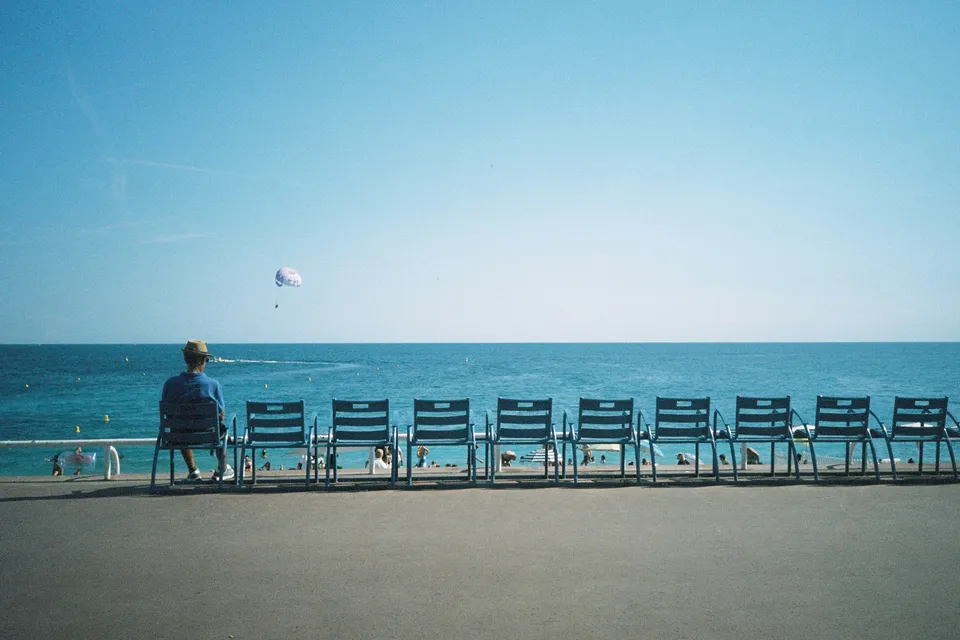
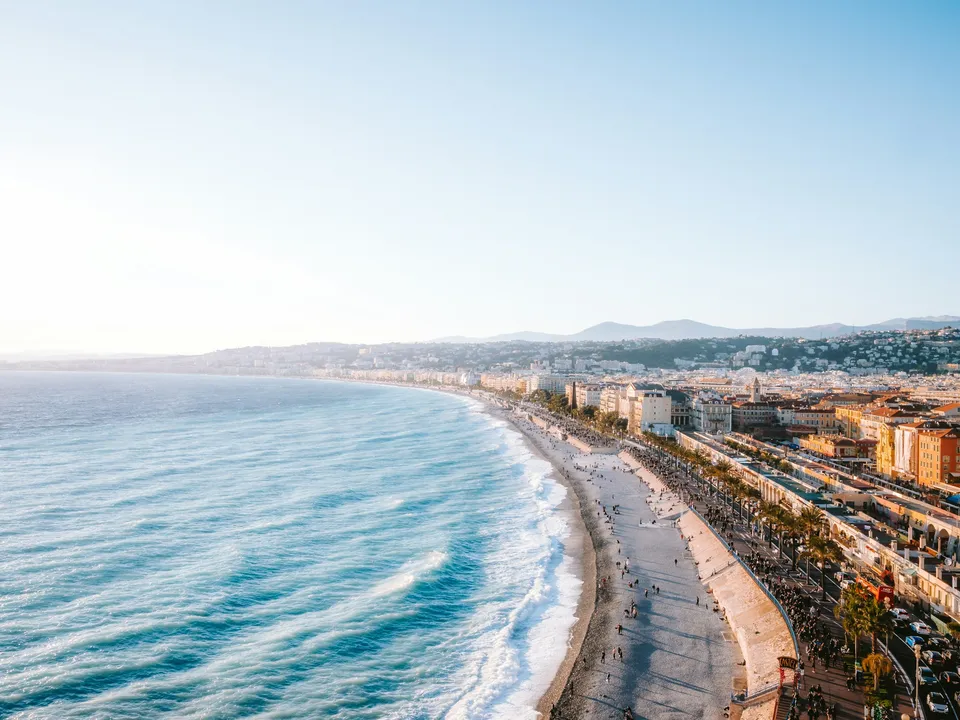
The Promenade runs for nearly 7 kilometers along the Baie des Anges, the tourist office says, and its blue chairs facing the sea are the city’s best-known picture. Its story starts in 1824, when the British Reverend Lewis Way encouraged the building of a path along the shore. Walk it from the old town westward in the late afternoon, or after dark.
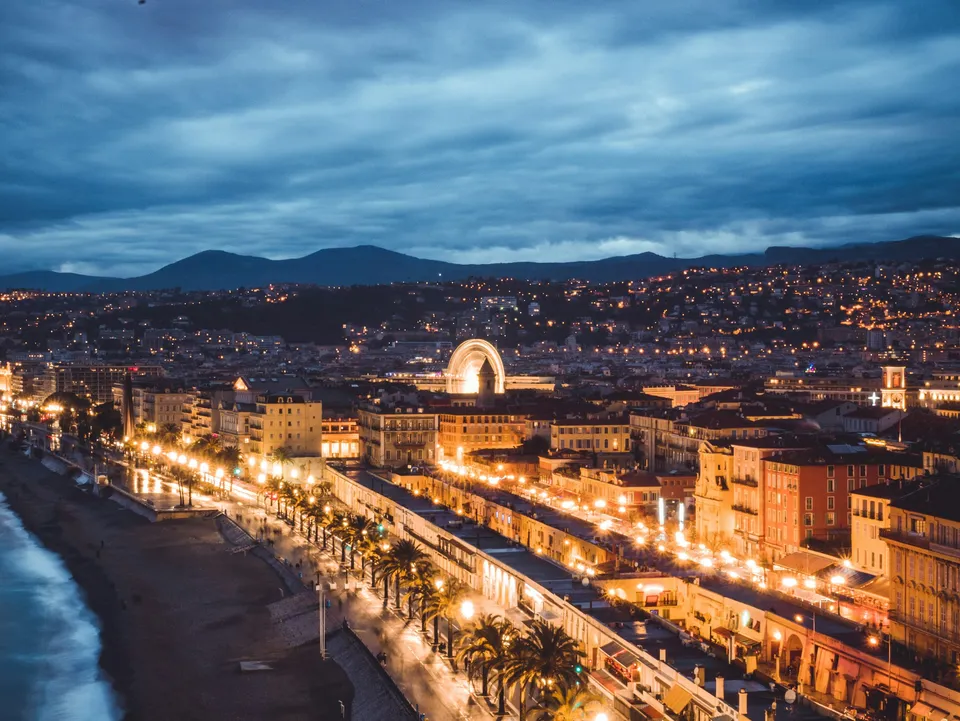
Vieux Nice (the old town) and the Cours Saleya
Nice is one of the rare cities in France with a large, consistent baroque heritage, and most of it is concentrated in the old town, the tourist office says, built over a baroque period that lasted from 1642 to 1790, in religious and civil buildings alike. The city’s heritage center runs guided tours, in English on Tuesday mornings.
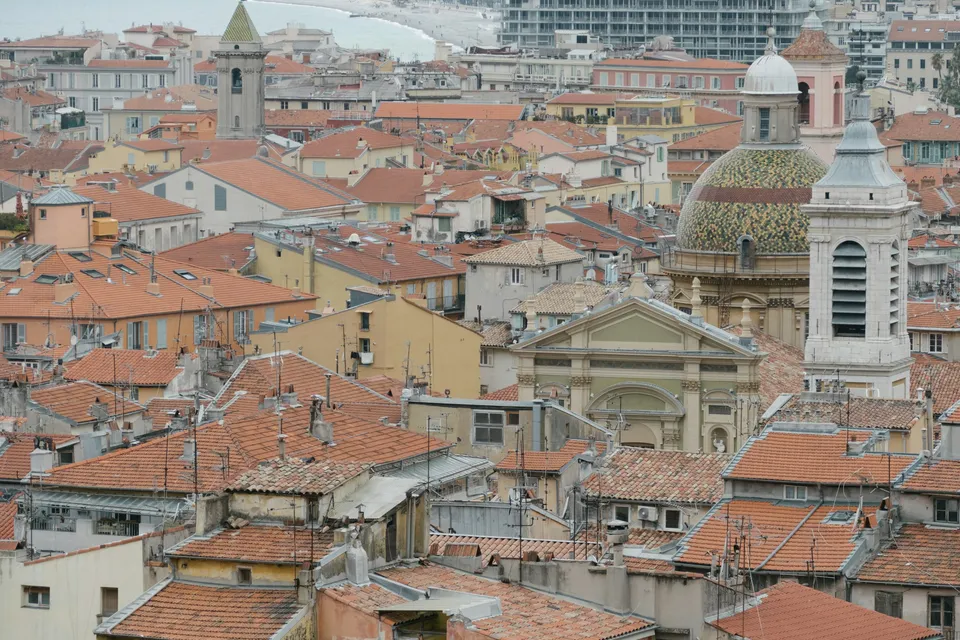
At its edge, the Cours Saleya is the city’s market street, which the tourist office ranks among the most picturesque markets in France:
| Market on the Cours Saleya | When, as published |
|---|---|
| Flower market, shopped by the people of Nice since 1861 | Tuesday to Sunday, mornings, all year |
| Fruit, vegetable and fish market | Tuesday to Sunday, 6 a.m. to 1:30 p.m., all year |
| Antiques and flea market, nearly 180 dealers | Mondays, 7 a.m. to 6 p.m. |
| Art and crafts night market | In summer |
Source: Office de Tourisme Nice Côte d’Azur, the Cours Saleya markets, read on November 25, 2026.
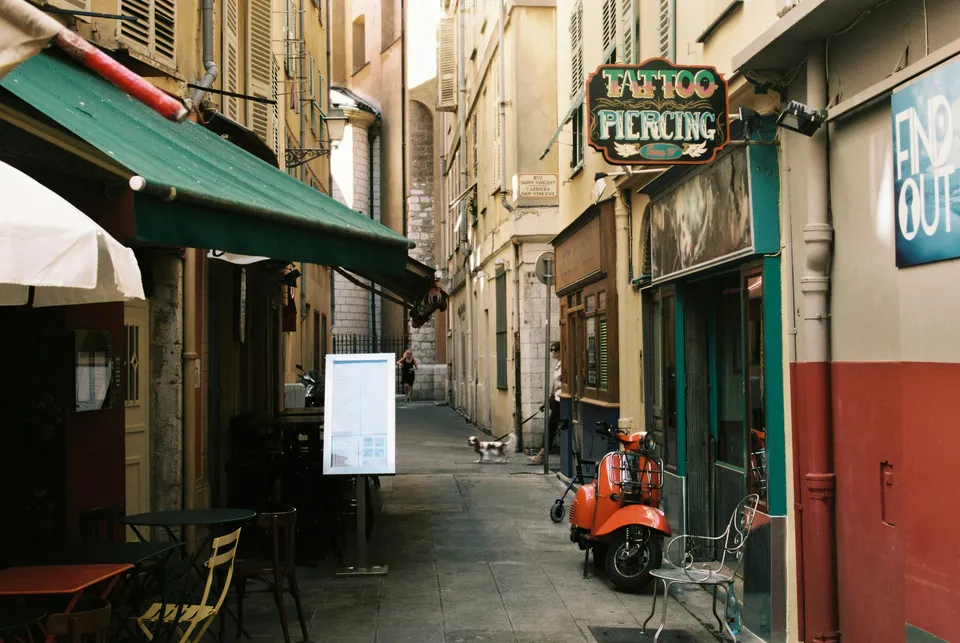
Castle Hill (Colline du Château) and the port
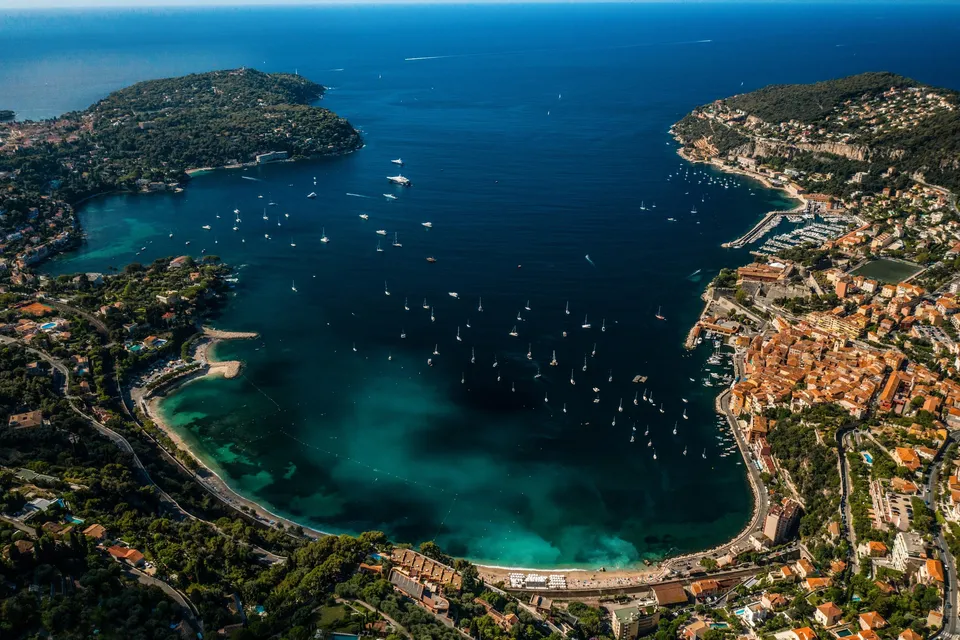
Above the old town, the Parc de la Colline du Château is a wooded park of 19.3 hectares with a belvedere 92 meters above the city, a waterfall, and the view in the photograph at the top of this guide. The tourist office places the founding of Nikaia here, by Greek colonists from Massalia (Marseille), in the third century B.C. Entry is free; the park opens at 8:30 a.m. and closes at 6 p.m. in winter and at 8 p.m. in summer (the city and the tourist office differ on whether October follows the summer or the winter hours). You can climb by the stairs or take the public elevator at the foot of the hill.
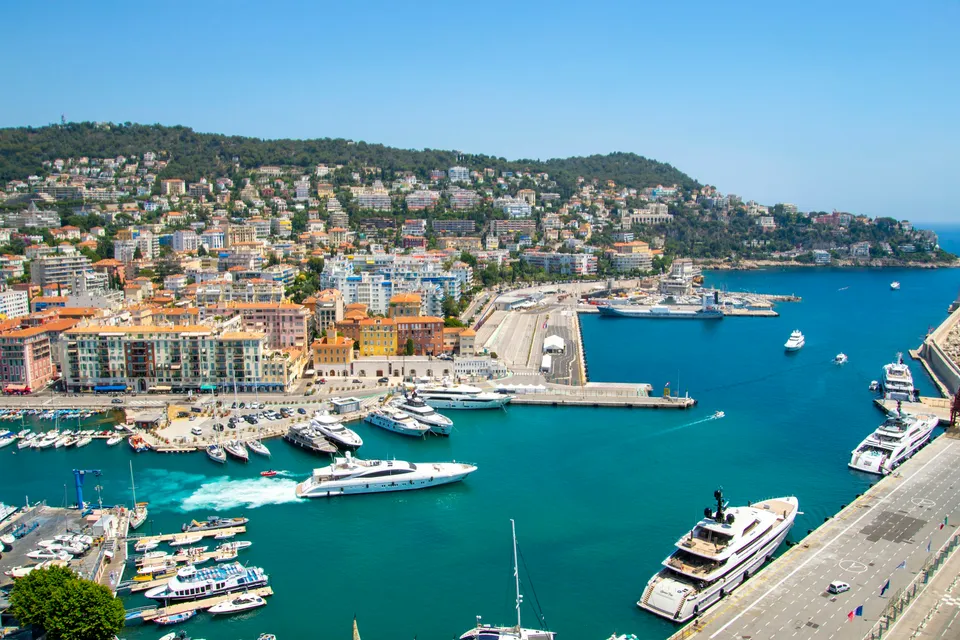
On the other side of the hill lies Port Lympia, the port of Nice, with its “pointus”, the traditional wooden boats painted in bright colors. In summer, a free boat, Lou Passagin, crosses the harbor. Beyond the port, the forest park of Mont Boron, 57 hectares on the hill that separates Nice from Villefranche, has 11 kilometers of marked trails, and the tourist office lists a 5.1-kilometer walk around it.
Place Masséna and the Promenade du Paillon
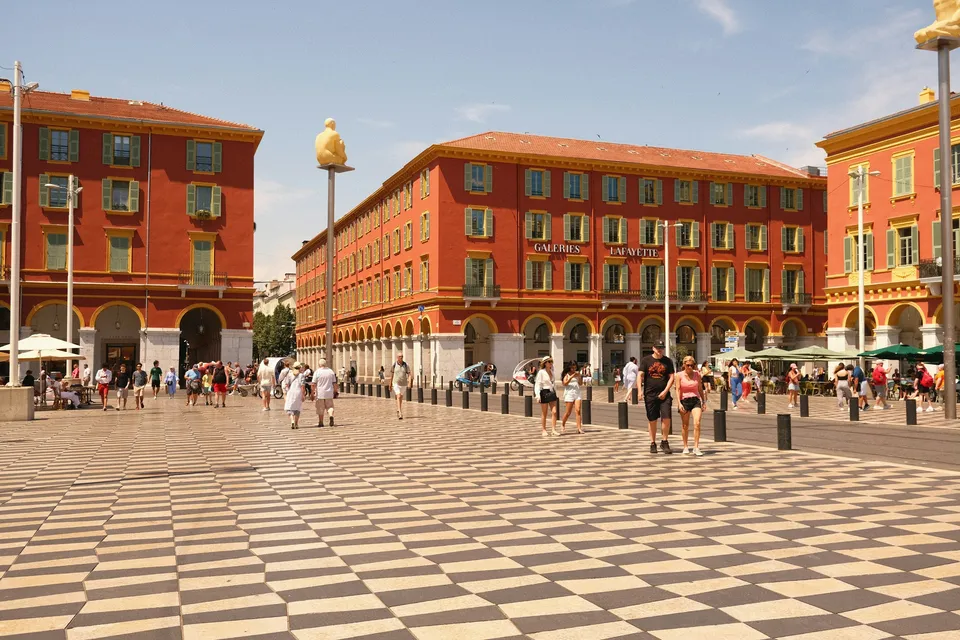
Place Masséna, the main square, is recognizable by its red facades with arcades inspired by Piedmontese architecture, its Fountain of the Sun and its black and white paving. Created in the nineteenth century and named after Marshal André Masséna, born in Nice, it also holds the seven figures of “Conversation à Nice” by the artist Jaume Plensa, one for each continent, perched on poles above the square.
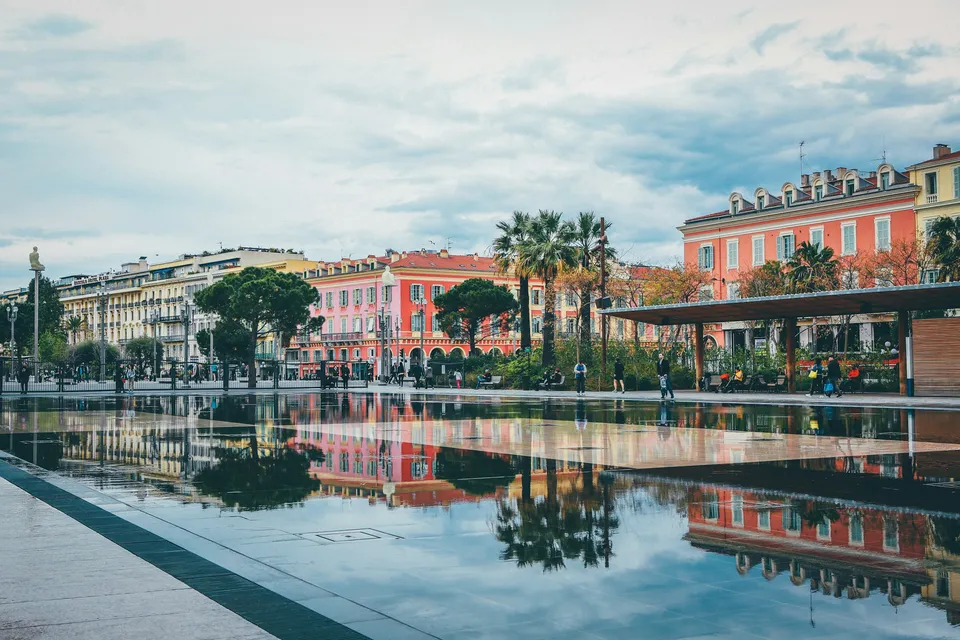
From the square, the Promenade du Paillon runs as a 14.5-hectare city park, with a giant water mirror (open 9 a.m. to 8 p.m. from October to March and to 10 p.m. from April to September) and a 3,000-square-meter pool fitted with 128 water jets. The park is free and open from 7 a.m. to 9 p.m. in winter and to 11 p.m. in summer.
Cimiez, the hill of Matisse and the Romans
On the hill of Cimiez, the tourist office points to the former Hôtel Regina, built especially for Queen Victoria. The hill holds the Matisse museum, the Musée national Marc Chagall, the Roman ruins of Cemenelum (founded by Augustus in 14 B.C., with its amphitheater and public baths, next to the archaeology museum), and the free garden of the Cimiez monastery, 9,550 square meters with a view over the sea and the city.
The Russian Orthodox Cathedral
The Russian Orthodox Cathedral of Saint-Nicolas, built from 1903 to 1912, is open every day. Its own site gives the hours from October 2026: Monday to Friday 10 a.m. to 1:30 p.m. and 2 to 5:30 p.m., Saturday 10 a.m. to 6 p.m., Sunday 9 a.m. to 6 p.m. It is closed to visitors on Sunday mornings from 9 a.m. to noon and during services, and the historic Tsarevich chapel can be seen only on a guided tour. The tourist office asks for proper dress.
The Museums of Nice: Hours and Prices
| Museum | What it holds | Opening, as published | Adult price |
|---|---|---|---|
| Musée Matisse, Cimiez | Opened in 1963 in the Villa des Arènes, nearly 600 works and 138 objects that belonged to Henri Matisse | Every day except Tuesday; 10 a.m. to 5 p.m. from November 1 to March 31, to 6 p.m. from April 1 to October 31 | 10 euros; free under 18 |
| Musée national Marc Chagall, Cimiez | The largest public collection of Chagall’s work, according to the tourist office, with the 17 canvases of the Biblical Message | Every day except Tuesday; 10 a.m. to 5 p.m. from November 1 to April 30, to 6 p.m. from May 2 to October 31; closed 1 to 2:30 p.m. in November and December 2026 | 10 euros, 12 euros during exhibitions; free for everyone on the first Sunday of the month and for under-26s from the European Union |
| Villa Masséna, museum of art and history | A villa built from 1898 to 1901 by the Danish architect Hans-Georg Tersling, a museum since 1921 | Closed Tuesdays; 11 a.m. to 6 p.m. from November 1 to April 30, from 10 a.m. from May 2 to October 31 | 10 euros; free under 18 |
| MAMAC, modern and contemporary art | Closed for renovation since January 7, 2024, in a four-year program the city places in 2024 to 2028 | Closed |
Sources: Musée Matisse; Musée national Marc Chagall; Ville de Nice, Villa Masséna; MAMAC, read on November 25, 2026. The Chagall museum searches every bag at the entrance.
Two passes can save money. The city’s Pass Musées de Nice, 4 days, costs 15 euros and gives access to all the municipal museums and galleries, the Matisse museum and the Villa Masséna among them. The tourist office’s French Riviera Pass, valid at more than 60 sites and activities around Nice, costs 30 euros for 24 hours, 45 euros for 48 hours and 65 euros for 72 hours; it covers the Matisse museum, the Chagall museum, the Russian cathedral and the guided tour of the old town, among others.
The Beaches of Nice
The beaches of Nice are pebble: the tourist office writes of “the immaculate white of the pebbles of its beaches”, and of eating a pan bagnat, the local sandwich, on the stones. Along the Promenade des Anglais, from west to east, there are many public beaches, free, and 14 concession beaches, the private ones with sun loungers and restaurants, plus two water sports bases, according to the city. Two public beaches are equipped for disabled bathers: Carras and Centenaire.
If you have never swum from a pebble beach, water shoes and a thicker towel make it easier.
The Weather in Nice, Month by Month
These are Météo-France’s climate normals for its Nice station, averages for 1991 to 2020:
| Month | Average low | Average high | Rain | Sunshine |
|---|---|---|---|---|
| January | 5.8 °C (42 °F) | 13.3 °C (56 °F) | 73.5 mm | 157 h |
| February | 6.1 °C (43 °F) | 13.5 °C (56 °F) | 53.6 mm | 166 h |
| March | 8.3 °C (47 °F) | 15.4 °C (60 °F) | 51.0 mm | 218 h |
| April | 10.8 °C (51 °F) | 17.4 °C (63 °F) | 68.8 mm | 229 h |
| May | 14.5 °C (58 °F) | 21.0 °C (70 °F) | 40.3 mm | 271 h |
| June | 18.1 °C (65 °F) | 24.7 °C (76 °F) | 35.7 mm | 310 h |
| July | 20.8 °C (69 °F) | 27.5 °C (82 °F) | 13.6 mm | 349 h |
| August | 21.1 °C (70 °F) | 27.9 °C (82 °F) | 17.2 mm | 323 h |
| September | 17.7 °C (64 °F) | 24.8 °C (77 °F) | 81.0 mm | 250 h |
| October | 14.0 °C (57 °F) | 21.0 °C (70 °F) | 127.9 mm | 191 h |
| November | 9.7 °C (49 °F) | 17.0 °C (63 °F) | 138.4 mm | 152 h |
| December | 6.6 °C (44 °F) | 14.1 °C (57 °F) | 90.3 mm | 145 h |
| Year | 12.8 °C (55 °F) | 19.8 °C (68 °F) | 791.3 mm | 2,760.5 h |
Source: Météo-France, Nice climate normals 1991-2020, read on November 25, 2026. Fahrenheit figures are converted from the Celsius values; monthly sunshine hours are rounded.
What the table means for a trip:
- For the beach: July and August are the warmest and the driest months, with the most sunshine, and June and September are not far behind.
- For walking and museums: April, May and late September to October give highs around 17 to 25 °C.
- For a winter escape: January and February average highs of about 13 °C, with more than 150 hours of sunshine a month. February is also Carnival month.
- The wettest months are October and November, with about 128 and 138 millimeters of rain on average, against under 20 in July and August.
The Carnival of Nice 2027
The Carnaval de Nice 2027 runs from February 9 to 28, 2027, on the theme “Vive l’Amour”, with 56 events, 45 of them entirely free, according to its official site. The big change this year: the standing areas (promenoirs) of every parade and flower battle are free, on reservation. Ticketing for the stands and the standing areas opens in early January 2027.
| Event | Dates in 2027 | Time |
|---|---|---|
| Opening illuminated parade, Place Masséna | Saturday February 13 | 9 p.m. |
| Illuminated parades (corsi carnavalesques illuminés) | Tuesdays February 16 and 23, Saturday February 20 | 8:30 p.m. |
| Flower battles (batailles de fleurs) | Wednesdays February 17 and 24, Saturdays February 20 and 27 | 2:30 p.m. |
| Closing parade, burning of the King and fireworks | Saturday February 27 | From 8:30 p.m.; fireworks at 10:45 p.m. on the Promenade des Anglais, free |
Source: Carnaval de Nice, official 2027 programme, read on November 25, 2026. The grandstand prices for 2027 were not yet published.
The flower battles go back to 1876, and the carnival says 80 percent of the flowers used are grown locally, with 250,000 stems and 21 tonnes of mimosa handed out to the public. In 2027 their route goes past Place Masséna, the avenue de Verdun, the Promenade des Anglais and the quai des États-Unis, which adds more than 2,000 places. With small children, the carnival recommends giving them a bracelet with their name and a parent’s phone number.
Getting to Nice and Around It
From the US and from Paris
Nice airport lists non-stop flights from four US cities, on its own pages: New York with Delta (JFK) and United (Newark), seven flights a week from April to October each, and La Compagnie, four a week all year; Philadelphia with American Airlines, daily from May to October; Atlanta with Delta, daily from May to October; and Boston with Delta, three times a week from mid-May. The airport puts the average flight time to New York at about 9 hours. From Paris, 13 trains a day run to Nice, the fastest in 5 hours 42 minutes and 6 hours 49 on average, from 25 euros on some trains, according to SNCF Connect.
From the airport to the city
| How | Time and price, as published |
|---|---|
| Tram line 2 | To the center (Jean Médecin station) in under 30 minutes, every 7 to 8 minutes on weekdays; airport round-trip ticket 10 euros, with connections for 74 minutes; free between the terminals |
| Taxi | Fixed fare to central Nice: 32 euros (indicative 2026 fare); from the official ranks only, card payment accepted |
| Train | Nice Saint-Augustin station is a 7-minute walk from Terminal 1 (exit A0), on the coast line to Cannes, Monaco and Menton |
| Bus 12+ | 150 meters from Terminal 1, along the Promenade des Anglais to the old town; no tickets sold on board |
Sources: Nice airport, public transport, taxis and trains; Lignes d’Azur, airport round trip, read on November 25, 2026. The airport advises turning down anyone who approaches you inside the terminal to offer a ride.
Getting around Nice
Nice is walkable, and its trams and buses, run by Lignes d’Azur, cover the rest: the network counts more than 140 bus lines and tram lines 1, 2, 3 and B. A Solo ticket costs 1.70 euros for one trip with connections for 74 minutes, and a 1-day pass 7 euros (2 days 13 euros, 7 days 20 euros). Tickets go on a rechargeable card, sold for 2 euros at the tram station machines, or on the Lignes d’Azur app; the tourist office notes that on an iPhone, the app only recharges a physical contactless card. You must validate at every trip. No Lignes d’Azur page read for this guide says that a bank card can be tapped on the validators, so buy a ticket first.
Day Trips from Nice by Train
The coast line is the best reason to base yourself in Nice: TER regional trains leave Nice-Ville for the whole Riviera from about 5:30 a.m. to past 10 p.m.
| Destination | Trains a day | Average time | Full one-way fare |
|---|---|---|---|
| Villefranche-sur-Mer | 60 | 5 minutes | 3.60 euros |
| Monaco | 65 | 20 minutes | 6.10 euros |
| Antibes | More than 140 | 20 minutes | 7.00 euros |
| Cannes | More than 140 | 35 minutes | 9.70 euros |
| Menton | 65 | 40 minutes | 7.70 euros |
| Èze (Èze-sur-Mer station) | Up to 80 a day in season, according to the Èze tourist office | 16 to 17 minutes on the regional departure boards | No published fare page; no ticket office at Èze, machines only |
Source: TER Sud, routes from Nice, read on November 25, 2026. A ZOU! Malin discount card cuts these fares by 30 percent, and the mini-group fare (5 people or more) by about half.
For several days of trains, trams and buses, the Pass SudAzur Explore gives unlimited travel in the Alpes-Maritimes and Monaco: 35 euros for 3 days, 50 euros for 7 days, 80 euros for 14 days. Two of the best day trips have their own guides: Èze, the perched village with its exotic garden, and Menton, the last town before Italy, with its Lemon Festival in February.
How Many Days in Nice?
The tourist office suggests a plan for one to three days, which works well:
- Day 1: the Promenade des Anglais, the Negresco, the Rauba Capeù point, Castle Hill, the Cours Saleya, Place Rossetti and Place Garibaldi in the old town, then the Promenade du Paillon and Place Masséna.
- Day 2: Port Lympia, the World Heritage interpretation center (75 quai des États-Unis), the Villa Masséna, then the hill of Cimiez and its museums.
- Day 3: a boat to Villefranche or the coastal path (6 kilometers), the Bellet vineyards, and Mont Boron.
With four or five days, add Monaco, Èze and Menton by train. With a week or more, Nice works as a base for the whole coast, from Cannes to the Italian border.
Staying Longer in Nice
Nice is also the practical base for a longer stay on the coast, with the airport and the train line at hand. Three rules matter once you stay beyond a holiday:
- The 90-day rule. As an American visiting the Schengen area, you can usually stay a maximum of 90 days within any 180-day period, according to the European Commission, and the European Union’s Entry/Exit System counts that period as one for all the countries using it, so trips to Italy count in the same total. Our guide to how long Americans can stay in France without a visa explains the count, and the Schengen calculator checks your dates. Beyond 90 days you need a long-stay visa.
- The tourist tax. The Métropole Nice Côte d’Azur charges a taxe de séjour per person and per night, with an additional 34 percent tax in the Alpes-Maritimes since a 2023 finance law. Its 2027 rates are unchanged from 2026, and minors are exempt.
- Furnished rentals. Since September 1, 2026, a main residence in Nice can be let as a tourist rental for up to 120 days a year, instead of 90, the city decided in June 2026, and a second home needs a prior change-of-use permit before any tourist rental. For a stay of one to ten months, a furnished lease under the bail mobilité is the usual route, and our guide to renting in Nice compares the neighborhoods for a longer stay.
Finding that furnished flat, calling the agencies and setting up a phone line or a bank account in French is the kind of work our Personal Assistant handles: the calls, the forms and the apartment search, in French.
FAQ
Where is Nice, France?
On the Mediterranean coast of southeastern France, in the Alpes-Maritimes, at the foot of the Alps and near the Italian border. Monaco is 20 minutes away by train and Menton, the last town before Italy, 40 minutes.
Is Nice worth visiting?
Yes: it combines a World Heritage seafront, a baroque old town, two major museums of modern art (Matisse and Chagall) at 10 euros each, pebble beaches in the city, and trains to the whole Riviera. It is also the easiest arrival point, with non-stop flights from four US cities in season.
What is the best time to visit Nice?
June and September for warm weather without the July and August crowds; July and August for the beach, the driest and sunniest months; February for the Carnival and mild winter days with about 13 °C highs. October and November are the wettest months, according to Météo-France.
Are the beaches in Nice sandy?
No, they are pebble. The city lists many free public beaches along the Promenade des Anglais and 14 private concession beaches, two of them equipped for disabled bathers.
How do you get from Nice airport to the city center?
Tram line 2 takes under 30 minutes to the center (Jean Médecin), every 7 to 8 minutes on weekdays, with a 10-euro airport round-trip ticket. A taxi to central Nice has a fixed fare of 32 euros.
How far is Nice from Paris?
933 km by rail: 13 trains a day, the fastest in 5 hours 42 minutes, according to SNCF Connect.
When is the Nice Carnival in 2027?
From February 9 to 28, 2027, on the theme “Vive l’Amour”. The flower battles are on February 17, 20, 24 and 27 at 2:30 p.m., and the standing areas are free on reservation for the first time.
Conclusion
Nice is the place to start the Riviera: a World Heritage seafront, an old town of markets and baroque churches, museums at 10 euros, pebble beaches in the city and a train line that puts Monaco, Èze, Menton, Antibes and Cannes within 40 minutes. Come in June or September for the sea without the crowds, in February for the Carnival, or in winter for a season of mild days, and keep the 90-day rule in mind if you stay. For the rest of the region, from Provence to the Languedoc, see our guide to the South of France.
The parts of the move Americans find out about too late.
What Americans get wrong about moving to France, and the number, form or deadline that fixes it. Straight to your inbox.
One email a week. Real numbers, nothing else.
Written by
Aurelio Maurici
Co-Founder, EasyFranceNow
Aurelio Maurici is a French entrepreneur and co-founder of EasyFranceNow. His work focuses on the intersection of French administration, banking constraints affecting U.S. nationals, tax residency and cross-border reporting, healthcare enrollment, and the procedural realities Americans encounter while settling in France.


