
Èze, France: The Perched Village, the Exotic Garden and the Nietzsche Path

By Aurelio Maurici Co-Founder, Master of Business Law, Aix-Marseille Université III
Published

In this article
- Èze at a Glance
- The Village, Èze-sur-Mer and the Three Corniches
- The Medieval Village
- The Exotic Garden of Èze (Jardin Exotique)
- The Perfumers of Èze: Fragonard and Galimard
- The Nietzsche Path (Chemin de Nietzsche)
- The Beach at Èze-sur-Mer
- How to Get to Èze
- How to Spend a Day in Èze
- Coming for More than a Day
- FAQ
- Conclusion
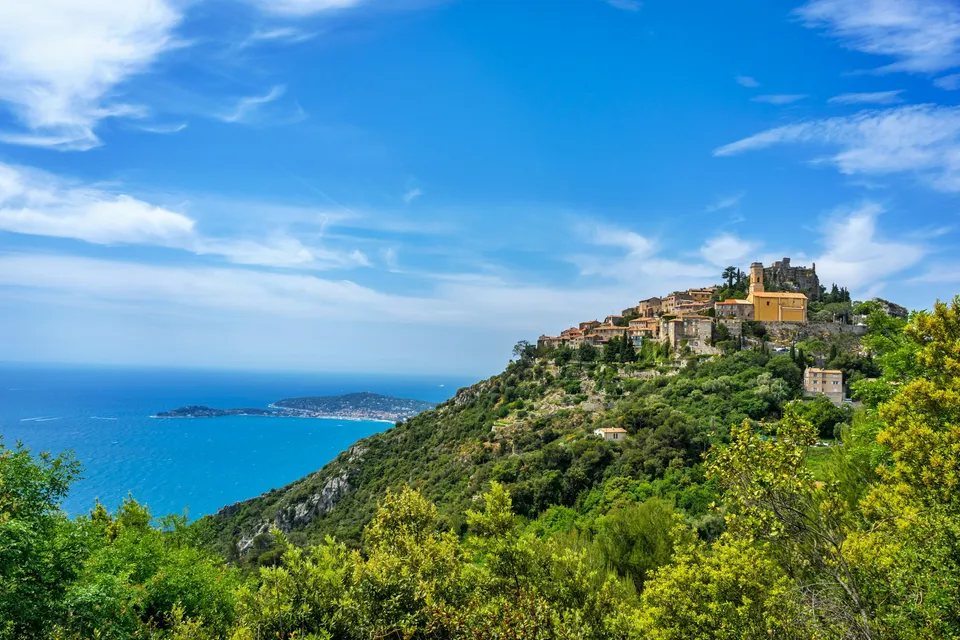
Èze is the perched village of the French Riviera: a medieval village on a rock 429 meters above the Mediterranean, between Nice and Monaco, crowned by an exotic garden on the ruins of its castle. The metropolitan tourist office calls it “the eagle’s nest of the Côte d’Azur”. It is small (2,144 residents, according to INSEE) and close: 11 km from Nice and 9 km from Monaco, half an hour by bus from Nice. The classic visit takes a morning or an afternoon: climb the lanes to the garden for the view, visit a perfumery, and, with good shoes, walk down the Nietzsche path to the sea.
This guide covers the village and its history, the exotic garden and its prices, the two perfumers, the Nietzsche path, the beach, how to get there by bus, train or car, and how to fit it all into a day. Every price and opening time below was read on the official page of the town, the tourist office, the garden or the operator on November 25, 2026.
Èze at a Glance
| Where | Alpes-Maritimes, between Nice (11 km) and Monaco (9 km); Nice airport 18 km |
| Population | 2,144 (INSEE reference population 2023) |
| The village | On a rocky promontory at 429 meters, on the Moyenne Corniche |
| Èze-sur-Mer | The seaside part, on the Basse Corniche, with the train station and the beach |
| Must-see | The Jardin exotique at the top of the village, the lanes, the perfumers |
| Time needed | Half a day for the village and the garden; a full day with the Nietzsche path and the beach |
| From Nice | Bus 82 to the village (about 30 minutes), or the train to Èze-sur-Mer (16 to 17 minutes) |
Sources: Office de Tourisme d’Èze, access and distances; INSEE, Èze; Office de Tourisme Nice Côte d’Azur, Èze, read on November 25, 2026.
The Village, Èze-sur-Mer and the Three Corniches
Èze spreads over the three roads that run along this part of the coast, the Corniches. The tourist office sets them out: the Basse Corniche (D6098), along the sea, leads to Èze Bord de Mer, also called Èze-sur-Mer, with its station, its beach and its Belle Époque villas; the Moyenne Corniche (D6007), halfway up, leads to the medieval village; and the Grande Corniche (D2564), the highest, leads to the Col d’Èze at 508 meters and the departmental park of the Grande Corniche. The village and the sea are linked by bus line 83 and, on foot, by the Nietzsche path.
The parts of the move Americans find out about too late.
What Americans get wrong about moving to France, and the number, form or deadline that fixes it. Straight to your inbox.
One email a week. Real numbers, nothing else.
The Medieval Village
The town hall’s history page traces the rock back to a hillfort around 220 B.C. and the name “Èze” to a document of the abbey of Saint-Pons of Nice in 1075. A castle was built in the second half of the twelfth century; in 1706, during the War of the Spanish Succession, Louis XIV had it razed. In between, the counts of Savoy fortified the village and protected it with a double fortified gate, the Poterne. Èze became French for good in 1860, after the people of Èze voted unanimously for it on April 15 and 16 of that year.
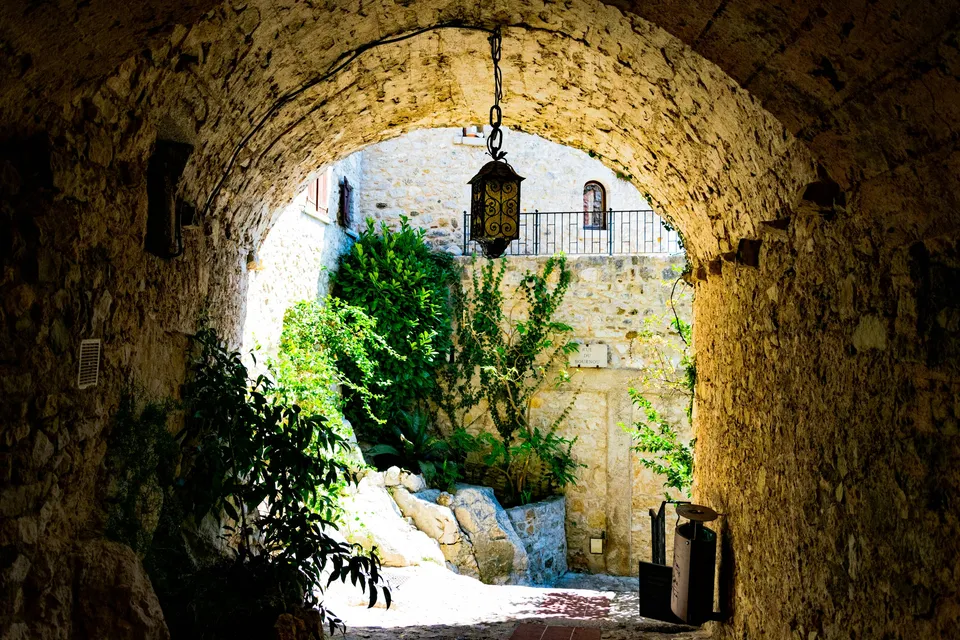
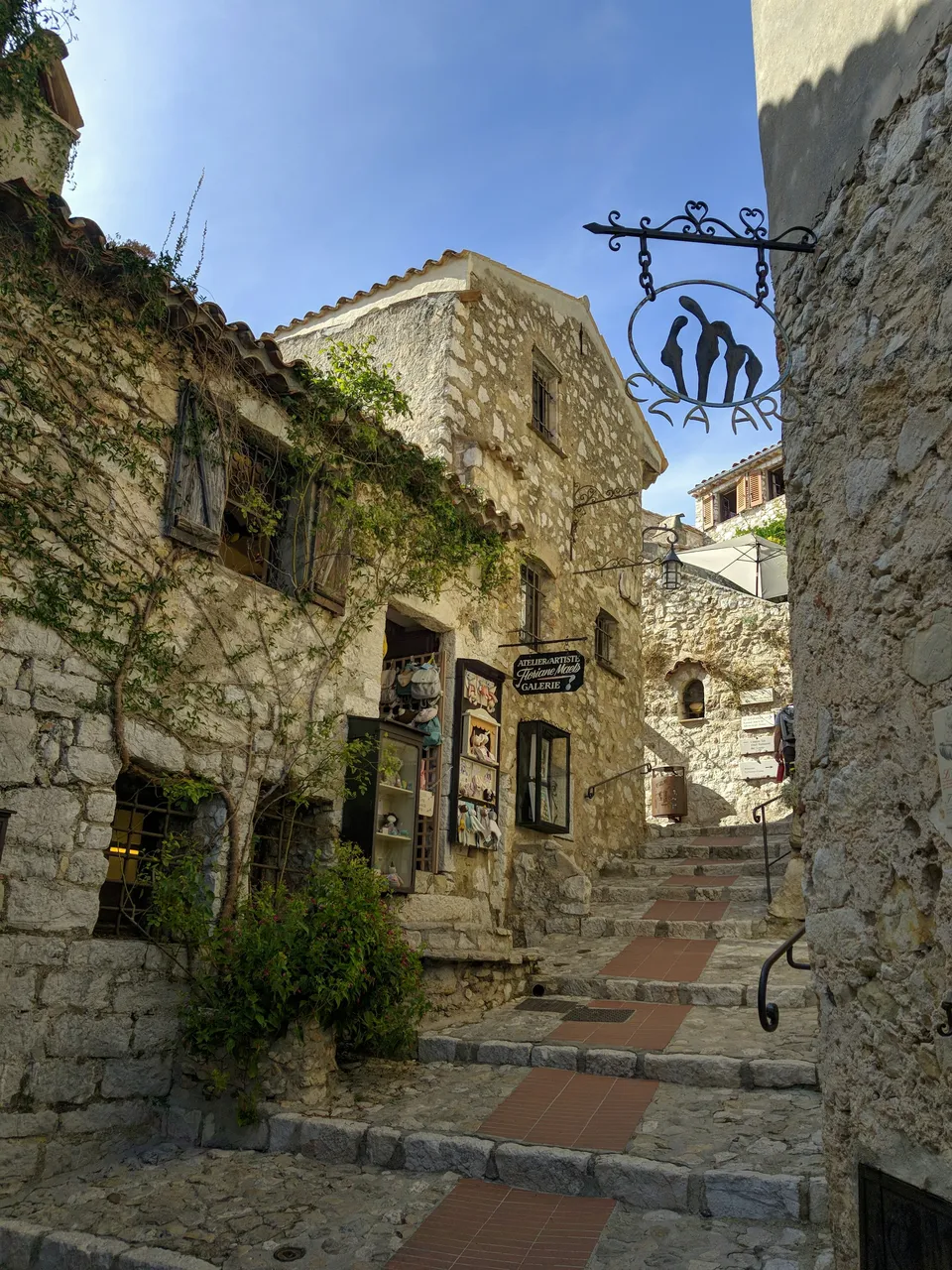
Inside the walls, the village is a maze of narrow streets, in the tourist office’s words, where restaurants and luxury hotels share the lanes with boutiques, workshops and artists’ galleries. You walk it on foot, by steps and switchbacks: the tourist office calls the climb “the only route into the village”. Two buildings stand out:
- The church of Notre-Dame-de-l’Assomption, rebuilt between 1764 and 1778 by the Italian architect Antoine Spinelli at the request of the Duke of Savoy, Charles-Emmanuel III, on the base of a twelfth-century church. Its sober facade hides a baroque interior with trompe-l’oeil windows. It has been a listed historic monument since December 5, 1984.
- The Chapel of the White Penitents, or Chapelle de la Sainte-Croix, from 1306, the oldest building in the commune: the brotherhood that cared for plague victims met there, and it is where the people of Èze voted to join France in 1860. It can be seen from outside, through a grille.
Both were marked “temporarily closed” on the tourist office listings on November 25, 2026, without dates: check before you plan around them.
The town hall adds two stories that visitors like. The Château Balsan, a private house that cannot be visited, was used in 1954 for scenes of Alfred Hitchcock’s “To Catch a Thief” (“La Main au collet”) with Grace Kelly and Cary Grant. And the Château de la Chèvre d’Or, today a hotel and restaurant, began as houses the violinist Zlatko Baloković bought and restored in 1923.
The Exotic Garden of Èze (Jardin Exotique)
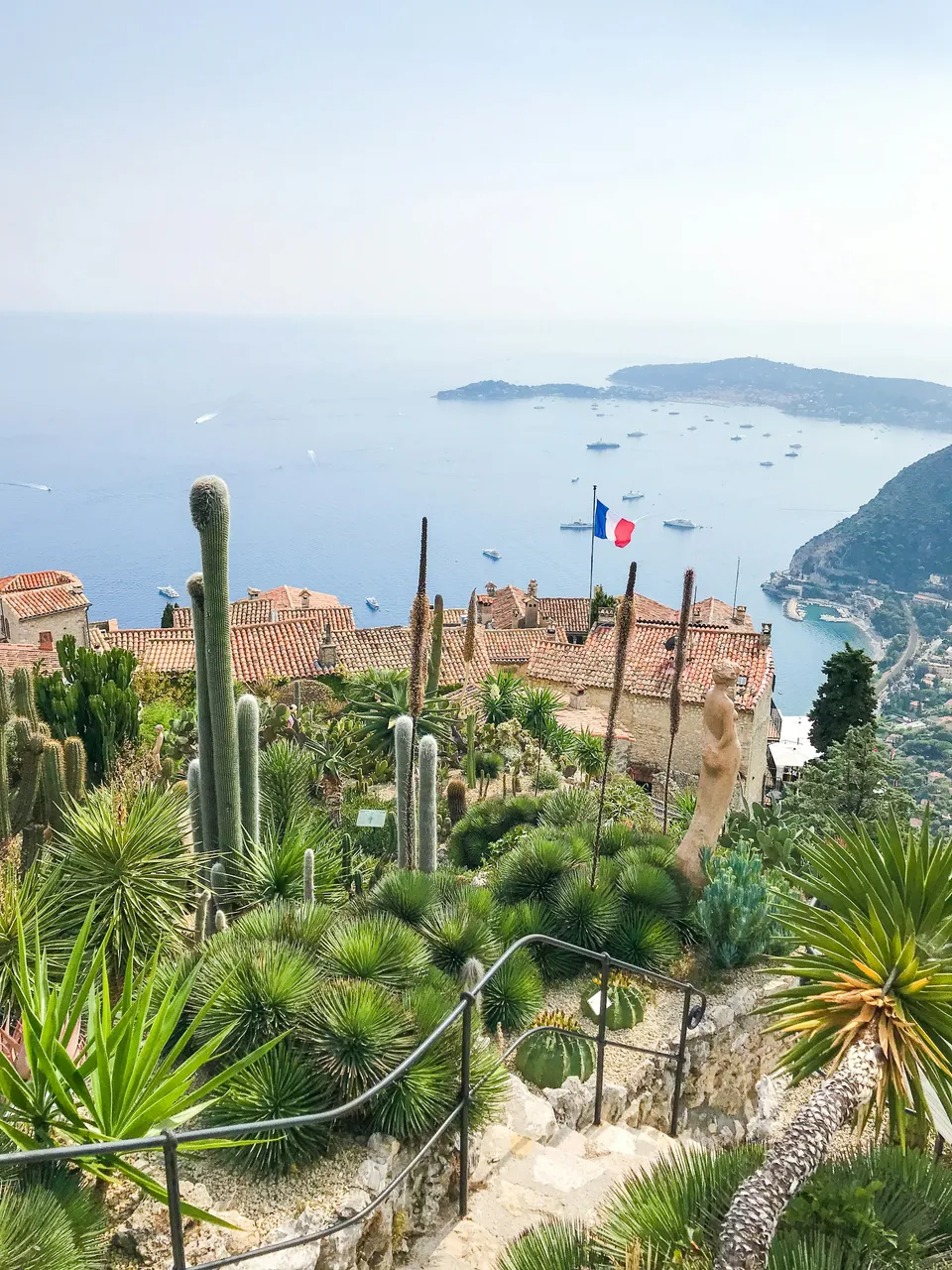
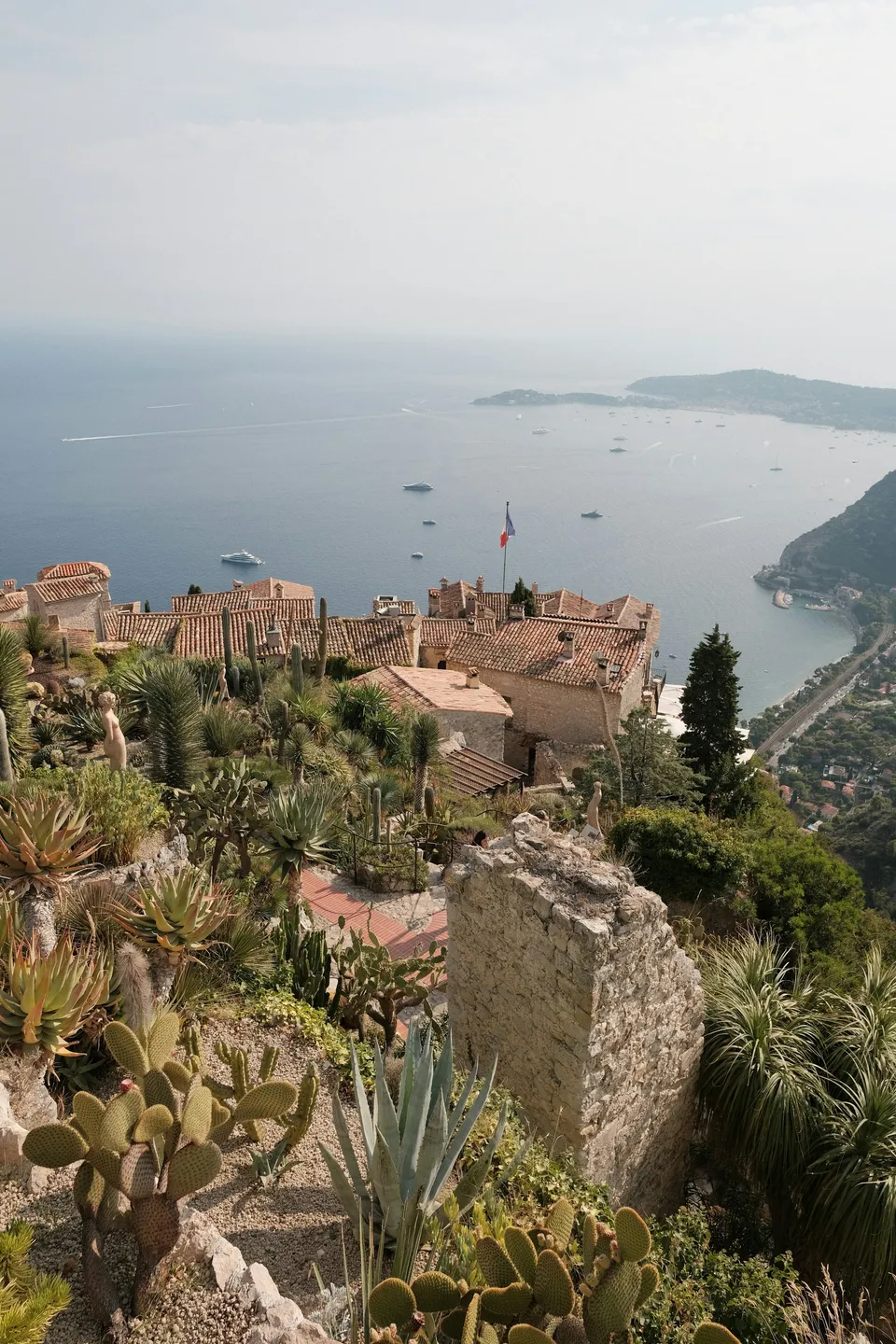
At the very top of the village, on the site of the medieval fortress, the Jardin exotique is the reason most people climb. After the Second World War, the garden’s history page says, dozens of men carried sacks of earth and rubble up to the castle ruins on their backs, and the mayor of the time, André Gianton, decided with Jean Gastaud, the father of Monaco’s exotic garden, to create an exotic garden there. Its south side holds several dozen species of succulents and xerophytes from every continent, among them the golden barrel cactus and the prickly pear; its north side, opened in July 2014, has Mediterranean and humid-climate plants with grottoes and a waterfall. Fourteen statues by the sculptor Jean-Philippe Richard stand along the paths.
| Exotic garden of Èze | As published |
|---|---|
| Opening hours | Every day: 9 a.m. to 4:30 p.m. in January, February, March, November and December; to 6:30 p.m. in April, May, June and October; to 7:30 p.m. in July, August and September. Closed on December 25 |
| Last entry (November and December 2026) | 4 p.m. |
| Adult price | 10 euros |
| Reduced price | 6 euros for students and for groups of 12 or more |
| Free | Children under 12, residents of Èze, disabled visitors |
| Visit | About 60 minutes; not wheelchair accessible; dogs allowed on a leash |
Sources: the garden’s own site, jardinexotique-eze.fr (hours, prices, history); Office de Tourisme Nice Côte d’Azur, Jardin exotique d’Èze, read on November 25, 2026. The garden is included in the French Riviera Pass.
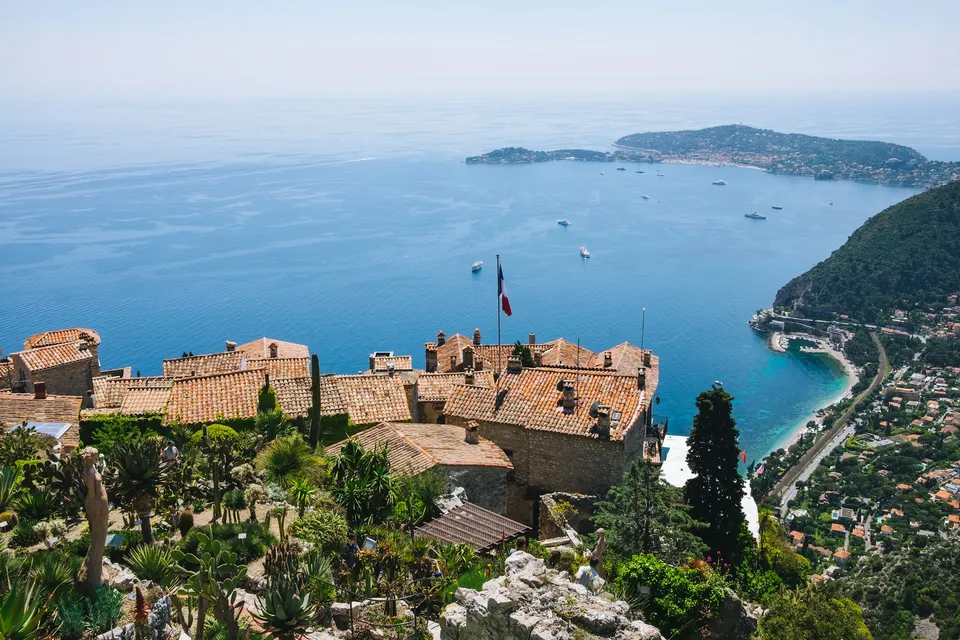
The view is the point. From the summit, the garden says, the eye reaches the Esterel mountains and the Gulf of Saint-Tropez, and the tourist office adds that on a clear day you can see Corsica. One practical detail from the garden itself: there is very little phone signal at the top of the village, so if you buy your ticket online, print it or take a screenshot.
The Perfumers of Èze: Fragonard and Galimard
The tourist office counts two renowned perfumeries in the village, and both open their workshops to visitors:
| Perfumer | What you can do | Price and hours, as published |
|---|---|---|
| Fragonard, the factory and laboratory of Èze-Village (opened in 1968, at the foot of the rock) | A free guided tour of the factory: stills, enfleurage, the perfumer’s organ, the soap workshop | Free; every day, tours throughout the day from 9 a.m. to noon and from 2 to 6 p.m.; no booking, go to the reception |
| Galimard, Èze-Village (a perfumer founded in Grasse in 1747, according to the tourist office) | A free guided tour of the factory and museum, or a workshop to make your own fragrance | Tour free, 45 minutes, every day from 9 a.m.; Cologne workshop (15 ml) 18 euros, about 45 minutes to an hour, from age 5; “Collection Privée” workshop (50 ml eau de parfum) 99 euros; “Studio n°1” (100 ml, 2 hours) 299 euros |
Sources: Fragonard, the Èze-Village factory; Galimard, Cologne workshop in Èze-Village; Office de Tourisme Nice Côte d’Azur, Galimard, read on November 25, 2026. Galimard recommends booking the workshops.
The Nietzsche Path (Chemin de Nietzsche)
The path links Èze-sur-Mer, by the sea, to the village, and it carries the philosopher’s name for a reason the town hall tells in his own words: in December 1883, Friedrich Nietzsche, then 39, got off the train at Èze Bord de Mer and took the mule track up to the village. In “Ecce Homo” he wrote that the decisive part of “Thus Spoke Zarathustra” titled “Of Old and New Tables” was composed during a most painful climb from the station to the marvelous Moorish village of Èze, built among the rocks.
What to expect, according to the town hall and the Èze tourist office: about 1 hour 30 to climb and 45 minutes to come down, for a difference in height of about 400 meters; wear walking shoes. The metropolitan tourist office’s itinerary gives 350 meters of climb over 2.1 km, rates it of medium difficulty, and notes that it is not signposted, on cement, then steps, then a paved section toward the village. From the village, it starts at the bottom, next to the entrance of the Château de la Chèvre d’Or hotel.
Walked downhill, it is the shorter way, 45 minutes, and it ends at the station and the beach of Èze-sur-Mer, with a train back to Nice.
The Beach at Èze-sur-Mer
Between Cap Roux and Cap Estel on the Basse Corniche, the beach of the bay of Èze is a shaded pebble beach, the tourist office says, supervised from June 15 to September 15, with two restaurants and concession beaches, and kayak and canoe rental at the nautical club. It is free and open all year; pets are not allowed.
How to Get to Èze
| From | How | Time, as published or observed |
|---|---|---|
| Nice, to the village | Lignes d’Azur bus 82, from Nice Vauban to Èze Village | 27 to 30 minutes; 8 departures on the timetable of Wednesday, November 25, 2026, from 6:30 a.m. to 7:10 p.m. |
| Nice, to the village | ZOU! bus 602, Nice Vauban to Monaco by Èze village | Timetable published as a PDF only |
| Nice, to the sea | TER train from Nice-Ville, Nice-Riquier or Nice-Saint-Augustin to Èze-sur-Mer | 16 to 17 minutes on the departure boards of November 25, 2026; up to 80 trains a day in season, according to the Èze tourist office |
| Èze-sur-Mer to the village | Lignes d’Azur bus 83 (the “shuttle of the three Corniches”) | 15 to 21 minutes on the November 25, 2026 timetable |
| Monaco | ZOU! bus 602 (to the village) or 605 (Èze, La Turbie, Monaco); the train to Èze-sur-Mer | |
| By car | The Moyenne Corniche (D6007) from Nice; from the A8 motorway, exit 57 (La Turbie) coming from Nice | About 25 minutes from Nice or Monaco by the motorway, according to the tourist office |
Sources: Lignes d’Azur, line 82 and line 83; ZOU!, Alpes-Maritimes lines; Office de Tourisme d’Èze, access; Office de Tourisme Nice Côte d’Azur, how to get to Èze, read on November 25, 2026. The bus and train times are those of one day, not a published frequency: check the operator’s app the day you go.
Tickets: a Lignes d’Azur Solo ticket costs 1.70 euros for one trip with 74 minutes of connections on the lines at urban fare, and the pages read do not say whether lines 82 and 83 are among them, so check the fare in the Lignes d’Azur app before you board. The Èze-sur-Mer station has no ticket office: tickets are sold only from the regional ticket machines there. For several days on the coast, the Pass SudAzur Explore covers trains, trams and buses in the Alpes-Maritimes and Monaco from 35 euros for 3 days.
Parking. The covered car park under Place du Général-de-Gaulle, at the foot of the village, is run by EFFIA, open 24 hours a day, with a height limit of 1.90 m: 4.30 euros for an hour, 10.60 euros for 3 hours, 34.70 euros for 24 hours. The La Colette and Figuiera car parks are also paid; no prices are published for them. An electric shuttle links the Colette car park to the Fragonard factory in about 10 minutes, for 6 euros per person per trip, on booking only.
How to Spend a Day in Èze
A plan that uses the bus up and the path down, built from the times above:
- Morning: bus 82 from Nice Vauban to Èze Village, about 30 minutes. Climb the lanes to the exotic garden; allow an hour.
- Late morning: walk back down through the village, past the church and the Chapel of the White Penitents, and stop at Fragonard or Galimard for a free tour.
- Afternoon: walk the Nietzsche path down to Èze-sur-Mer, about 45 minutes, then the beach.
- Back: the train from Èze-sur-Mer to Nice-Ville, 16 to 17 minutes.
If you are staying longer on the coast, Èze fits between Nice and Monaco: our Nice guide covers the other day trips by train, and Menton, 21 km farther east, is the last town before Italy.
Coming for More than a Day
Èze is a village to visit rather than a base: for a stay of weeks, a base in Nice, Villefranche-sur-Mer or Menton puts it a short bus or train ride away. Whatever the base, the rules are those of any stay in France: as an American, you can usually stay a maximum of 90 days within any 180-day period in the Schengen area, according to the European Commission, and our guide to how long Americans can stay in France without a visa explains the count. For a furnished flat on the coast for a winter or a season, the calls, the forms and the apartment search in French are what our Personal Assistant handles.
FAQ
How do you get from Nice to Èze?
By Lignes d’Azur bus 82 from Nice Vauban to Èze Village, about 30 minutes, or by TER train from Nice-Ville to Èze-sur-Mer, 16 to 17 minutes, then bus 83 or the Nietzsche path up to the village.
Is Èze worth visiting?
Yes, for the view as much as the village: from the exotic garden at 429 meters, the panorama reaches the Esterel and the Gulf of Saint-Tropez, and on a clear day Corsica. The medieval lanes, the free perfumery tours and the Nietzsche path make it a full half day or day from Nice or Monaco.
How much does the Èze exotic garden cost?
10 euros for an adult, 6 euros for students and groups of 12 or more, free for children under 12, according to the garden and the tourist office. It is open every day from 9 a.m., until 4:30 p.m. in winter and 7:30 p.m. in July, August and September.
Is the Nietzsche path hard?
It is a steady climb: about 400 meters of height difference, 1 hour 30 up and 45 minutes down, on cement, steps and paving, and it is not signposted. The town hall recommends walking shoes; the descent takes about half the time of the climb.
What is the difference between Èze Village and Èze-sur-Mer?
Èze Village is the medieval village on its rock at 429 meters, on the Moyenne Corniche, with the exotic garden and the perfumers. Èze-sur-Mer, or Èze Bord de Mer, is the seaside part on the Basse Corniche, with the train station and the beach.
Can you drive to Èze?
Yes, by the Moyenne Corniche from Nice or Monaco. You park at the foot of the village, in the underground car park of Place du Général-de-Gaulle (4.30 euros an hour) or at the La Colette and Figuiera car parks, and you go up on foot.
Conclusion
Èze rewards a few hours: a medieval village of stone lanes, an exotic garden on the ruins of the castle with a panorama the garden counts among the most exceptional of the Riviera, two perfumers who show their workshops for free, and a path down to the sea that Nietzsche climbed in 1883. Take bus 82 up from Nice, keep the descent for the Nietzsche path, and come back by train. For the rest of the coast, from the Riviera to Provence, see our guide to the South of France.
The parts of the move Americans find out about too late.
What Americans get wrong about moving to France, and the number, form or deadline that fixes it. Straight to your inbox.
One email a week. Real numbers, nothing else.
Written by
Aurelio Maurici
Co-Founder, EasyFranceNow
Aurelio Maurici is a French entrepreneur and co-founder of EasyFranceNow. His work focuses on the intersection of French administration, banking constraints affecting U.S. nationals, tax residency and cross-border reporting, healthcare enrollment, and the procedural realities Americans encounter while settling in France.


