
Antibes, France: The Complete Guide to the Old Town, the Picasso Museum, Juan-les-Pins and the Cap d'Antibes

By Aurelio Maurici Co-Founder, Master of Business Law, Aix-Marseille Université III
Published Updated

In this article
- Antibes at a Glance
- The Old Town and the Ramparts
- The Picasso Museum (Château Grimaldi)
- The other museums and Fort Carré
- Port Vauban and the Billionaires’ Quay
- The Provençal Market (Marché Provençal)
- The Beaches of Antibes and Juan-les-Pins
- The Cap d’Antibes and Its Coastal Path
- Juan-les-Pins and Jazz à Juan
- Is Marineland Antibes Open?
- The Weather in Antibes Month by Month
- Getting to Antibes and Around It
- From the US and from Paris
- From Nice airport to Antibes
- By train along the coast
- Getting around Antibes
- How Many Days in Antibes?
- Antibes or Nice?
- Christmas in Antibes and the Year’s Events
- Staying Longer in Antibes
- FAQ
- Conclusion
Antibes is a walled port town on the French Riviera, between Nice and Cannes: a town of 77,637 residents (INSEE, 2023) whose old town still stands behind its ramparts above the sea, with the Picasso Museum in the Château Grimaldi and, at its foot, Port Vauban, which the tourist office calls the largest marina in Europe. The tourist office presents it as one town in three places: Old Antibes, Juan-les-Pins, the 1920s seaside resort of the Jazz à Juan festival, and the Cap d’Antibes, with its coastal path and its lighthouse. Regional trains reach it from Cannes in about 10 minutes and from Nice in 20 to 30.
This guide covers the old town and the ramparts, the Picasso Museum and the town’s other museums with their prices, Port Vauban and Fort Carré, the market, the beaches, the Cap d’Antibes path, Juan-les-Pins and its jazz festival, whether Marineland is open, Christmas in Antibes, the weather month by month, how to get there from the airport, Paris, Nice or Cannes, and what changes if you stay longer. Every price, date and opening time was read on November 26, 2026 on the official page of the body that publishes it: the town, the tourist office, the museum, the festival, the garden, the port, the airport or the transport operator.
Antibes at a Glance
| Where | Alpes-Maritimes, on the coast between Nice and Cannes; 25 km of coastline according to the tourist office, 23 km according to the town |
| Population | 77,637 (INSEE reference population 2023, in force since January 1, 2026) |
| Three places | Old Antibes and Port Vauban, Juan-les-Pins, the Cap d’Antibes |
| Known for | The ramparts and the old town, the Picasso Museum, Port Vauban, Jazz à Juan in July |
| From Cannes and Nice | About 10 minutes from Cannes and 20 to 30 from Nice by regional train |
| From Nice airport | 20 km, the tourist office says; bus ZOU! line 82 (11 euros) or a fixed-fare taxi (72 euros) |
| From Paris | 15 trains a day, the fastest in 5 h 15 |
| Best for | Sandy beaches in town, a walled old town, a base between Nice and Cannes |
Sources: INSEE, reference population of Antibes; Office de Tourisme Antibes Juan-les-Pins, how to get here, the beaches and one city, 3 places; Ville d’Antibes, the Blue Flag; TER Sud, Nice to Antibes; SNCF Connect, Paris to Antibes; Nice airport, taxis; ZOU! line 82 tickets, read on November 26, 2026.
The Old Town and the Ramparts
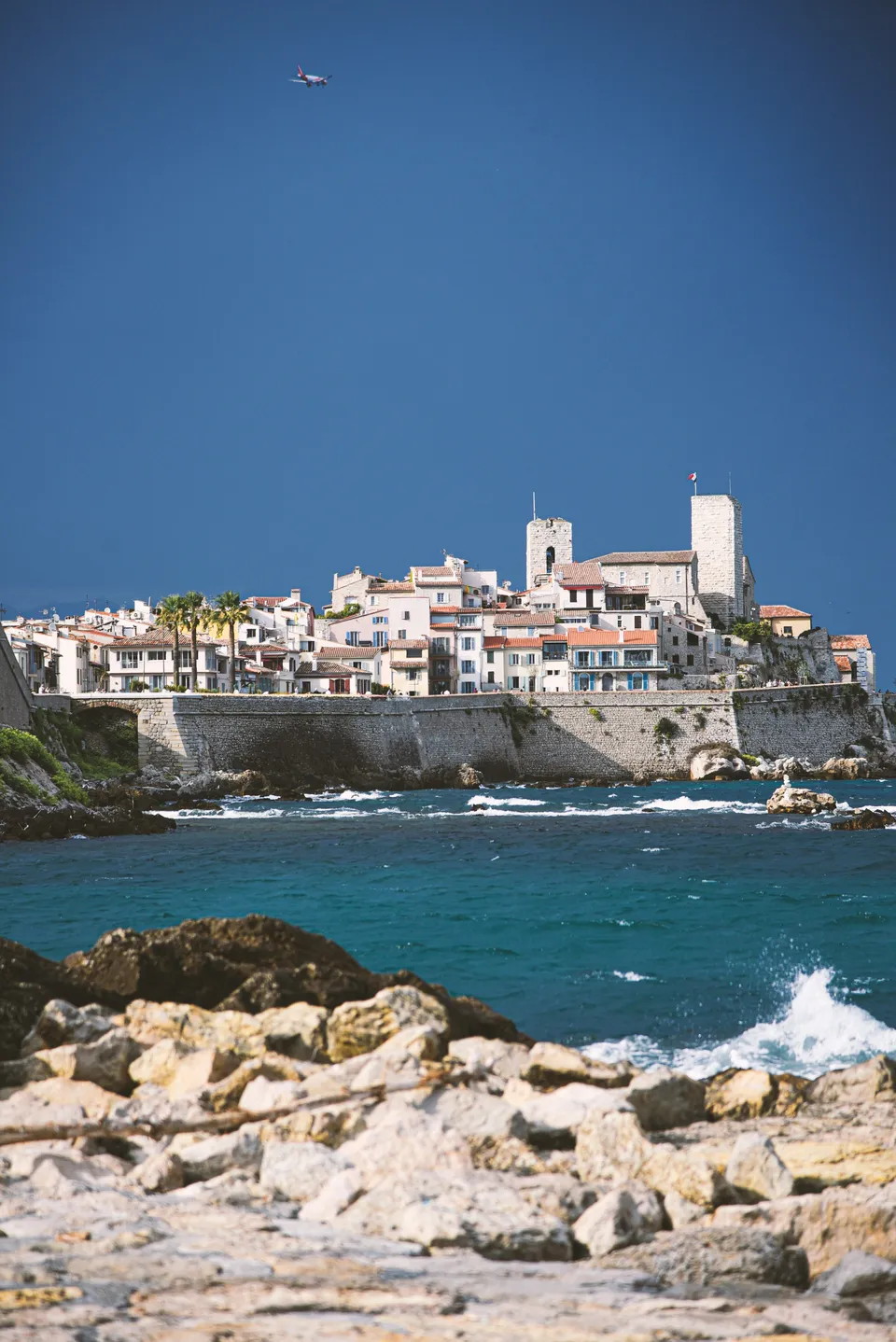
The Greeks who founded Marseille set up a trading post here in the fifth century B.C. and named it Antipolis, before setting up another at Nice (Nikaia), the tourist office says. When Provence became French in 1481, Antibes turned into the last stronghold of the kingdom, facing the County of Nice and the Savoy states. Louis XIV had Vauban redesign its fortifications, and in 1746, during the War of the Austrian Succession, the town held out for 57 days against 2,600 bombs. Once the County of Nice became French for good in 1860, the town lost its strategic role, and it pulled down part of its walls to grow into the countryside around it.
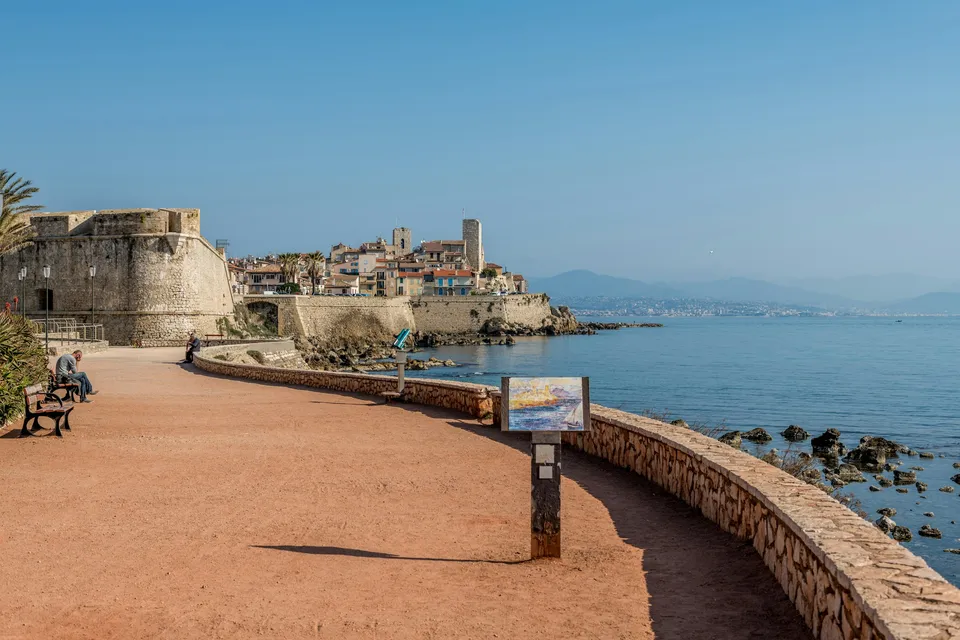
This walk strings together the stops of the tourist office’s two walks through the old town, Antibes, the city with rampart walls and Antibes step by step:
- Start at the Porte Marine, the gate from the port into old Antibes, and take one of the lanes on the right, the rue de l’Horloge or the rue du Saint-Esprit.
- Walk up to the cathedral, Cathédrale Notre-Dame, and its Saracen tower, then the steps to the Château Grimaldi, home of the Picasso Museum.
- Cross the Safranier, the “Commune libre du Safranier”, a small neighborhood between the rue de la Tourraque and the rue du Haut Castelet, made a “free commune” in 1966 to keep its traditions. It has artists’ studios and the house where Nikos Kazantzakis lived, and the Tourraque wash house, the only one of the town’s three left, hides faces in its walls, added by the artist Ho-Lui.
- Come back along the ramparts by the Promenade Amiral de Grasse, past the house where Nicolas de Staël painted more than 350 works between September 1954 and March 1955.
- End at the Cours Masséna and its covered market, then the Place Nationale, with the Peynet museum and a Carrara marble column from 1818.
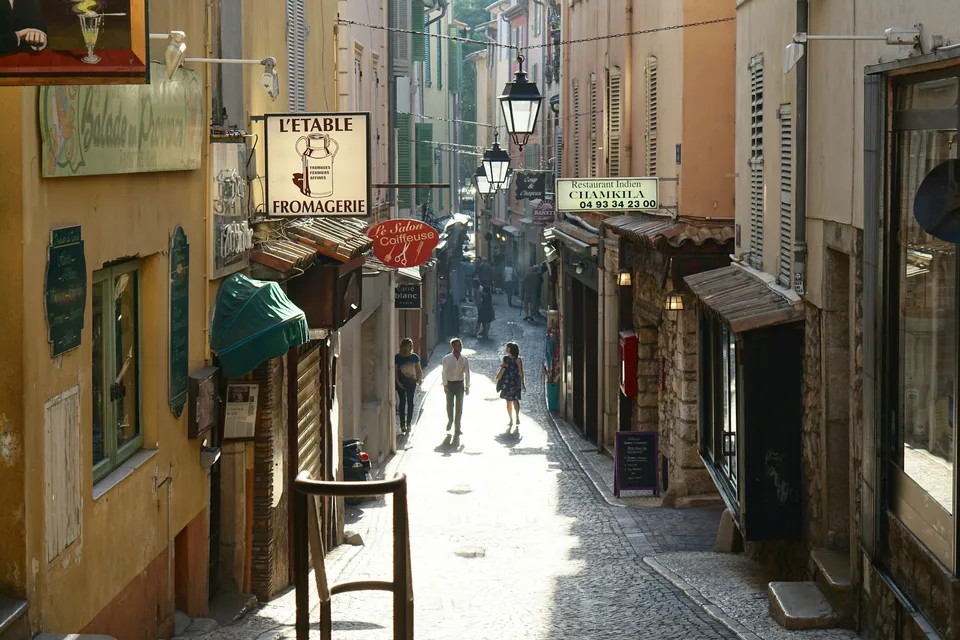
On the way, the Chapelle Saint-Bernardin, built in 1513 for the White Penitents and a listed historic monument since 1989, and the Casemates of the boulevard d’Aguillon, eight former barracks where some twenty artists and craftspeople show their work, are worth the detour. For shopping, the tourist office names the rue Sade, the rue James Close, the rue Thuret, the rue Clemenceau, the rue de la République and the rue Wilson.
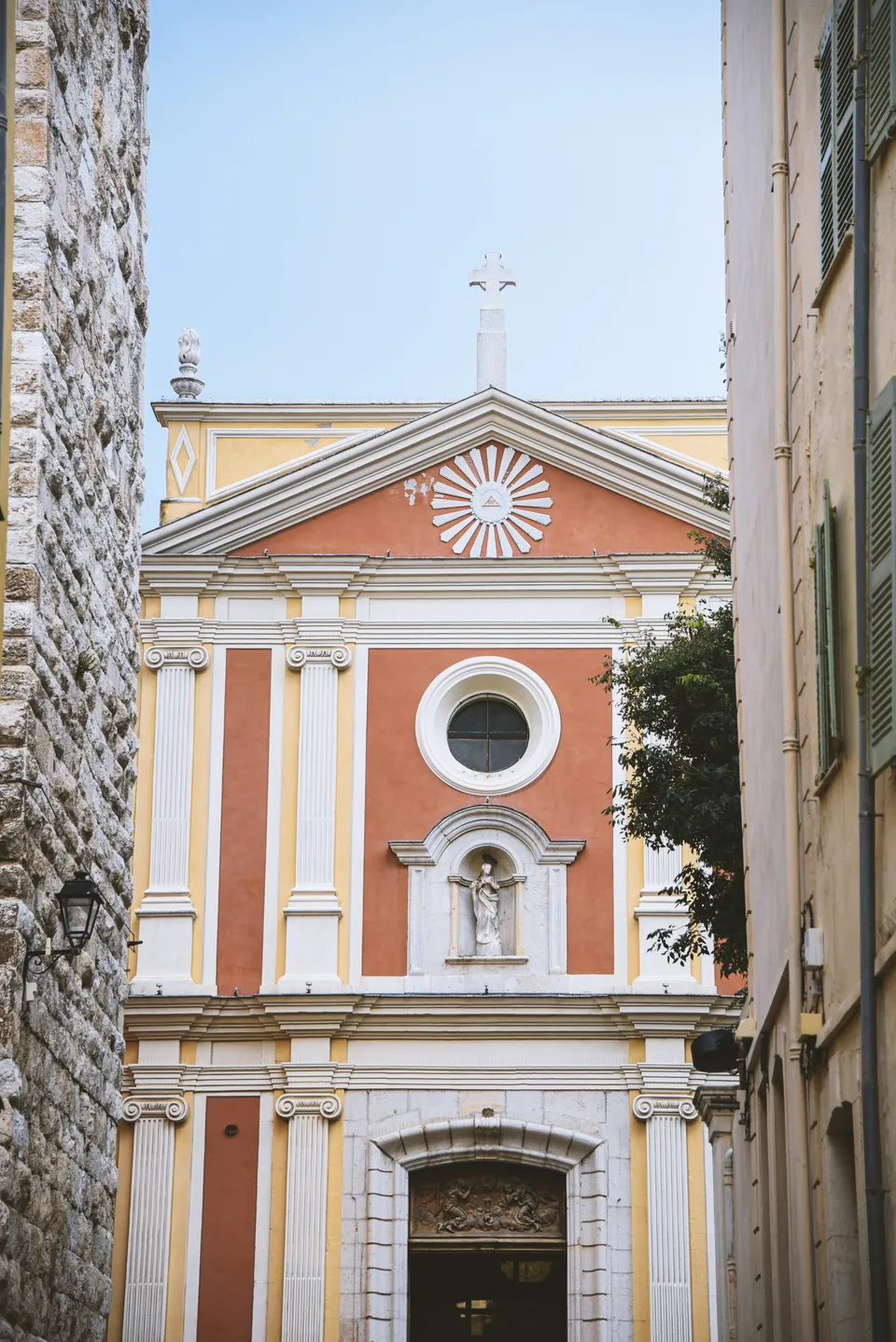
The cathedral, Notre-Dame-de-la-Platea, is the largest church in Antibes, the tourist office says. Antibes was the seat of a bishop from 442 until the see moved to Grasse in 1244 (1243 on the tourist office’s history page), and the church kept its title. Destroyed by the Saracens in 1124 and rebuilt in 1125, it has doors carved by the Antibes sculptor Joseph Dolle in the eighteenth century and an altarpiece, the Virgin of the Rosary, painted by Louis Bréa in 1513. With the Chapel of the Holy Spirit and the Grimaldi tower, it has been a listed historic monument since October 16, 1945.
The parts of the move Americans find out about too late.
What Americans get wrong about moving to France, and the number, form or deadline that fixes it. Straight to your inbox.
One email a week. Real numbers, nothing else.
The Picasso Museum (Château Grimaldi)
The Château Grimaldi stands on the site of the acropolis of Greek Antipolis. It was a Roman castrum, the bishops’ residence from 442 to 1385, then the home of the Monegasque Grimaldi family, who gave it its name, and later the town hall and a barracks, according to the museum. The town bought it in 1925. In September 1945, Pablo Picasso visited the museum, and in 1946 its curator, Romuald Dor de la Souchère, offered him part of the castle as a studio. Picasso worked there for two months that autumn, the tourist office says, and left 23 paintings and 44 drawings on deposit with the town, among them “La Joie de vivre”. On December 27, 1966, the château officially became the Musée Picasso, according to the museum (the tourist office’s Picasso page says December 26), and the tourist office calls it the first museum dedicated to the artist. The terrace holds a permanent collection of sculptures by Germaine Richier, other artists such as Joan Miró are represented, and the works of Nicolas de Staël are not always on display.
| Picasso Museum | As published by the museum |
|---|---|
| Opening days | Every day except Monday; closed January 1, May 1, November 1 and December 25 |
| Hours, September 16 to June 14 | 10 a.m. to 1 p.m. and 2 to 6 p.m. |
| Hours, June 15 to September 15 | 10 a.m. to 6 p.m. |
| Last tickets | 30 minutes before closing |
| Adult ticket | 12 euros, permanent collection and temporary exhibitions |
| Reduced ticket | 8 euros (students, large families, teachers) |
| Free | Under 18, jobseekers, disabled visitors on benefits and their companions; free for everyone for two weeks a year: from the first Tuesday after November 1 to the following Sunday, and from the first Tuesday of February to the following Sunday |
| Combined ticket | 15 euros, all the municipal museums and Fort Carré, for 7 consecutive days; the tourist office sells it as the Pass Musées, valid 7 days from the first visit and usable for a year after purchase |
| Bags | Suitcases, luggage and backpacks are refused and cannot be left in the cloakroom |
Source: Ville d’Antibes, Picasso Museum, plan your visit, read on November 26, 2026. Tickets can be bought online on the museum’s own ticketing site.
Until January 10, 2027, the museum shows “Claude Picasso, Une vie en marges”, the first exhibition of the photographs of Claude Picasso: portraits, surrealist compositions and fashion magazine work.
The other museums and Fort Carré
| Site | What it is | Opening, as published | Adult price |
|---|---|---|---|
| Musée d’Archéologie, Bastion Saint-André | A bastion built by Vauban in 1698, a museum since 1963, with more than 150 pieces, some 2,000 years old | March to October, Tuesday to Sunday; November to February, Tuesday to Saturday; 10 a.m. to 1 p.m. and 2 to 5:30 p.m. | 5 euros |
| Musée Peynet et du Dessin humoristique, Place Nationale | Raymond Peynet, the “father of the lovers”, and humorous drawing, more than 300 pieces | Tuesday to Sunday, 10 a.m. to 12:50 p.m. and 2 to 6 p.m. | 5 euros; free for everyone on Valentine’s Day |
| Fort Carré | A sixteenth-century fort on the Saint-Roch peninsula, one of the first bastioned forts in France | Every day except Monday; 10 a.m. to 6 p.m. from July 1 to August 31, to 5 p.m. from September 1 to June 30; last entry 30 minutes before closing | 5 euros; guided tours at 11 a.m., 2 p.m. and 4 p.m. included |
Sources: Ville d’Antibes, Musée d’Archéologie, Musée Peynet and Fort Carré, read on November 26, 2026. All three are closed on January 1, May 1, November 1 and December 25, and the reduced price is 3 euros. The Peynet museum asks visitors to call before coming, as its hours can change.
Fort Carré is not a Vauban fort, the town insists: Henri II had it built in the middle of the sixteenth century to watch the border with the County of Nice, it was in service from 1585 and first attacked in 1592, and Vauban only improved it at the end of the seventeenth century. It rises 26 meters above the sea at its highest point, the tourist office says, and the view takes in the town, the port and the Baie des Anges. It has been open to the public since 1998. A free shuttle runs from the old town to its free car park (150 places), and from there the entrance is about a 10-minute walk. The tourist office recommends booking; unaccompanied minors are not admitted, the fort closes in bad weather, and it is not accessible to wheelchairs. A path around the fort leads back to Port Vauban.
Port Vauban and the Billionaires’ Quay
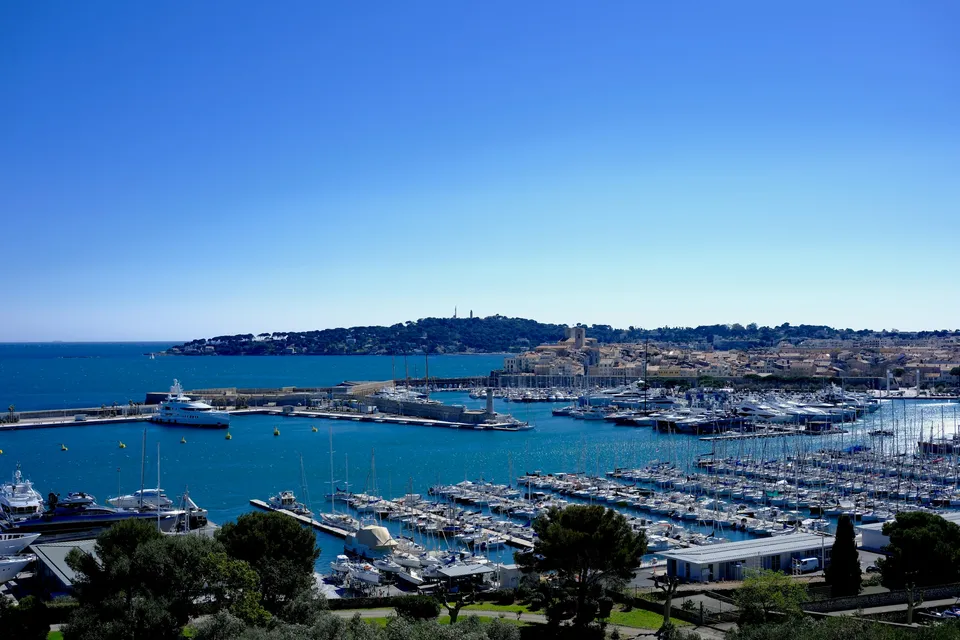
Below the ramparts lies Port Vauban, which the tourist office calls “the largest marina in Europe”. The bay was already a port in ancient times and its present layout dates from the 1970s, the tourist office says, for boats from the local 4-meter fishing boats, the “pointus”, to 165-meter yachts; the port’s own site gives 1,500 berths, the tourist office 1,501. Since 1986, the Quai de Grande Plaisance, better known as the “Billionaires’ Quay”, has moored the largest yachts; the port gives 18 superyacht berths up to 160 meters, the tourist office 19 berths from 70 to 165 meters. A heritage walk with 15 panels runs along the vaults of the quai Baudino.
On the Bastion Saint-Jaume, which looks over the Billionaires’ Quay, stands the Nomade, an 8-meter sculpture of letters by the Spanish artist Jaume Plensa, shown there in 2007 in an exhibition of the Picasso Museum and back for good since 2010. Entry to the bastion is free and it is closed on Mondays, but three official pages give three sets of hours: 10 a.m. to 8 p.m. from September to June and to 11 p.m. in July and August, says the museum; 10 a.m. to 6 p.m. from September to May and to 11 p.m. from June to August, says the town’s page on the bastion; 10 a.m. to 6 p.m., says the tourist office’s old-town page.
The Provençal Market (Marché Provençal)
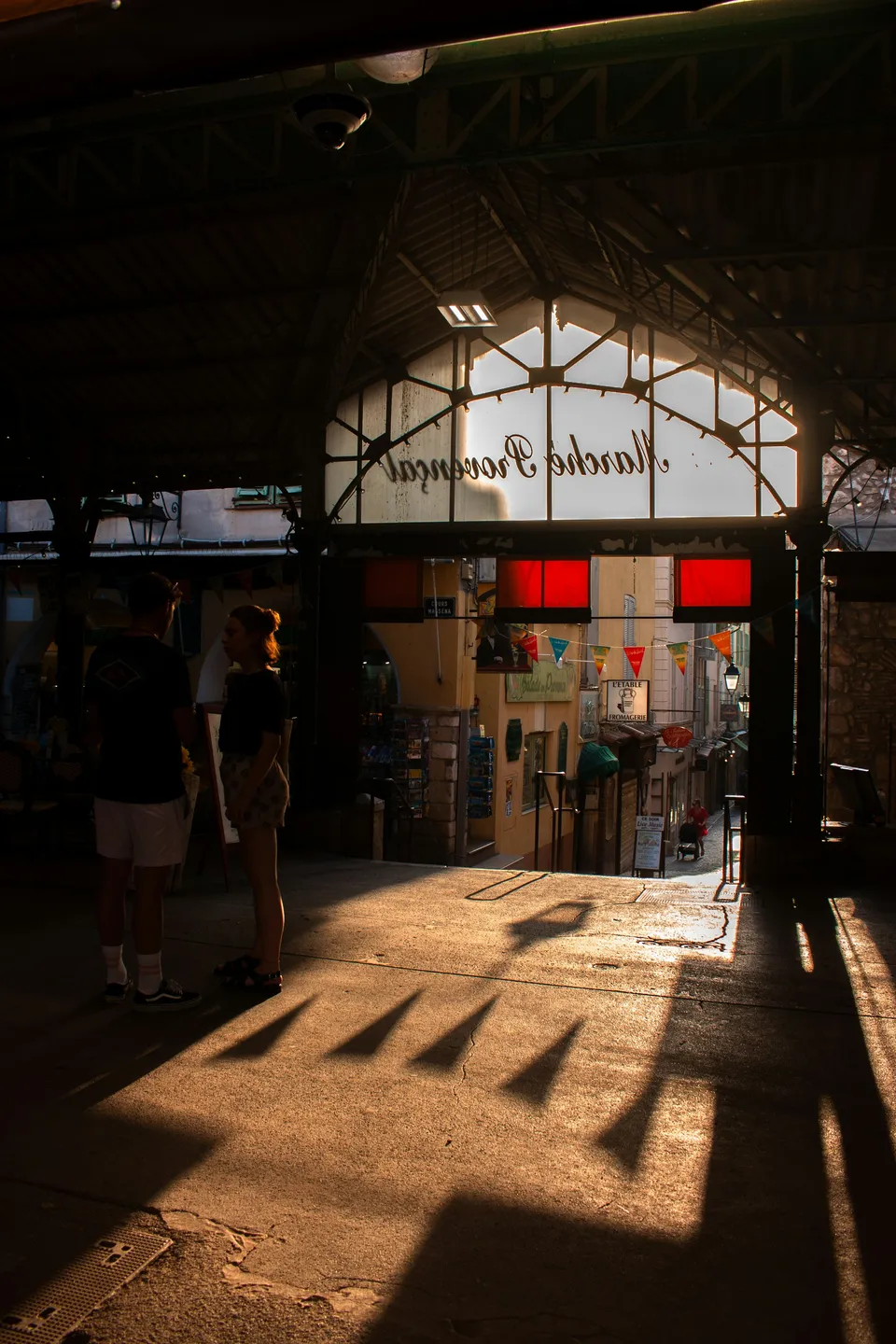
The covered hall of the Cours Masséna holds the food market every morning, except Mondays from September to May: fresh regional produce, delicatessen and cheese from the mountains, spices and flowers, the tourist office says, and socca, the chickpea pancake of the coast cooked over a wood fire. Farmers already sold here at the start of the nineteenth century; the metal hall dates from 1928.
| Market | When, as published by the town |
|---|---|
| Marché provençal (food), Cours Masséna hall | Every day, 7:30 a.m. to 1 p.m. (to 1:45 p.m. from June 1 to August 31); closed Mondays from September 1 to May 31 |
| Flowers and makers’ market, same hall | October 1 to May 31: Friday to Sunday, 3 to 7 p.m.; June 1 to September 30: Thursday to Sunday, 3:30 p.m. to 12:30 a.m. |
| Flea market (brocante), Place Nationale | Thursdays and Saturdays, 7:30 a.m. to 6 p.m. |
| Summer night market, Pré des Pêcheurs (old town) and Promenade du Soleil (Juan-les-Pins) | July 1 to August 31, 6 p.m. to 12:30 a.m. |
| Farmers’ market, esplanade de la Garoupe | Third Sunday of each month, 10 a.m. to 4 p.m. (tourist office) |
Sources: Ville d’Antibes, halls and markets; Office de Tourisme, the markets, read on November 26, 2026. The tourist office’s pages give slightly different hours for some markets (a 6 a.m. start for the food market on one page, the night market until midnight); the table follows the town, which runs them.
The Beaches of Antibes and Juan-les-Pins
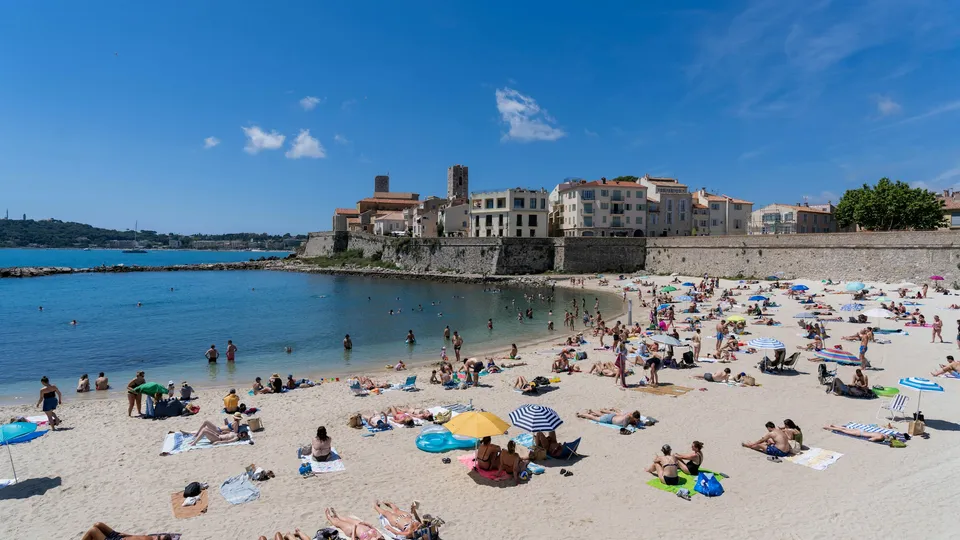
Antibes has 25 kilometers of coastline, according to the tourist office (the town says 23), and beaches of both kinds, sand and pebbles, public with showers and toilets or private with restaurants and sun loungers. Which one to pick depends on where you are staying and who is with you:
| Beach or stretch | What the tourist office says |
|---|---|
| La Gravette, in the port by the ramparts | Sandy, sheltered from the wind and the swell, shaded by the ramparts late in the day; a lifeguard and first-aid post |
| Le Ponteil and La Salis, from the old town toward the Cap | Two long sandy beaches with shallow water, “perfect for young children”; a large car park, a sailing school, access for disabled visitors, lifeguard posts, showers and toilets |
| East of town, from La Brague to Fort Carré | Pebble beaches; the water gets deep a few meters out, so watch young children and wear water shoes; supervised in summer |
| Juan-les-Pins | Public beaches from the town center to the road toward Golfe-Juan, with lifeguard posts, food, showers and toilets |
| The south and west of the Cap d’Antibes | Small beaches, some hidden or private, for a mask and snorkel; not all of them are supervised |
Source: Office de Tourisme Antibes Juan-les-Pins, the beaches, read on November 26, 2026. Private beaches, in every part of the town, rent sun loungers and parasols, serve food, and some offer water sports.
The town’s beach map marks every beach it lists as sand except four pebble ones: La Fontonne and La Siesta, on the route du Bord de Mer, and Fort Carré, east of town, and Port Mallet, on boulevard Maréchal Juin. In Juan-les-Pins, the town rebuilt the seafront for the summer of 2026, it said in July: a new pedestrian promenade, larger public beaches and lifts down to the sand. It also opened a second town-run beach there on July 1, 2026, Square Gould, which like Lutétia rents sun loungers at prices it calls affordable; the concession beaches were to open in the autumn of 2026. At the nautical base on boulevard James Wyllie, the town’s handiplage welcomes disabled visitors seven days a week from 8:30 a.m. to 6:15 p.m. with free services; Antibes was the first town in France to receive the top “Handiplage 4 bouées” label, in 2005.
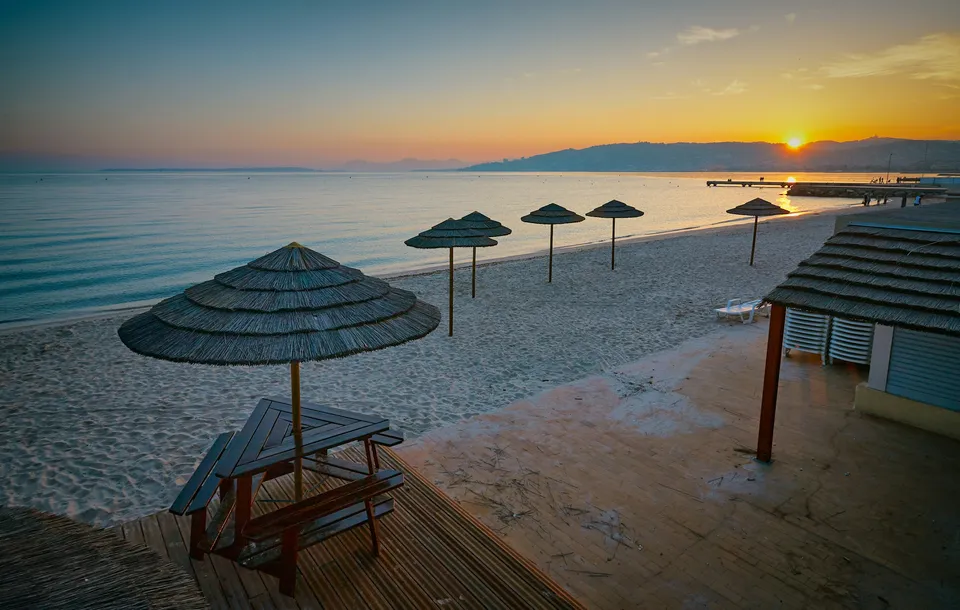
Eleven beaches of the town hold the Blue Flag (Pavillon Bleu) in 2026: Les Groules, Marineland, Fontonne Est, Fontonne Ouest, Fort Carré, Salis, Garoupe Ouest, Croûton, Square Gould, Antibes-les-Pins Est and Antibes-les-Pins Ouest. In season, 18 water samples are taken every week under the regional health agency and their results posted, and the town runs its own daily bacteriological check, it says on its bathing water page. In the summer of 2026, all 24 beaches tested every week were rated good or excellent, the town said in July, except La Gravette, enclosed in its cove, rated “sufficient”, and the town advises not swimming for 24 hours after heavy rain. Barbecues, fires and camping are banned on the whole coast. No page of the town or the tourist office gives the dates of the lifeguard season.
The Cap d’Antibes and Its Coastal Path
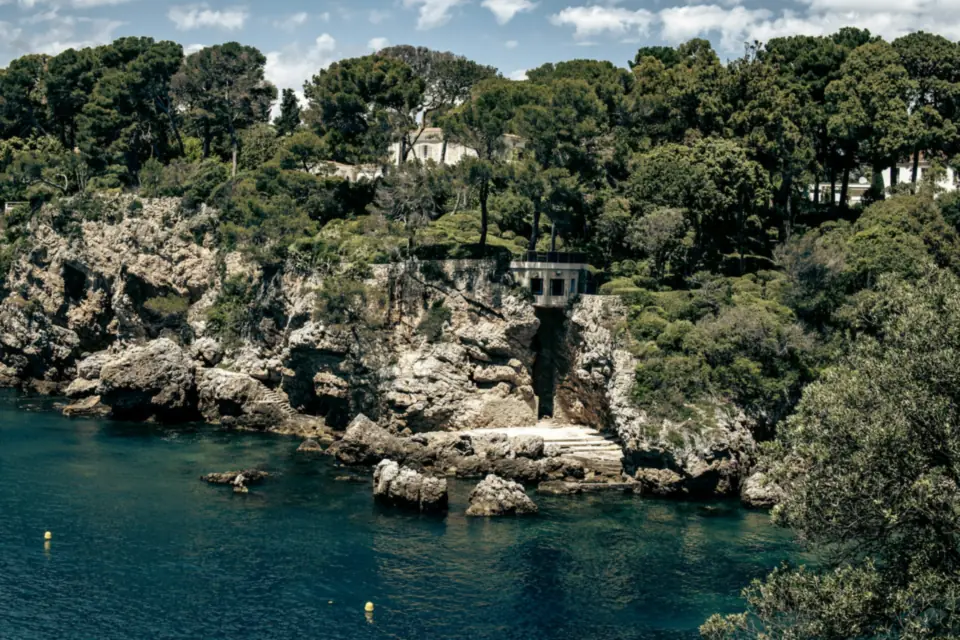
South of the old town, the Cap d’Antibes peninsula has the coastal path, the Sentier de Tire-Poil (literally “hair-puller”, after the sea wind, the tourist office says). It runs along the southern tip of the Cap, with paths and steps on the steeper parts: 3.7 kilometers from the Anse de la Garoupe to the Villa Eilenroc, according to the town, or a 5-kilometer loop back by the road, according to the tourist office, which counts about one and a half to two hours. It is easy in good shoes, but the steps keep out wheelchairs and pushchairs, and it closes in bad weather, such as gales. This part of the Cap is in the Natura 2000 site “Baie et cap d’Antibes - îles de Lérins”.
- Where to start: the large car park on avenue André Sella, 200 meters from the first view over Nice and the Baie des Anges, or Envibus line 02. The tourist office points to the Fontaine stop, but Envibus has closed it in the Posidonia direction until December 31, 2027 for works, and sends riders to the Chemin des Ondes or Chênes Verts stops.
- What is closed: a section of about 50 meters below the Villa Eilenroc, between the Croupatassière beach and the chemin des Douaniers, is closed until May 31, 2027 while the cliffs are made safe, and swimming is banned in a 50-meter strip of the Anse de l’Argent Faux. The rest of the path is open from the Garoupe, from the chemin des Douaniers and between the Villa Eilenroc and the Croupatassière beach, the town said on October 7, 2026.
- With a guide: the tourist office runs guided walks on the path, in French.
Above the path, the Garoupe plateau rises to 75 meters, the tourist office says, with a lighthouse, a navy semaphore, a chapel and a small oratory designed by Raymond Peynet. In clear weather the view runs from Italy to Cap Camarat and the snowy Alps, and early in the morning you may even see Corsica.
| On the Cap d’Antibes | What it is | Opening, as published | Price |
|---|---|---|---|
| Phare de la Garoupe | A lighthouse built in 1836, destroyed at the end of the Second World War and rebuilt in 1948; 29 meters, 116 steps, 103 meters above the sea | School holidays: Wednesday to Sunday from 10 a.m.; July 1 to August 31: Wednesday to Sunday, 10 a.m. to 12:20 p.m. and 1:20 to 6 p.m.; outside school holidays: Saturdays and Sundays from 10 a.m.; closing time by season | Free; visits every 20 minutes in groups of 10 |
| Chapelle Notre-Dame-de-la-Garoupe | The chapel at the foot of the lighthouse, full of sailors’ votive offerings, with two naves | Every day, 10 a.m. to 6 p.m. | No price published |
| Villa Eilenroc and its gardens | A villa finished in 1867 for the Dutchman Hugh-Hope Loudon, its name an anagram of his wife’s first name, Cornélie; an 11-hectare park, left to the town in 1982, with a rose garden of 1,000 plants | Saturdays, 10 a.m. to 5 p.m. (last entry 4:30 p.m.) | Free from October 1 to March 31; 2 euros from April 1 to September 30, free under 12 |
| Jardin botanique de la Villa Thuret | A 3.5-hectare botanical garden created from 1857, about 2,400 plants, owned by the state and run by the research institute INRAE | Monday to Friday, 8:30 a.m. to 5 p.m., all year; closed on weekends and public holidays | Free |
Sources: Ville d’Antibes, the Garoupe lighthouse, the Garoupe chapel and the Villa Eilenroc; INRAE, Jardin Thuret, read on November 26, 2026. The lighthouse’s bus stop, “Phare du Cap” on line 02, is about 15 minutes away on foot, and its car park has few spaces. The tourist office still gives older hours for the Jardin Thuret; the table follows INRAE, which runs it.
Juan-les-Pins and Jazz à Juan
On the west side of the Cap, Juan-les-Pins is the town’s seaside resort. It was born on March 12, 1882, the tourist office says, as a new district of Antibes “bordered by fine sandy beaches and scattered with pine trees”. It took off after the First World War with the arrival of the Americans: the developer Édouard Baudoin bought the casino, renovated it and opened it in the spring of 1924, the American heir Frank Jay Gould opened Le Provençal in May 1927, which the tourist office calls the first big luxury hotel of the Côte d’Azur, and the American patrons Gerald and Sara Murphy spent their summers on the Cap d’Antibes with Picasso, Fernand Léger, Scott Fitzgerald, Ernest Hemingway and John Dos Passos. Scott and Zelda Fitzgerald spent a few months in the Villa Saint-Louis, now the Hôtel Belles-Rives, and the Cap and Juan inspired “Tender Is the Night”.
A short walk from the hotel, La Pinède is a park of century-old pines: a playground and a carousel to the north, and to the south the Pinède Gould, which turns into an open-air concert hall every July. On the path along it, you can see the handprints of the jazz musicians who made the festival’s history. From the end of the boulevard Édouard Baudoin, the Promenade du Soleil runs along the sea, with cafés, restaurants and private beaches, and the summer night market. The Juan-les-Pins tourist office is on the second floor of the Palais des Congrès, completed in 2013; the Antibes one is at 2 bis rue Fontvieille. Both are open every day from 9 a.m. to 7 p.m. in July and August.
Jazz à Juan opened on July 7, 1960, the festival says, at the Fort Carré stadium and in the Pinède Gould, which became the musicians’ favorite venue from the concert of July 10, 1960, given in tribute to Sidney Bechet; Bechet had lived in Juan-les-Pins for a while and brought jazz to the resort, the tourist office adds. From its second edition the festival has been held only in Juan-les-Pins. Ray Charles gave his first concert in Europe there, and John Coltrane played “A Love Supreme”. The tourist office has organized it since 1971, and the festival calls itself the oldest jazz festival in Europe.
| Jazz à Juan | As published by the festival |
|---|---|
| 2027 dates | Not yet announced on November 26, 2026 |
| Last edition | The 65th, July 9 to 19, 2026, in the Pinède Gould |
| Tickets | On sale from March 25 for the 2026 edition; valid only if bought on the official site or at the counters of the Antibes Juan-les-Pins tourist offices |
| 2026 prices for an evening of two concerts | Varied by evening: full price from 35 euros (category 3) to 90 euros (category Or) on some nights, standing places at 20 or 25 euros on others; a youth rate in category 3 for under-18s and students |
| Getting there | Doors open at 6:30 p.m.; Juan-les-Pins station is about 10 minutes away on foot |
Sources: Jazz à Juan, the festival, ticket information, getting there and the 2026 evenings of Fatoumata Diawara, Samara Joy and Tom Jones, read on November 26, 2026. In July, the Pinède also holds free early-evening concerts, the Jammin’Summer sessions, the tourist office says.
Is Marineland Antibes Open?
No. Marineland, whose site still calls it the largest marine zoo in Europe, has been closed since January 5, 2025, according to its official site. The same page said that the neighboring parks, Aquasplash and Adventure Golf, would open as planned in 2025, and it gives no date for 2026 or 2027; the Marineland hotel has become the So.Blue Hôtel. The name survives on the beach: “Marineland” is one of the town’s Blue Flag beaches in 2026.
The Weather in Antibes Month by Month
Météo-France’s climate normals pages have no station for Antibes: the only one in the Alpes-Maritimes is Nice, up the coast. These are its averages for 1991 to 2020:
| Month | Average low | Average high | Rain | Sunshine |
|---|---|---|---|---|
| January | 5.8 °C (42 °F) | 13.3 °C (56 °F) | 73.5 mm | 157 h |
| February | 6.1 °C (43 °F) | 13.5 °C (56 °F) | 53.6 mm | 166 h |
| March | 8.3 °C (47 °F) | 15.4 °C (60 °F) | 51.0 mm | 218 h |
| April | 10.8 °C (51 °F) | 17.4 °C (63 °F) | 68.8 mm | 229 h |
| May | 14.5 °C (58 °F) | 21.0 °C (70 °F) | 40.3 mm | 271 h |
| June | 18.1 °C (65 °F) | 24.7 °C (76 °F) | 35.7 mm | 310 h |
| July | 20.8 °C (69 °F) | 27.5 °C (82 °F) | 13.6 mm | 349 h |
| August | 21.1 °C (70 °F) | 27.9 °C (82 °F) | 17.2 mm | 323 h |
| September | 17.7 °C (64 °F) | 24.8 °C (77 °F) | 81.0 mm | 250 h |
| October | 14.0 °C (57 °F) | 21.0 °C (70 °F) | 127.9 mm | 191 h |
| November | 9.7 °C (49 °F) | 17.0 °C (63 °F) | 138.4 mm | 152 h |
| December | 6.6 °C (44 °F) | 14.1 °C (57 °F) | 90.3 mm | 145 h |
| Year | 12.8 °C (55 °F) | 19.8 °C (68 °F) | 791.3 mm | 2,760.5 h |
Source: Météo-France, Nice climate normals 1991-2020, read on November 26, 2026. Fahrenheit figures are converted from the Celsius values; monthly sunshine hours are rounded.
What the table means for a trip to Antibes:
- For the beach: July and August are the warmest and driest months, with the most sunshine; June and September are nearly as warm (highs of 24.7 and 24.8 °C, 76 and 77 °F), but September already has 81 mm of rain.
- For the old town, the museums and the coastal path: April, May and late September to October, with highs of about 17 to 25 °C (63 to 77 °F).
- For a quiet stay: from November to February the highs stay around 13 to 17 °C (56 to 63 °F), but the Picasso Museum closes at lunchtime and the food market takes Mondays off.
- The wettest months are October and November, with about 128 and 138 millimeters of rain on average, against under 20 in July and August. It rains on about 62 days a year.
Getting to Antibes and Around It
From the US and from Paris
Nice Côte d’Azur, the international airport 20 kilometers from Antibes according to the tourist office, lists direct flights to four US cities on its own pages: New York (JFK or Newark, with La Compagnie, United or Delta), Atlanta (Delta, every day), Boston (Delta) and Philadelphia (American Airlines). The airport’s pages give no season or timetable for these routes (only the Atlanta page says the flight runs every day), so check the dates you want with the airline. From Paris, 15 trains a day run to Antibes, the fastest in 5 hours 15 minutes and 6 hours 15 on average, from 25 euros one way in second class on some trains and dates, according to SNCF Connect; TGV INOUI and OUIGO trains run direct from Paris Gare de Lyon, and the Intercités night train runs direct from Paris Austerlitz.
From Nice airport to Antibes
| How | Time and price, as published |
|---|---|
| Train from Nice Saint-Augustin | The station is a 7-minute walk from Terminal 1 (exit A0), with a free tram from Terminal 2; on the coast line, a train every 15 minutes on weekdays from 5:50 a.m. to 10 p.m., then every 30 minutes until 11:30 p.m. |
| Bus ZOU! line 82 (Antibes, Golfe-Juan, Vallauris) | From Terminal 2 (bay 3), then Terminal 1 on request; 11 euros one way; no tickets on board, the airport says: buy at the Terminal 2 service center (card only) or by text message on the line’s ticket site, valid 1 hour 30 minutes |
| Taxi | Fixed fare to Antibes or Juan-les-Pins: 72 euros (indicative 2026 fare); from the official ranks only, card payment accepted. The tourist office gives 75 euros for a taxi booked from Juan-les-Pins to the airport (72 euros plus 3 for the booking) |
Sources: Nice airport, public transport, trains and taxis; ZOU! line 82 tickets, read on November 26, 2026. The timetable of line 82, valid from June 2, 2026, is published only as a PDF on the ZOU! site, so check its times there. The tourist office’s page still gives 10.90 euros and says tickets can be bought on the bus; the ticket site says 11 euros and the airport says tickets are not sold on board, so buy before boarding. By road, the airport is 20 kilometers from Antibes, 20 to 40 minutes when traffic is light, the tourist office says (A8 motorway, exit 44 for Antibes).
By train along the coast
Three stations serve the town, the tourist office says: Antibes, in town on place Pierre Semard; Juan-les-Pins, on avenue de l’Esterel, whose ticket office opens on weekdays from 2 to 4 p.m.; and Biot, in the La Brague quarter on the RN7, which has no ticket office any more. All types of trains stop at Antibes, the TGV and the Lyria trains to Geneva among them; only regional trains stop at Juan-les-Pins and Biot.
| Route | Return trips a day | Average time | Full one-way fare |
|---|---|---|---|
| Nice to Antibes | More than 140 | 20 minutes | 7.00 euros |
| Antibes to Nice | 80 | 30 minutes | 5.70 euros |
| Cannes to Antibes | More than 160 | 10 minutes | 5.00 euros |
| Antibes to Marseille | More than 30 | Not given | 39.60 euros |
Source: TER Sud, Nice to Antibes, Antibes to Nice, Cannes to Antibes and Antibes to Marseille, read on November 26, 2026. The two pages for Nice and Antibes give different figures for each direction; both are shown as published. A ZOU! Malin card (20 euros a year) takes 30 percent off for the holder and one companion.
For Monaco and Menton, the TER site has no route page from Antibes, but the coast line runs on past Nice: Nice airport’s train page names it the Cannes, Nice, Monaco and Menton line, and on November 26, 2026 the departure board of Juan-les-Pins station listed a train to Ventimiglia, across the Italian border. From Nice, Monaco is 20 minutes away and Menton 40. For a day of trains only, the Pass Journée costs 20 euros in the Alpes-Maritimes for one traveler, plus 5 euros for each companion (up to eight); for several days of trains, trams and buses, the Pass SudAzur Explore costs 35 euros for 3 days, 50 euros for 7 days and 80 euros for 14 days, and is sold in Antibes at the Envibus office of the Pôle d’Échanges, boulevard Vautrin, 100 meters from the station.
Getting around Antibes
The old town, the port and Juan-les-Pins are easy on foot, and the buses of Envibus, the network of the Sophia Antipolis area, cover the rest:
| Ticket or line | As published by Envibus |
|---|---|
| Single ticket | 1 euro bought in advance (Envibus agency, machine, Envibus CapAzur app), 1.50 euros on board; valid 1 hour with transfers |
| Day pass / 7-day pass | 3.50 euros / 10 euros |
| Free shuttles (lines A, B, 14, 15, 16 and 17) | Free with a “Pass Navette”, itself free, from the app, a machine or the Envibus agency |
| Line 02 | Pôle d’Échanges (by Antibes station) to Posidonia, on the Cap d’Antibes |
| Line 15 (free) | A loop from Port Gallice to Posidonia on the Cap and Juan-les-Pins |
| Line 14 (free) | A loop from Place Guynemer to the Fort Carré park-and-ride and the Port de la Salis |
| Lines 30 and 31 | Loops between the Pôle d’Échanges and Juan-les-Pins |
Source: Envibus, fares and urban lines, read on November 26, 2026. Children under 6 ride free with a ticket holder over 16. On line 02, the Fontaine stop toward Posidonia is closed for works until December 31, 2027.
If you drive, leave the car outside the old town. The town has 1,800 free street spaces, its parking meters give one free hour a day per vehicle, and street parking is free on Saturdays, Sundays and public holidays, from noon to 2 p.m. and from 6 p.m. to 9 a.m., the tourist office says. The Fort Carré car park (150 spaces) and the Azurarena car park (568 spaces) are free; the large paid car parks by the old town are Vauban (1,000 spaces) and Pré-des-Pêcheurs (571 spaces), both on avenue de Verdun.
How Many Days in Antibes?
“Three days is the minimum time we recommend to fully enjoy our city”, the tourist office writes, and its three-day plan runs like this:
- Day 1, the old town: one of the tourist office’s guided tours, which change with the season (the old town, the painters’ trail, a gourmet tour and others), the Provençal market and the lanes by the ramparts, lunch in the old town, the Picasso Museum, then La Gravette beach or the shopping streets, and in the evening the ramparts and the Casemates of the boulevard d’Aguillon.
- Day 2, Fort Carré and the Cap: Fort Carré (booking recommended) and the path around it, the Nomade and the view over the Billionaires’ Quay, the Ponteil and Salis beaches, the Jardin Thuret on a weekday, then the Garoupe lighthouse and its chapel.
- Day 3, the coastal path and Juan-les-Pins: the Tire-Poil path from the Garoupe beach (mind the section below the Villa Eilenroc, closed until May 31, 2027), then past the Hôtel du Cap-Eden-Roc toward Juan-les-Pins, and an evening on its beaches.
With more time, Antibes is a good base for the coast: Cannes is 10 minutes away by train and Nice 20 to 30, and from Nice the trains go on to Èze, Monaco and Menton.
Antibes or Nice?
They are different trips. Nice is a city of 357,737 residents, Antibes a town of 77,637 (INSEE, 2023). Antibes has sandy beaches in the town itself, La Gravette, Le Ponteil, La Salis and Juan-les-Pins, a walled old town on the sea, and the Cap d’Antibes for walking; Nice, with its international airport, is the city of the two, and our Nice guide covers it. You can sleep in one and visit the other: the first train leaves Nice for Antibes at 5:31 a.m. and the last at 10:56 p.m., according to TER Sud.
Christmas in Antibes and the Year’s Events
| Event | Dates and place, as published |
|---|---|
| Christmas village, Antibes | December 5, 2026 to January 3, 2027, Esplanade du Pré des Pêcheurs, 11 a.m. to 9 p.m. (to 10 p.m. on Fridays and Saturdays): 23 food chalets, 9 craft chalets, a big wheel and a carousel |
| Ice rink, Juan-les-Pins | December 19 to January 3, Pinède Gould, 10 a.m. to 9 p.m.: a 525-square-meter rink, free up to age 10, 5 euros above; gloves required |
| Chemin des Crèches (nativity scenes) | December 13 to January 10, in the Garoupe chapel and the cathedral of Antibes |
| Christmas lights, Port Vauban | December 1 to 31, 2026 |
| Jazz à Juan | July, in the Pinède Gould; 2027 dates not yet announced |
Sources: Ville d’Antibes, the year-end festivities; Port Vauban, events, read on November 26, 2026. The town’s New Year program ends with fireworks over the bay of Juan-les-Pins at 6 p.m., and Port Vauban hosts the Voiles d’Antibes and the Coupe Napoléon, and its traditional fireworks on July 13; no 2027 date for the Voiles d’Antibes was published.
Staying Longer in Antibes
For a stay of several weeks or months, three rules matter:
- The 90-day rule. As a visitor from a visa-exempt country such as the US, the UK, Canada or Australia, you can usually stay a maximum of 90 days within any 180-day period, according to the European Commission, and the European Union’s Entry/Exit System counts that period as a single one for all the countries using it, Italy included. Our guide to how long Americans can stay in France without a visa explains the count, and the Schengen calculator checks your dates. Beyond 90 days you need a long-stay visa or a residence permit.
- The tourist tax. Antibes has charged a taxe de séjour since 1973. Adults pay it per night, and minors are exempt. With the additional 34 percent tax charged since January 1, 2023 in the Bouches-du-Rhône, the Var and the Alpes-Maritimes, it comes to 1.07 euros a night in a 1-star hotel, 2.28 in a 3-star, 3.48 in a 4-star and 4.69 in a 5-star. An unclassified furnished rental pays 5 percent of the price per person and per night, plus the 34 percent additional tax, up to 6.43 euros in all, according to the tourist office; for one adult at 50 euros a night, the town’s tax simulator gives 3.35 euros. These rates, in force since January 1, 2025, are the ones the town’s tax site applied to a stay in November 2026; neither the town’s tax site nor the tourist office gave 2027 rates on November 26, 2026.
- Furnished rentals. Anyone who lets a furnished tourist rental in Antibes must declare it to the town hall, with the Cerfa form 14004*04 on the town’s online platform, which then sends an identifier number. A bail mobilité, a furnished lease of 1 to 10 months, is open only to a tenant in professional training, higher education, an apprenticeship, an internship, a civic service, a job transfer or a temporary work assignment, according to service-public.fr, so a visitor who simply wants a few months in Antibes does not qualify. Our comparison of where to live on the Côte d’Azur sets Antibes beside Nice, Cagnes-sur-Mer, Cannes, Menton and Villefranche-sur-Mer with official rent figures.
Finding that furnished flat, calling the agencies and setting up a phone line or a bank account in French is the kind of work our Personal Assistant handles: the calls, the forms and the apartment search, in French.
FAQ
Is Antibes worth visiting?
Yes. In one town you get a walled old town on the sea, the Picasso Museum in the castle where Picasso worked in 1946, a Provençal market every morning (except Mondays from September to May), sandy beaches in town, the coastal path of the Cap d’Antibes and Juan-les-Pins, all 10 minutes by train from Cannes and 20 to 30 from Nice. The tourist office recommends three days at least.
Is Antibes expensive?
Much of it is free: the ramparts and the old town, the market, the Garoupe lighthouse, the Jardin Thuret, the coastal path and the public beaches. The Picasso Museum costs 12 euros and is free under 18, Fort Carré and the smaller museums cost 5 euros, and a 15-euro ticket covers all of them for 7 days. A regional train from Nice costs 7 euros at the full fare, and the tourist tax runs from 1.07 euros in a 1-star hotel to 6.43 euros in a palace per adult per night (0.27 to 0.80 euros at a campsite). For rents, our Côte d’Azur comparison gives the official figures.
Is Antibes nicer than Nice?
It is smaller and different: a town of 77,637 residents against a city of 357,737 (INSEE, 2023), with sandy beaches in town and a walled old town, where Nice has the airport and a city’s size. Since trains link them all day, you can stay in one and visit the other; our Nice guide covers the city.
How do you get from Nice to Antibes?
By regional train: more than 140 return trips a day from Nice, in about 20 minutes, for 7 euros one way at the full fare, according to TER Sud (its page for the other direction gives 80 trips, 30 minutes and 5.70 euros). From Nice airport, bus ZOU! line 82 costs 11 euros, and a taxi has a fixed fare of 72 euros.
Are the beaches in Antibes sandy?
Most of them. The town’s beach map marks every beach it lists as sand except four pebble ones: La Fontonne, La Siesta and Fort Carré, east of town, and Port Mallet. La Gravette, Le Ponteil, La Salis, La Garoupe and the beaches of Juan-les-Pins are sandy, and Le Ponteil and La Salis have shallow water for young children, the tourist office says. East of town, the water deepens a few meters out.
When is Jazz à Juan in 2027?
The festival had not announced its 2027 dates on November 26, 2026. It is held in July in the Pinède Gould in Juan-les-Pins; the 2026 edition, the 65th, ran from July 9 to 19.
Is Marineland Antibes still open?
No. Its official site says the marine zoo has been closed since January 5, 2025.
Conclusion
Antibes gives you three trips in one town: the old town behind its ramparts, with the Picasso Museum, the market and Port Vauban; Juan-les-Pins and its beaches, with Jazz à Juan in July; and the Cap d’Antibes for a morning on the coastal path, keeping in mind the section below the Villa Eilenroc that stays closed until May 31, 2027. Come in June or September for the sea without the peak of the summer, in spring or autumn for walking, or in December for the Christmas village and the ice rink, and keep the 90-day rule in mind if you stay. For the rest of the coast, see our guide to the French Riviera, town by town from Menton to Saint-Tropez with a map, and our guides to Nice, Èze and Menton, for the whole region our guide to the South of France, and for the whole country our guide to the best places to visit in France.
The parts of the move Americans find out about too late.
What Americans get wrong about moving to France, and the number, form or deadline that fixes it. Straight to your inbox.
One email a week. Real numbers, nothing else.
Written by
Aurelio Maurici
Co-Founder, EasyFranceNow
Aurelio Maurici is a French entrepreneur and co-founder of EasyFranceNow. His work focuses on the intersection of French administration, banking constraints affecting U.S. nationals, tax residency and cross-border reporting, healthcare enrollment, and the procedural realities Americans encounter while settling in France.


