
Driving in France With a US License: Visitors, the IDP and the One-Year Limit

By Maxime Roseau Co-founder, Master of Business and Communication, Université Nice Sophia Antipolis
Published Updated

Which state issued your licence? Look up your own case further down.
In this article
Which state issued your licence?- Is a US Driver’s License Valid in France?
- Driving in France as a Tourist: The Three Conditions
- The International Driving Permit: Required, Who Issues It, What It Costs
- How Long a New Resident Can Drive on a US License
- Students: The US License Stays Valid for the Whole of Your Studies
- After the First Year: Exchange or the French Tests
- Renting a Car in France With a US License
- Insurance and the Papers to Carry
- Speed Limits in France by Road Type and in the Rain
- Alcohol, Phones, Seat Belts and Child Seats
- Priority to the Right, Roundabouts and Red Lights
- Compulsory Equipment, Crit’Air Stickers and Low-Emission Zones
- Tolls and How Fines Reach a Foreign Driver or a Rental Car
- Common Mistakes to Avoid
- Practical Checklist
- When to Get Help
- FAQ
- Conclusion
Yes, you can drive in France with a US driver’s license. As a visitor you may drive on it if it is valid and accompanied by an international driving permit or an official French translation; as a new resident it stays valid for one year from the date you acquire your normal residence. This guide covers the tourist conditions, the permit, the one-year clock, car rental, and the road rules that differ most from American ones. This article is for informational purposes only and does not constitute legal advice. Rules change, and your situation may differ: always verify current requirements with the relevant French authorities or a licensed professional.
Is a US Driver’s License Valid in France?
Yes, in three situations: on a short stay, during your first year as a resident, and for the whole of your studies with a student residence permit. Service-Public states the principle for licenses issued outside Europe: you may drive on one during a short stay or your studies, under conditions, and if you settle in France you must exchange it or pass the French test.
| Your situation | Is the US license enough? | Until when | What to carry |
|---|---|---|---|
| Visitor on a short stay | Yes, with a companion document | The end of the stay, if under 185 days | US license, plus an international driving permit or an official French translation |
| New resident (validated long-stay visa or first residence permit) | Yes, for one year | One year from the date you acquire normal residence | US license, plus an official French translation |
| Student (permit marked “étudiant” or RECE card) | Yes, for your whole studies | The end of your studies | US license, official French translation, student permit |
| Resident whose license was mailed in for the exchange | The ADS certificate replaces the card | Four months, within the one-year period | The ADS downloaded from ANTS |
| Resident past one year, no French license | No | The US license is no longer recognized | Only a French license |
RECE is the job-search and business-creation permit (recherche d’emploi/création d’entreprise) that can follow a student one. The ADS (attestation de dépôt sécurisée) comes from ANTS, the license agency now called France Titres.
Driving in France as a Tourist: The Three Conditions
On a short stay, you may drive in France on your non-European license under three conditions (page verified June 1, 2026). It must be valid, you must respect any medical restriction noted on it, and it must be written in French or accompanied by an international driving permit or an official translation.
Service-Public defines the short stay as under 185 days: beyond that you are considered resident. Without a visa the real ceiling is lower, since a visa-free stay is limited to 90 days in any 180-day period. Entry formalities are separate: see the EES biometric border system and the ETIAS travel authorization planned for late 2026.
The short-stay list sets no minimum age; the lists for students and for the license exchange require the French minimum, 17 for a car. A translation made abroad must be legalized or apostilled, and one made in France must come from an approved translator or the embassy of the issuing country: for a visitor, the permit is far simpler.
The International Driving Permit: Required, Who Issues It, What It Costs
A US license is written in English, so the French page leaves two options: an international driving permit (IDP) or an official translation. One of the two is a condition: treat the IDP as required for a visit, whatever you have read about it being optional.
USA.gov describes the IDP as a document that translates your identifying information into different languages (page updated April 14, 2026). It is not a license: you carry both. It is valid for one year and cannot be renewed. Only two organizations are authorized by the US Department of State to issue it, the American Automobile Association (AAA) and the American Automobile Touring Alliance (AATA), and USA.gov warns against other websites that claim to issue one.
As of October 2026, AAA charges a 20 dollar permit fee, online, by mail or at a branch. It asks for 5 business days plus shipping for an online application, issues no permit more than six months ahead, and warns that return mail overseas can take 5 to 7 weeks. Get it before you fly, as the pre-departure checklist for a move to France advises.
How Long a New Resident Can Drive on a US License
Once you live in France, your US license is valid for one year from the date you acquire your normal residence (page verified June 1, 2026). Service-Public dates that year from the handing over of your first residence permit or, for a long-stay visa that serves as a residence permit (VLS-TS), from its online validation or the date of the OFII sticker.
Your arrival date is therefore not the reference: the validation of the visa, due within three months of entry, is. A renewal or change of status does not restart the year.
During that year the license must be written in French or accompanied by an official translation. The international permit appears only in the short-stay list, and the ministerial order of January 12, 2012 states that it is neither recognized nor exchanged for people who acquire their normal residence in France. Carry a translation by an approved translator, which the exchange file needs anyway: see apostilles and certified translations of US documents.
When the year ends, article R222-3 of the Code de la route is blunt: the license is no longer recognized and its holder loses all right to drive, even if the card is still valid in your state.
Students: The US License Stays Valid for the Whole of Your Studies
A foreign student may drive on a non-European license for the whole of their studies, without exchanging it. You need a valid residence permit marked “étudiant” (how the student visa works) or the RECE card, the French minimum age (17 for a car), and a license that is valid, was never suspended or withdrawn, was issued by the country where you lived before France, and comes with an official translation.
When you move to a non-student permit, you must request the exchange at the latest in the year after it is handed over. One limit: a French citizen holding a US license, dual nationals included, gets no student rule and has one year from settling in France.
After the First Year: Exchange or the French Tests
After the year there are two routes and no third: exchange the US license if the state that issued it has an agreement with France, or pass the French exams.
The exchange. Eighteen states are on the list as of 2026. The request goes online to ANTS with a 40 euro tax stamp and must be filed within the year: see the list of the 18 states and the one-year deadline.
The French tests. Without an agreement, you take the theory exam (code de la route) and the road test, typically 1,500 to 3,000 euros through a driving school and most of a year: see what Americans from non-reciprocal states must do to get a French license.
Exchange or exam: it depends on the state that issued your license. Check yours.
Renting a Car in France With a US License
You can rent a car in France with a US license under the same conditions as for driving: a valid license and, on a short stay, the IDP or official translation that goes with it. No official page fixes what a rental counter may add: each company sets its conditions (how long you have held the license, the cost for a young driver) and must tell you before you book, according to the Institut national de la consommation, a national public body (page verified June 24, 2025).
Also worth knowing:
- The deposit is a pre-authorization on your bank card, and damage not noted at the pick-up inspection (état des lieux) is yours at return.
- Manual transmissions dominate the French market: reserve an automatic explicitly.
- Some automated terminals, toll booths included, require a card with a PIN: see how French card payments work for Americans.
Insurance and the Papers to Carry
Any vehicle on a public road in France must be insured at least for third-party liability (responsabilité civile), and a newcomer with no French claims record starts without a no-claims discount: see car insurance in France for Americans without a French driving history.
At a roadside check you must present your valid license and the vehicle’s registration certificate, even in a car that is not yours; since April 1, 2024, insurance papers are no longer required. To own a car, see buying and registering one in France or why most Americans do not import theirs.
Speed Limits in France by Road Type and in the Rain
French speed limits depend on the type of road and drop in rain: 130 km/h on a motorway in dry weather, 110 when it rains. Service-Public gives the national limits (page verified December 29, 2025), and local authorities can set lower ones, shown by signs.
| Road | Dry weather | Rain or other precipitation | Visibility under 50 m |
|---|---|---|---|
| Motorway (autoroute) | 130 km/h (81 mph) | 110 km/h (68 mph) | 50 km/h (31 mph) |
| Two carriageways separated by a central divider | 110 km/h (68 mph) | 100 km/h (62 mph) | 50 km/h |
| At least two lanes in the same direction | 90 km/h (56 mph) | 80 km/h (50 mph) | 50 km/h |
| Two-way road with no central divider | 80 km/h (50 mph) | 80 km/h | 50 km/h |
| Built-up area (agglomération) | 50 km/h (31 mph) | 50 km/h | 50 km/h |
On two-way roads with no divider, the local authority may raise the limit to 90 km/h.
An excess under 20 km/h is a fixed fine of 68 euros where the limit is above 50 km/h, and 135 euros where it is 50 or under or when the excess is 20 to 49 km/h. Since December 29, 2025, 50 km/h or more over the limit is a criminal offense: up to three months in prison and a 3,750 euro fine. Radar detectors are forbidden, with a fine of up to 1,500 euros.
Alcohol, Phones, Seat Belts and Child Seats
The legal limit is 0.5 gram of alcohol per liter of blood (page verified August 27, 2026): 0.05 percent in American notation. From 0.5 to under 0.8 g/l the usual penalty is a 135 euro fixed fine; from 0.8 g/l it is a criminal offense, up to 9,000 euros and three years in prison. The limit is 0.2 g/l for French probationary licenses, and the Sécurité routière booklet for foreign drivers applies it to anyone licensed for three years or less, with a three-year ban on driving in France among the penalties.
Holding a phone while driving is forbidden, as is wearing earbuds or a headset: the fixed fine is 135 euros. A prefect may suspend the license for up to six months without waiting for a judge, and on September 29, 2026 the Interior Ministry asked all prefects to use that power.
Seat belts are compulsory front and back. A child under 10 rides in an approved restraint suited to their build, in the back except in a few listed cases. The driver is fined, generally 135 euros. A child in a taxi is exempt.
Priority to the Right, Roundabouts and Red Lights
At an intersection with no sign, the driver coming from your right goes first: article R415-5 of the Code de la route requires the driver arriving from the left to give way unless another rule applies. This is the priorité à droite.
- Roundabouts work the opposite way: a driver entering one must give way to those already on it (article R415-10).
- A stop sign means a full stop before giving way (article R415-6).
- Pedestrians come first: you give way, stopping if necessary, to anyone crossing or clearly intending to (article R415-11).
- No turn on red: article R412-30 requires an absolute stop at a red light.
Ignoring priority to the right, the roundabout rule or a red light is a fourth-class offense: a fixed fine of 135 euros, 90 if paid within 15 days, 375 once increased for late payment.
Compulsory Equipment, Crit’Air Stickers and Low-Emission Zones
Every car must carry a high-visibility vest and a warning triangle (page verified June 11, 2026). After a breakdown you put the vest on, switch on the hazard lights and place the triangle 30 meters or more from the car. A breathalyzer is not compulsory. From November 1 to March 31, winter tires or snow chains are compulsory in certain mountain municipalities.
The Crit’Air sticker ranks a vehicle by its emissions. It is compulsory in a low-emission zone (zone à faibles émissions mobilité, ZFE-m) and when a prefect restricts traffic during a pollution episode (page verified January 1, 2026). There is one per vehicle, on the lower right of the windshield. It costs 3.85 euros delivered in France from certificat-air.gouv.fr, the only official site, and driving without it in a zone is generally a 68 euro fixed fine.
The government lists 25 active zones with the rules of each. In greater Paris, Crit’Air 3 vehicles are restricted on weekdays from 8 am to 8 pm; in Lyon, vehicles rated 3, 4, 5 or unclassified may neither drive nor park.
Tolls and How Fines Reach a Foreign Driver or a Rental Car
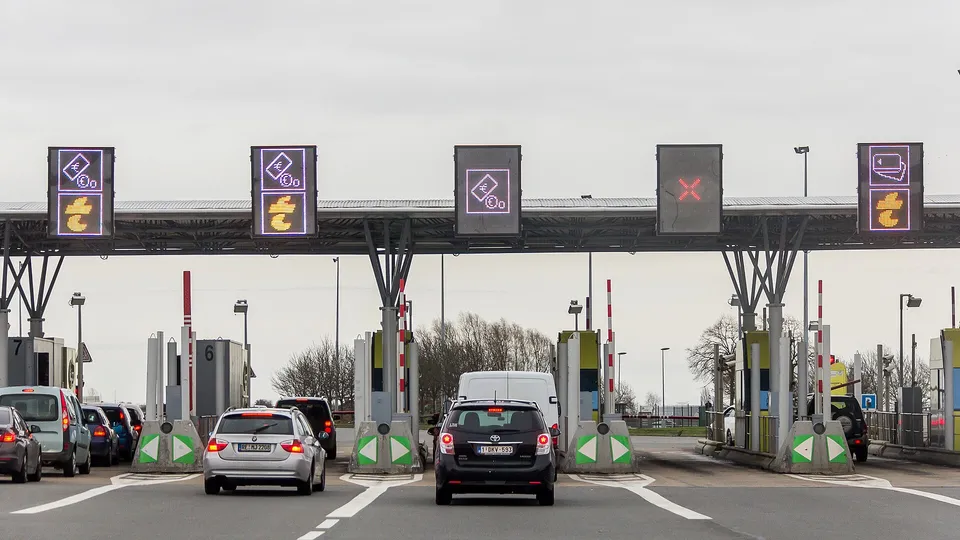
A toll motorway either has barriers, where you pay on the spot, or is free-flow (péage en flux libre), as on the A79 in the Allier, the A13 and A14 between Paris and Normandy, and one exit of the A4. On a free-flow section you pay within 72 hours on the motorway company’s website, at a tobacconist equipped with the Nirio system or with a toll tag. Otherwise the notice adds 90 euros, reduced to 10 if paid within 15 days, and a 375 euro fine follows after two months. With a hire car, you enter the plate and the rental period on the operator’s site.
Stopped by the police. Service-Public’s page on foreign drivers (verified January 1, 2026) says you risk a fixed fine or a deposit (consignation). With no home or job in France, if you cannot pay or the offense has no fixed fine, your vehicle can be held until the deposit is paid; the prosecutor decides within 24 hours.
Caught by a camera in a rental car. The rental company names you as the driver, and may bill a handling fee for it. ANTAI, the agency that processes automated fines, then sends the notice in your name, by email or by post. You have 45 days to act, one month more when the notice is sent abroad, and you pay on amendes.gouv.fr. ANTAI warns of fraudulent emails: check the Marianne and ANTAI logos and the recipient’s name.
Common Mistakes to Avoid
Treating the IDP as a license. It only translates your license, and only AAA and AATA issue it.
Counting the year from your landing date or from the expiry printed on the US card. It runs from the validation of your visa or the handing over of your first permit.
Relying on the IDP as a resident. The official lists name it for short stays only: a resident carries an official French translation.
Driving as at home at intersections. Priority to the right, priority to cars on the roundabout and no turn on red are the reflexes to change.
Practical Checklist
Before a visit:
- Check that your US license is valid for the whole trip, and get an IDP from AAA or AATA.
- Bring a bank card with a PIN, and reserve an automatic if you need one.
- Read your rental terms for the accepted license, the minimum age and the deposit.
On the road:
- Carry the license, the IDP or translation, and the car’s registration certificate.
- Check for the vest, the triangle and the Crit’Air sticker, and pay any free-flow toll within 72 hours.
- Keep the emergency numbers: 112 (Europe-wide), 15 (ambulance), 17 (police), 18 (fire service).
If you are moving to France:
- Note the date your visa was validated or your first permit handed over.
- Order an official French translation of your license.
- Check your state against the exchange list, then file the exchange or register for the French tests early.
When to Get Help
A visit needs no help: a valid license, an IDP and the rules above are enough. A move is different, because your right to drive hangs on dates in your immigration file: the day the visa was validated, the state that issued the license and when, the end of a student status. The France Navigator checks your state against the exchange list and places your license deadline among the other steps of your first year.
FAQ
Can I drive in France with an international driving permit alone?
No. The IDP translates your license and is not one: USA.gov tells travelers to carry both, and the French conditions start with a valid license that the permit accompanies. With an expired or suspended US license, the IDP gives you nothing to drive on.
Is a US driver’s license valid in the rest of Europe?
Each country sets its own rule. USA.gov sends travelers to the State Department’s country pages to check whether a country asks for an IDP. Check every country on your route, and ask the rental company whether the car may leave France.
Can you drive in the US with a French license?
It depends on the state. USA.gov says that not every state requires an IDP, that you should check with each state’s motor vehicle department, and that renting a car may take both the license and an IDP. This matters to Americans who exchanged their license, since the US card is surrendered. The French international permit (7.25 euros, valid three years) is requested from France Titres before the trip; it has no value in France itself.
What happens if I keep driving on my US license after one year in France?
You are driving on a license France no longer recognizes: under article R222-3 of the Code de la route, the holder loses all right to drive a vehicle that requires a license. A pending exchange does not change that: Service-Public limits both the US license and the ADS to the one-year period.
What changed in the rules for driving in France in 2026?
Four things. Exceeding a limit by 50 km/h or more has been a criminal offense since December 29, 2025. The French international permit has been an online, paid request since March 3, 2026. Exchanging a foreign license has cost 40 euros since May 12, 2026. And on September 29, 2026 the Interior Ministry asked prefects to suspend licenses for hand-held phone use.
Conclusion
A US license is enough for a visit and for a first year of residence, and for nothing after that. On a visit, pair it with an IDP and learn the rules that differ, from the rain limits to priority to the right. Once you live here, choose your route in the first months: the exchange for the 18 states or the French tests for the others. Still planning? The step-by-step guide to moving to France from the US shows where driving fits.
Written by
Maxime Roseau
Co-founder, EasyFranceNow
Maxime Roseau is a French entrepreneur and co-founder of EasyFranceNow. His work focuses on French visas, residency, and citizenship: long-stay visa applications, OFII validation, prefecture procedures, permit renewals, and naturalization files, along with the operational side of relocation such as housing, rental dossiers, and administrative coordination after arrival.


