France's 2026 Healthcare Contribution: Do You Owe It, and How Much?

Published Apr 2, 2026-Updated Jul 1, 2026

Do you owe the healthcare contribution, or not?
Two charges, opposite triggers. Your Social Security exempts you from the CSM and is exactly what pulls you into the new Article 53 charge.
Key Takeaways
Most American retirees in France pay nothing for PUMa healthcare. The CSM exempts anyone receiving US Social Security or a pension. It applies only to residents living on capital income above €24,030, at 6.5%. A separate 2026 contribution for visitor-visa holders exists, but its amount awaits a decree.
Receiving US Social Security or a pension → you owe no CSM.
Capital income above €24,030 (50% of the 2026 PASS, €48,060) → CSM at 6.5% on the excess.
LOI 2025-1403 Article 53 adds a contribution for visitor-visa holders exempt under the US-France treaty. Amount not yet set — the decree is pending.
URSSAF bills a year late: 2025 income → notice in November 2026 → 30 days to pay or contest.
Sources: urssaf.fr, legifrance.gouv.fr
A legal change embedded in France's 2026 Social Security Finance Law has created a new mandatory healthcare contribution specifically designed to apply to non-working foreign residents who access French public healthcare without paying into the system. For Americans on a long-stay visitor visa (VLS-TS visiteur), this development is concrete and time-sensitive. The law, known as LOI 2025-1403, was signed on December 30, 2025 and confirmed by the Constitutional Council that same day. What it introduced, the amount it requires, and how it sits alongside the existing Cotisation Subsidiaire Maladie (CSM) are exactly what the American community in France needs to understand clearly. The implementing decree setting the specific amount had not yet been published as of this article's date, but the obligation itself is now embedded in French law. This article is for informational purposes only and does not constitute medical or administrative advice. Healthcare rules and processing times vary: verify current requirements directly with your local CPAM or a qualified professional.
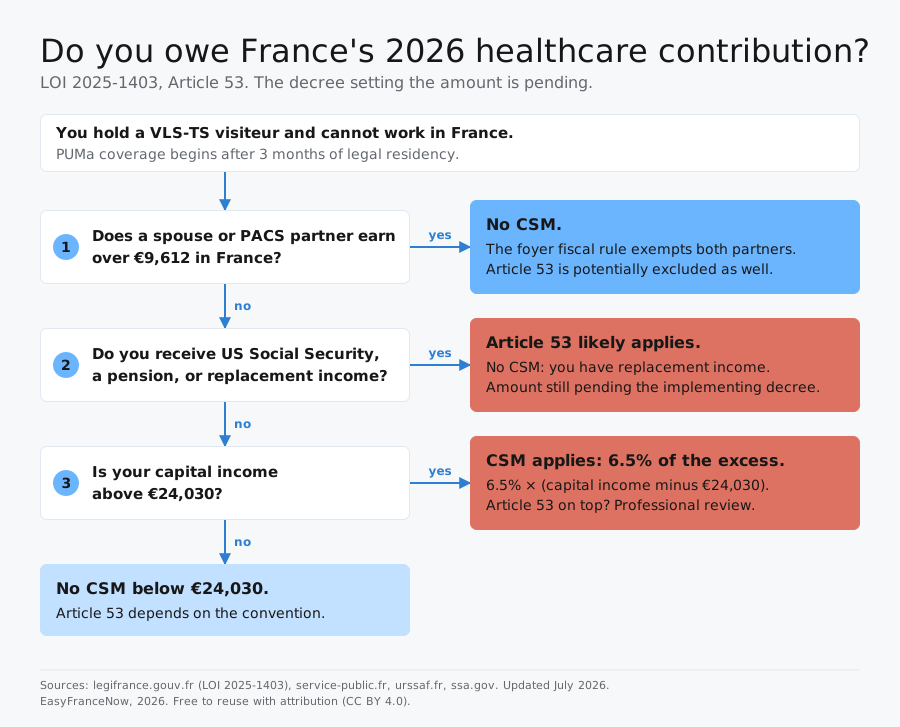
What LOI 2025-1403 changed: the new participation financière for visitor visa holders
Before this law, the situation was inconsistent. Some Americans living in France on a visitor visa were assessed for the existing Cotisation Subsidiaire Maladie (CSM) by URSSAF, while others in apparently identical circumstances were not. Local interpretations varied. The US-France social security totalization agreement added another layer of ambiguity: Americans whose income was classified as exempt from French social contributions under the agreement could potentially access PUMa coverage while owing little or nothing to the French healthcare system. This inconsistency attracted parliamentary attention and generated cross-party support for a fix.
MP François Gernigon of the Horizons group proposed an amendment to the 2026 Social Security Finance Bill designed to clarify healthcare contributions for non-EU residents, particularly American retirees who access the French public healthcare system through PUMa.
The result was Article 53 of the law. As published in the Journal Officiel and codified on Légifrance, Article 53 states:
Any person who resides in France in a stable and regular manner, who does not exercise a professional activity there, and who is not subject to the social contributions and charges mentioned in Articles L. 131-9 and L. 136-1 by reason of an international convention, benefits from healthcare coverage on the condition that they pay a financial contribution (participation financière).
This is a departure from the prior framework. The new article does not modify the existing CSM. It creates a separate, additional obligation for a specific category of people: those who are exempt from paying French social contributions (specifically CSG and health insurance contributions) because an international convention, such as the US-France totalization agreement, shields their income from those contributions. As service-public.fr confirms, a decree is still awaited to set the amount of this new contribution. Until that decree is published, the specific figure remains to be determined.
Understanding PUMa and why it matters for Americans on a visitor visa
PUMa (Protection Universelle Maladie) is the French universal health coverage system that guarantees healthcare reimbursements to any person who resides in France in a stable and regular manner, regardless of employment status. After three months of legal residency in France, a person holding a valid long-stay visa is generally entitled to register for PUMa, access the Assurance Maladie system, and eventually receive a Carte Vitale. This is one of the major advantages of living in France rather than simply visiting, and it is precisely what draws many American retirees and early retirees to the visitor visa path.
For Americans on a VLS-TS visiteur, who by definition cannot work in France, PUMa coverage provides access to French public healthcare at standard reimbursement rates: approximately 70 percent of most medical acts, with the remainder covered either out of pocket or by a complementary mutuelle insurance. The alternative, private full-coverage insurance (assurance premier euro), covers expenses from the first euro without going through the French public system and is required during the first three months before PUMa eligibility begins. Our guide to private health insurance before CPAM covers the options and costs for that initial period.
The funding question is where things get complicated. PUMa is not free. French residents who work pay into it through payroll contributions and the CSG. Those who do not work but have significant passive income pay through the CSM. LOI 2025-1403 adds a new tier: those whose passive income is exempt from French social contributions under an international convention now face a mandatory participation financière to maintain PUMa access.
The existing CSM: who it applies to and how it's calculated
The Cotisation Subsidiaire Maladie, often called the "taxe PUMa" informally, is the contribution France has required from PUMa beneficiaries who have no professional income but do have significant income from capital and investments. It predates the 2026 law and continues to apply on its established terms.
The CSM applies to those who reside in France in a stable and regular manner, whose professional activity income (for both the individual and any spouse or PACS partner) is below 20 percent of the PASS, which amounts to 9,612 euros in 2026, and who receive no replacement income such as a retirement pension, disability pension, unemployment allocation, or other substitute income for that year. It also applies when capital income exceeds 50 percent of the PASS, which is 24,030 euros in 2026.
CSM parameter (2026) | Figure | Why it matters |
|---|---|---|
2026 PASS | €48,060 | Base for all thresholds below |
Professional income exemption | €9,612 (20% of PASS) | Earn above this and CSM tapers off |
Capital income threshold | €24,030 (50% of PASS) | CSM applies above this |
Deduction (abattement) | €24,030 | Subtracted before the 6.5% rate |
Rate | 6.5% | Applied to capital income above the abattement |
Receiving SS / pension / replacement income | Exempt | Most US retirees owe no CSM |
The practical formula: CSM = 6.5% × (total capital income - 24,030€), adjusted downward progressively if you have some professional income between zero and 9,612 euros.
A critical exemption: Americans who receive US Social Security, a pension, a disability payment, or any form of replacement income for the year in question are explicitly not liable for the CSM. Persons having received a disability pension during the year for which the contribution is due, as well as holders of other replacement or substitute income such as a retirement pension, are no longer liable for the cotisation subsidiaire maladie.
This exemption is significant: most American retirees living on US Social Security income are not subject to the CSM. The CSM primarily falls on Americans whose income comes entirely from investment returns, dividends, capital gains, US rental income, or similar passive sources rather than from any form of pension or retirement benefit.
The CSM is collected by URSSAF, the French social contribution collection agency. Full details of the applicable rules are published on the URSSAF website dedicated to PUMa beneficiaries.
How the US-France social security agreement determines which contribution you owe
The US-France totalization agreement is the legal mechanism that shapes how the new Article 53 participation financière applies to Americans specifically. The agreement is administered by the US Social Security Administration and prevents Americans from paying into both US and French social security systems simultaneously. In practice, it means that Americans receiving US Social Security benefits, or those whose coverage is established under the US system, are generally exempt from the equivalent French social contributions.
Articles L. 131-9 and L. 136-1 of the French Social Security Code, which the new Article 53 references, correspond to the health insurance contribution and the CSG (Contribution Sociale Généralisée). When an international convention such as the US-France totalization agreement exempts an American resident from these contributions, they fall into the exact category that Article 53 was written to address: a legal resident of France who benefits from PUMa but does not fund it through the standard contribution mechanism.
In our experience, this creates a two-track situation depending on the American resident's income profile:
For Americans living primarily on US Social Security or pension income: the CSM does not apply (replacement income exemption). But the new Article 53 participation financière likely does apply, because the totalization agreement may exempt their US Social Security from French social contributions. The amount of this new contribution is still pending the implementing decree.
For Americans living primarily on investment income (dividends, US rental income, capital gains, brokerage income) with no pension or Social Security: the CSM may apply if their capital income exceeds 24,030 euros and their professional income is below 9,612 euros. Whether the new Article 53 participation financière also applies depends on whether their income is shielded by the international convention. The interaction between these two contributions in individual cases is a question that requires professional review rather than general guidance.
For Americans with a spouse or PACS partner whose professional income exceeds 9,612 euros in France: neither the CSM nor, potentially, the new contribution applies. The foyer fiscal (tax household) rule exempts both members when one has sufficient professional income.
Whether this contribution applies to you, and how it compares to private cover, turns on your income and visa type. You can estimate your first-year healthcare costs alongside the rest of your move budget.
What happens if you don't pay: the coverage suspension risk
The consequences of non-payment differ between the existing CSM and the new Article 53 participation financière, and both are significant.
For the CSM: late payment triggers a penalty of 5 percent of the amount due, plus a further 0.2 percent for each month of delay, as set out on the official URSSAF page for PUMa beneficiaries. URSSAF has collection authority and can pursue recovery. Consistent non-payment can escalate to enforcement procedures. The practical approach is to pay within 30 days of the November notice, arrange the three-installment option available through the URSSAF online portal, or formally contest the assessment if you believe you are exempt.
For the new Article 53 participation financière: the stakes are more direct. The text of Article 53 states that if the person does not pay the contribution for a determined period, the director of the healthcare coverage organization (CPAM) must notify them, after verifying their situation, that their right to healthcare coverage will be suspended if the due amount is not paid. Loss of PUMa coverage means returning to mandatory private insurance at first-euro rates, which is significantly more expensive than a mutuelle supplement on top of the public system.
For American retirees living in France, this change means it is more important than ever to plan ahead. Understanding the eligibility criteria for public healthcare, budgeting for the new contribution, and considering private health insurance to supplement public coverage are all crucial steps.
The full healthcare setup sequence for Americans in France covers the full CPAM registration process and what having active PUMa coverage means for your day-to-day healthcare access.
How URSSAF bills you and what the timing means
The existing CSM billing cycle follows a specific annual rhythm that Americans frequently misunderstand. URSSAF does not assess the CSM in real time. It assesses it retroactively, based on your prior year's income as reported in your French tax return.
The sequence works as follows. When you file your French income tax return (typically in May or June for the prior calendar year), the French tax authority transmits your income data to URSSAF. URSSAF uses that data to calculate whether you owe the CSM. The assessment notice arrives in November of the year following the year your income was earned. For income earned in 2025, the URSSAF notice arrives in November 2026. For income earned in 2026, the notice arrives in November 2027.
This one-year lag means that Americans who arrive in France and register for PUMa in 2026 will not receive their first possible CSM or participation financière assessment until late 2027. The delay feels reassuring but it is not an exemption. The obligation accrues from the date of PUMa registration. The bill simply arrives late.
Once you receive the notice, you have 30 days to pay the full amount, arrange three equal installments available through the URSSAF online account, or formally contest the assessment. Late payment carries a penalty of 5 percent of the amount due plus 0.2 percent per month of delay. If you believe you are exempt from the CSM (for example, because you receive a pension), the contest process requires submitting documentation showing your income type to URSSAF directly.
The implementing decree for the new Article 53 participation financière will specify its own billing mechanism. Until the decree is published, URSSAF cannot calculate or bill the new contribution. This means Americans who are subject to it are not yet receiving notices, but planning ahead is prudent because the obligation is now established in law.
What to do while the implementing decree is still pending
The most practical stance for Americans on a visitor visa in France while the Article 53 decree is still pending is to prepare for a contribution rather than wait for it. Several steps are actionable now regardless of the final amount.
Document your income sources in clear categories. URSSAF and CPAM will evaluate your income to determine which contribution applies and at what level. Knowing whether your income comes from US Social Security, private pension, dividends, rental income, or a combination helps you and any professional advisor you work with understand your exposure under both the CSM rules and the incoming Article 53 framework.
Confirm your private health insurance remains current if you are in France but have not yet registered for PUMa, or if you have any gap in coverage status. The visitor visa already requires private health insurance for the first three months and for the visa application itself. If the Article 53 regime requires payment before PUMa access is confirmed, private coverage as a backup is not optional.
File your French income tax return accurately and on time. The CSM is triggered by data from your French tax return. Accurate filing, including properly declaring your US-source income under the applicable treaty provisions, is the foundation for any contribution assessment being correctly calculated.
Consult a cross-border tax and social security professional before the decree is published if your financial situation is complex. The interaction between the totalization agreement, the CSM, and the new Article 53 contribution involves technical distinctions between income types that do not translate directly from US tax categories to French ones. Our guide to US taxes while living in France provides context on the treaty framework that sits behind these contribution categories.
Whatever the decree finally sets, the practical gap does not change: PUMa affiliation begins after three months of continuous residence, and processing runs longer than that in most CPAM offices. Everything you spend on healthcare in the interval is yours to pay unless you arrive covered. Private expat health insurance for the pre-CPAM period is the standard bridge, and it can be cancelled monthly once your affiliation is confirmed.
Common mistakes to avoid
Assuming the CSM does not apply because you receive US Social Security and then discovering the new Article 53 participation financière does apply is the most consequential confusion in this area. These are two different contributions with two different triggers. The CSM exempts pension recipients. The new Article 53 contribution targets exactly those people who are exempt from French social contributions under a convention, which may include many Social Security recipients. Being exempt from one does not guarantee exemption from the other.
Not filing a French income tax return is a second error with compounding consequences. Some Americans on a visitor visa, particularly those who are not yet French tax residents or who mistakenly believe their US income is not reportable in France, skip the French income tax filing. The CSM assessment flows from the French tax return. No return means URSSAF cannot calculate a proper assessment, but it does not mean no obligation. It also removes the documentation that could establish your income type and any exemptions that apply.
In our experience, Americans who receive an unexpected URSSAF bill for the CSM often did not realize they had become French tax residents, that their worldwide income was reportable in France, and that the November URSSAF billing cycle was timed against the prior year's French tax return. The surprise of a several-thousand-euro bill arriving in November for a year you thought was already settled is genuinely preventable with advance planning.
Assuming the new Article 53 contribution hasn't taken effect yet because the decree hasn't been published is a fourth mistake. The legal obligation is established. The implementing decree sets the specific amount and billing mechanism, but the underlying legal obligation created by Article 53 is in force. When the decree is published, the contribution will apply retroactively for the applicable period under the terms the decree specifies.
Practical checklist
If you are already in France on a VLS-TS visiteur and registered for PUMa:
Identify your income categories: US Social Security, private pension, dividends, capital gains, rental income, other passive sources
Determine whether you have received a URSSAF CSM notice (they arrive in November for the prior year)
If you received a CSM notice, verify whether you qualify for the pension/replacement income exemption before paying
File your French income tax return accurately, including US-source income under applicable treaty provisions
Ensure your private health insurance is current while the Article 53 decree is pending and your PUMa status is being established
If you are planning to move to France on a visitor visa in 2026:
Budget for a healthcare contribution from year one: both the CSM (if applicable to your income profile) and the Article 53 participation financière (once the decree is published and the amount is known)
Do not cancel your private health insurance before PUMa registration is confirmed and contribution status is established
Consult a cross-border professional before arrival to understand how your specific income sources are classified under both US and French frameworks
Regardless of current status:
Monitor the publication of the implementing decree for Article 53 through service-public.fr or with the help of a professional
Keep documentation of all income sources, including Social Security benefit statements and any pension letters, for URSSAF verification purposes
When to get help
If your income consists entirely of US Social Security and you have received no URSSAF correspondence yet, the most urgent step is simply to track the Article 53 decree publication and budget accordingly.
Situations that benefit from professional support: your income is a mix of Social Security, investment income, and US rental property; you have already received a CSM notice that you believe was incorrectly calculated; you are not sure whether the US-France totalization agreement applies to your specific income sources; you have not been filing French income tax returns and are not sure whether you should be; or you want to understand the interaction between the new Article 53 contribution, the CSM, and your overall financial plan in France.
If you are holding a CSM notice and still waiting on the Article 53 decree, the contribution sits inside a larger setup that has its own order, and where this fits in the setup order is already worked out.
FAQ
Do retirees pay for French healthcare in France?
Usually not. Anyone receiving US Social Security, a pension, or other replacement income is exempt from France's healthcare contribution (CSM), so most American retirees pay nothing. The CSM only applies to residents living on capital income, at 6.5% above a €24,030 deduction. A separate 2026 contribution for visitor-visa holders exists, but its amount is still pending a decree.
Does LOI 2025-1403 mean Americans can no longer access French public healthcare through PUMa?
No. The law does not remove healthcare access. It conditions access on paying a financial contribution for a specific group: those who reside in France stably, have no professional activity, and are exempt from French social contributions under an international convention. For Americans covered by the US-France totalization agreement, PUMa coverage continues to be available, but it is now conditioned on paying the Article 53 participation financière once its amount is set by decree. Those who pay maintain full PUMa access. Those who do not pay risk having their coverage suspended after a notification process.
Who owes the existing CSM versus the new Article 53 participation financière?
The CSM applies to PUMa beneficiaries who have no professional income, no replacement income (no pension, no unemployment, no disability payment), and whose capital income exceeds 24,030 euros in 2026. It does not apply to those who receive a pension or Social Security equivalent. The new Article 53 participation financière applies to those who are exempt from French social contributions (CSG and health insurance contributions) under an international convention, regardless of income type. An American receiving only US Social Security is typically exempt from the CSM (pension exemption applies) but may be subject to the new Article 53 contribution (convention exemption applies). An American with only investment income may be subject to the CSM (if income exceeds the threshold) and may also have Article 53 exposure. The exact interaction depends on individual circumstances and requires professional review.
How much will the Article 53 participation financière be?
The amount has not yet been set. LOI 2025-1403 establishes the obligation and the suspension mechanism for non-payment, but delegates the specific amount to an implementing decree. Early parliamentary discussions suggest the amount will be lower than the CSM and non-retroactive, but no official figure has been published. Monitor service-public.fr for the decree update. Budget conservatively until the amount is known.
What do I do if I receive a URSSAF CSM notice I believe is incorrect?
You have 30 days from the date of the notice to contest it through your URSSAF online account or in writing to URSSAF directly. The most common grounds for contesting are: you receive a pension or Social Security equivalent that should exempt you from the CSM; your income was below the capital income threshold; or your professional income, or your spouse's, exceeded the 9,612 euro exemption threshold. Gather documentation of your income sources before contesting. If the CSM was incorrectly assessed because of an income categorization issue related to the US-France treaty, a cross-border tax professional familiar with both systems is useful to have on hand for the contest.
Conclusion
LOI 2025-1403 has added a new layer to the healthcare contribution picture for Americans on a visitor visa in France. The existing CSM continues to apply to those with investment income above the threshold and no pension income. The new Article 53 participation financière applies to those whose income is exempt from French social contributions under the US-France totalization agreement. The amount of the new contribution is pending a decree, but the obligation is in law.
The Americans most at risk of being caught unprepared are those who moved to France assuming that their US Social Security income fully protected them from French healthcare contributions, or those who have not yet aligned their French tax filing with their contribution exposure. Neither situation is irreversible, but both are much easier to address before the URSSAF notice arrives than after.
If you want to map your income profile to the applicable French contribution framework and see your 2026 exposure, work through the contribution rules for your case.
About the author
Aurelio Maurici
Related posts