
Car Accidents in France: The Paperwork, the Payout and Your Bonus

By Fabien Pelissier Managing Director, Fab French Insurance
Published

Nobody plans to spend their afternoon beside a dented car, trying to explain a collision or complete paperwork in French. But whether you live here or are just visiting, knowing what happens next can save you a considerable amount of stress.
At the scene
The first thing to consider is safety. Stop, pull the car off the road if possible and place yourself and others in a safe place. If anyone is injured, there’s immediate danger or even just the possibility of your accident causing traffic issues, call 112. The paperwork can come afterwards.
Any accident involving injuries must be reported to the police or gendarmerie and if it is a serious accident they are likely to turn up swiftly in any case.
Once it is safe to do so, you should take photographs and get the other driver’s registration and insurance information. If they leave the scene of the accident, note down whatever you can and report it to the police. If there are any witnesses, ask them for their details too. You may well not need them but it is better to prepare for any eventuality.
The constat amiable
You will then need to deal with what is known as le constat amiable; this is the accident report used to record what happened. The most important thing to remember here, is to read it before you sign it! The shared front page records the vehicles, the circumstances, the damage and a sketch. Check every box carefully, for example, “changing lanes” and “travelling in the same lane” describe very different situations.
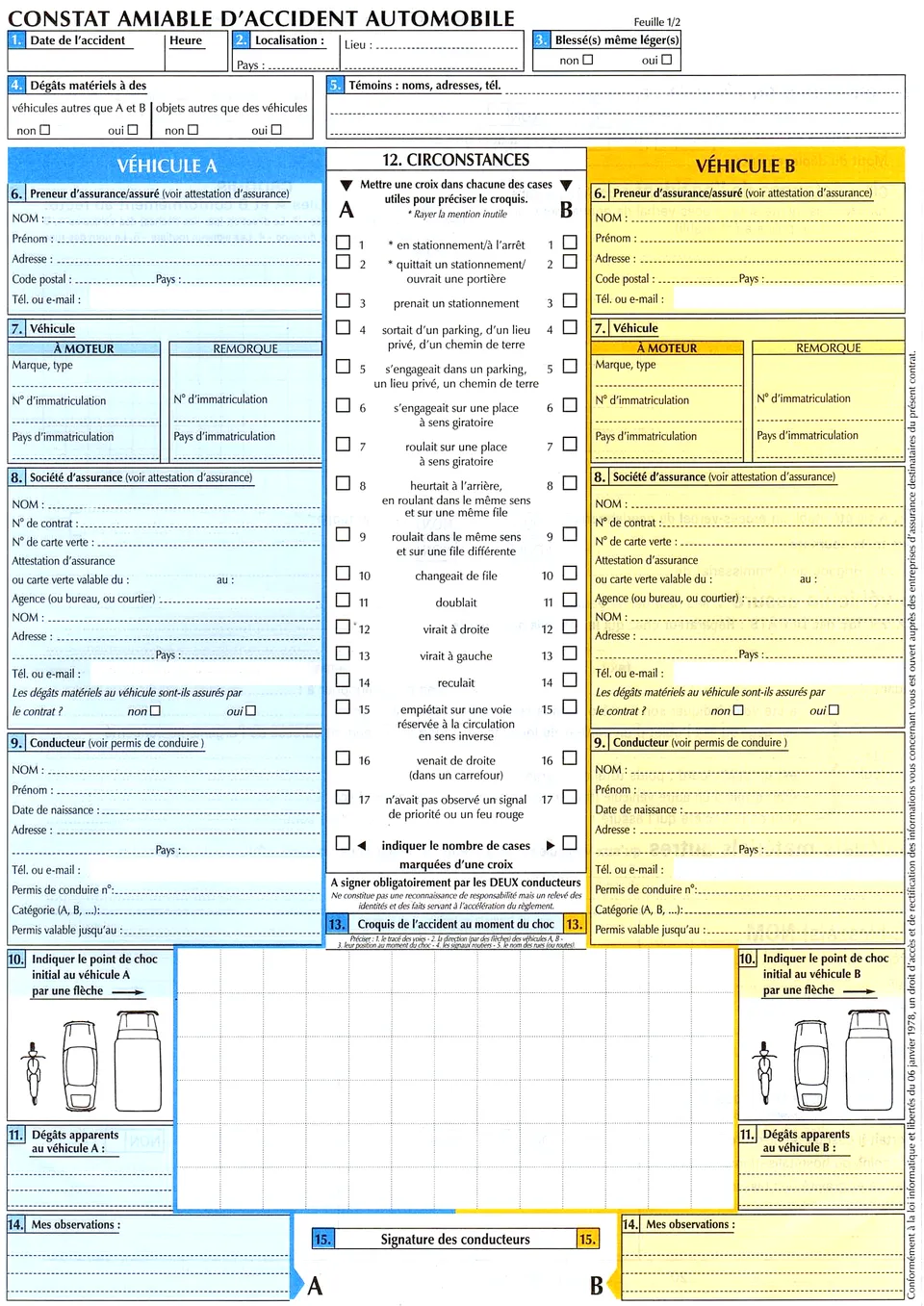
Although signing merely confirms the recorded account and doesn’t automatically mean accepting fault, you should never sign an account you disagree with or don’t understand. There is an ‘observations’ section where you can record anything you disagree with. Once both drivers have signed, don’t alter the shared front page and if the other driver refuses to sign, you submit your own report and make a note of their refusal to do so.
You should always keep a paper form in the car (your insurers will normally send you one), especially if you are driving a foreign-registered vehicle. There is now an electronic version but this French ‘e-constat’ isn’t suitable for every accident, including those involving foreign vehicles or injuries. An English-language European accident statement is very helpful to have because the sections follow the same layout.
Telling your insurer
You need to inform your insurer as soon as possible and for a French insurance contract, the deadline is normally five working days. Do check your policy, but contractually, the deadline cannot be shorter than that. Article L113-2 of the Code des assurances provides the legal framework.
Don’t wait for the other driver to be in touch, a garage repair estimate, a police report or anything else before contacting your insurer. Let them know about the accident, send them all the information you currently have available and you can provide anything missing afterwards.
If your car is insured abroad, pretty much the same applies; contact your own insurer promptly and follow their reporting requirements.
Who pays: the IRSA
The next step is to decide on who was responsible and this is the stage at which the insurers assess the evidence, including the constat, any photographs and witness accounts. Your roadside discussion with the other driver is often not the final verdict!
For many vehicle-damage claims, French insurers use what is called the convention IRSA. This agreement allows your own insurer to handle compensation on behalf of the responsible driver’s insurer, with reimbursement settled between the companies. They use standard accident scenarios to help them allocate responsibility and process claims.
It’s important to understand that the IRSA is an agreement between insurers, not legislation binding you. If its application produces an outcome you disagree with, you can ask for the reasoning in writing and request assessment under ordinary legal rules. Whether your own repairs are covered will also depend on who was at fault and your policy. Third-party insurance doesn’t automatically pay for your car when you cause the accident and comprehensive cover remains subject to its terms and excess.
Injuries and the loi Badinter
Compensation for injuries follows different rules and is governed by the loi Badinter, the law of 5 July 1985.
A high degree of protection is afforded to passengers, pedestrians and cyclists. Even what could be considered ordinary ‘carelessness’, generally doesn’t remove their right to compensation. Exceptions include things such as deliberately seeking an injury or, for some victims, an inexcusable ‘fault’ that was determined to be the sole cause of the accident. Children under 16, people over 70 and certain severely disabled victims receive an additional level of protection.
Drivers however are treated differently. If the accident is deemed to be their own fault, this can reduce or even exclude any compensation. This is why the garantie du conducteur, personal injury cover for the driver, is an important part of your car insurance policy.
Compensation could include payments for lost earnings, pain, disability and assistance needs and not simply medical bills. Keep medical records and receipts, and get advice before accepting a settlement for serious injuries. If you develop pain at a later date as a result of the accident, seek medical attention and notify your insurer.
Your no-claims bonus
The question that concerns many people after an accident is ‘Will I lose my no-claims bonus’?
Under the standard French bonus-malus system (which is akin to the no-claims bonus system), an accident where you are deemed to be fully responsible increases your coefficient by 25% and partial responsibility by 12.5%. An accident for which you have no responsibility doesn’t trigger a malus.
There is an exception, if you have had the maximum 50% bonus for at least three years, the first accident where you are held to be responsible, doesn’t increase the coefficient.
These percentages relate to the coefficient that is applied, not a guaranteed change in your final bill. Insurers can also change their underlying prices and of course, foreign policies will follow their own no-claims rules.
Before you drive
The best preparation is to have a chat with your insurer and make sure you understand your cover, keep a constat handy and know who to call should the worst happen. Any accident, even a minor one, can be a shock but if you understand the process, it will be a whole lot easier to deal with.
Fabien Pelissier is the managing director of Fab French Insurance, an English-speaking insurance broker based in France that he founded in 2015. He previously sat on the boards of URSSAF Aquitaine and CPAM Pays Basque.
Guest post by
Fabien Pelissier
Managing Director, Fab French Insurance
Fabien Pelissier founded Fab French Insurance, an English-speaking insurance broker based in France, in 2015 and has run it since. He helps people relocating to France with the insurance that their visa, their residency and their daily life require.


