Dual Citizenship France USA: The Complete Guide for Americans Who Naturalize French

Published Jan 10, 2026-Updated Aug 28, 2026
Key Takeaways
Yes, you can hold both: France allows dual nationality and does not ask you to renounce your US passport.
The oath is civic, not a renunciation: the naturalization declaration commits you to French values, nothing more.
The US side is fine too: the US permits dual citizenship.
Taxes follow you: as a US citizen you keep filing US returns, see US taxes in France.
Two passports, two rule sets: travel, voting, and military obligations differ by country.
Sources: service-public.fr, legifrance.gouv.fr
Dual citizenship France USA is one of the most frequently searched questions among Americans approaching French naturalization, and the answer is clearer than most people expect: both countries allow it. France does not require you to give up your U.S. citizenship to naturalize as French. The United States does not automatically revoke citizenship when a U.S. citizen naturalizes in another country. Americans who go through the French naturalization process keep both passports, both nationalities, and the rights that come with each. What complicates the picture is not the nationality law but two practical realities that generic guides almost never address clearly: the French naturalization ceremony includes an oath of allegiance that some Americans misread as conflicting with U.S. law, and acquiring French citizenship does not end a single one of your U.S. tax obligations. This guide covers both countries' legal positions, what dual nationality means in practice for your passports and consular rights, the EU mobility benefit that French citizenship unlocks, and the tax obligations that follow you regardless of the nationality question. This article is for informational purposes only and does not constitute immigration or legal advice. Rules change, and your situation may differ: always verify current requirements with the relevant French authorities or a licensed immigration professional. This article is for informational purposes only and does not constitute tax or legal advice. Tax rules are complex and change frequently: consult a qualified cross-border tax professional before making any filing or planning decisions.
France's Legal Position on Dual Nationality
France explicitly allows dual nationality. There is no provision in French law that requires renunciation of a prior nationality as a condition of naturalization. The Code civil, which governs French nationality law, grants French nationality to naturalized citizens without conditioning that grant on abandonment of prior citizenship. The service-public.fr page on naturalization confirms this: acquiring French nationality does not result in the loss of a prior nationality, unless the other country's law treats naturalization elsewhere as automatic grounds for citizenship loss.
The French naturalization ceremony includes a declaration of allegiance to France and its values. This declaration is a statement of civic commitment. It is not a renunciation of prior nationality. France does not require, record, or enforce any renunciation of prior nationalities as part of the naturalization process. After the ceremony, the applicant is French. They remain whatever else they were before.
In our experience, Americans sometimes confuse the phrase "allegiance to France" in the naturalization ceremony with a legal renunciation of U.S. citizenship. It is not. The French declaration is a civic commitment. It has no legal effect on U.S. citizenship status.
The U.S. Government's Position on Dual Nationality
The United States formally permits dual nationality in practice, even though U.S. law does not explicitly embrace it as a right. The key legal framework is the Afroyim v. Rusk Supreme Court decision (1967) and Vance v. Terrazas (1980), which established that a U.S. citizen cannot lose citizenship unless they perform a potentially expatriating act with the specific intent to relinquish citizenship. Naturalizing in a foreign country is listed among these potentially expatriating acts under 8 U.S.C. section 1481, but the operative word is intent.
The U.S. State Department's position, as published at travel.state.gov, is that U.S. law does not prohibit dual nationality. The State Department recognizes that Americans can hold citizenship in another country and will not take action against those who do. When a U.S. citizen naturalizes in France without the intent to give up U.S. citizenship, the U.S. government does not initiate any process to revoke that citizenship. The vast majority of Americans who naturalize in France do so without any intent to relinquish U.S. citizenship, and the U.S. government treats them accordingly: as U.S. citizens who are also French citizens.
Renunciation Is Not Naturalization: A Distinction That Matters
One of the most persistent confusions in this area is between two completely separate acts: naturalizing as French, and voluntarily renouncing U.S. citizenship. These are not the same thing and should never be conflated.
Naturalizing as French is the process of becoming a French citizen after meeting the residence, language, integration, and other criteria set by French law. At the end of this process, you are French. You are also still American. Both nationalities coexist.
Voluntarily renouncing U.S. citizenship is a separate, deliberate, and irreversible legal act performed before a U.S. consular officer, governed by 8 U.S.C. section 1481, and involving a formal oath of renunciation. Renunciation is permanent. It must be voluntary and unequivocal. It has significant financial consequences, including potential exit tax exposure for high-net-worth Americans. France does not require it. The vast majority of Americans who naturalize French never take this step and never need to.
The confusion between these two acts often arises from generic internet content that mixes the legal concepts, or from Americans who assume that becoming French automatically means giving up something American. It does not. Renunciation is always a separate, additional, voluntary choice, with its own legal process and significant irreversible consequences. If you are naturalizing French and you have not separately initiated a renunciation process with a U.S. consular officer, your U.S. citizenship is intact.
What Happens to Your U.S. Passport After French Naturalization
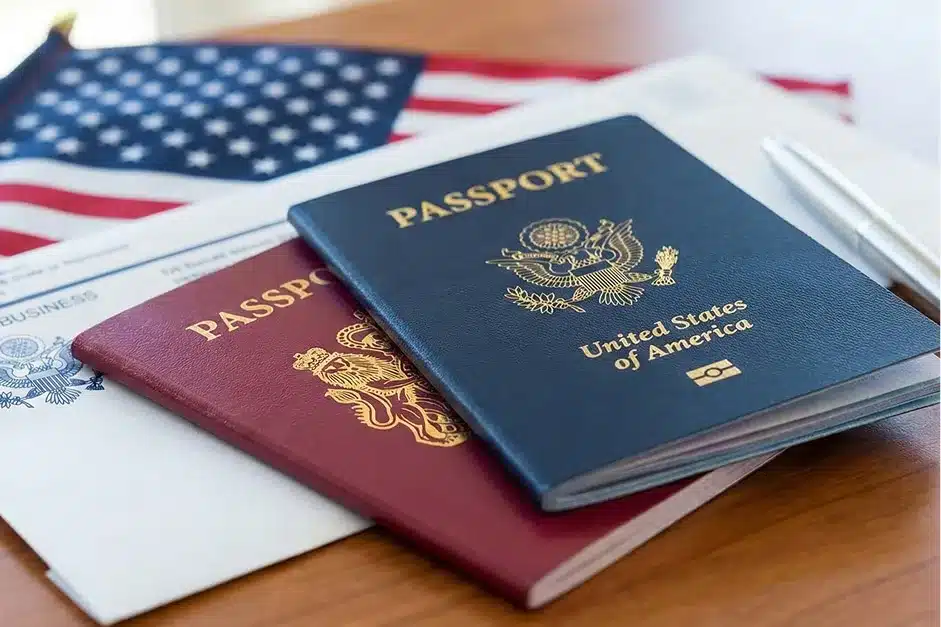
After completing French naturalization, you are entitled to apply for a French passport. You also retain your U.S. passport. Both are valid simultaneously. There is no requirement to surrender, cancel, or stop using your U.S. passport when you receive a French one. You hold two fully valid passports from two sovereign nations.
In practice, dual U.S.-French citizens use their passports strategically depending on where they are traveling. When entering France or another EU country, using the French passport is both permitted and typically faster, as EU and EEA lanes at border control move more quickly. When entering the United States, U.S. law requires U.S. citizens to enter and exit on their U.S. passport. Using a French passport to enter the U.S. as a U.S. citizen is not permitted. When traveling to third countries, the choice of passport to present is driven by visa requirements and bilateral agreements of each country with France and the U.S. respectively.
What we see most often in practice: Americans who naturalize French tend to use their U.S. passport for U.S. travel and their French passport for Europe and countries where the French passport offers better visa-free access. The two passports complement each other rather than creating conflict. Neither government requires notification of the other when a dual citizen acquires the second nationality, beyond what is implicit in the passport application process itself.
Consular Protection: Who Protects You and Where
Consular protection is one of the practical complexities of dual nationality that is worth understanding before it becomes relevant in an emergency.
When you are in France, French authorities treat you as French. If you encounter a legal situation in France that would normally trigger consular protection, such as an arrest or a civil emergency, France will not automatically allow the U.S. Embassy to intervene on your behalf, because France considers you its own national. The U.S. Embassy in Paris may be limited in its ability to provide consular services to a dual citizen while that person is in France, depending on the circumstances.
When you are in a third country (neither France nor the U.S.), the situation is more flexible. As a dual citizen, you can request assistance from either country's consular mission, depending on which passport you presented at entry and what the third country's treatment of dual nationals is. The U.S. Embassy in Paris provides guidance on consular services for Americans in France, including dual nationals.
The EU Mobility Benefit: What a French Passport Opens Up
For Americans considering naturalization, the concrete practical benefit that French citizenship provides beyond life in France is EU freedom of movement. A French citizen is an EU citizen by operation of EU law. As an EU citizen, you have the right to live, work, and establish a business in any of the 27 EU member states without applying for a separate visa or residence permit. This is a right, not a privilege that requires employer sponsorship or points-based qualification.
For American remote workers, entrepreneurs, or families who might want to spend time in Germany, Spain, Italy, the Netherlands, Portugal, or any other EU country, French citizenship transforms that option from a visa question into a simple logistical one. You arrive as a citizen of Europe, not as a third-country national subject to that country's immigration policy.
The French passport also provides visa-free or visa-on-arrival access to some countries where the U.S. passport requires prior visa applications. The U.S. passport remains one of the most powerful travel documents in the world, so the marginal benefit for Americans varies by destination, but for those who travel extensively to parts of the world where French or EU standing is stronger, the second passport provides real additional mobility.
To understand whether French citizenship is worth pursuing for your specific situation beyond the mobility question, our analysis of whether citizenship is worth it for Americans compares the practical differences between permanent residency and naturalization across multiple dimensions.
U.S. Tax Obligations That Survive French Naturalization
This is the part of the dual nationality picture that generic content almost never covers honestly, and it is the most important practical consequence of French-American dual nationality for most Americans.
The United States taxes its citizens based on citizenship, not residency. This is unusual: most countries, including France, tax based on tax residency. The U.S. does not. If you are a U.S. citizen living in France, you are required to file a U.S. federal income tax return every year, report your worldwide income, and comply with all U.S. reporting obligations, regardless of how long you have lived in France, regardless of whether France taxes that income, and regardless of whether you have become a French citizen.
Acquiring French citizenship changes nothing in this framework. On the day after your naturalization ceremony, your U.S. federal tax filing obligation is identical to what it was the day before. You remain a U.S. citizen, and the U.S. taxes U.S. citizens wherever they live and however many other nationalities they hold.
The specific continuing obligations include: annual U.S. federal income tax return (Form 1040), FBAR filing (FinCEN Form 114) if your non-U.S. financial accounts exceed $10,000 in aggregate at any point during the year, FATCA reporting (Form 8938) if your foreign financial assets exceed the applicable threshold, and potentially additional informational returns depending on your financial situation in France. Our article on your ongoing US tax obligations as an American in France covers this framework in full.
The foreign earned income exclusion (Form 2555) and the U.S.-France tax treaty provide mechanisms to reduce or eliminate double taxation on income that is taxed in both countries, but they do not eliminate the filing obligation. Americans who acquire French citizenship and mistakenly believe they are released from U.S. tax obligations because they are now also French can face significant penalties, back taxes, and interest when the IRS eventually identifies the non-compliance. The filing obligation does not go away. It must be actively managed every year. American citizens who naturalize as French retain their full US voting rights. The practical steps for maintaining overseas voter registration and requesting an absentee ballot from France are covered in our guide to voting absentee from France as an American.
Americans who discover this obligation only after naturalizing are often several years behind, and the IRS runs a specific penalty-free route for exactly that situation, which we cover in our guide to the streamlined procedure for late U.S. filers in France.
The Exit Tax and the Covered Expatriate: A Separate Scenario
The exit tax, technically the expatriation tax under IRC Section 877A, is an entirely separate issue from French naturalization. It applies only to Americans who voluntarily renounce U.S. citizenship, not to those who acquire French citizenship while retaining their U.S. citizenship. Because renunciation and naturalization are two separate and independent acts, the exit tax question only becomes relevant if you actively decide to renounce U.S. citizenship at some point.
If you do choose to renounce, Americans who meet the definition of a covered expatriate may be subject to the mark-to-market exit tax. A covered expatriate is a U.S. citizen who renounces citizenship and who meets at least one of these conditions: average annual U.S. net income tax liability for the five years before renunciation exceeds the annually adjusted threshold (approximately $206,000 in 2026); net worth on the date of renunciation is $2 million or more; or the person cannot certify full tax compliance for the five years preceding renunciation. Current thresholds and guidance are published at irs.gov. Dual nationality means permanent obligations to both systems, and a consulting call is where to see what that actually costs you each year.
For the majority of Americans who naturalize French and continue holding both nationalities, the exit tax is not relevant. It becomes relevant only if renunciation is actively pursued. Anyone considering renunciation should treat it as a major, irreversible financial and legal decision requiring advice from a cross-border tax attorney, not something to approach without full professional guidance.
If you do reach that decision, the mechanics run through the tax system rather than the consulate alone: a final-year return, Form 8854, and the covered-expatriate tests applied against your net worth and average tax liability. The certifying statement requires five years of compliant filings behind you, which is why people who stopped filing years earlier have to catch up before they can renounce at all. Bundles covering the final return and Form 8854 exist for exactly this sequence.
Common Mistakes to Avoid
Assuming that the French naturalization oath constitutes a renunciation of U.S. citizenship is the most damaging misconception in this area. Some Americans delay or forgo naturalization because they believe becoming French means giving up being American. It does not. The French oath of allegiance is a civic declaration with no legal effect on U.S. citizenship status. The U.S. government does not treat voluntary naturalization in France, without declared intent to relinquish, as grounds for U.S. citizenship loss.
Stopping U.S. tax filings after French naturalization is a serious error with compounding consequences. U.S. tax obligations are tied to U.S. citizenship, not to French residency or French nationality status. Becoming French does not trigger a single exception to the FBAR filing requirement, the Form 1040 obligation, or any other U.S. reporting requirement. Americans who stop filing after naturalization are not complying with U.S. law and risk significant penalties.
In our experience, dual nationals who encounter problems with U.S. tax obligations typically fall into one of two patterns: those who never fully understood that the obligation continued post-naturalization, and those who believed that physical residence in France for enough years would automatically change their U.S. tax status. Neither is accurate. The obligation is citizenship-based and explicit.
Conflating what can block a naturalization application with the dual nationality outcome is a fourth mistake. The question of whether France will grant you citizenship is entirely separate from the question of what dual nationality means once you have it. For a full picture of what can prevent a successful naturalization, see what can block a naturalization application. For the full naturalization process, see the full naturalization process for Americans.
Practical Checklist
Confirm that your U.S. passport remains valid or renew it before beginning the French naturalization process
Do not initiate any renunciation process at a U.S. consulate unless you have made a fully informed, independent decision to do so; renunciation is permanent and entirely separate from naturalization
After naturalization, apply for your French passport through the standard process via the Agence Nationale des Titres Securises (ANTS)
Continue filing your annual U.S. federal income tax return (Form 1040) and all required informational returns (FBAR, FATCA) without interruption
Review your French financial accounts for FATCA and FBAR reporting purposes; the thresholds and forms are unchanged by French citizenship
Use your U.S. passport for entry and exit from the United States as required by U.S. law; use your French passport for EU travel
If your asset and income profile is above the covered expatriate thresholds and you are considering eventual renunciation, consult a cross-border tax attorney well in advance
If your income situation is complex, engage a qualified cross-border tax professional annually
When to Get Help
For the nationality and passport questions, most Americans navigating dual citizenship France USA do not require legal counsel. The rules are clear: both countries allow it, the passports coexist, and the naturalization ceremony does not affect U.S. citizenship. What does require professional guidance is the tax dimension. The interaction between French tax residency, U.S. citizenship-based taxation, the U.S.-France tax treaty, and U.S. reporting obligations involves enough complexity that a cross-border tax professional is not optional for most dual nationals with meaningful financial activity in both countries.
FAQ
Can Americans hold dual citizenship with France without renouncing U.S. citizenship?
Yes. France does not require renunciation of prior nationality as a condition of naturalization. The United States does not automatically revoke citizenship when a U.S. citizen voluntarily naturalizes in France without the intent to relinquish U.S. citizenship. Americans who complete the French naturalization process emerge as dual French-American citizens, holding both nationalities simultaneously. The French naturalization ceremony includes an oath of allegiance to France: this oath is a civic declaration, not a legal renunciation of U.S. citizenship. The two nationalities coexist without either country requiring abandonment of the other. Renunciation of U.S. citizenship is a completely separate, voluntary, irreversible process that the vast majority of Americans who naturalize French never pursue.
Do I still need to file U.S. taxes after becoming a French citizen?
Yes, without exception. The United States taxes based on citizenship, not residency. Acquiring French citizenship does not change your status as a U.S. citizen, and U.S. citizens are required to file a federal income tax return annually, report worldwide income, and comply with all U.S. reporting obligations including FBAR (FinCEN Form 114) and FATCA (Form 8938). These obligations apply regardless of how long you have lived in France, how much tax you pay in France, and whether you hold French citizenship. The U.S.-France tax treaty and the foreign earned income exclusion (Form 2555) can reduce or eliminate double taxation on certain income, but they do not eliminate the filing requirement. Americans who stop filing after naturalization face penalties and potential back tax liability.
What does a French passport give an American that a U.S. passport does not?
The most significant practical benefit is EU freedom of movement: the right to live, work, and establish a business in any of the 27 EU member states without a visa or residence permit. For Americans who want to spend extended time in other EU countries, this transforms the question from an immigration matter to a simple logistical one. The French passport also provides visa-free or visa-on-arrival access to some countries where the U.S. passport requires prior visa applications, though the U.S. passport is itself one of the most powerful travel documents globally. The two passports are complementary: Americans retain the U.S. passport for U.S. entry and exit as required by U.S. law, and gain the French passport for European and relevant international travel.
What is the exit tax and does French naturalization trigger it?
The U.S. expatriation exit tax under IRC Section 877A applies only to Americans who voluntarily renounce U.S. citizenship, not to those who acquire French citizenship while retaining their U.S. citizenship. French naturalization alone never triggers the exit tax. The exit tax becomes relevant only if a dual citizen subsequently chooses to renounce U.S. citizenship and meets the covered expatriate criteria: a net worth of $2 million or more, an average annual U.S. net income tax liability above the annually adjusted threshold, or inability to certify five years of full U.S. tax compliance. Renunciation is permanent and irreversible. Anyone considering it should treat it as a major financial decision requiring a qualified cross-border tax attorney, not a routine step in the naturalization process.
Conclusion
Dual citizenship France USA is legally straightforward: both countries permit it, both passports remain valid, and the French naturalization ceremony creates no conflict with U.S. citizenship. The practical complexity lies in what does not change: U.S. tax obligations, U.S. reporting requirements, and the need for annual cross-border tax compliance are all fully intact after naturalization. French citizenship adds EU mobility, a second passport, and the full rights of a French citizen. It removes none of your U.S. obligations.
For Americans who are still weighing whether to pursue naturalization at all, our comparison of whether citizenship is worth it for Americans covers the full picture. Dual nationality means permanent obligations to both tax systems, and a consulting call is the place to map what that actually costs you each year before you commit to it.
About the author
Maxime Roseau
Related posts